




History of Human Civilization: From Ancient Times to the Modern Age
 By Dhiraj Sharma · Published
· Updated
The history of human civilization is the story of how people went from small bands of hunter-gatherers to the cities, states, empires and global networks of today. A civilization is a complex society marked by the development of the state, by urbanization, and by standard systems of symbolic communication, most importantly writing.[1] The word comes from the Latin civitas, meaning "city", and the National Geographic Society describes the simplest definition of civilization as "a society made up of cities".[1]
The first civilizations grew out of the Neolithic Revolution, when people began to farm and settle in one place, starting about 11,700 years ago.[2] Over the next ten thousand years came writing, law, empires, world religions and philosophy, science, industry and, most recently, the digital age. This Finepedia guide, updated in October 2026, follows that story in order, from the first farming villages to the information age, and explains the turning points that historians see as most important.
Key Facts
| Milestone | Approximate date | Where |
|---|---|---|
| Start of farming (Neolithic Revolution) | About 11,700 years ago | Several regions worldwide[2] |
| Göbekli Tepe in use | About 9500–8000 BCE | Upper Mesopotamia, modern Turkey[4] |
| First cities of tens of thousands | By the 31st century BC | Uruk, Ur, Kish and Eridu in Mesopotamia[3] |
| Earliest known writing | Early Bronze Age | Cuneiform, southern Mesopotamia[6] |
| Unification of Egypt | About 3150 BC | Nile valley[8] |
| Mature Indus Valley Civilisation | 2600–1900 BCE | Pakistan and northwestern India[9] |
| Fall of the Western Roman Empire | 476 AD | Europe[17] |
| Gutenberg's printing press | About 1440 | Germany[23] |
| Start of the Industrial Revolution | About 1760 | Great Britain[27] |
| Invention of the transistor | 1947 | Linked to the start of the Information Age[29] |
What Makes a Civilization?
Historians usually contrast civilizations with smaller, non-centralized societies such as hunter-gatherer bands, nomadic herders and Neolithic villages.[1] Civilizations are built around densely populated settlements. Their people are divided into fairly rigid social classes with a division of labour, often with a ruling elite above urban and rural workers, and they practise intensive farming, mining, small-scale manufacturing and trade.[1] Typical features include elaborate agriculture and architecture, infrastructure, currency, taxation, regulation and specialised jobs.[1]
The archaeologist Gordon Childe described the rise of civilization as the result of two revolutions in a row. The first was the Neolithic Revolution, which produced settled communities. The second was the urban revolution, which concentrated people in dense settlements.[3] Both began in Western Asia.[3]
The Neolithic Revolution
For most of human history, people lived by hunting and gathering. The Neolithic Revolution, also called the First Agricultural Revolution, was the large-scale move from that way of life to farming and settlement, which allowed much larger populations.[2] Archaeology shows that plants and animals were domesticated separately in different parts of the world, starting at the beginning of the Holocene epoch about 11,700 years ago, after the last Ice Age.[2]
Farming had costs. It narrowed the range of foods people ate, and nutrition got worse compared with what hunting and foraging had provided.[2] But because food production became more efficient, people could put their time into other work. That made farming, in the words of one study, "ultimately necessary to the rise of modern civilization".[2] Over the following millennia, small mobile groups became settled villages and towns, and people reshaped their surroundings through irrigation and deforestation.[2]
The earliest signs of settled life appear in the Levant, where the Natufian culture became sedentary as early as 12,000 BC and had become an agricultural society by 10,000 BC.[3] Göbekli Tepe, a site in modern Turkey that was in use from about 9500 BCE to at least 8000 BCE, has huge circular structures with carved stone pillars that are among the oldest known megaliths in the world.[4] Its decorated pillars give archaeologists clues to the religion of the time.[4]
The Cradles of Civilization
Scholars generally recognise six cradles of civilization, places where civilization arose independently. Mesopotamia, ancient Egypt, ancient India and ancient China were the earliest in Afro-Eurasia, while the Caral–Supe civilization of coastal Peru and the Olmec civilization of Mexico were the earliest in the Americas.[3] All of them, except possibly Caral–Supe, depended on farming. Their farmers produced a surplus that fed rulers, priests and the workers who built public monuments in the cities.[3]
Mesopotamia
Mesopotamia lay between the Tigris and Euphrates rivers, roughly in what is now Iraq. It is the site of the earliest developments of the Neolithic Revolution, from around 10,000 BC.[5] The region has been described as the source of "some of the most important developments in human history, including the invention of the wheel, the planting of the first cereal crops, the development of cursive script, mathematics, astronomy, and agriculture".[5]
The first cities to hold several tens of thousands of people, Uruk, Ur, Kish and Eridu, all grew up in Mesopotamia by the 31st century BC.[3] The Sumerians created cuneiform, a script made of wedge-shaped marks pressed into clay. It is the earliest known writing system.[6] Sumerians and Akkadians dominated the region from the start of recorded history, around 3100 BC, until the fall of Babylon in 539 BC. Empire-building began with Sargon of Akkad around 2350 BC.[5]
Mesopotamia also gave the world one of its most famous early law codes. The Code of Hammurabi, a Babylonian text from about 1753 BC, is carved on a basalt stele 2.25 metres tall that is now in the Louvre.[7] In its prologue, Hammurabi claims the gods gave him power "to prevent the strong from oppressing the weak".[7]
Ancient Egypt
Ancient Egypt grew up along the lower Nile. It began around 3150 BC, when Upper and Lower Egypt were united under a king called Menes, whom most Egyptologists identify with Narmer.[8] Its history is divided into the Old, Middle and New Kingdoms, separated by "Intermediate Periods" of instability. Egypt was at its most powerful in the New Kingdom, when it ruled much of Nubia and part of the Levant.[8]
Egypt's success came largely from the Nile. The river flooded predictably, and controlled irrigation of the fertile valley produced surplus crops that supported a dense population.[8] Egypt was later conquered by a series of foreign powers, including the Persians, the Greeks and the Romans, and the Roman conquest in 30 BC is one of the dates used to mark the end of ancient Egypt.[8]
Related: The Republic of India: Geography, History, and Diversity
The Indus Valley Civilisation
The Indus Valley Civilisation, also called the Harappan civilisation, was a Bronze Age culture in the northwest of South Asia. It lasted from 3300 BCE to 1300 BCE, with its mature phase from 2600 BCE to 1900 BCE.[9] It covered more land than ancient Egypt and Mesopotamia put together, spreading across much of Pakistan, northwestern India and northeastern Afghanistan.[9]
Its cities were known for their town planning, baked-brick houses, elaborate drainage and water-supply systems, and skilled crafts and metalwork. Mohenjo-daro and Harappa probably held between 30,000 and 60,000 people each.[9] Proto-writing developed at Harappa around 3300 BC, one of the earliest examples anywhere.[3]
Ancient China
In China, the Shang dynasty ruled the Yellow River valley in the second millennium BC. Modern scholars date it to between the 16th and 11th centuries BC.[10] It is the earliest dynasty in traditional Chinese history that is firmly backed by archaeological evidence. Excavations at Yinxu, its last capital, have found royal tombs, palace foundations and tens of thousands of bronze, jade, stone, bone and ceramic objects.[10] Chinese proto-writing later developed into the oracle bone script.[3]
The Americas
The Olmecs flourished in what are now the Mexican states of Veracruz and Tabasco from roughly 1200 to 400 BC, and are counted among the cradles of civilization.[11] They appear to have practised ritual bloodletting and played the Mesoamerican ballgame, both of which became features of almost every later Mesoamerican society.[11] Mesoamerican writing systems emerged from about 900 BC.[3]
The Bronze Age and the Birth of History
The Bronze Age is the middle of the three ages of the traditional system, after the Stone Age and before the Iron Age. A culture belongs to it if it made bronze by smelting copper and alloying it with tin or other metals, or traded for bronze.[12] It had begun in much of the Old World by 3000 BC.[12]
Bronze Age cultures were the first to develop writing. Mesopotamia, with cuneiform, and Egypt, with hieroglyphs, developed the earliest practical writing systems.[12] Historians mark the line between prehistory and history at the point when "records of the past begin to be kept for the benefit of future generations".[3] Writing let people keep records, pass laws, collect taxes and store knowledge that could outlive any one person.
The Classical Age
The Axial Age
In 1949 the German philosopher Karl Jaspers coined the term Axial Age for a period of great change in religious and philosophical thought from about the 8th to the 3rd century BCE.[13] He argued that new, universal ways of thinking appeared at about the same time in Persia, India, China, the Levant and the Greco-Roman world, without clear contact between them.[13] The idea is disputed, but many scholars accept that deep changes in religion and philosophy did take place in these centuries.[13]
Related: Mark Zuckerberg: The Rise of a Social Media Pioneer
Ancient Greece
Ancient Greek civilization was a loose collection of related city-states around the northeastern Mediterranean.[14] Greek city-states, or poleis, began forming in the 8th century BC. The Classical period that followed included the Golden Age of Athens, the Peloponnesian War between Athens and Sparta, and the conquest of the Persian Empire by Alexander the Great, who died in 323 BC.[14] Alexander's conquests spread Greek culture into North Africa and Western Asia.[14]
Classical Greek culture, and Greek philosophy in particular, strongly influenced Rome, which spread it across the Mediterranean and much of Europe. For this reason Classical Greece is generally considered the cradle of Western civilization.[14]
The Maurya Empire
In South Asia, Chandragupta Maurya founded the Maurya Empire around 320 BCE, with its power base in Magadha. It lasted until 185 BCE.[15] Under his grandson Ashoka, who reigned from about 268 to 232 BCE, the empire briefly controlled the major cities and routes of the subcontinent, except for the far south.[15]
The Han Dynasty
China's Han dynasty, founded by Liu Bang, ruled from 202 BC to 220 AD, with a short break under the Xin dynasty.[16] It is considered a golden age of Chinese history. China's majority ethnic group still calls itself the "Han people", and written Chinese characters are called "Han characters".[16] From the reign of Emperor Wu onward, the court officially promoted Confucianism in education and politics.[16]
The Roman Empire
Rome dominated the Mediterranean, much of Europe, Western Asia and North Africa.[17] After Octavian defeated Mark Antony and Cleopatra at the Battle of Actium in 31 BC, the Senate gave him the title Augustus in 27 BC, making him the first Roman emperor.[17] The first two centuries of the empire brought the Pax Romana, a time of unusual peace and prosperity, and the empire reached its largest size under Trajan, who ruled from 98 to 117 AD.[17] The Western Roman Empire collapsed in 476 AD, while the Eastern Roman, or Byzantine, Empire lasted until the fall of Constantinople in 1453.[17]
The Medieval World
Europe in the Middle Ages
In European history, the Middle Ages ran from roughly the 5th to the late 15th century, beginning with the fall of the Western Roman Empire.[18] Population decline, the collapse of central authority, invasions and mass migrations marked the early part of the period, and Germanic peoples formed new kingdoms in the former western empire.[18] Monasteries spread as campaigns to convert Europe to Christianity continued.[18]
The Islamic Golden Age
Between the 8th and 14th centuries, the Islamic world went through a period of great cultural achievement known as the Islamic Golden Age. It is usually dated from the reign of the Abbasid caliph Harun al-Rashid (786–809) and the founding of the House of Wisdom in Baghdad, which drew scholars to translate the knowledge of the known world into Arabic.[19] Learning also flourished in Cairo, Córdoba, Damascus, Samarkand and other cities. The period is often said to have ended with the Mongol siege of Baghdad in 1258.[19]
The Mongol Empire
The Mongol Empire was the largest contiguous empire in history.[20] It began when the Mongol tribes united under Temüjin, who was proclaimed ruler of all Mongols in 1206 with the title Genghis Khan.[20] At its height it stretched from the Sea of Japan to Eastern Europe, and its enforced peace, the Pax Mongolica, let trade, technology, goods and ideas travel across Eurasia.[20]
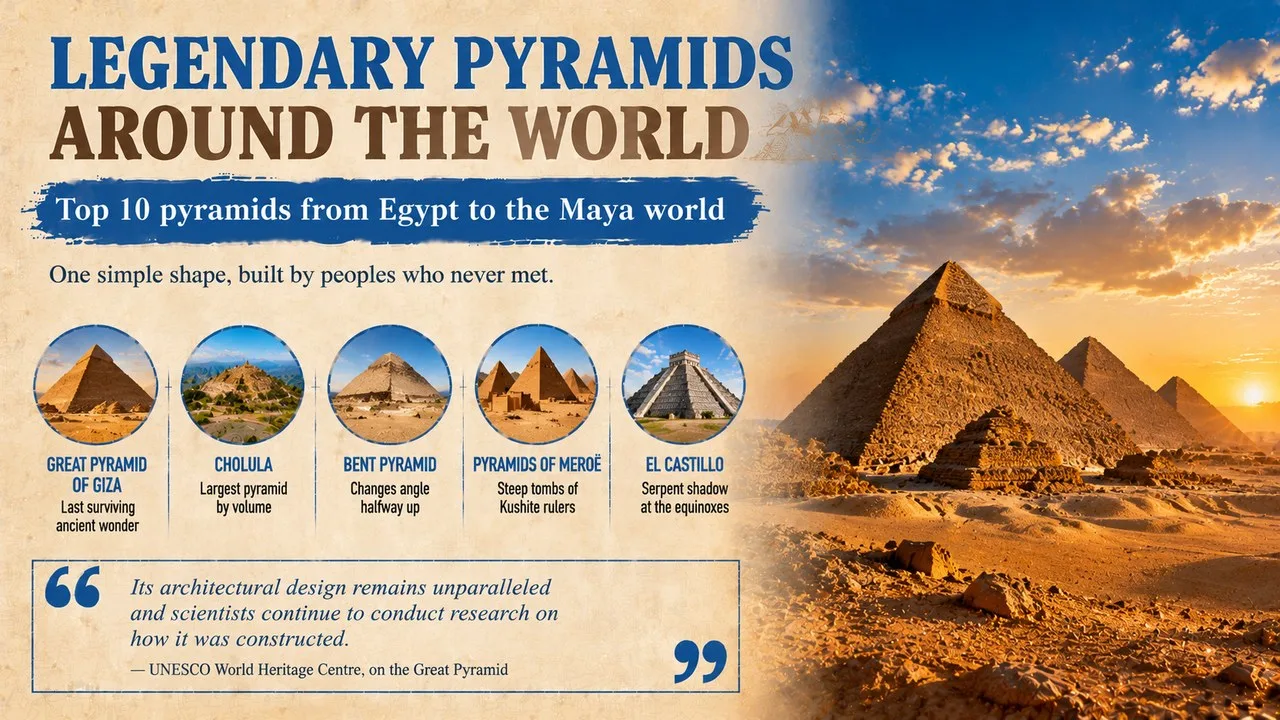
Related: Top 10 Legendary Pyramids Around the World
The Inca Empire
In the Americas, the Inca Empire, centred on Cusco, became the largest empire in the pre-Columbian Americas.[21] Between 1438 and 1533 the Incas took over a large part of western South America along the Andes. The Spanish began conquering the empire in 1532, and the last Inca state fell in 1572.[21]
The Early Modern Age
The Renaissance
The Renaissance was a period of European history at the end of the Middle Ages, usually dated to the 15th and 16th centuries. It was marked by a revival of the literature, philosophy and art of classical antiquity.[22] It started in the Republic of Florence, spread through Italy and then across Europe, and produced polymaths such as Leonardo da Vinci and Michelangelo, who inspired the phrase "Renaissance man".[22]
The Printing Press
Around 1440 the German goldsmith Johannes Gutenberg invented the printing press.[23] Printing made mass communication possible in Europe. Ideas spread quickly, which helped bring about the Reformation and the Scientific Revolution. Printed books became cheaper and easier to find, literacy rose, and more books appeared in local languages rather than Latin.[23]
The Age of Discovery
From about 1418 to about 1620, European sailors explored, colonised and conquered regions across the globe in what is called the Age of Discovery.[24] Vasco da Gama opened a sea route to India in 1498, and Christopher Columbus's voyages from 1492 to 1504 began the colonisation of the Americas.[24] The period linked regions of the world that had been isolated from each other and laid the foundations of globalisation.[24]
The Scientific Revolution and the Enlightenment
The Scientific Revolution of the 16th and 17th centuries was a decisive break with earlier natural philosophy. Its new science was more mechanical in its view of nature, more mathematical, and focused on gathering new evidence.[25] It is often dated from 1543, when Nicolaus Copernicus and Andreas Vesalius published major works, and it reached its high point with Isaac Newton's Principia in 1687.[25]
The Age of Enlightenment followed, emerging in the late 17th century and peaking in the 18th.[26] It stressed reason, evidence and the scientific method, and promoted individual liberty, religious tolerance, progress and natural rights. Its thinkers argued for constitutional government and the separation of church and state.[26]
The Modern Age
The Industrial Revolution
The Industrial Revolution began in Great Britain around 1760 and had spread to continental Europe and the United States by about 1840.[27] It replaced hand production with machines and brought new chemical and iron-making processes, steam power, machine tools and the factory system.[27] Economic historians agree that its onset is the most important event in human history, comparable only to the adoption of farming in its effect on material life.[27] Output rose enormously, and so did population.[27]
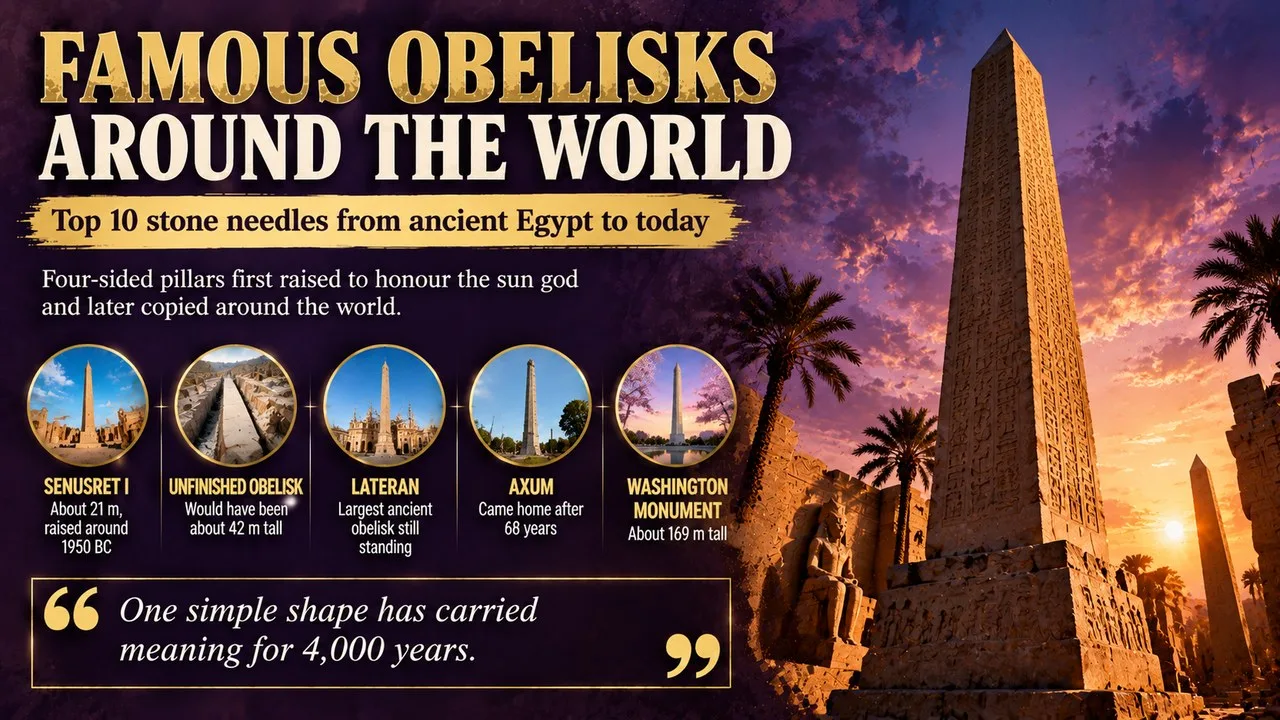
Related: Top 10 Famous Obelisks Around the World
World Wars
The 20th century brought wars on a scale never seen before. World War II, fought from 1939 to 1945, was the deadliest conflict in history, killing 60 to 75 million people, most of them civilians, including the victims of the Holocaust.[28]
The Information Age
The Information Age is the period in which economies shifted from the traditional industries of the Industrial Revolution to information technology. Its start has been linked to the invention of the transistor in 1947.[29] The Internet, a global system of linked computer networks, has transformed telephone, radio, television, mail, newspapers and publishing, and created new media such as email and streaming.[30] Some scholars argue that recent breakthroughs in artificial intelligence and biotechnology mark the start of a Fourth Industrial Revolution.[29]
Key Figures
- Start of farming: about 11,700 years ago[2]
- Natufian culture becomes sedentary: as early as 12,000 BC[3]
- Recognised cradles of civilization: 6[3]
- Population of Mohenjo-daro or Harappa: probably 30,000–60,000 each[9]
- Height of the Code of Hammurabi stele: 2.25 metres[7]
- Fall of the Western Roman Empire: 476 AD; fall of Constantinople: 1453[17]
- Mongol unification under Genghis Khan: 1206[20]
- Deaths in World War II: 60–75 million[28]
Frequently Asked Questions
What was the first civilization?
Mesopotamia is usually counted as the earliest. Its cities of Uruk, Ur, Kish and Eridu were the first to hold tens of thousands of people, by the 31st century BC, and it produced cuneiform, the earliest known writing.[3][6]
What are the six cradles of civilization?
Mesopotamia, ancient Egypt, ancient India, ancient China, the Caral–Supe civilization of Peru and the Olmec civilization of Mexico.[3]
Why was farming so important?
Farming let people settle in one place and produce surplus food. That surplus supported rulers, priests, craftsmen and builders, which made cities and states possible.[2][3]
What is the Axial Age?
It is a term coined by Karl Jaspers in 1949 for the period from about the 8th to the 3rd century BCE, when major new religious and philosophical ideas appeared in several regions at once. The idea remains debated.[13]
When did the modern age begin?
Historians give different dates, but the Renaissance, the Age of Discovery and the Scientific Revolution are usually seen as the bridge from the medieval to the modern world, and the Industrial Revolution from about 1760 transformed how people lived and worked.[18][27]
See also
- ^ [1] "Civilization". Wikipedia. Wikipedia
- ^ [2] "Neolithic Revolution". Wikipedia. Wikipedia
- ^ [3] "Cradle of civilization". Wikipedia. Wikipedia
- ^ [4] "Göbekli Tepe". Wikipedia. Wikipedia
- ^ [5] "Mesopotamia". Wikipedia. Wikipedia
- ^ [6] "Cuneiform". Wikipedia. Wikipedia
- ^ [7] "Code of Hammurabi". Wikipedia. Wikipedia
- ^ [8] "Ancient Egypt". Wikipedia. Wikipedia
- ^ [9] "Indus Valley Civilisation". Wikipedia. Wikipedia
- ^ [10] "Shang dynasty". Wikipedia. Wikipedia
- ^ [11] "Olmecs". Wikipedia. Wikipedia
- ^ [12] "Bronze Age". Wikipedia. Wikipedia
- ^ [13] "Axial Age". Wikipedia. Wikipedia
- ^ [14] "Ancient Greece". Wikipedia. Wikipedia
- ^ [15] "Maurya Empire". Wikipedia. Wikipedia
- ^ [16] "Han dynasty". Wikipedia. Wikipedia
- ^ [17] "Roman Empire". Wikipedia. Wikipedia
- ^ [18] "Middle Ages". Wikipedia. Wikipedia
- ^ [19] "Islamic Golden Age". Wikipedia. Wikipedia
- ^ [20] "Mongol Empire". Wikipedia. Wikipedia
- ^ [21] "Inca Empire". Wikipedia. Wikipedia
- ^ [22] "Renaissance". Wikipedia. Wikipedia
- ^ [23] "Printing press". Wikipedia. Wikipedia
- ^ [24] "Age of Discovery". Wikipedia. Wikipedia
- ^ [25] "Scientific Revolution". Wikipedia. Wikipedia
- ^ [26] "Age of Enlightenment". Wikipedia. Wikipedia
- ^ [27] "Industrial Revolution". Wikipedia. Wikipedia
- ^ [28] "World War II". Wikipedia. Wikipedia
- ^ [29] "Information Age". Wikipedia. Wikipedia
- ^ [30] "Internet". Wikipedia. Wikipedia























Discussion
Log in with