










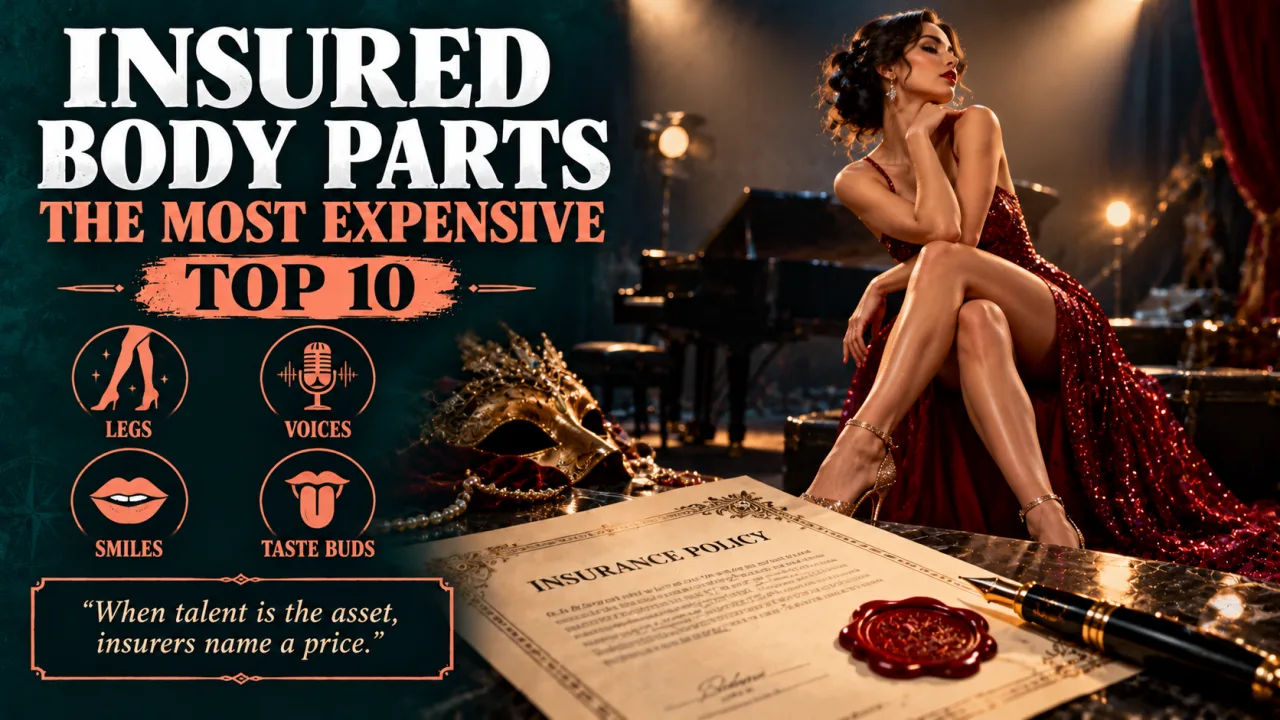
The most expensive insured body parts are the legs, voices, smiles, noses and tongues that stars and sponsors have insured for millions at Lloyd's of London.
Body part insurance sounds like a celebrity gimmick, and sometimes it is exactly that. Yet behind the headlines sits a real corner of the specialist insurance market, where underwriters price the risk of a footballer's career-ending injury, a coffee taster losing his palate or a singer losing her voice. This guide ranks ten of the best-documented cases by the value that was announced or reported at the time, explains how these unusual policies actually work, and separates confirmed cover from the rumours that have been repeated for decades.
A quick word on method. Insurers rarely publish policy details, so many figures come from press releases issued by sponsors or from newspaper reports. Where a sum was officially announced by Lloyd's or the brand that bought the policy, we say so. Where it was only reported, or later doubted, we say that too. Values are given in the currency in which they were first reported.
At a Glance
| Rank | Body part | Owner | Reported value | Year | Status |
|---|---|---|---|---|---|
| 1 | Legs | Mariah Carey | $1 billion | 2006 | Reported, never confirmed by Lloyd's |
| 2 | Legs | David Beckham | £100 million | 2006 | Reported |
| 3 | Legs | Cristiano Ronaldo | £90 million | 2009 | Reported, renewed at about €100 million in 2013 |
| 4 | Legs | Michael Flatley | £25 million | 1990s | Reported |
| 5 | Tongue | Gennaro Pelliccia | £10 million | 2009 | Announced by Lloyd's broker |
| 6 | Smile | America Ferrera | $10 million | 2007 | Announced by sponsor and Lloyd's |
| 7 | Nose | Ilja Gort | €5 million | 2008 | Announced by Lloyd's |
| 8 | Voice | Bruce Springsteen | £3.5 million | 1990s | Reported by the BBC |
| 9 | Legs | Heidi Klum | About $2 million | 2000s | Confirmed by Klum |
| 10 | Hair | Troy Polamalu | $1 million | 2010 | Announced by sponsor |
How Body Part Insurance Works
Most people imagine a single cheque written the moment a famous leg is bruised. In practice, body part cover is usually a tailored form of accident and disability insurance. The policy names a specific part of the body, sets a maximum payout, and lists the events that trigger a claim, such as an accidental injury that ends a career or the permanent loss of a sense.
Who Buys the Policy
The person whose body is insured is often not the buyer. Football clubs protect the transfer fees they paid for star players. Brands that build an advertising campaign around a famous smile or pair of legs insure the asset they are promoting, and they make sure the press hears about it. Some performers do buy their own cover, mainly singers and dancers whose income depends on one physical skill.
Where the Policies Are Written
Lloyd's of London is the name attached to nearly every famous case. It is not a single insurance company but a marketplace in which independent syndicates accept risks that mainstream insurers will not touch. The market grew out of Edward Lloyd's coffee house, opened in London around 1688, where merchants and ship owners met to share the risk of voyages. That tradition of pricing the unusual is why a winemaker's nose or a coffee taster's tongue ends up there.
What These Policies Usually Contain
- A named body part or sense, such as the legs, voice or sense of smell
- A maximum sum insured, which is the headline figure the public hears
- A fixed policy period, often linked to a sponsorship contract or a tour
- Exclusions and lifestyle conditions, for example bans on dangerous sports
- A medical inspection, sometimes with different values for each limb
Lloyd's itself has said that policies on body parts generally top out at between $120 million and $150 million, a useful benchmark when judging the biggest numbers on this list.
Where It All Began
The idea of insuring a famous body part is almost as old as Hollywood's star system. In the 1940s, 20th Century Fox insured the legs of pin-up star Betty Grable for $1 million as a publicity stunt. The story fitted perfectly with her image as the girl with the million-dollar legs, and it became the template for every celebrity policy that followed.
Other early examples were less glamorous. The BBC reported in 1999 that food critic Egon Ronay had insured his taste buds for £250,000, a forerunner of the coffee and wine tasters who appear later in this list. From the start, the pattern was set: a famous name, a memorable body part and a round number that newspapers could not resist.
1. Mariah Carey's Legs
| Attribute | Details |
|---|---|
| Owner | Mariah Carey, American singer and songwriter |
| Body part | Legs |
| Reported value | $1 billion |
| Year | 2006 |
| Linked campaign | Gillette Venus "Legs of a Goddess" |
The Story Behind the Policy
In late May 2006, newspapers reported that Mariah Carey had insured her legs for $1 billion. The figure appeared just as she was signed to front Gillette's "Legs of a Goddess" campaign for its women's razors, which was launched with a giant image of her legs at Radio City Music Hall in New York. A source close to the singer told the British press that the sum reflected her popularity and that she would need to be careful on her upcoming American tour.
That tour, The Adventures of Mimi, began in August 2006 and was her first tour of America in three years. Protecting a headline act against injury before a long run of arena dates was the stated logic, but the timing alongside a big advertising launch made the story an obvious piece of promotion too.
Key Features
- The $1 billion figure is the largest body part valuation ever widely reported
- It was attached to a beauty campaign rather than a sporting career
- The claim came from an unnamed source, not from an insurer
- It covered a tour period when the risk of injury on stage was highest
Significance
Carey's legs sit at the top of almost every list of this kind, but the number deserves caution. When asked years later, Lloyd's declined to confirm any figure for her policy and pointed out that body part cover usually tops out at $120 million to $150 million. The billion-dollar legs are therefore best understood as a reported value, and possibly a marketing one, rather than a verified sum. Even so, the story shows how effectively a single headline can link a star to a product.
Interesting Facts
- Carey was 36 when the policy was reported
- The campaign name, "Legs of a Goddess", became shorthand for the whole story
- Lloyd's has never publicly confirmed the figure
2. David Beckham's Legs
| Attribute | Details |
|---|---|
| Owner | David Beckham, English footballer |
| Body part | Legs |
| Reported value | £100 million |
| Year | 2006 |
| Insurance market | Lloyd's of London |
The Story Behind the Policy
By the mid-2000s David Beckham was arguably the most marketable footballer on earth. He had moved from Manchester United to Real Madrid in 2003, captained England at the 2006 World Cup and carried endorsement deals that dwarfed his playing salary. Reports from 2006 state that his legs were insured at Lloyd's for £100 million, a figure that reflected not only his value on the pitch but the commercial empire built on his image.
For a player whose right foot produced some of the most famous free kicks of his era, the legs were the obvious asset to protect. A serious injury would have hit his club, his sponsors and his own business interests all at once, which is why cover for elite footballers is often shared between several parties.
Key Features
- Cover was linked to his playing career and commercial value
- The policy came during his Real Madrid years
- It reflected endorsement income as much as football wages
- The figure has been repeated in British newspapers for years
Significance
Beckham's case shows how sport changed the logic of body part insurance. Earlier policies were often studio publicity. In football, the money is very real: clubs pay enormous transfer fees, and sponsors sign long contracts that depend on a player staying fit. During his playing career Beckham is estimated to have generated around £1 billion in shirt and boot sales, which helps explain why insurers were willing to put a nine-figure price on his legs.
Interesting Facts
- Beckham's playing career ended in May 2013 at Paris Saint-Germain
- Several different values for his legs have appeared in the press over the years
- His fame as a free-kick specialist made his legs a natural focus for the story
- His legs became part of a wider trend of clubs insuring star players
3. Cristiano Ronaldo's Legs
| Attribute | Details |
|---|---|
| Owner | Cristiano Ronaldo, Portuguese footballer |
| Body part | Legs |
| Reported value | £90 million (2009), about €100 million (2013) |
| Policy holder | Real Madrid, according to reports |
| Context | Record transfer from Manchester United in 2009 |
The Story Behind the Policy
In the summer of 2009 Real Madrid signed Cristiano Ronaldo from Manchester United for a then world-record fee of £80 million. Within weeks, British newspapers reported that the club had insured his legs for £90 million. The reasoning was straightforward: the club had just paid more for a single player than any club in history and wanted protection if an injury ended his career.
Spanish and Portuguese media reported in 2013 that the club had renewed the arrangement, with cover put at around €100 million, and some outlets citing €103 million. By then Ronaldo had become the team's leading scorer and the face of its global brand, so the value of the cover kept pace with his importance.
Key Features
- Cover was taken out by the club rather than by the player himself
- It was linked to a world-record transfer fee
- The policy was reported as renewed and raised during his Madrid years
- It protected against injury that would stop him playing
Significance
Ronaldo's legs are the clearest example of body part insurance as a financial tool rather than a publicity stunt. When a club spends a fortune on one player, insuring that investment is simple risk management. His case also shows how football has pushed the top values on these lists far beyond what Hollywood studios ever paid in the age of Betty Grable.
Interesting Facts
- The original £90 million figure was reported in 2009, his first year in Madrid
- The renewed figure was reported in euros by Spanish media
- Ronaldo went on to become Real Madrid's all-time top scorer
- His extraordinary fitness record means the policy was never famous for a claim
4. Michael Flatley's Legs
| Attribute | Details |
|---|---|
| Owner | Michael Flatley, American-born Irish dancer |
| Body part | Legs |
| Reported value | £25 million |
| Insurance market | Lloyd's of London |
| Known for | Riverdance and Lord of the Dance |
The Story Behind the Policy
Michael Flatley became a global star after the Riverdance interval act at the 1994 Eurovision Song Contest in Dublin. He then created Lord of the Dance, a touring show whose productions have been seen by tens of millions of people. With a career built entirely on rapid, precise footwork, his legs were the core of a business worth far more than any single performance.
The BBC has reported that his legs were insured for £25 million at Lloyd's of London. Other outlets have printed different figures over the years, including dollar values in the tens of millions, which is common for policies that were never officially published.
Key Features
- Cover protected a touring business, not just one performer
- The figure is the highest widely reported for a dancer in modern times
- He once held a Guinness World Record for tap speed, at 35 taps per second
- Several different amounts have been printed by different outlets
Significance
Flatley's legs connect today's sports stars with the old Hollywood tradition of insuring dancers. Unlike a footballer, a dancer cannot rely on a club to absorb the cost of an injury. His policy reflected the reality that a single ruptured tendon could halt a production employing dozens of performers and crew.
Interesting Facts
- Flatley retired from dancing in 2016, citing pain in his spine, knees, feet and ribs
- He was born in Chicago to Irish parents
- Lord of the Dance shows have toured dozens of countries
- His legs are often listed alongside Fred Astaire's in histories of insured dancers
5. Gennaro Pelliccia's Tongue
| Attribute | Details |
|---|---|
| Owner | Gennaro Pelliccia, master coffee taster for Costa Coffee |
| Body part | Tongue and taste buds |
| Value | £10 million |
| Date announced | 9 March 2009 |
| Arranged by | Lloyd's broker Glencairn |
The Story Behind the Policy
Gennaro Pelliccia was Costa Coffee's Italian master of coffee, the person who personally tasted samples from each batch of raw beans at the company's London roastery before they were roasted and sent to stores. In March 2009 Costa announced that his tongue had been insured for £10 million through Lloyd's, placed by the broker Glencairn, a firm better known for insuring cargo for shipping and mining companies.
Pelliccia explained that his 18 years of experience allowed him to tell apart thousands of flavours and spot defects that could spoil the company's signature blend. Glencairn's spokesman compared his taste buds to the vocal cords of a singer or the legs of a top model.
Key Features
- The policy was officially announced, not just rumoured
- It protected the quality control of an entire coffee chain
- Guinness World Records lists it as the highest insured tongue
- It is one of the largest policies ever written on a single person's senses
Significance
Pelliccia's tongue proved that body part insurance is not only for the famous. Companies whose products depend on a single expert's senses have a genuine business reason to protect them. Lloyd's noted that the average tongue has about 10,000 taste buds, which meant each of Pelliccia's was effectively insured for around £1,000.
Interesting Facts
- Costa said it sold 108 million cups of coffee a year worldwide at the time
- The broker described it as one of the biggest single policies ever taken out for one person
- Wine tasters for supermarkets and merchants have taken out similar cover
6. America Ferrera's Smile
| Attribute | Details |
|---|---|
| Owner | America Ferrera, American actress |
| Body part | Smile, including teeth and gums |
| Value | $10 million |
| Year | 2007 |
| Bought by | Aquafresh White Trays, for the charity Smiles for Success |
The Story Behind the Policy
In May 2007, at the height of her fame as the braces-wearing Betty Suarez in the series Ugly Betty, America Ferrera had her smile insured for $10 million at Lloyd's of London. The policy was bought by the teeth-whitening brand Aquafresh White Trays as part of a campaign for Smiles for Success, an American charity that provides dental care for women moving from welfare into work.
Ferrera said she was flattered and had never imagined such a thing happening, adding that she would try her hardest to take care of it. The campaign donated money to the charity for each product sold and each sweepstakes entry, up to a target of $100,000.
Key Features
- The policy covered her teeth and gums against accidental injury
- It paid for reasonable dental treatment costs during the policy term
- It expired on 1 January 2008
- It was placed through the Lloyd's broker Glencairn
Significance
Ferrera's smile is a rare example of a body part policy whose terms were made public in detail. It shows how such cover often works: a limited period, a specific kind of loss and a clear link to a campaign. It also turned an insurance stunt into a fundraising tool for a real cause.
Interesting Facts
- Ferrera was 23 when the policy was announced
- Her character's braces made the choice of body part especially memorable
- The same broker later arranged the Costa Coffee tongue policy
- Aquafresh said it was one of the most valuable policies Lloyd's had granted for a body part
7. Ilja Gort's Nose
| Attribute | Details |
|---|---|
| Owner | Ilja Gort, Dutch winemaker and owner of Château de la Garde |
| Body part | Nose and sense of smell |
| Value | €5 million |
| Date announced | March 2008 |
| Insurers | Lloyd's syndicate Watkins with Allianz Nederland |
The Story Behind the Policy
Ilja Gort, a Dutch musician turned winemaker, bought a Bordeaux estate in 1994 and built a wine business around his own palate. After hearing about a man who lost his sense of smell in a car accident, he approached Lloyd's about insuring the organ he called his most important asset. In March 2008 the market announced a €5 million policy covering the loss of either his nose or his sense of smell.
Gort argued that the tongue picks up only a handful of basic tastes while the nose can tell apart a vast range of scents, which makes smell the real tool of a winemaker. The lead underwriter compared a winemaker's nose to the fingers of a chef.
Key Features
- The policy covered both physical damage and loss of the sense of smell
- He was barred from boxing, riding a motorcycle and fire-breathing
- He could not work as a knife thrower's assistant
- A clause required careful, experienced barbers near his face
Significance
Gort's nose is a perfect illustration of how underwriters manage unusual risks through conditions as well as price. The lifestyle bans made headlines, but they are a normal part of any policy that protects a single, irreplaceable skill. Guinness World Records lists it as the highest insured nose.
Interesting Facts
- Gort was 47 when the policy was taken out
- His estate is near Bordeaux, one of France's most famous wine regions
- He joked that the policy meant he could not fight Mike Tyson
- His long beard was specifically considered when the policy was drafted
8. Bruce Springsteen's Voice
| Attribute | Details |
|---|---|
| Owner | Bruce Springsteen, American rock singer and songwriter |
| Body part | Voice |
| Reported value | £3.5 million |
| Source of report | BBC News, 1999 |
| Insurance market | Lloyd's of London |
The Story Behind the Policy
Bruce Springsteen built his reputation on marathon concerts that can run for well over three hours. For a performer like that, the voice is the instrument that carries the whole tour. In a 1999 report on unusual Lloyd's policies, the BBC listed Springsteen among the rock acts covered by the market and stated that he had insured his voice for £3.5 million.
Later articles have printed larger dollar figures, but the BBC report remains the most reliable early source. Rock acts more commonly insure equipment, personal effects and the risk of cancelled concerts, so a policy on the voice itself stands out.
Key Features
- The policy protected his main professional asset
- It sat alongside wider tour and cancellation cover common in the music industry
- The figure was reported in sterling by a British source
- Later reports quote different amounts
Significance
Springsteen's voice shows the musical side of body part insurance. A singer who loses their voice faces cancelled tours, refunded tickets and lost recording income. Insuring the voice is a way of turning that fear into a known cost.
Interesting Facts
- The BBC listed him alongside Eric Clapton, Bob Dylan, Elton John and others insured at Lloyd's
- Springsteen's concerts are famous for their length
- His nickname, The Boss, is known worldwide
9. Heidi Klum's Legs
| Attribute | Details |
|---|---|
| Owner | Heidi Klum, German-American model and TV host |
| Body part | Legs |
| Value | About $2 million |
| Split | About $1.2 million for the right leg and $1 million for the left |
| Bought by | A client, not Klum herself |
The Story Behind the Policy
Heidi Klum has spoken about her insured legs several times, which makes her one of the few stars to confirm such a policy in her own words. In a 2011 interview she said she had not insured them personally; a client had. She described travelling to London, where assessors examined her legs before the cover was set.
The examination produced an unusual result. A scar on her left leg, from falling into glass as a child, meant that leg was valued lower than the right. In later interviews she said the two were insured for different amounts, with the right leg worth more.
Key Features
- The policy was confirmed by Klum herself
- Each leg was valued separately after an inspection in London
- A childhood scar lowered the value of the left leg
- The cover was bought by a commercial client
Significance
Klum's legs reveal the practical side of these policies. Insurers assess the condition of the body part much as they would inspect a building or a ship, and existing marks or injuries change the price. Her story also confirms the pattern seen elsewhere on this list: the buyer is often a brand protecting its investment in a famous face.
Interesting Facts
- Klum has joked that she finds the whole idea weird
- She discussed the policy on The Ellen DeGeneres Show in 2022
- She has said spray tan now hides the scar
- She was a Victoria's Secret model for more than a decade
10. Troy Polamalu's Hair
| Attribute | Details |
|---|---|
| Owner | Troy Polamalu, American football safety |
| Body part | Hair |
| Value | $1 million |
| Year | 2010 |
| Bought by | Procter and Gamble's Head and Shoulders brand |
The Story Behind the Policy
Troy Polamalu, the Pittsburgh Steelers safety, was famous for the long curly hair that flowed out from beneath his helmet. In a 2006 game, Kansas City Chiefs running back Larry Johnson famously tackled him by pulling him down by that hair. Polamalu had not cut it for years, and it became central to his image and to sponsorship deals with Procter and Gamble.
In September 2010 the shampoo brand Head and Shoulders insured his hair for $1 million through Lloyd's of London. The insurer did not say what kind of damage would trigger a payout, which added to the playful tone of the announcement.
Key Features
- The policy was bought by his sponsor
- It protected a trademark look rather than a physical skill
- The terms of a claim were not disclosed
- It followed a famous incident in which he was tackled by the hair
Significance
Polamalu's hair is the clearest example of image insurance. It does nothing to help him play, yet it was worth protecting because it sold products. The policy shows that insurers will cover almost anything with a measurable commercial value.
Interesting Facts
- His hair reportedly hung about three feet down his back
- Polamalu is of Samoan descent and spoke about the cultural meaning of his hair
- He played his entire NFL career with the Steelers, from 2003 to 2014
- He was elected to the Pro Football Hall of Fame in 2020
Myths, Rumours and Exaggerations
Few subjects attract as many invented numbers as celebrity body insurance. Lists online repeat dramatic figures for chest hair, smiles and other body parts, often with no source at all. Some well-known examples show why caution is needed.
Cyd Charisse's Legs
The dancer Cyd Charisse was listed in the 2001 Guinness Book of World Records for the most valuable legs, based on a $5 million policy reportedly issued in 1952. Later accounts suggest that the policy was a studio publicity story rather than a real contract, which is a reminder that even old record books relied on press releases.
Merv Hughes's Moustache
The Australian fast bowler Merv Hughes was long rumoured to have insured his famous horseshoe moustache for £200,000. In a 2013 Sky Sports interview he dismissed the story as false.
Other Popular Claims
Lists of insured body parts regularly include figures for other singers, actors and athletes that cannot be traced to any insurer, sponsor or reliable newspaper. We have left these out. If a figure appears only on list websites and never in an announcement or a named report, it is best treated as entertainment rather than fact.
Comparison by Body Part
| Body part | Typical owner | Main reason for cover | Example on this list |
|---|---|---|---|
| Legs | Footballers, dancers, models | Career injury and sponsorship | Ronaldo, Beckham, Flatley, Klum, Carey |
| Tongue | Food and drink tasters | Loss of taste and quality control | Gennaro Pelliccia |
| Nose | Winemakers and perfumers | Loss of smell | Ilja Gort |
| Voice | Singers | Cancelled tours and recordings | Bruce Springsteen |
| Smile | Actors and brand faces | Campaign promotion | America Ferrera |
| Hair | Athletes with a trademark look | Sponsorship image | Troy Polamalu |
Why It Matters
Body part insurance is easy to laugh at, but it reflects how much modern income depends on a single talent. A football club's balance sheet can hinge on one player's knees. A coffee chain's reputation can rest on one taster's palate. For sponsors, a policy also doubles as advertising, which is why so many announcements arrive alongside a new campaign.
The stories also teach a useful lesson in reading the news. Officially announced policies, such as those for Pelliccia, Ferrera, Gort and Polamalu, come with dates, brokers and terms. The biggest figures, by contrast, often rest on unnamed sources. Knowing the difference helps separate genuine financial planning from clever marketing.
For more record-breaking price tags, see our guides to the most expensive cars in the world and the most expensive hobbies, or read about the health benefits of coffee that Costa's tasters spend their careers perfecting.
Frequently Asked Questions
What is the most expensive body part ever insured?
The highest figure ever widely reported belongs to Mariah Carey, whose legs were said to be covered for a billion dollars in 2006, tied to Gillette's "Legs of a Goddess" campaign. Lloyd's of London never confirmed that amount and has said body part policies usually top out at $120 million to $150 million, so the figure is best treated as reported rather than verified.
Can ordinary people insure a body part?
Yes. Specialist insurers and Lloyd's syndicates will consider cover for anyone whose income depends on a particular body part or sense, such as musicians, surgeons, tasters or hand models. The cost depends on the sum insured, the person's health, their job and the activities they agree to avoid during the policy period.
Who usually pays for celebrity body part insurance?
Often it is not the celebrity. Football clubs insure players they paid large transfer fees for, and brands insure the faces of their advertising campaigns. America Ferrera's smile was insured by Aquafresh, Troy Polamalu's hair by Head and Shoulders, and Heidi Klum has said a client insured her legs.
Why is Lloyd's of London linked to so many of these policies?
Lloyd's is a marketplace of independent syndicates that specialise in unusual and complex risks. It grew from a seventeenth-century London coffee house where merchants shared the risks of sea voyages. Its willingness to price one-off risks makes it the natural home for policies on noses, tongues, voices and famous legs.
Has anyone ever claimed on a body part policy?
Insurers rarely publish claims, and none of the famous policies on this list is known to have paid out publicly. Many were short-term contracts linked to tours or campaigns that ended without incident. The terms are usually confidential, so the absence of reported claims does not mean none have ever been paid.
Are all the celebrity body insurance stories true?
No. Some popular stories have been denied or doubted, such as Merv Hughes's moustache and Cyd Charisse's legs. Many figures circulating online cannot be traced to any insurer or reliable report. The most trustworthy cases are those announced by Lloyd's, a broker or the sponsor, with dates and policy terms.
Conclusion
From Betty Grable's million-dollar legs to a coffee taster's £10 million tongue, the most expensive insured body parts reveal how talent, fame and marketing meet in the insurance market. The very largest figures, led by Mariah Carey's reported billion-dollar legs, are hard to verify, while the best-documented policies tell a more practical story of clubs, brands and specialists protecting the one asset their business cannot replace. Either way, these policies remain one of the most curious corners of modern finance.
- Lloyd's of London, Wikipedia
- Betty Grable, Wikipedia
- Troy Polamalu, Wikipedia
- Merv Hughes, Wikipedia
- Cyd Charisse, Wikipedia
- David Beckham, Wikipedia
- BBC News, "Lloyd's: insuring the famous and the bizarre", 29 October 1999
- BBC News, "Coffee taster's tongue worth £10m", March 2009
- BBC News, "NFL player Troy Polamalu gets $1m hair insurance", 1 September 2010
- BBC News, Michael Flatley interview, 30 April 2024
- Reuters, "Lloyd's insures winemaker's nose", 18 March 2008
- Reuters, "Ugly Betty TV star insures smile for $10 mln", May 2007
- The Telegraph, "Costa Coffee's taster has tongue insured for £10 million", 9 March 2009
- The Telegraph, "Real Madrid insure Cristiano Ronaldo's legs for £90 million", 2009
- Digital Spy, "Mariah Carey insures legs for $1 billion", 30 May 2006
- WWD, "Legging It With Lloyd's of London"
- The Independent and CNN, interviews with Heidi Klum, 2022
- Guinness World Records, highest insured tongue and highest insured nose
- 10mosttoday, "10 Most Expensive Body Parts Insured" (topic reference)















Log in with