






 By
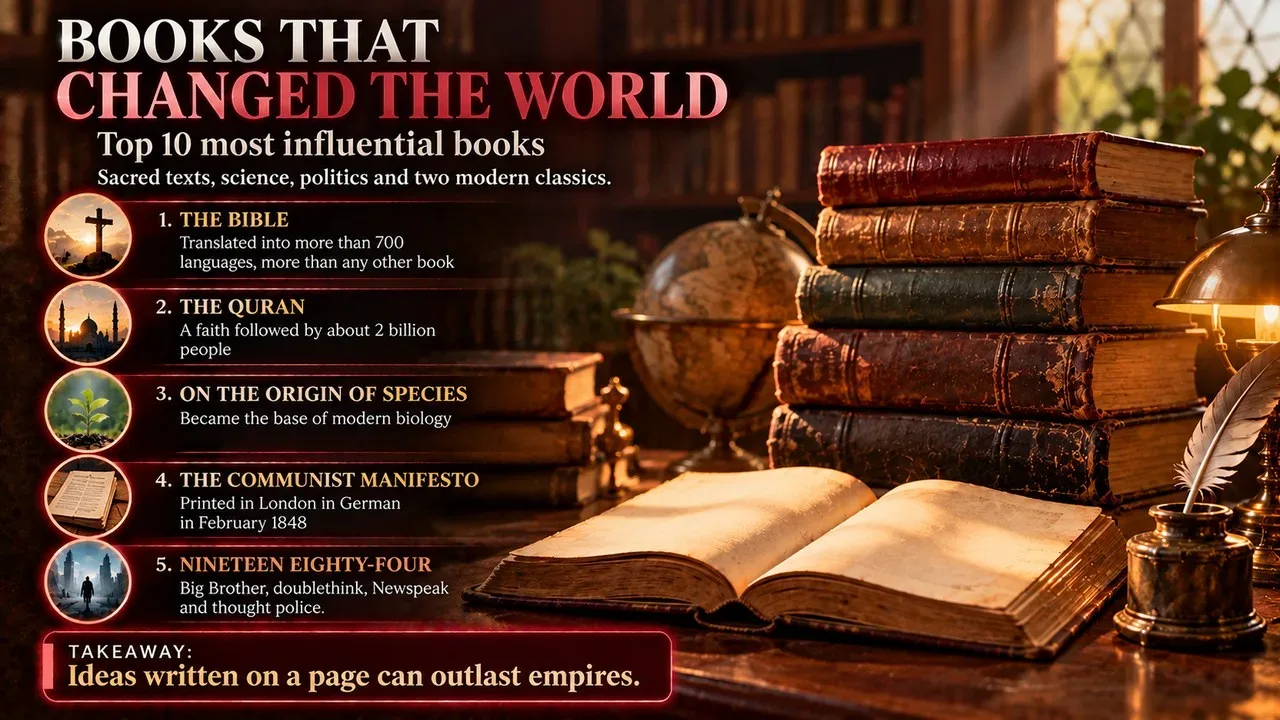
A small number of books have done far more than entertain or inform their first readers. They have founded religions, launched sciences, inspired revolutions and given whole languages new words. This Finepedia list looks at ten books whose influence has lasted for generations and spread far beyond the readers of their first editions, from ancient sacred texts to a teenager's wartime diary.
The books are ranked by a mix of four things: how many people they have reached through readers, translations and teaching; how deeply they changed beliefs, laws or institutions; how long that influence has lasted; and how many fields they touched. Religious works appear here for their reach and cultural impact, not as a judgement on any faith. Any list of this kind is a matter of judgement, and many other books could claim a place.
Key Facts
The table below sums up the ten books on this list, with the author, date and field of each.
The 10 Books at a Glance
| Rank | Book | Author | First appeared | Field |
|---|---|---|---|---|
| 1 | The Bible | Many authors | Written over many centuries | Religion |
| 2 | The Quran | Revealed to Muhammad, in Muslim belief | 610 to 632 CE | Religion |
| 3 | On the Origin of Species | Charles Darwin | 24 November 1859 | Science |
| 4 | The Communist Manifesto | Karl Marx and Friedrich Engels | February 1848 | Politics |
| 5 | The Wealth of Nations | Adam Smith | 9 March 1776 | Economics |
| 6 | The Republic | Plato | About 375 BC | Philosophy |
| 7 | Tao Te Ching | Traditionally Laozi | About 4th to 3rd century BC | Philosophy and religion |
| 8 | The Divine Comedy | Dante Alighieri | About 1308 to 1321 | Literature |
| 9 | Nineteen Eighty-Four | George Orwell | 8 June 1949 | Literature and politics |
| 10 | The Diary of a Young Girl | Anne Frank | 1947 | History and memoir |
1. The Bible
Origins
The Bible is the collection of sacred texts of Judaism and Christianity. It was written over many centuries by many authors, in Hebrew, Aramaic and Greek, and gathered into canons that still differ between churches. The Catholic Church recognises 73 books, most Protestant denominations recognise 66, and the Ethiopian Orthodox Tewahedo Church recognises 81.[1]
The Gutenberg Bible was the first book printed in Europe using movable type, so the Bible also stands at the start of the age of printing.[1]
Influence
With estimated total sales of more than five billion copies, the Bible is the best-selling publication of all time.[1] Its stories, laws and poetry shaped Western law, art, music, literature and education, and its phrases run through everyday English and many other languages.
No other book has been translated so widely. According to Wycliffe Bible Translators, as of September 2026 the full Protestant Bible exists in 807 languages, the New Testament in a further 1,844 languages, and smaller portions in 1,519 more. In total, at least part of the Bible is available in 4,170 of the world's 7,394 known languages.[2]
Key figures
- Total sales: more than 5 billion copies (estimate) [1]
- Full Bible translations: 807 languages [2]
- Languages with at least some portion: 4,170 [2]
- Books in the canon: 66 (Protestant), 73 (Catholic), 81 (Ethiopian Orthodox) [1]
2. The Quran
Origins
The Quran is the central religious text of Islam. Muslims believe it was revealed by God to the Prophet Muhammad through the angel Gabriel over about 23 years, beginning in 610 CE in the Cave of Hira and ending in 632 CE, the year of his death.[3]
After Muhammad's death the text was compiled on the orders of the first caliph, Abu Bakr. The third caliph, Uthman, who ruled from 644 to 656, then established a standard version, known as the Uthmanic codex, which is generally regarded as the basis of the Quran read today.[3]
Influence
The Quran is organised into 114 chapters, called surahs, made up of verses called ayat.[3] It guides the prayer, law, ethics and daily life of Muslims around the world, and the practice of memorising the whole text is still widespread.
Beyond its religious role, the Quran is widely regarded as the finest work of classical Arabic literature.[3] Its language shaped the development of Arabic grammar and style, and Quranic verses became a central subject of Islamic calligraphy and architecture, from mosque walls to manuscripts.
Related: Top 10 Best-Selling Books of All Time
Key figures
- Chapters: 114 surahs [3]
- Period of revelation: about 23 years, 610 to 632 CE [3]
- Standard text: the Uthmanic codex, under Caliph Uthman (ruled 644 to 656) [3]
3. On the Origin of Species
Origins
The English naturalist Charles Darwin published On the Origin of Species on 24 November 1859. The publisher John Murray printed 1,250 copies priced at fifteen shillings, and all available copies were taken up immediately when booksellers were offered the book at Murray's autumn sale on 22 November.[4]
Darwin had been developing his ideas for about two decades. He was pushed to publish when Alfred Russel Wallace reached similar conclusions; Wallace's 1855 paper on the introduction of species led Charles Lyell to urge Darwin to publish in 1856.[4]
Influence
The book introduced the scientific theory that populations evolve over generations through natural selection, and it is considered the foundation of evolutionary biology.[4] It changed how people understand the history of life, the relationship between humans and other animals, and the age and workings of the natural world.
Darwin kept revising the work. By his death in 1882 it was in its sixth edition, which was also the first edition in which he used the word "evolution".[4]
Key figures
- Published: 24 November 1859 [4]
- First printing: 1,250 copies at 15 shillings [4]
- Editions in Darwin's lifetime: six [4]
4. The Communist Manifesto
Origins
The Communist Manifesto, originally titled Manifesto of the Communist Party, was written by Karl Marx and Friedrich Engels. It was commissioned by the Communist League and published anonymously in London in late February 1848, in German.[5]
The deadline was tight. The League's Central Committee sent Marx an ultimatum in January 1848, demanding the finished manuscript by 1 February.[5]
Influence
Published just as revolutions swept across Europe in 1848, the pamphlet became one of the world's most influential political documents.[5] Its opening line, "A spectre is haunting Europe, the spectre of communism", and its closing call, popularised as "Workers of the world, unite!", are among the best-known lines in political writing.[5]
Its ideas shaped labour movements, socialist and communist parties, and the twentieth-century states that called themselves Marxist. In 2013 a manuscript page of the Manifesto was added to UNESCO's Memory of the World Register, together with Marx's annotated copy of Capital, Volume I.[5]
Key figures
- Published: late February 1848, London [5]
- Authors: Karl Marx and Friedrich Engels [5]
- UNESCO Memory of the World: inscribed in 2013 [5]
5. The Wealth of Nations
Origins
The Scottish economist and moral philosopher Adam Smith published An Inquiry into the Nature and Causes of the Wealth of Nations on 9 March 1776, in two volumes, during the Scottish Enlightenment.[6]
Related: Top 10 Most Bizarre Phobias: Strange Fears That Exist
Influence
Smith argued that wealth is created through free exchange and competition between individuals and through the higher productivity that comes from the division of labour.[6] The book became the founding text of classical economics.
Its best-known image is the "invisible hand", the idea that people pursuing their own interest in a free market can, without intending it, benefit society. Although the phrase is constantly quoted, Smith uses it only once in the book.[6] Debates about free trade, taxation and the role of government still refer back to Smith's arguments, and later economists, including Marx, built on or argued against his ideas.[6]
Key figures
- Published: 9 March 1776, in two volumes [6]
- Central ideas: division of labour, free exchange, the invisible hand [6]
6. The Republic
Origins
The Republic is a Socratic dialogue written by the Greek philosopher Plato around 375 BC. It asks what justice is and describes the order and character of a just city-state and a just person.[7] It is Plato's best-known work.
Influence
The Republic is one of the most influential works of philosophy and political theory ever written.[7] Its idea that a state should be ruled by philosopher-kings, its theory of Forms, and its debates on education and the soul shaped Western thought for more than two thousand years.
Its most famous passage is the allegory of the cave in Book VII. Prisoners chained in a cave mistake shadows on a wall for reality, and the philosopher is the one who escapes to see the real world outside. The image is Plato's way of separating the world of appearances from the world of the Forms, and it is still taught in schools and universities.[7]
Key figures
- Written: about 375 BC [7]
- Form: Socratic dialogue in ten books
- Best-known passage: the allegory of the cave, Book VII [7]
7. Tao Te Ching
Origins
The Tao Te Ching, also written Daodejing and also known as the Laozi, is an ancient Chinese classic traditionally attributed to the sage Laozi. It is the foundational text of Taoism.[8] The oldest surviving versions date to about the fourth century BC, while a cautious estimate dates the modern text to the mid-third century BC.[8]
The work is short. It is divided into 81 chapters: the first 37 are known as the Daojing (Classic of the Way) and chapters 38 to 81 as the Dejing (Classic of Virtue).[8]
Influence
The Tao Te Ching shaped Chinese philosophy, religion, politics and art, and it influenced Chinese Buddhism after that faith reached China.[8] Its teachings on simplicity, humility and acting in harmony with the Way have reached readers well beyond China.
Related: Top 10 Oldest Buildings in the World
It is one of the most translated texts in world literature. One estimate counts about 1,930 translations into 94 languages.[8]
Key figures
- Chapters: 81 [8]
- Translations: about 1,930 into 94 languages (one estimate) [8]
- Tradition: foundational text of Taoism [8]
8. The Divine Comedy
Origins
The Italian poet Dante Alighieri began The Divine Comedy around 1308 and finished it around 1321, shortly before his death.[9] It describes a journey through Hell, Purgatory and Paradise.
The poem has 14,233 lines divided into three parts, Inferno, Purgatorio and Paradiso, each of 33 cantos. It is written in terza rima, a linked rhyme scheme that Dante made famous.[9]
Influence
The Divine Comedy is widely considered the greatest work of Italian literature and one of the greatest works of Western literature.[9] Dante wrote it in his Tuscan vernacular instead of Latin, and the poem helped establish Tuscan as the basis of standard Italian.[9]
Its images of the afterlife influenced painters, sculptors, composers and writers for centuries, and many popular ideas about Hell and its circles come from Dante's poem.
Key figures
9. Nineteen Eighty-Four
Origins
George Orwell's Nineteen Eighty-Four was published on 8 June 1949 by Secker and Warburg. It was his ninth and final completed book, and the first printing ran to 25,575 copies.[10]
The novel follows Winston Smith, who works at the Ministry of Truth in London rewriting historical records to fit the Party's changing version of events. Britain, renamed Airstrip One, is a province of the totalitarian superstate Oceania, ruled in the name of Big Brother.[10]
Influence
Nineteen Eighty-Four became the classic example of dystopian political fiction. It made "Orwellian" an everyday adjective, and many of its terms entered common use, among them "Big Brother", "doublethink", "Thought Police", "thoughtcrime" and "Newspeak".[10]
Related: The Evolution of Stranger Things: Seasons, Themes, and Characters
By 1989 it had been translated into 65 languages.[10] Whenever surveillance, propaganda or the twisting of language is in the news, readers and commentators return to the novel.
Key figures
10. The Diary of a Young Girl
Origins
Anne Frank was a Jewish girl who hid with her family in a secret annex in Amsterdam during the Nazi occupation of the Netherlands. She kept a diary between June 1942 and August 1944. The family was arrested in 1944, and Anne died in the Bergen-Belsen concentration camp in 1945, aged 15. Of the eight people in hiding, only her father, Otto Frank, survived the war.[11]
The diary was rescued by the helpers Miep Gies and Bep Voskuijl and given to Otto Frank. It was first published in Dutch in 1947 as Het Achterhuis (The Secret Annex).[11]
Influence
The diary became one of the most widely read accounts of the Holocaust, giving a personal voice to the millions of victims. By 2014 more than 35 million copies had been published, and according to the Anne Frank House the diary has now been translated into more than 75 languages.[11][12]
In 2009 the diary notebooks were added to UNESCO's Memory of the World Register.[11] The book is read in schools around the world and has been adapted for the stage and screen many times.
Key figures
- Written: 1942 to 1944 [11]
- First published: 1947, in Dutch [11]
- Copies published: more than 35 million by 2014 [11]
- Languages: more than 75 [12]
Comparison
| Book | Original language | Best-known idea or image |
|---|---|---|
| The Bible | Hebrew, Aramaic, Greek | Creation, the Ten Commandments, the life of Jesus |
| The Quran | Arabic | Revelation to the Prophet Muhammad |
| On the Origin of Species | English | Evolution by natural selection |
| The Communist Manifesto | German | "Workers of the world, unite!" |
| The Wealth of Nations | English | The invisible hand and the division of labour |
| The Republic | Ancient Greek | The allegory of the cave |
| Tao Te Ching | Classical Chinese | The Way (Dao) and its virtue (De) |
| The Divine Comedy | Tuscan Italian | The circles of Hell |
| Nineteen Eighty-Four | English | Big Brother is watching you |
| The Diary of a Young Girl | Dutch | A girl's life in hiding |
Why These Books Lasted
The ten books on this list share a few traits. Several gave large communities a shared story or set of rules, as the Bible and the Quran did. Others offered a new explanation of how the world works, as Darwin did for life and Smith did for markets. Some supplied a vivid image that people still use to think with, such as Plato's cave or Orwell's Big Brother.
Translation and printing also played a part. The Bible's early spread through print and its translation into thousands of languages, the Tao Te Ching's roughly 1,930 translations, and the diary's translation into more than 75 languages show how books that cross languages can reach far more readers than their authors imagined.[2][8][12]
See also
- Top 25 Unique Religions You Have Probably Never Heard Of
- List of best-selling books
- History of printing
- ^ [1] "Bible". Wikipedia. Wikipedia: Bible
- ^ [2] "Bible translations". Wikipedia (citing Wycliffe Bible Translators statistics). Wikipedia: Bible translations
- ^ [3] "Quran". Wikipedia. Wikipedia: Quran
- ^ [4] "On the Origin of Species". Wikipedia. Wikipedia: On the Origin of Species
- ^ [5] "The Communist Manifesto". Wikipedia. Wikipedia: The Communist Manifesto
- ^ [6] "The Wealth of Nations". Wikipedia. Wikipedia: The Wealth of Nations
- ^ [7] "Republic (Plato)". Wikipedia. Wikipedia: Republic (Plato)
- ^ [8] "Tao Te Ching". Wikipedia. Wikipedia: Tao Te Ching
- ^ [9] "Divine Comedy". Wikipedia. Wikipedia: Divine Comedy
- ^ [10] "Nineteen Eighty-Four". Wikipedia. Wikipedia: Nineteen Eighty-Four
- ^ [11] "The Diary of a Young Girl". Wikipedia. Wikipedia: The Diary of a Young Girl
- ^ [12] "Anne Frank's diary". Anne Frank House. Anne Frank House: the diary




















Discussion
Log in with