





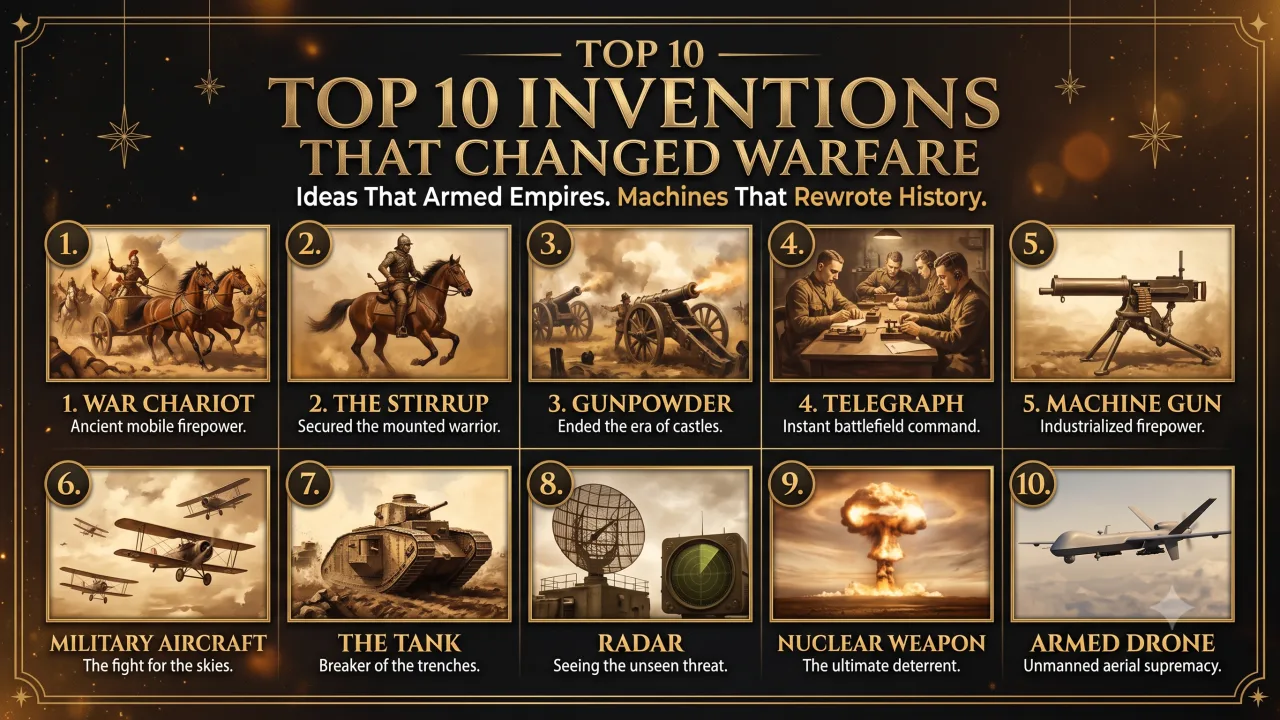
The inventions that changed warfare forever, from the Bronze Age war chariot to today's armed drones, reshaped how armies move, strike, communicate and survive. Each of the ten breakthroughs below arrived at a specific moment, was tested in a specific battle, and left the battlefield permanently different from the one before it.
Military history is usually told through generals and empires, but underneath it runs a quieter story about tools. A better wheel, a loop of metal on a saddle, a powder from an alchemist's lab and a copper wire beside a railway each changed who could win a war.
The list runs in chronological order, so you can see how each invention built on the last. Every entry includes quick facts, the battle that proved it, why it mattered and lesser-known details, followed by a timeline, a comparison table and FAQs.
The 10 Inventions at a Glance
| # | Invention | First appeared | Where | What it changed |
|---|---|---|---|---|
| 1 | War chariot | c. 2000 BCE | Eurasian steppe, southern Urals | Speed and mobile firepower |
| 2 | Paired stirrup | 4th–5th century CE | China and Korea | Stable mounted combat |
| 3 | Gunpowder | 9th century CE (first formula 1044) | China | Firearms, artillery, the end of castle walls |
| 4 | Electric telegraph | 1840s | Britain and the United States | Real-time command over long distances |
| 5 | Machine gun | 1862 (Gatling), 1884 (Maxim) | United States and Britain | Overwhelming defensive firepower |
| 6 | Military aircraft | 1903 flight, 1911 first bombing | United States and Italy | War in three dimensions |
| 7 | Tank | 1915 prototype, 1916 combat | Britain | Armoured mobility that broke trench deadlock |
| 8 | Radar | 1935 demonstration | Britain (with parallel work elsewhere) | Seeing the enemy beyond sight |
| 9 | Nuclear weapon | 1945 | United States | Deterrence and the limits of total war |
| 10 | Armed drone | 1918 concept, 2001 first armed strike | United States, later worldwide | Remote and low-cost precision strike |
1. The War Chariot
| Attribute | Details |
|---|---|
| First appeared | Around 2000 BCE; burials dated c. 1950–1880 BCE |
| Origin | Sintashta culture, southern Ural steppe (modern Russia and Kazakhstan) |
| Key innovation | Light spoked wheels pulled by domesticated horses |
| Defining battle | Kadesh, c. 1274 BCE (Egypt vs the Hittite Empire) |
| Lasting impact | First fast, mobile weapons platform in history |
Origins and History
Wheeled carts had existed for well over a thousand years before the chariot, but they were heavy, solid-wheeled wagons pulled by oxen. The breakthrough came when steppe communities of the Sintashta culture combined two things: the domesticated horse and the light spoked wheel. Graves at sites such as Sintashta and Kamennyj Ambar-5 contain the remains of two-wheeled vehicles buried with their owners, and radiocarbon modelling dates one such chariot grave to roughly 1950–1880 BCE.
Within a few centuries the technology had spread south and west. Chariots appear on Anatolian cylinder seals from about 1900 BCE, and the Hyksos rulers who took control of northern Egypt around 1650 BCE are generally credited with bringing horse and chariot to the Nile. The Egyptians adopted the idea, refined it, and turned it into the backbone of the New Kingdom army. Far to the east, Shang dynasty China was burying chariots at Anyang by about 1200 BCE.
How It Worked
- Two horses pulled a light frame of wood and leather on two spoked wheels.
- Egyptian chariots usually carried two men: a driver and an archer armed with a powerful composite bow.
- Hittite chariots often carried three men, adding a shield bearer or spearman.
- The tactic was speed: circle the slow-moving infantry, shower it with arrows, then charge once the formation broke.
The Battle That Proved It: Kadesh
At Kadesh on the Orontes River, in what is now the border region of Lebanon and Syria, Pharaoh Ramesses II met the Hittite king Muwatalli II in around 1274 BCE. Modern estimates put between 5,000 and 6,000 chariots on the field, which would make it the largest chariot battle ever fought. The Hittites ambushed the Egyptian vanguard, and Ramesses survived only by leading a desperate counter-charge until reinforcements arrived.
Neither side won outright. Roughly fifteen years later, the two empires signed a treaty whose text survives in both Egyptian and Hittite versions. It is often described as the oldest peace treaty in recorded history. Kadesh is also the earliest pitched battle for which historians know details of the formations and tactics used.
Why It Changed War
The chariot created the first military elite defined by expensive technology. Horses, trained drivers, skilled archers and carpenters to repair wheels cost a fortune, so chariot forces became symbols of royal power. For the first time, the side with the better machine and the better logistics could defeat a much larger army of foot soldiers. That idea, that technology can multiply the strength of a small force, runs through every other entry on this list.
The chariot's decline came from its weaknesses: it needed flat ground and was vulnerable to disciplined infantry. At Gaugamela in 331 BCE, Alexander the Great's soldiers simply opened lanes in their ranks and let the Persian scythed chariots pass through harmlessly. Mounted cavalry, cheaper and more flexible, gradually replaced chariots across most of the ancient world.
Lesser-Known Facts
- In 2018 the Archaeological Survey of India excavated three two-wheeled vehicles at Sanauli in Uttar Pradesh, dated to roughly 1900 BCE. The find is debated because the wheels are solid rather than spoked, and some scholars think they were bull-drawn carts.
2. The Stirrup
| Attribute | Details |
|---|---|
| First appeared | Single mounting stirrups by c. 271–302 CE; paired riding stirrups by the early 4th century |
| Origin | China and the Korean peninsula |
| Oldest dated pair | Gilded bronze stirrups from the tomb of Feng Sufu (died 415 CE), Liaoning, China |
| Reached Europe | Late 6th century, brought by the Avars |
| Lasting impact | Stable mounted combat with lance, sword and bow |
Origins and History
For thousands of years, horsemen rode with nothing to support their feet. The earliest stirrup-like objects in China appear on ceramic figurines from tombs dated around 271 and 302 CE, but these show a single loop on the left side of the saddle, which was too short to ride with and was almost certainly a mounting aid. A horse figurine from a Nanjing tomb dated to about 322 CE shows a full pair, and the oldest surviving pair with a firm date comes from the tomb of Feng Sufu, a statesman of the Northern Yan state who died in 415 CE. His stirrups were made of bent mulberry wood covered with gilded bronze.
From north-east Asia, the idea travelled west along the steppe. The Avars, a nomadic people who arrived on the frontiers of the Byzantine Empire in the second half of the sixth century, brought stirrups with them. A Byzantine military manual known as the Strategikon, usually dated to around 600 CE, already recommends iron stirrups for cavalry.
How It Worked
- Two loops hanging from the saddle supported both feet and transferred the rider's weight to the horse.
- The rider could stand up to shoot a bow, lean far to one side to strike with a sword, or brace against the shock of a lance hitting a target.
- Combined with a rigid saddle, the stirrup turned horse and rider into a single fighting unit.
The Battle That Proved It
No single battle introduced the stirrup, but its effects can be seen in two very different styles of war. In the West, heavily armoured knights relied on stirrups and high saddles to deliver the couched-lance charge; the Bayeux Tapestry, which shows the Norman victory at Hastings in 1066, clearly depicts mounted riders using stirrups. On the steppe, the Mongol armies of the thirteenth century used stirrups to give their horse archers a stable firing platform at full gallop, a combination that carried them from Korea to Hungary.
Why It Changed War
The stirrup made cavalry more effective, more versatile and more deadly for roughly a thousand years. In 1962 the American historian Lynn White Jr. argued that the stirrup made the mounted knight possible, and that the cost of supporting knights helped create European feudalism. His thesis started what scholars still call the Great Stirrup Controversy, and many historians now think he overstated the case. Even the critics agree, however, that the stirrup reshaped mounted warfare across Eurasia.
Lesser-Known Facts
- An earlier form, the toe stirrup, a small loop for the big toe, was used in India around the second century BCE. It did little for a rider wearing boots, which may explain why it did not spread north.
3. Gunpowder
| Attribute | Details |
|---|---|
| First appeared | 9th century CE, among Chinese alchemists |
| First written formula | Wujing Zongyao military manual, completed in 1044 |
| First firearm in battle | Fire lances at the Siege of De'an, 1132 |
| Ingredients | Saltpetre (potassium nitrate), sulphur and charcoal |
| Lasting impact | Guns, cannons, rockets and the end of medieval fortifications |
Origins and History
Gunpowder was discovered by accident. Daoist alchemists in Tang dynasty China experimented with saltpetre while searching for elixirs of long life, and a text usually dated to the mid-ninth century warns that certain mixtures could flare up and burn both hands and houses. By 1044 the Song court had finished the Wujing Zongyao, a compendium of military techniques that records the earliest known written formulas for what the Chinese called huoyao, or fire drug. The original manual was lost when the Jurchen captured Kaifeng in 1127, and the oldest complete surviving edition dates to 1510.
At first, gunpowder was an incendiary. Soldiers tied packets of it to arrows or hurled fire bombs from catapults. The fire lance, a bamboo tube of gunpowder attached to a spear, appears in a painting from Dunhuang dated to around 950. Its first recorded use in combat came in 1132, when Song defenders at De'an used fire lances against siege towers. Over the next two centuries, bamboo gave way to metal barrels, and the fire lance evolved into the first hand cannons.
The Battles That Proved It
On 29 May 1453, after a siege of nearly two months, the Ottoman sultan Mehmed II captured Constantinople. His guns, including an enormous bronze bombard cast by a Hungarian engineer named Orban, pounded the land walls that had protected the city for a thousand years. The fall of Constantinople showed that no medieval wall could resist sustained artillery fire.
In India, the First Battle of Panipat on 21 April 1526 played a similar role. Babur arrived with an army of perhaps 12,000 to 15,000 men, field guns and matchlock musketeers, and faced Ibrahim Lodi's much larger force, which included around 1,000 war elephants. Babur chained carts together into a defensive line, placed his guns and musketeers behind them, and used flanking cavalry to surround the enemy. The Lodi army was destroyed in half a day, Ibrahim Lodi was killed, and the Mughal Empire began.
Why It Changed War
Gunpowder shifted power from those who could afford armour and castles to those who could afford guns and the factories to make them. Engineers responded with low, thick, angled walls known as star forts, armies grew larger, and states needed bigger tax systems to pay for artillery. Historians often call this sequence of changes the Military Revolution of the early modern period.
Lesser-Known Facts
- Hyder Ali and Tipu Sultan of Mysore used iron-cased rockets against the East India Company. At the Battle of Pollilur in 1780, rockets reportedly hit British ammunition carts.
- Captured Mysorean rockets were studied in Britain and influenced William Congreve's rocket programme at Woolwich in the early 1800s. Two original Mysorean rockets survive in the Royal Artillery collection.
4. The Electric Telegraph
| Attribute | Details |
|---|---|
| First public message | 24 May 1844, Washington to Baltimore, by Samuel Morse |
| First wartime use | Crimean War, 1854–56 |
| Defining conflicts | Crimean War, Indian Rebellion of 1857, American Civil War |
| Key figures | Samuel Morse, William Cooke, Charles Wheatstone |
| Lasting impact | Command and intelligence moving faster than armies |
Origins and History
Before the telegraph, a message could travel no faster than a horse, a ship or a semaphore tower in good weather. William Cooke and Charles Wheatstone in Britain and Samuel Morse in the United States developed working electric telegraphs in the late 1830s and 1840s. Morse's line from Washington to Baltimore carried the famous message "What hath God wrought" on 24 May 1844. Within a decade, wires followed railways across Europe, North America and British India.
Armies saw the value at once. During the Crimean War, Britain and France laid an underwater cable across the Black Sea between Varna and Balaklava in 1855, connecting the siege lines at Sevastopol to London and Paris. News that once took weeks now arrived within hours.
The Conflicts That Proved It
In India, the telegraph played a dramatic role on 11 May 1857, when rebel sepoys from Meerut entered Delhi. Two young signallers at the Delhi telegraph office, William Brendish and J. W. Pilkington, sent warnings up the line to Ambala before abandoning the office. The alert allowed British officials in the Punjab to disarm suspect regiments before the uprising spread there. A memorial outside the old telegraph office at Kashmere Gate quotes Sir Robert Montgomery: "The Electric Telegraph has saved India."
During the American Civil War, the US Military Telegraph Corps strung more than 15,000 miles of wire and handled millions of messages. President Abraham Lincoln spent long hours in the War Department telegraph office reading reports from the front and sending instructions directly to his generals.
Why It Changed War
The telegraph separated the speed of information from the speed of armies. Governments could coordinate several armies at once, move troops by railway in response to news, and follow battles almost as they happened. It also brought a new problem: politicians far from the front could now second-guess their commanders in real time. Every later communication system, from radio to satellite links, follows the path the telegraph opened.
Lesser-Known Facts
- At the Battle of Tsushima in May 1905, a Japanese scout ship used wireless telegraphy to report the approaching Russian fleet, an early naval use of radio.
- The Zimmermann Telegram of January 1917, intercepted and decoded by British naval intelligence, helped bring the United States into the First World War.
- India's state telegram service, which began in the 1850s, sent its last telegram in July 2013.
5. The Machine Gun
| Attribute | Details |
|---|---|
| First practical design | Gatling gun, US patent No. 36,836, granted 4 November 1862 |
| First fully automatic gun | Maxim gun, patented 1884 by Hiram Maxim |
| Rate of fire | About 600 rounds per minute (Maxim) |
| Defining battles | Omdurman 1898; the Somme 1916 |
| Lasting impact | Defensive firepower that made massed infantry charges suicidal |
Origins and History
Richard Jordan Gatling, an American doctor and inventor, patented a hand-cranked gun with a ring of rotating barrels in 1862, in the middle of the American Civil War. Gatling later wrote that he hoped a gun that let one man do the work of many would reduce the size of armies and therefore the number of soldiers killed by disease and battle. The opposite happened.
The real leap came from Hiram Maxim, an American-born inventor working in London. His gun, patented in 1884, used the recoil of each shot to eject the spent cartridge and load the next one. As long as the trigger was held and the ammunition belt kept feeding, it kept firing. Water in a jacket around the barrel stopped it from overheating.
The Battles That Proved It
At Omdurman in Sudan on 2 September 1898, an Anglo-Egyptian army under Herbert Kitchener faced the much larger Mahdist army. Maxim guns, artillery and modern rifles cut down successive charges. The Mahdist forces lost around 10,000 killed, while Anglo-Egyptian deaths numbered fewer than 50. The poet Hilaire Belloc captured the imperial arrogance of the era in a couplet published that year: "Whatever happens, we have got / The Maxim gun, and they have not."
Eighteen years later, both sides had machine guns. On 1 July 1916, the first day of the Battle of the Somme, the British Army suffered 57,470 casualties, including 19,240 dead, many of them cut down by German machine guns as they advanced across open ground.
Why It Changed War
The machine gun gave defenders a huge advantage. Infantry could no longer advance in dense lines, and on the Western Front the result was trench warfare: years of stalemate in which armies dug into the ground to survive. The search for a way to break that deadlock led directly to the tank and to new infantry tactics based on small groups moving in short rushes.
Lesser-Known Facts
- Hiram Maxim became a British subject and was knighted in 1901.
6. The Military Aircraft
| Attribute | Details |
|---|---|
| First powered flight | 17 December 1903, Wright brothers, Kitty Hawk, North Carolina |
| First aerial bombing | 1 November 1911, Lt. Giulio Gavotti, Libya |
| Key developments | Synchronised machine guns (1915), aircraft carriers, strategic bombers |
| Defining battles | Battle of Britain 1940; Midway 1942; Longewala 1971 |
| Lasting impact | Air superiority became the precondition for winning on land and sea |
Origins and History
The first powered flight by Orville and Wilbur Wright lasted twelve seconds and covered about 36 metres. Armies took time to see its potential, but in 1909 the US Army Signal Corps bought a Wright aircraft, and other nations soon followed. The first bomb ever dropped from an aeroplane fell during the Italo-Turkish War in Libya. On 1 November 1911, Lieutenant Giulio Gavotti, flying an Etrich Taube monoplane, threw small hand grenades over Ottoman positions near Tripoli.
The First World War turned aircraft from curiosities into weapons. Early machines were used for reconnaissance, and pilots took pistols and rifles aloft. In 1915 the Fokker Eindecker arrived with a gear that synchronised its machine gun with the propeller, allowing the pilot to fire straight ahead. The fighter aircraft was born, and with it the struggle for control of the sky.
The Battles That Proved It
In the summer and autumn of 1940, the Royal Air Force defended Britain against the Luftwaffe, preventing a German invasion; the battle was fought almost entirely in the air. At Midway in June 1942, American carrier aircraft sank four Japanese fleet carriers without the opposing ships ever coming into sight of one another, a clear sign that the aircraft carrier had replaced the battleship as the queen of the seas.
India has its own example. At Longewala in the Thar Desert, in December 1971, a single company of Indian infantry held off a Pakistani armoured attack through the night. At first light, Hawker Hunter jets of the Indian Air Force flying from Jaisalmer attacked the exposed tank column, and Indian accounts credit the aircraft with destroying more than twenty tanks.
Why It Changed War
Aircraft added a third dimension to war. No frontline, fortress or fleet was safe from attack from above, and since the Second World War most military planners have treated air superiority as a requirement before any major ground or sea operation. Air power also extended war to cities and civilians on an unprecedented scale.
Lesser-Known Facts
- The Indian Air Force was officially established on 8 October 1932; Air Force Day is still marked on that date.
- The first aircraft carriers were converted ships; the first carrier strike force to sink a major fleet in harbour was the Japanese attack on Pearl Harbor on 7 December 1941.
7. The Tank
| Attribute | Details |
|---|---|
| First prototype | Little Willie, September 1915, Britain |
| First combat | 15 September 1916, Flers-Courcelette, Battle of the Somme |
| Key organisation | The Landships Committee, backed by Winston Churchill at the Admiralty |
| Defining battles | Cambrai 1917; Kursk 1943; Asal Uttar 1965 |
| Lasting impact | Armoured, tracked firepower that restored movement to land warfare |
Origins and History
The tank was a direct answer to the machine gun. By 1915, the Western Front had become a continuous line of trenches and barbed wire, and infantry attacks were being slaughtered. A British committee, created under the Admiralty and originally called the Landships Committee, set out to build an armoured vehicle that could cross trenches, crush wire and protect its crew from bullets. The first prototype, Little Willie, ran in September 1915, followed by the larger rhomboid-shaped design known as Mother, which became the Mark I.
To keep the project secret, workers were told the vehicles were water carriers for the Middle East. The name tank stuck.
How It Worked
- Caterpillar tracks spread the vehicle's weight so it could cross mud and trenches.
- Armour plate protected the crew from rifle and machine-gun fire.
- Guns mounted in side sponsons or, later, a rotating turret gave it firepower in every direction.
The Battles That Proved It
At Flers-Courcelette on 15 September 1916, 49 Mark I tanks were allocated, 32 reached the start line, and only a handful made a real impact; many broke down or got stuck. Results improved quickly. At Cambrai on 20 November 1917, the British used 476 tanks in a massed surprise attack that broke through German lines on a scale never achieved before on the Western Front.
During the Second World War, tanks working with aircraft and motorised infantry overran Poland and France in weeks. On the Eastern Front, the Battle of Kursk in July 1943 involved thousands of tanks and is often described as the largest tank battle in history.
In the India-Pakistan war of 1965, Pakistani armour advancing into Punjab was stopped at Asal Uttar between 8 and 10 September. Indian forces flooded fields to slow the attackers and destroyed or captured around 97 Pakistani tanks, many of them American-made Pattons. Company Quartermaster Havildar Abdul Hamid of 4 Grenadiers, firing a recoilless gun mounted on a jeep, destroyed several tanks before he was killed. He received the Param Vir Chakra posthumously, and the area where captured tanks were displayed became known as Patton Nagar.
Why It Changed War
The tank restored manoeuvre to land warfare after the stalemate of the trenches. It became the core of armoured divisions and of the combined-arms doctrine in which tanks, infantry, artillery and aircraft work together. Armies still debate how tanks can survive missiles and drones, but no major land army has abandoned them.
Lesser-Known Facts
- The first tank-versus-tank battle took place at Villers-Bretonneux, France, on 24 April 1918.
- Germany built only about twenty of its own A7V tanks during the First World War and used captured British tanks as well.
8. Radar
| Attribute | Details |
|---|---|
| Name | RAdio Detection And Ranging; term coined by the US Navy in 1940 |
| Key demonstration | Daventry Experiment, 26 February 1935 |
| Key figures | Robert Watson-Watt, Arnold Wilkins; John Randall and Harry Boot (cavity magnetron) |
| Defining battle | Battle of Britain, 1940 |
| Lasting impact | Air defence, naval warfare, missile guidance and stealth all depend on it |
Origins and History
The idea that radio waves bounce off metal objects was known early. The German engineer Christian Hülsmeyer patented a ship-detecting device in 1904, but navies showed no interest. In the 1930s, several countries began secret research at the same time, driven by the fear of bombing raids. In Britain, Robert Watson-Watt and Arnold Wilkins proved the idea on 26 February 1935 near Daventry: a receiver picked up BBC radio signals reflected from an RAF Heyford bomber flying several miles away. Funding followed immediately.
By the outbreak of war in 1939, a string of Chain Home radar stations guarded the south and east coasts of Britain. Then, on 21 February 1940, John Randall and Harry Boot at the University of Birmingham ran the first cavity magnetron, a compact device that produced powerful microwaves. It made small, precise radars possible for aircraft and ships.
The Battle That Proved It
During the Battle of Britain in 1940, Chain Home stations spotted German formations as they gathered and crossed the Channel. Their reports flowed to a filter room at RAF Fighter Command and then to sector stations, which sent fighters to meet the raids. This integrated network, often called the Dowding system, meant that the outnumbered RAF did not waste fuel and pilots on standing patrols. Radar alone did not win the battle, but without it the RAF would have been fighting blind.
In September 1940, the British Tizard Mission carried a cavity magnetron to the United States, where it launched a vast radar programme at the Massachusetts Institute of Technology. The American historian James Phinney Baxter III later described the magnetron as the most valuable cargo ever brought to American shores.
Why It Changed War
Radar ended the era in which darkness, cloud or distance could hide an attacking force. It shaped air defence, night fighting, anti-submarine warfare and naval gunnery during the Second World War, and later became the foundation for missile guidance, air traffic control and early-warning systems against nuclear attack. Stealth aircraft, electronic jamming and radar-absorbing paint all exist because of the need to beat it.
Lesser-Known Facts
- In 1943, the RAF began dropping strips of aluminium foil codenamed Window to blind German radar, the first large-scale use of chaff.
- The microwave oven came from wartime radar research: Percy Spencer, an engineer at Raytheon, noticed a magnetron melting a chocolate bar in his pocket and patented the idea in 1945.
9. The Nuclear Weapon
| Attribute | Details |
|---|---|
| First test | Trinity, 16 July 1945, New Mexico (yield revised in 2021 to about 24.8 kilotons) |
| Programme | The Manhattan Project, led by Gen. Leslie Groves and J. Robert Oppenheimer |
| Only wartime use | Hiroshima (6 August 1945) and Nagasaki (9 August 1945) |
| Global stockpile | About 12,187 warheads in January 2026 (SIPRI estimate) |
| Lasting impact | Deterrence, the Cold War and limits on direct war between great powers |
Origins and History
The discovery of nuclear fission in Germany in late 1938 revealed that splitting uranium atoms could release enormous energy. In August 1939, the physicist Leo Szilárd drafted a letter, signed by Albert Einstein, warning President Franklin D. Roosevelt that Germany might build an atomic bomb. The United States, Britain and Canada eventually created the Manhattan Project, which grew into one of the largest scientific and industrial enterprises in history.
On 16 July 1945, the first nuclear device was detonated in the New Mexico desert. Recalling that moment in a 1965 NBC documentary, Oppenheimer quoted the Bhagavad Gita: "Now I am become Death, the destroyer of worlds."
How It Worked
- Fission bombs split heavy nuclei (uranium-235 or plutonium-239) in a chain reaction.
- Later thermonuclear (hydrogen) bombs used a fission explosion to trigger fusion, multiplying the power hundreds of times.
The Use That Proved It
On 6 August 1945, the B-29 bomber Enola Gay dropped Little Boy, with a yield of about 15 kilotons, on Hiroshima. Three days later, Fat Man destroyed much of Nagasaki. Estimates suggest well over 100,000 people had died in Hiroshima by the end of 1945, and tens of thousands more in Nagasaki, many of them from burns and radiation sickness. Japan announced its surrender on 15 August 1945.
Why It Changed War
Nuclear weapons are the only invention on this list that made total war between major powers potentially suicidal. The Soviet Union tested its first bomb in 1949, and the Cold War that followed was shaped by deterrence: the threat that any nuclear attack would bring an equally devastating response. The Cuban Missile Crisis of October 1962 showed how close that system came to failure. Treaties such as the Nuclear Non-Proliferation Treaty, which entered into force in 1970, tried to limit the spread of the weapons.
India conducted its first nuclear test, Smiling Buddha, at Pokhran on 18 May 1974, and further tests in May 1998, after which it declared itself a nuclear weapons state. According to SIPRI, nine countries possessed nuclear weapons in January 2026, with about 4,012 warheads deployed on missiles or aircraft.
Lesser-Known Facts
- The largest bomb ever tested, the Soviet Tsar Bomba, exploded on 30 October 1961 with a yield of around 50 megatons.
- The 2021 reassessment of the Trinity test by Los Alamos researchers raised its estimated yield from 21 to about 24.8 kilotons.
- Nature built a nuclear reactor first: about two billion years ago, uranium deposits at Oklo in Gabon sustained natural fission reactions.
10. The Armed Drone
| Attribute | Details |
|---|---|
| Early concept | Kettering Bug aerial torpedo, first flown in 1918 |
| Origin of the name | Britain's Queen Bee target aircraft (1935) inspired the US Navy term drone |
| First armed combat strike | 7 October 2001, CIA Predator, Afghanistan |
| Defining conflicts | Afghanistan, Nagorno-Karabakh 2020, Russia–Ukraine war |
| Lasting impact | Cheap, remote precision strike available to almost any army |
Origins and History
Pilotless aircraft are older than most people think. In 1918 the American engineer Charles Kettering built the Kettering Bug, an unmanned aerial torpedo designed to fly a set distance and dive onto its target. The war ended before it was used. In the 1930s, Britain flew radio-controlled target aircraft called Queen Bees for gunnery practice, and the US Navy adopted the word drone, a male bee, for its own versions.
Reconnaissance drones flew over Vietnam in large numbers, and in 1982 Israel used drones as scouts and decoys to help destroy Syrian air defences in Lebanon's Bekaa Valley. The decisive change came after 2000, when the General Atomics Predator was fitted with Hellfire missiles. On 7 October 2001, the first night of the US campaign in Afghanistan, a CIA-operated Predator fired a missile in combat for the first time.
How It Worked
- Large drones like the Predator and Reaper are flown by crews via satellite links, sometimes from thousands of kilometres away.
- Loitering munitions circle over an area and then dive onto a target, acting as both scout and warhead.
- Small first-person-view (FPV) drones, often built from commercial parts, carry an explosive charge and are steered by an operator wearing video goggles.
The Conflicts That Proved It
In the 2020 war between Azerbaijan and Armenia over Nagorno-Karabakh, Turkish-made Bayraktar TB2 drones and loitering munitions destroyed large numbers of tanks, artillery and air-defence systems, a result that surprised many military analysts. The Russia–Ukraine war turned drones into an everyday weapon on a massive scale. Ukrainian officials reported producing millions of FPV drones in 2025, and an early 2025 analysis by the British think tank RUSI estimated that drones accounted for 60 to 70 percent of damaged and destroyed Russian systems.
South Asia has also entered the drone age: the India-Pakistan clashes of May 2025 saw drones and loitering munitions used extensively by both sides.
Why It Changed War
Drones combine three things that once required separate inventions: the aircraft, the camera and the guided weapon. They remove the pilot from danger, keep a constant watch over the battlefield, and, in their cheapest forms, give even small units their own air force. The result is a battlefield where hiding is harder than ever, and where a few hundred dollars of electronics can destroy a tank worth millions.
Lesser-Known Facts
- The Predator that flew the first armed strike in 2001 is preserved at the Smithsonian's National Air and Space Museum.
- Electronic jamming is now so common in Ukraine that some FPV drones are guided by thin fibre-optic cables unspooling behind them.
Timeline of Military Innovation
| Date | Milestone |
|---|---|
| c. 1950–1880 BCE | Chariot burials of the Sintashta culture |
| c. 1274 BCE | Battle of Kadesh, the largest known chariot battle |
| 415 CE | Oldest firmly dated pair of stirrups (tomb of Feng Sufu) |
| 1044 | Wujing Zongyao records the first written gunpowder formulas |
| 1132 | Fire lances used at the Siege of De'an |
| 1453 | Ottoman artillery helps capture Constantinople |
| 1526 | Babur's guns win the First Battle of Panipat |
| 1844 | Morse sends "What hath God wrought" |
| 1855 | Crimean War cable links the front to London and Paris |
| 1862 | Gatling gun patented |
| 1884 | Maxim gun patented |
| 1903 | First powered flight by the Wright brothers |
| 1911 | First aerial bombing, Libya |
| 1916 | First tanks in combat at Flers-Courcelette |
| 1935 | Daventry radar demonstration |
| 1940 | Cavity magnetron; Battle of Britain |
| 1945 | Trinity test; Hiroshima and Nagasaki |
| 1974 | India's first nuclear test at Pokhran |
| 2001 | First armed drone strike in combat |
| 2025 | Mass production of FPV drones in the Russia–Ukraine war |
How the Ten Inventions Compare
| Invention | Main effect | Favoured attack or defence? | Time to spread widely |
|---|---|---|---|
| War chariot | Mobility and firepower | Attack | Several centuries |
| Stirrup | Mounted combat | Attack | About two centuries to reach Europe |
| Gunpowder | Firepower and siege warfare | Attack, then defence (star forts) | About three centuries |
| Telegraph | Command and control | Both | About ten years |
| Machine gun | Firepower | Defence | About twenty years |
| Aircraft | Reach and observation | Attack | About ten years |
| Tank | Protected mobility | Attack | About twenty years |
| Radar | Detection | Defence | About five years |
| Nuclear weapon | Destruction and deterrence | Deterrence | Four years to a second nuclear power |
| Armed drone | Surveillance and precision strike | Both | About two decades |
What These Inventions Have in Common
Looking at all ten together reveals some clear patterns.
- Many were not designed for war. Gunpowder came from alchemy, the telegraph from commerce, the aircraft from hobby engineers, and the drone from target practice. Armies adapted tools that civilians had invented.
- Each one provoked a counter. Pikes and disciplined infantry answered the chariot, star forts answered the cannon, the tank answered the machine gun, chaff and stealth answered radar, and jamming now answers the drone.
- The pace keeps accelerating. The chariot took centuries to spread, while drone tactics in Ukraine have changed within weeks.
- Information matters as much as firepower. Three of the ten inventions, the telegraph, radar and the drone, are mainly about knowing where the enemy is and passing that knowledge on quickly.
Frequently Asked Questions
What invention changed warfare the most?
Most historians would point to gunpowder, because it led to firearms, artillery, rockets and modern explosives, and it reshaped states, armies and fortifications over several centuries. Nuclear weapons are the other strong candidate, since they made all-out war between major powers potentially self-destructive and created the logic of deterrence.
Who invented gunpowder and when?
No single inventor is known. Gunpowder was discovered by Chinese alchemists, probably in the ninth century CE, while they were experimenting with saltpetre. The earliest written formulas appear in the Wujing Zongyao, a Song dynasty military manual completed in 1044, and the first recorded battlefield use of a gunpowder weapon was at De'an in 1132.
When were tanks first used in battle?
Tanks were first used on 15 September 1916 at Flers-Courcelette, during the Battle of the Somme in the First World War. Britain committed 49 Mark I tanks, though many broke down. Their first truly successful mass use came at Cambrai on 20 November 1917, when 476 British tanks broke through German lines.
How did radar help win the Second World War?
Radar gave the Allies early warning of air raids, especially during the Battle of Britain in 1940, allowing outnumbered fighters to be sent exactly where they were needed. The cavity magnetron, invented in Britain in 1940, made small and powerful radars possible for aircraft and ships, helping to defeat U-boats in the Atlantic and improving night fighting.
Why are drones changing modern warfare?
Drones are cheap, can stay over the battlefield for long periods, and do not put a pilot at risk. Small FPV drones cost a tiny fraction of the tanks and artillery they can destroy, and in the Russia–Ukraine war they have become one of the main causes of equipment losses, forcing armies to rethink camouflage, armour and air defence.
Which Indian battles were shaped by these inventions?
Several were. Babur's cannons and matchlocks decided the First Battle of Panipat in 1526, the telegraph helped the British respond to the 1857 uprising, tanks and anti-tank weapons dominated the Battle of Asal Uttar in 1965, and Indian Air Force jets turned the Battle of Longewala in 1971.
Conclusion
From the spoked wheels of the Sintashta chariot to the plastic propellers of a Ukrainian FPV drone, the history of war is also a history of invention. Each breakthrough on this list solved a specific problem, whether it was moving faster, hitting harder, seeing further or communicating sooner, and each one created new problems that the next generation of inventors tried to solve.
No technological edge lasts forever. The winners were rarely those who simply owned a new invention first, but those who combined it with tactics, training and logistics, a lesson as true for drone swarms today as for the chariots at Kadesh.
- Encyclopaedia Britannica, "Tactics: The chariot" – https://www.britannica.com/topic/tactics/The-chariot
- Chechushkov, I. et al., "Chariots in the Eurasian Steppe: a Bayesian approach", Antiquity (Cambridge University Press) – https://www.cambridge.org/core/journals/antiquity/article/chariots-in-the-eurasian-steppe-a-bayesian-approach-to-the-emergence-of-horsedrawn-transport-in-the-early-second-millennium-bc/C4FDF8C5E7D1D20A28BEB7F6C50A9AF4
- Encyclopaedia Britannica, "Battle of Kadesh" – https://www.britannica.com/event/Battle-of-Kadesh
- Dien, A. E., "The Stirrup and its Effect on Chinese Military History" (Silk Road Foundation) – http://www.silkroadfoundation.org/artl/stirrup.shtml
- "The origins of saddles and riding technology in East Asia", Antiquity (Cambridge University Press) – https://www.cambridge.org/core/journals/antiquity/article/origins-of-saddles-and-riding-technology-in-east-asia-discoveries-from-the-mongolian-altai/95BA971FD64B2A7544D4BEF6694A8E14
- Columbia University, Asia for Educators, "Song Dynasty China: Gunpowder" – https://community.gsb.columbia.edu/songdynasty-module/tech-gunpowder.html
- Encyclopaedia Britannica, "First Battle of Panipat" – https://www.britannica.com/event/First-Battle-of-Panipat-1526
- District Administration Panipat, "First Battle of Panipat" – https://panipat.gov.in/first-battle/
- Royal Artillery Museum, "Congreve's Rocket" – https://www.royalartillerymuseum.com/our-collection/congreves-rocket-0
- National Army Museum, London, "Field telegraph wire used during the Crimean War" – https://collection.nam.ac.uk/detail.php?acc=1965-10-202-4
- The Victorian Web, "The Telegraph Memorial, Delhi" – https://victorianweb.org/history/empire/india/133.html
- Encyclopaedia Britannica, "Battle of Omdurman" – https://www.britannica.com/event/Battle-of-Omdurman
- The Tank Museum, "Tanks at Flers" – https://tankmuseum.org/article/tanks-at-flers
- The Indian Express, "Explained: The 1965 Battle of Asal Uttar and the role of Abdul Hamid" – https://indianexpress.com/article/explained/battle-of-asal-uttar-anniversary-ceremony-abdul-hamid-7500645/
- Bharat Rakshak, "Saga of Longewala – Indian Air Force" – https://www.bharat-rakshak.com/iaf/history/1971war/longewala-saga/
- IET Archives, "GEC Wembley Laboratories and the Cavity Magnetron" – https://www.theiet.org/membership/library-and-archives/the-iet-archives/archives-highlights/gec-wembley-laboratories-and-the-cavity-magnetron
- Los Alamos National Laboratory, "Revising Trinity" – https://www.lanl.gov/media/publications/1663/0922-revising-trinity
- Bulletin of the Atomic Scientists, "Counting the dead at Hiroshima and Nagasaki" – https://thebulletin.org/2020/08/counting-the-dead-at-hiroshima-and-nagasaki/
- SIPRI Yearbook 2026, "World nuclear forces" – https://www.sipri.org/yearbook/2026/08
- Smithsonian National Air and Space Museum, "General Atomics MQ-1L Predator A" – https://airandspace.si.edu/collection-objects/general-atomics-mq-1l-predator/nasm_A20040180000
- OSW Centre for Eastern Studies, "Game of drones: the production and use of Ukrainian battlefield unmanned aerial vehicles" – https://www.osw.waw.pl/en/publikacje/osw-commentary/2025-10-14/game-drones-production-and-use-ukrainian-battlefield-unmanned

















Log in with