











Introduction
Quasars are extremely luminous objects generally understood as the bright centers of very distant galaxies powered by supermassive black holes【26†L363-L372】. In the 1960s some astronomers, notably James Terrell, speculated that a few “odd-ball” quasars might actually lie much closer – perhaps even within or near our own Milky Way – and that their redshifts could be intrinsic rather than due to cosmic expansion【27†L273-L279】【29†L181-L190】. Modern observations, however, have overwhelmingly confirmed that quasars follow the Hubble redshift–distance relation. Quasar light shows absorption by intervening gas clouds (the Lyman-α forest), and many quasars appear gravitationally lensed by foreground galaxies, demonstrating that they lie at cosmological distances【27†L283-L289】【55†L13-L18】. The local-origin idea was largely abandoned by the 1980s. This article reviews the background on quasars and redshift, summarizes Terrell’s and others’ arguments and the modern evidence, compares the competing explanations in a table, and highlights the implications for cosmology and astrophysics, with references to the original science literature and credible sources.
Background: Quasars and Redshift
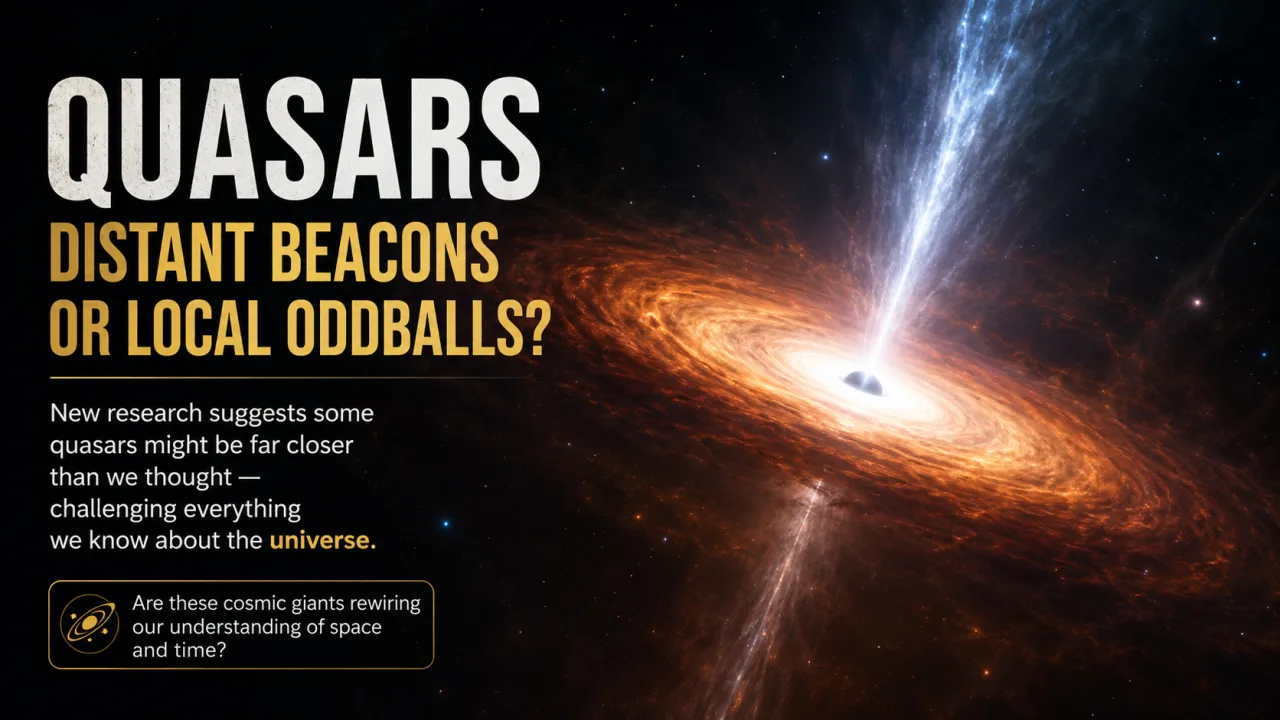
Quasars (or QSOs) were first discovered in the late 1950s and early 1960s as star-like radio sources【26†L405-L408】. They turned out to be active galactic nuclei – the intensely bright cores of distant galaxies – shining with extraordinary power. According to NASA’s Hubble Space Telescope site, “quasars are distant galaxies whose incredibly bright cores are powered by supermassive black holes”【26†L363-L372】. Gas falling toward the black hole heats up and emits vast amounts of radiation, often outshining the host galaxy【26†L363-L372】. (An ''artist’s conception'' of a quasar is shown below.)
【46†embed_image】 ''Artist’s concept of a quasar: an extremely bright, compact region (blue) powered by gas swirling into a supermassive black hole at a galaxy’s center【26†L363-L372】.''
A key feature of quasars is their large '''redshift''' – the displacement of known spectral lines (like hydrogen lines) toward longer (redder) wavelengths. In the standard cosmological model, a quasar’s redshift is interpreted as a measure of its distance via Hubble’s law: higher redshift means the object is farther away in an expanding universe. For example, the nearest known quasar is about 600 million light-years away, while others lie over 10 billion light-years away【36†L253-L259】. Even the “closest quasars to Earth are hundreds of millions of light-years away” according to NASA【26†L387-L390】. Quasar luminosities are correspondingly extreme – the most powerful quasars can emit thousands of times the energy of a galaxy like the Milky Way【26†L363-L372】【36†L233-L236】.
However, early on some astronomers questioned whether all quasar redshifts must be cosmological. In 1964, James Terrell of Los Alamos argued in a Science News letter that one or two “odd-ball” quasars might actually be much nearer – perhaps within a few million light-years – and that their redshifts were “intrinsic” rather than due to cosmic expansion【27†L273-L279】【29†L181-L190】. If true, those quasars would need much lower intrinsic brightness, easing energy- and size-problems of the models. Terrell published a detailed local-origin model in ''Science'' (1966) arguing that quasars could be ejected from our own galaxy and be only millions of light-years away【29†L181-L190】.
Over the next decades, astronomers examined these claims. High-resolution images (especially from the Hubble Space Telescope) showed quasars at the centers of galaxies【26†L405-L408】, and spectral analyses of quasar light revealed patterns (like the Lyman-α forest of absorption lines) expected if their light crossed vast intergalactic distances【27†L283-L289】. Furthermore, gravitational lensing provided dramatic confirmation: multiple images of the same quasar lensed by foreground galaxies show they lie far beyond those galaxies【55†L13-L18】【45†L441-L449】. The consensus became that quasar redshifts are cosmological, and the “local quasar” idea fell out of favor by the 1980s【27†L281-L289】.
Observations and Methods
Astronomers have applied a variety of observations and techniques to study quasar distances. The key methods include '''spectroscopy''', '''imaging''', and '''statistical analyses'''. To measure a quasar’s redshift, telescopes with spectrographs (optical, ultraviolet, and radio) split its light into a spectrum. By identifying known emission lines (e.g. hydrogen Lyman-α at ultraviolet) or molecular transitions in radio wavelengths, researchers determine the redshift very precisely. Instruments like Hubble’s spectrographs and large ground-based telescopes (e.g. Keck, VLT) are used for this purpose. The spectra of quasars typically show broad emission lines and an absorption-line “forest” from intervening gas clouds. Finding absorption lines at various redshifts along the line of sight is strong evidence the quasar light has traveled through the intervening universe, reinforcing the object’s large distance【27†L283-L289】【55†L13-L18】.
In addition, high-resolution imaging has been crucial. The Hubble Space Telescope (HST) resolved many quasars’ host galaxies【26†L405-L408】. For example, HST images have clearly shown that quasars reside at the centers of galaxies undergoing mergers or having active star formation【26†L405-L408】. This reinforces the view that quasars are part of galactic nuclei, not isolated nearby objects. HST and other telescopes have also captured '''gravitational lensing''' of quasars: a foreground galaxy’s gravity bends the light of a distant quasar into multiple images or arcs. One famous case is the Einstein Cross (G2237+0305): four images of a quasar arranged around a central galaxy【55†L13-L18】. Analysis of these lens systems (e.g. by Keck and HST) shows the quasar is indeed billions of light-years away, while the lensing galaxy is relatively nearby. In fact, the Einstein Cross quasar is about 8 billion light-years distant, whereas its lens galaxy is only about 400 million light-years away【55†L13-L18】. Such lensing observations are powerful evidence that quasar redshifts reflect true distance.
Radio observations have also contributed. Very Long Baseline Interferometry (VLBI) can measure a quasar’s apparent size and motion. Early on, Terrell used radio data on the quasar 3C 273 to argue a local origin: he claimed the variability timescales and synchrotron self-absorption implied the source was too large if at cosmological distance【29†L181-L190】. He also reported tiny proper motions consistent with ejection from our galaxy【29†L181-L190】. However, those analyses had uncertainties and were eventually overshadowed by better data.
Statistical studies have also been done. Halton Arp and others noted that certain bright, low-redshift galaxies seem to have many quasars aligned along their axes or in pairs around them【60†L13-L18】. To test this, astronomers perform surveys of quasars and galaxies, checking if quasar positions correlate with nearby galaxies more than by chance. In practice this is difficult: quasar catalogs were once sparse and surveys incomplete【60†L20-L28】. Critics of the local hypothesis pointed out that Arp’s “search outward until a quasar appears” method can bias the result【60†L20-L28】. In general, modern sky surveys show only the statistical excess of lensed quasars and background clustering expected from lensing, with no convincing global evidence for a significant population of intrinsically nearby quasars.
Findings
The findings from these observations support the standard cosmological interpretation of quasars. Here are the main results:
- '''Quasars are extremely luminous and distant:''' Measured redshifts indicate most quasars lie billions of light-years away. The Hubble Space Telescope and other telescopes have confirmed this by detecting hosts or by gravitational lenses. For example, NASA reports that even the nearest quasars are on the order of hundreds of millions of light-years distant【26†L387-L390】, and the most luminous ones emit thousands of times the light of a galaxy【26†L363-L372】. In 2012 astronomers discovered an especially powerful quasar (SDSS J1106+1939) whose nucleus outputs about 100 times the energy of the entire Milky Way galaxy【33†L96-L100】. This quasar is at very high redshift; if it were nearby it would be unphysically bright.
- '''Spectral signatures of distance:''' Quasar spectra often contain many absorption features (the “Lyman-α forest”) produced by gas in galaxies and intergalactic space between us and the quasar. This directly shows that light has traveled through the universe on its way to us【27†L283-L289】. The pattern and distribution of these lines match expectations for distant sources, not something local.
- '''Gravitational lensing confirmation:''' Multiple quasars have been found to be gravitationally lensed by intervening galaxies. In each case, detailed modeling yields consistent redshifts: the lensed quasar is far behind the lensing galaxy. In the classic Einstein Cross, for instance, the four quasar images and the central lensing galaxy together confirm an 8-billion-light-year distance for the quasar【55†L13-L18】. Such clear demonstrations are very hard to reconcile with a local quasar.
- '''Context of active galactic nuclei:''' As more was learned, quasars fit naturally into a broader picture of active galaxies. Many lower-luminosity active galactic nuclei (AGN) were found at much smaller redshifts but with similar physical mechanisms. The realization was that quasars are simply the most luminous AGN. The missing “power source” problem was resolved by black hole accretion theory. Once this mechanism was understood, the extraordinary luminosities (at cosmic distances) became plausible【27†L281-L289】. Terrell’s local model addressed the energy problem by shrinking distances, but in hindsight we see that the energy budget can be met with supermassive black holes at the centers of galaxies (as NASA explains)【26†L363-L372】.
- '''No bulk proper motion:''' If quasars were nearby objects ejected from our galaxy at high speed, one might expect measurable changes in their positions over years. High-resolution astrometry finds essentially no proper motion for quasars beyond what is explained by parallax or micro-lensing from stars in the Milky Way. Their positions are too stable, implying they are either at vast distances or moving in a very unlikely way if local.
In short, the data show that quasars behave as expected for cosmologically distant objects powered by black holes. The anomalous features cited by Terrell and others can be explained in the distant-quasar model. For example, Terrell had noted an apparent lack of Lyman-α absorption in some objects, but this was later understood as due to selection biases in what spectra were available【29†L181-L190】. He also calculated a “synchrotron self-absorption” size that conflicted with an assumed Hubble distance, but better radio measurements relaxed those conflicts. Meanwhile, virtually every new observation – from the discovery of quasar host galaxies to the lensing events to the surveys of quasar distribution – has confirmed the large distances.
Competing Explanations
Two main explanations have been proposed for quasar redshifts:
| Explanation & Proponents | Supporting Evidence | Criticisms / Counterevidence |
| '''Cosmological redshift (distant quasars)''' <br>''(Mainstream view: Hubble Law; e.g. NASA, Hubble observations)'' | – '''Hubble’s Law:''' Most quasars obey the redshift–distance relation seen for galaxies.<br>– '''Spectral fingerprints:''' Intervening absorption lines (e.g. Lyman-α forest) show quasar light passed through the distant universe【27†L283-L289】.<br>– '''Host galaxies:''' HST images reveal quasars at galaxy centers【26†L405-L408】.<br>– '''Gravitational lensing:''' Multiple-imaged quasars confirm large distances (e.g. 8 billion ly vs 400 million ly lens【55†L13-L18】). | – '''Extreme luminosity:''' Implies unprecedented energy output, though now explained by black hole accretion【26†L363-L372】【27†L281-L289】.<br>– '''Rarity of nearby examples:''' No convincing local quasars have been found, except possibly 3C 273’s low-velocity cluster which is explained by being in Virgo cluster.<br>– '''Initial puzzles:''' Early quasar variability and size arguments seemed to strain this model, but were resolved with better data【29†L181-L190】【26†L363-L372】. |
| '''Intrinsic redshift (local, ejected quasars)'''<br>''(Proposed by James Terrell 1966, Halton Arp, others)'' | – '''Energy problem solution:''' If quasars are only millions of ly away (e.g. near Milky Way), their brightness is much lower, easing energy requirements【29†L181-L190】.<br>– '''Host associations:''' Some observed alignments of quasars with low-redshift galaxies (Arp pairs) hint at physical associations【60†L13-L18】.<br>– '''Proper motions:''' A few authors claimed tiny motions consistent with ejection speeds in the Milky Way (e.g. Terrell for 3C 273)【29†L181-L190】. | – '''Lack of absorption:''' Local models must explain why most quasar spectra lack the absorption lines one would expect from gas around the Milky Way – but instead we see intergalactic absorption【27†L283-L289】.<br>– '''Lens observations:''' Gravitational lensing shows the lensing galaxy is much closer than the quasar (e.g. Einstein Cross)【55†L13-L18】, incompatible with a local quasar.<br>– '''Statistical bias:''' Searches starting from a galaxy and looking outward (Arp’s method) tend to find what one looks for; broader surveys find no significant excess of quasars around galaxies beyond chance【60†L20-L28】.<br>– '''Modern consensus:''' No confirmed example of a quasar with truly non-cosmological redshift has held up. |
Other fringe ideas (like gravitational “tired-light” or exotic quantum effects) have been proposed historically, but they have even less observational support than the two above. As the table shows, the overwhelming weight of evidence (especially absorption-line spectra and lensing geometries) favors the standard cosmological interpretation.
Interpretation: What Does It Mean?
The interpretation of quasar redshifts has profound implications. The mainstream view – endorsed by the Hubble Space Telescope team and many studies – is that quasars are the farthest and most powerful known objects. They serve as cosmic lighthouses, illuminating the early universe. For example, NASA explains that quasars’ luminosities allow them to be seen across ''cosmological distances''【41†L83-L89】; modern observations find quasars at epochs when the universe was a small fraction of its current age. In this picture, the large redshift is simply due to universal expansion, and the only oddities were transient puzzles of energy and emission mechanisms, which are now explained by accretion physics【26†L363-L372】【27†L281-L289】.
In contrast, the local-origin proponents interpreted redshift as partly intrinsic to the quasar (not caused by expansion) and thought quasars might be objects ejected from galaxies like the Milky Way. That interpretation would require rethinking the Big Bang and large-scale structure, effectively discarding much of modern cosmology. Terrell himself admitted that ''if'' quasars were local, “understanding of quasars will radically change our understanding of the universe”【29†L217-L222】. Halton Arp argued similarly, suggesting that if even a few quasars were local, it would challenge the foundation of the Hubble expansion law【60†L13-L18】.
Today, mainstream astrophysics largely rejects the local interpretation. The successes of the cosmological model (in cosmic microwave background, galaxy surveys, etc.) and the consistency of quasar observations with it have kept the standard view intact. Even if some coincidences remain puzzling, most astronomers consider them statistical anomalies or selection effects. The discovery of more and more quasars in deep surveys has also shown that their number and distribution fit the cosmological framework.
Controversies and Historical Notes
'''1960s – 1980s:''' The debate flourished in this period. In 1964-66, James Terrell published arguments for a local model【27†L273-L279】【29†L181-L190】. His 1966 ''Science'' paper listed many “difficulties” of the distant model (energy supply, absence of Lyman-α absorption, source size) and proposed that quasars were ejected from a collapse in our galaxy only a few million years ago【29†L181-L190】. His calculations implied distances of order 10^6–10^7 light-years instead of billions.
Halton Arp amplified these ideas. Starting in 1967 he pointed out apparent associations between high-redshift quasars and low-redshift galaxies【60†L13-L18】. He argued that such alignments (and sometimes apparent luminous connections seen in photographs) indicated a common origin, with quasars carrying “excess” redshift. Arp’s work attracted attention but also criticism: mainstream astronomers noted that Arp’s samples were subjective and statistical significance was low【60†L20-L28】. Dr. Keel at the University of Alabama summarized the issue well: Arp’s methods (“seek and ye shall find”) would almost guarantee finding a quasar near a galaxy eventually, and incomplete sky surveys made firm conclusions difficult【60†L20-L28】. Many of Arp’s high-profile cases (like a quasar apparently embedded in the halo of galaxy NGC 4319) were later shown to have plausible explanations or to be chance line-of-sight overlaps.
Meanwhile, observational breakthroughs occurred: in 1979 astronomers discovered the first gravitationally lensed quasar (0957+561), directly demonstrating that a quasar’s light could be split into two images by a nearer galaxy. As NASA notes, “radio astronomers announced the discovery of a double quasar, Q0957+561, that provided observational evidence for Einstein’s theory”【45†L423-L425】 – confirming the quasar was behind a galaxy cluster. In 1990 Hubble produced the famous Einstein Cross image of a quasar lensed into four images by a single galaxy【45†L441-L449】【55†L13-L18】. Such images left little doubt: the geometry and relative brightnesses match the distant-quasar scenario.
By the late 1980s and 1990s, “the intrinsic redshift” idea was regarded as fringe. Quasar spectra, host galaxies, and the success of black-hole models all pointed to normal cosmological distances. The 2014 Science News retrospective uses the term “odd-ball” only historically, and its update section bluntly states: “astronomers figured out that quasars are luminous disks of gas powered by super-massive black holes, most of which are located more than halfway across the universe”【27†L281-L289】.
Implications and Open Questions
For '''cosmology''', the implication is that we can reliably use quasars as distant probes. High-redshift quasars have been used to study the early universe (e.g. reionization epoch) and large-scale structure. The success of the cosmological interpretation reinforces the standard ΛCDM model and Hubble expansion. If, hypothetically, a subset of quasars had intrinsic redshifts, that would have required revising estimates of cosmic expansion and distance scales. But current measurements (including independent distance indicators and observations of the universe’s geometry) show no need for such revision.
For '''quasar physics''', the consensus model has proven rich: quasars are now understood as phases in galaxy evolution, often triggered by galaxy mergers. Their luminosity evolution and demographics are consistent with expectations from black hole growth. The local-origin hypothesis left many phenomena unexplained (e.g. how local ejection would create the exact same emission line spectra seen at high z), whereas the black-hole model explains variability, jet production, and environments.
'''Limitations & Open Questions:''' There remain some puzzling cases at the margins. A few apparently anomalous associations or redshift “outliers” have been reported occasionally, though none is generally accepted as fatal to the standard view. Astronomers continue to study very high-redshift quasars (z>7) and “changing-look” quasars, but these are usually well explained by known physics. The redshift controversy itself is largely considered settled by the evidence. Ongoing work may improve our understanding of how quasar jets and winds interact with galaxies, but the cosmic-distance interpretation stands robust.
'''Further Reading:''' For more, see the original ''Science'' paper by Terrell (1966) and responses【29†L181-L190】, Halton Arp’s book ''Quasars, Redshifts and Controversies'', and reviews of quasar lensing and cosmology. NASA’s Hubble pages (e.g. “Hubble Quasars”) and popular articles (e.g. the 2012 PopSci story on the brightest quasars【33†L96-L100】) provide accessible summaries.
See also
·'''Active galactic nucleus (AGN)''' – Quasars are a type of AGN powered by accreting black holes.
·'''Hubble’s law''' – The redshift–distance relation used in cosmology.
·'''Gravitational lensing''' – The phenomenon confirming quasars’ cosmological distances.
·'''Halton Arp''' – Astronomer who advocated intrinsic redshifts.
·'''Cosmological redshift''' – Expansion-related redshift vs. alternative explanations (e.g. tired light).
·Crockett, C. (2014). ''Distance to quasars debated''. ''Science News'' (retrospective, quoting Science News Letter 1964)【27†L273-L279】【27†L281-L289】.
·Terrell, J. (1966). ''Quasi-stellar objects: Possible local origin''. ''Science'', 154(3754), 1281–1285 (abstract)【29†L181-L190】.
·NASA, ESA. (n.d.). ''Hubble Quasars''. NASA Science & Hubble Sites【26†L363-L372】【26†L405-L408】.
·NASA/ESA (1990). ''The Gravitational Lens G2237+0305''. ESA/Hubble press release, Sept 13, 1990【55†L13-L18】.
·Keel, W.C. (n.d.). ''Alternate Approaches and the Redshift Controversy''. (Summary of Arp’s claims and critique)【60†L13-L18】【60†L20-L28】.
·Elert, E. (2012, Nov 29). ''Largest Quasar Ever Discovered Burns 100 Times Brighter Than Entire Milky Way''. ''Popular Science''【33†L96-L100】.
·NASA Hubble (n.d.). ''Hubble’s Gravitational Lenses''. (Einstein Cross and other lens discoveries)【45†L423-L425】【45†L441-L449】【55†L13-L18】.
Source
Portions of this article are adapted from the Wikipedia article 'Quasars: Distant Beacons or Local Oddballs?', licensed under CC BY-SA 4.0.






















Log in with