






General Knowledge Facts About the Aloe Vera Plant: Botany, Uses and Safety
 By Dhiraj Sharma · Published
· Updated
Share Post
Loading…
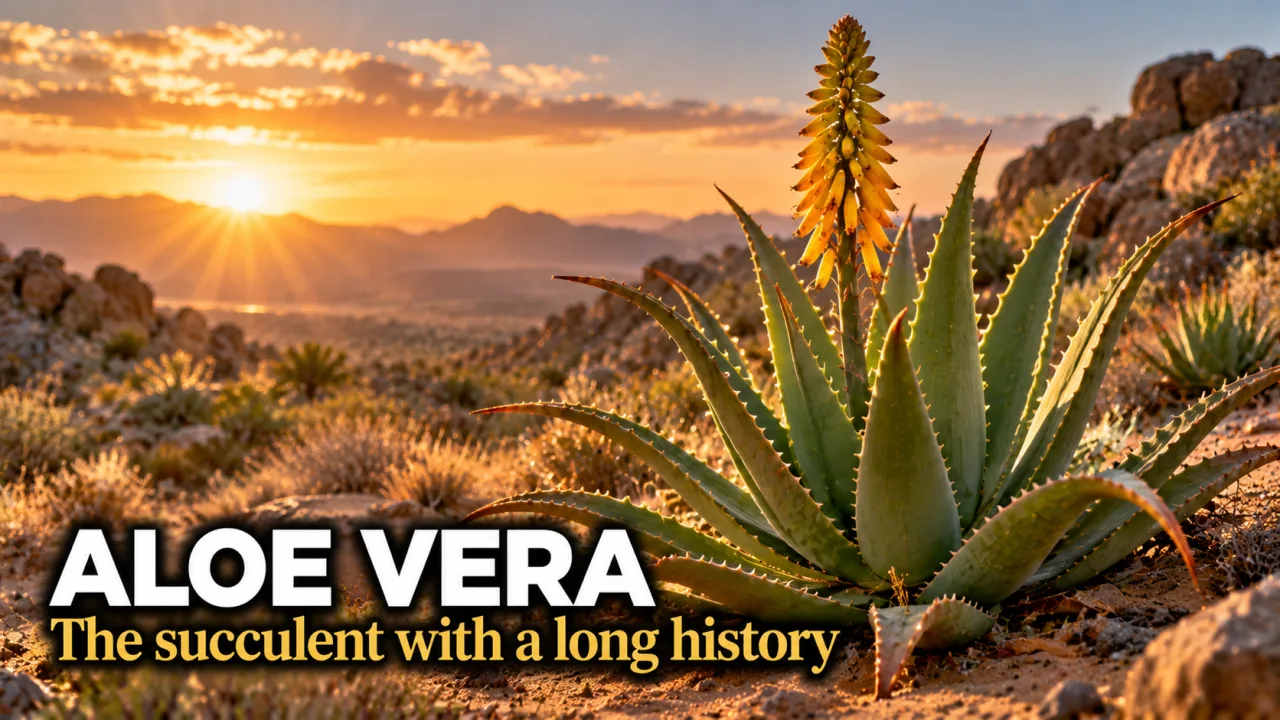
Aloe vera is a succulent plant of the genus Aloe, an evergreen perennial that stores water in thick, fleshy leaves.[1] Its wild origin lies in the Arabian Peninsula, but centuries of cultivation have carried it to dry and warm regions on every inhabited continent, and it is now one of the most widely grown medicinal plants in the world.[1][4] Two quite different products come from its leaves: a clear inner gel, used mainly on the skin, and a bitter yellow latex, once sold as a laxative.[1][5] This Finepedia article covers the plant's naming, botany, origin, cultivation, uses, chemistry, the scientific evidence for its health claims, its safety, its place in culture and its conservation status. It is general information, not medical advice.
Key Facts
| Attribute | Details |
|---|---|
| Scientific name | Aloe vera (L.) Burm.f.[3] |
| Synonyms | Aloe barbadensis Mill., Aloe indica Royle, Aloe perfoliata var. vera L., Aloe vulgaris Lam.[1] |
| Common names | Aloe vera, true aloe, Barbados aloe, Indian aloe, Kumari (Sanskrit), Gheekumari (Hindi), Kattarvazha (Malayalam)[1][16] |
| Kingdom | Plantae[3] |
| Class | Liliopsida (monocots)[3] |
| Order | Asparagales[3] |
| Family | Asphodelaceae, subfamily Asphodeloideae[2][3] |
| Genus | Aloe, with about 594 accepted species[2] |
| Native range | Southeastern Arabian Peninsula: Hajar Mountains of northeastern Oman and the eastern United Arab Emirates[1][4] |
| Height | About 60 to 100 cm, stemless or nearly so[1] |
| Flowers | Yellow tubular flowers on a spike up to about 90 cm tall, in summer[1] |
| Photosynthesis | Crassulacean acid metabolism (CAM)[8][19] |
| Gel water content | About 99.5% water[6] |
| CITES | Not listed; Aloe vera is the one aloe excluded from the Appendix II listing of the genus[15] |
| IUCN Red List | Not Evaluated[3] |
Etymology
The genus name Aloe is thought to come from an Arabic word meaning a "bitter and shiny substance", which describes the dried leaf latex that was traded for centuries. Another suggested source is the Hebrew ahalim, the plural of ahal.[1][2] The species name vera is Latin for "true", so Aloe vera simply means "true aloe".[1]
Common names often pair the word aloe with a place, as in Barbados aloe, Cape aloe or Chinese aloe.[1] In India the plant is known in Sanskrit as Kumari, in Hindi as Gheekumari and in Malayalam as Kattarvazha.[16]
The English word aloes has a second, unrelated meaning. In the Bible, the "lign aloes" of the Book of Numbers and the aloes used with myrrh at the burial of Jesus in the Gospel of John are generally understood to be agarwood, a fragrant resinous wood from Asian trees, not the succulent plant.[18] The plant called American aloe, Agave americana, is also unrelated; it belongs to a different family, the Asparagaceae.[2]
Taxonomy
Carl Linnaeus first described the plant in 1753 as Aloe perfoliata var. vera. In 1768 it was described twice more as a full species: by Nicolaas Laurens Burman as Aloe vera in Flora Indica on 6 April, and about ten days later by Philip Miller as Aloe barbadensis in the Gardener's Dictionary. Burman's name has priority, which is why the accepted name is Aloe vera (L.) Burm.f.[1][3] The name Aloe barbadensis is still common on product labels.[1]
Aloe belongs to the family Asphodelaceae. In the past it was placed in the lily family, Liliaceae, or in a separate family called Aloaceae.[2] The family Asphodelaceae as now defined has about 40 genera and 900 species, and it also contains popular succulents such as Haworthia and Gasteria.[20] Molecular studies from 2010 onwards showed that the old, broad genus Aloe was not a single natural group. In 2014 it was split into six genera: Aloidendron, Kumara, Aloiampelos, Aloe, Aristaloe and Gonialoe.[2]
DNA studies place Aloe vera close to Aloe perryi, a species of Socotra in Yemen. Other close relatives include Aloe forbesii, Aloe inermis, Aloe scobinifolia, Aloe sinkatana and Aloe striata. Most of these are native to Socotra, Somalia and Sudan; only A. striata is South African.[1] Because no obvious natural populations of Aloe vera are known, some authors have suggested that it may be of hybrid origin.[1]
Description
Form
Aloe vera is a stemless or very short-stemmed plant that grows to about 60 to 100 cm tall. It spreads by offsets, the small side shoots that gardeners call "pups".[1] Like most aloes it forms a rosette of large, thick, fleshy leaves.[2]
Leaves
The leaves are thick and succulent, green to grey-green, and in some forms flecked with white on the upper and lower surfaces. The leaf margin carries small white teeth.[1]
Inside, the leaf has three main layers. The outer green rind protects the leaf. Just under the rind, next to the vascular bundles, are cells that produce the yellow, bitter latex.[7] The centre of the leaf is a clear, jelly-like tissue that stores water. This inner gel is what most aloe vera products are made from.[1][5]
Flowers
The flowers appear in summer on a spike that can grow to about 90 cm tall. Each flower hangs downward and has a yellow tubular corolla 2 to 3 cm long.[1] Across the genus, aloe flowers are tubular and usually yellow, orange, pink or red, and they are carried in dense clusters at the top of leafless stems.[2]
Roots
Like other aloes, Aloe vera forms arbuscular mycorrhiza. This is a partnership with soil fungi that helps the roots take up mineral nutrients.[1]
Related: Top 10 Most Deadly Fruits on Earth
Water storage and CAM photosynthesis
Aloe vera survives drought partly because it uses crassulacean acid metabolism, or CAM. In CAM plants the leaf pores, called stomata, stay shut during the hot day to cut water loss. They open at night to take in carbon dioxide, which is stored as malic acid and then used for photosynthesis the next day.[8] In a 2021 study, Aloe vera plants switched to strong CAM after 25 to 30 days of drought, then fell back to their normal, background level of CAM when salt stress was added on top of drought.[19] CAM is found in about 16,000 plant species in more than 300 genera.[8]
Evolution and Origin
A 2015 study led by scientists at the Royal Botanic Gardens, Kew built a family tree of the aloes to explain why Aloe vera became so popular.[4] Its key findings are as follows:
- Aloe vera originated in the Arabian Peninsula, at the northern edge of the range of aloes.[4]
- The genus Aloe itself arose in southern Africa about 16 million years ago and then diversified in two major bursts.[4]
- The large, juicy leaves typical of medicinal aloes evolved during the most recent burst, about 10 million years ago. Leaf succulence is the best predictor of whether an aloe species is used in medicine.[4]
- Aloe vera most likely came to dominate world trade because it grew close to important historic trade routes and was brought into trade and cultivation early, not because it is chemically unique among the more than 500 related species.[4]
Distribution and Habitat
Aloe vera is considered native to the southeastern Arabian Peninsula, in the Hajar Mountains of northeastern Oman and the eastern United Arab Emirates.[1][4] It has since become naturalised in North Africa, in Sudan and neighbouring countries, in the Canary Islands, Cape Verde and Madeira, in the Algarve region of Portugal and in wild areas across Spain, especially Murcia.[1]
The plant reached China and parts of southern Europe in the 17th century.[1] Its present wide range across arid, temperate and tropical regions is probably the result of cultivation.[1] In the United States it grows outdoors in the southern border areas of Texas, New Mexico, Arizona and California.[5] It is considered an invasive species in many parts of the world.[1]
The genus as a whole is native to tropical and southern Africa, Madagascar, the Arabian Peninsula, India and islands in the Indian Ocean.[2] Some South African aloes grow into trees.[2]
Cultivation
In gardens and homes
Aloe vera is widely grown as an ornamental plant and as a potted house plant.[1] Its succulence lets it cope with low rainfall, which makes it a good choice for rockeries and other low-water gardens. It is hardy in USDA zones 8 to 11 but does not tolerate heavy frost or snow, so in colder climates it is grown indoors or in heated glasshouses.[1] The plant has earned the Royal Horticultural Society's Award of Garden Merit.[1]
Growing tips from horticultural sources are as follows:
- Use well-drained, sandy potting soil or a packaged cactus and succulent mix.[1]
- Terracotta pots are preferred because they are porous and help the soil dry out.[1]
- Let the soil dry completely before watering again. In winter the plant may go dormant and needs very little water.[1]
- Give it bright light, but acclimatise it slowly; too much direct sun can turn the leaves red from sunburn.[1]
- Crowded pots can be divided by separating the pups and repotting them.[1]
The plant resists most insect pests, although spider mites, mealybugs, scale insects and aphids can weaken it.[1]
Commercial production
Large-scale farming of Aloe vera takes place in Australia, Cuba, the Dominican Republic, China, Mexico, India, Jamaica, Kenya, Tanzania, South Africa, Spain and the United States. Much of the harvest goes to the cosmetics industry.[1] In India the plant is grown as a medicinal crop and is used in Ayurveda, Unani and folk medicine.[16]
Uses
Gel and latex
Commercial products come from two different parts of the leaf, and the difference matters for safety.[1][5]
Related: Top 10 Most Poisonous Plants on Earth
| Leaf part | What it is | Main uses |
|---|---|---|
| Inner leaf gel | Clear, jelly-like tissue from the centre of the leaf | Skin gels, lotions, cosmetics, some foods and drinks[1][5] |
| Latex | Bitter yellow sap from cells just under the rind; contains aloin | Formerly used as a laxative; dried form called aloe resin or "aloe dried juice"[1][7] |
| Whole leaf | Crushed leaf containing both gel and latex | Extracts; non-decolorized forms keep the latex compounds[5] |
Skin care and cosmetics
Aloe gel is used in topical products for minor burns, skin abrasions, insect bites, windburn, rashes, cold sores and dry skin.[1] Cosmetic companies add aloe to makeup, moisturisers, soaps, sunscreens, shaving cream, shampoos and facial tissues. A review of the literature attributes its use in so many hygiene products to its moisturising, emollient effect.[1] The cosmetics industry limits the anthraquinone content of aloe extracts to 50 parts per million.[1]
Food and flavouring
Aloe gel is used as an ingredient in yogurts, drinks and some desserts.[1] In the United States, Aloe barbadensis and several other aloes are listed in federal regulations as natural flavouring substances. Dried aloe is used in small amounts as a bittering agent in alcoholic drinks, where it is usually labelled only as a "natural flavor".[2][7]
Pharmaceutical uses
Researchers have studied dried aloe gel powder as an excipient, an inactive ingredient that controls how a tablet releases its drug. Aloe gel and whole-leaf liquids have also been studied for their ability to increase how well other drugs are absorbed through the gut and the skin.[6]
Traditional medicine
Aloe was used in ancient Greece, Rome, Babylonia and China, mainly for skin conditions and wound healing.[5] Records of its use go back to the fourth millennium BCE, and it appears in the Juliana Anicia Codex, an illustrated manuscript of 512 CE.[1] In the Middle Ages the yellow leaf liquid was valued as a purgative.[2] In India the leaf juice is used in traditional systems for skin diseases, burns, wounds, constipation and digestive complaints, among many other conditions.[16] The World Health Organization published separate monographs on aloe (the dried latex) and aloe vera gel in the first volume of its Monographs on Selected Medicinal Plants in 1999.[17]
Chemistry
Composition of the gel
The raw leaf pulp is about 98.5% water, and the gel itself is about 99.5% water.[6] The remaining 0.5 to 1% of solid matter is a mixture of vitamins, minerals, enzymes, polysaccharides, phenolic compounds and organic acids.[6] Many of the health effects claimed for aloe have been attributed to its polysaccharides.[6]
The best-known of these is acemannan, an acetylated mannan, which is a chain of mannose sugars linked together.[1][21] In laboratory studies acemannan makes immune cells called macrophages release signalling molecules such as interferon and tumour necrosis factor alpha. It has been used in veterinary medicine in the management of fibrosarcoma in dogs and cats.[21]
The leaves also contain lignans, phytosterols, polyphenols, anthraquinone C-glycosides, anthrones and other anthraquinones such as emodin, along with various lectins.[1] The gel is acidic, with a pH of 4.4 to 4.7.[1]
Aloin and the latex
Aloin, also called barbaloin, is a bitter yellow-brown compound found in the latex of at least 68 aloe species, at 0.1 to 6.6% of leaf dry weight.[7] It acts as a stimulant laxative, triggering bowel movements.[7] Aloin and related anthraquinones are the main reason why the latex and unprocessed whole-leaf extracts carry more risk than the inner gel.[5][7]
Processors can remove most of these compounds by filtering the extract through activated carbon. The result is called "decolorized" whole-leaf extract, while untreated extract is called "non-decolorized".[5]
Related: Top 10 Most Bizarre Phobias: Strange Fears That Exist
Medicinal Research and Evidence
Aloe vera is not approved as a drug, and in many areas the research is small, varied in quality or inconsistent.[2][5] The table below grades the evidence from systematic reviews and from the US National Center for Complementary and Integrative Health (NCCIH).
| Use | What the research shows | Evidence grade |
|---|---|---|
| Burns (second-degree) | A 2024 meta-analysis of 9 randomised trials found aloe shortened healing time by about 3.8 days compared with other topical treatments, with no rise in infection; effect on pain unclear[10] | Moderate |
| Acute and chronic wounds | A 2012 Cochrane review of 7 trials (347 people) found no high-quality evidence; one trial found aloe delayed healing of surgical wounds[9] | Insufficient or conflicting |
| Acne | Two small studies suggest aloe gel combined with other treatment may help[5] | Limited |
| Psoriasis, lichen planus, genital herpes, mouth sores, oral submucous fibrosis, radiation skin damage | Small amounts of research suggest possible benefit[5] | Limited |
| Blood sugar in prediabetes and type 2 diabetes | A 2016 meta-analysis of 8 trials (470 patients) found some improvement in fasting glucose and HbA1c, but with high variation between studies[11] | Limited |
| Weight loss | One small 8-week study of a specific aloe gel product found modest weight and fat loss[5] | Limited |
| Constipation (latex) | Aloe latex does act as a laxative, but the US FDA ruled in 2002 that it was not shown to be safe and effective for over-the-counter use[2][7] | Effective but not considered safe |
| Eczema, diabetic foot ulcers, irritable bowel syndrome, ulcerative colitis | Not enough reliable information[5] | Insufficient |
| Cancer prevention or treatment | No evidence that aloe products prevent or treat cancer in humans[2] | Not supported |
| Digestive health (aloe juice) | Neither scientific evidence nor regulatory approval for this marketing claim[1] | Not supported |
Burns
Burns are the best-studied use. The 2012 Cochrane review found that aloe mucilage did not heal burns better than silver sulfadiazine, a standard cream, and it called the trials of poor quality with a high risk of bias.[9] A later meta-analysis in 2024, which used the GRADE method to rate the evidence, found that aloe sped up healing of second-degree burns by about 3.76 days on average compared with other topical agents. It found no clear difference in pain or infection.[10] NCCIH likewise says clinical research suggests topical aloe gel may speed burn healing and reduce burn pain.[5]
Diabetes
The 2016 meta-analysis on blood sugar found that aloe vera improved fasting plasma glucose in people with prediabetes and lowered HbA1c in people with type 2 diabetes. The authors warned that the studies varied widely and called for larger, well-designed trials using standard preparations.[11] Aloe is not a replacement for diabetes medicine, and it can interact with it.[1]
Safety and Toxicity
On the skin
Topical aloe gel is generally well tolerated, though there are occasional reports of burning, itching, rash and eczema.[5] Because the gel is acidic, it can sting or cause a rash.[1] People who are allergic to aloe may get contact dermatitis. Rarely, a severe reaction can cause difficulty breathing or swelling of the face, lips, tongue or throat.[1]
Taken by mouth
Short-term oral use of aloe gel, for up to 42 days, appears to be safe in research studies.[5] The latex and whole-leaf extracts carry more risk. The key safety points are as follows:
- Aloe latex can cause abdominal pain, cramps and diarrhoea.[5]
- Oral aloe leaf extracts, taken for anywhere from 3 weeks to 5 years, have been linked to cases of acute hepatitis.[5]
- Long-term use of about 1 gram a day has been linked to blood in the urine, weight loss, and heart or kidney problems.[1]
- Diarrhoea from aloe can reduce how well other medicines are absorbed.[1]
- Overuse of aloe latex may increase the risk of side effects from cardiac glycosides such as digoxin.[5]
- Aloe may interact with medicines for blood clots, diabetes and heart disease, and with diuretics.[1]
- Aloe gel, latex or whole-leaf extract taken by mouth may be unsafe during pregnancy and while breastfeeding.[5]
Regulation of aloe laxatives
Aloin was a common ingredient in over-the-counter laxatives in the United States until 2002. In May 2002 the Food and Drug Administration ruled that aloe laxatives were no longer generally recognised as safe and effective, after manufacturers failed to supply the necessary safety data. Aloe latex therefore had to be removed from these products.[1][5][7]
Cancer findings in animals
In 2013 the US National Toxicology Program published a two-year study in which rats and mice drank water containing non-decolorized whole-leaf aloe vera extract. It found "clear evidence of carcinogenic activity" in male and female rats, which developed tumours of the large intestine at the two higher doses. Mice developed intestinal hyperplasia but not tumours.[12][13]
The International Agency for Research on Cancer classified whole-leaf extract of aloe vera as possibly carcinogenic to humans (Group 2B).[5][14] This applies to the non-decolorized form, which keeps its anthraquinones and is not the type most consumers use.[5] California also lists orally taken non-decolorized aloe vera whole-leaf extract as a chemical known to the state to cause cancer.[1]
A 2023 review of food-grade drinkable products made from inner leaf gel or decolorized whole-leaf extract, with no more than 10 parts per million of aloin, concluded that these products were not genotoxic.[5] A small amount of laboratory research, however, suggests that even decolorized extract might damage DNA.[5]
Related: Top 10 Oldest Buildings in the World
Pets
The ASPCA lists aloe as toxic to dogs and cats, naming saponins and anthraquinones as the harmful substances. Signs of poisoning are vomiting, lethargy and diarrhoea.[22]
False cancer cures
Cancer Research UK has warned about a concentrated aloe product called T-UP that was promoted as a cancer cure, stating that there is no evidence aloe products can prevent or treat cancer in humans.[2]
Cultural and Historical Significance
Aloe has a long written history as a healing plant. NCCIH notes its use in ancient Greece, Rome, Babylonia and China, where it was thought to heal wounds and even to prevent premature greying of hair.[5] The Greeks and Romans used it to treat wounds.[2]
The 2015 Kew-led study argued that the plant's cultural importance is tied to geography. Aloe vera grew near major historic trade routes around the Arabian Peninsula and was traded and cultivated early, which helped it become the aloe the world knows best.[4]
In India, Aloe vera, called Kumari or Gheekumari, is one of the familiar plants of Ayurveda and Unani medicine and is also used in folk medicine.[16]
In southern Africa, a related species, Aloe variegata, has been planted on graves in the belief that it ensures eternal life.[2]
Conservation
Aloe vera itself is not threatened. It is grown in huge numbers around the world and has become naturalised and even invasive in many regions.[1] It has not been assessed for the IUCN Red List.[3]
Many of its wild relatives are less fortunate. All aloes except Aloe vera are listed in Appendix II of CITES, the Convention on International Trade in Endangered Species of Wild Fauna and Flora, which controls international trade in their plants and products. Aloe vera, also referenced as Aloe barbadensis, is the only species excluded from that listing.[15] Some aloes, such as Aloe ferox, are harvested from the wild for products similar to those made from Aloe vera.[2]
Trivia
- The name Aloe vera means "true aloe".[1]
- The gel inside the leaf is about 99.5% water.[6]
- Aloe vera was formally named twice in the same month of 1768, by Burman and by Miller, which is why both Aloe vera and Aloe barbadensis appear on labels.[1]
- No obvious wild populations of the plant are known, and some botanists think it may be a hybrid.[1]
- The genus Aloe has about 594 accepted species, yet one species dominates world trade.[2][4]
- The aloes in the Bible were most likely fragrant agarwood, not the succulent.[18]
- Too much sun can turn aloe leaves red.[1]
- Aloe is used as a bittering agent in some alcoholic drinks, and Aloe socotrina is said to be used in yellow Chartreuse.[2]
See also
- General Knowledge Facts About the Banyan Tree
- General Knowledge Facts About the Marijuana Plant
- Agave americana
- Crassulacean acid metabolism
- Ayurveda
- ^ [1] "Aloe vera". Wikipedia. Wikipedia: Aloe vera
- ^ [2] "Aloe". Wikipedia. Wikipedia: Aloe
- ^ [3] "Aloe vera (L.) Burm.f.". GBIF Backbone Taxonomy. GBIF: Aloe vera
- ^ [4] Grace, O. M. and others (2015). "Evolutionary history and leaf succulence as explanations for medicinal use in aloes and the global popularity of Aloe vera". BMC Evolutionary Biology 15: 29. BMC Evolutionary Biology: Grace 2015
- ^ [5] "Aloe Vera". National Center for Complementary and Integrative Health, US National Institutes of Health. NCCIH: Aloe Vera
- ^ [6] Hamman, J. H. (2008). "Composition and Applications of Aloe vera Leaf Gel". Molecules 13(8): 1599–1616. Molecules: Hamman 2008
- ^ [7] "Aloin". Wikipedia. Wikipedia: Aloin
- ^ [8] "Crassulacean acid metabolism". Wikipedia. Wikipedia: Crassulacean acid metabolism
- ^ [9] Dat, A. D. and others (2012). "Aloe vera for treating acute and chronic wounds". Cochrane Database of Systematic Reviews CD008762. Cochrane: Aloe vera for wounds
- ^ [10] Huang, Y. N. and others (2024). "Effects of Aloe vera on Burn Injuries: A Systematic Review and Meta-Analysis of Randomized Controlled Trials". Journal of Burn Care and Research 45(6): 1536–1545. Journal of Burn Care and Research: Huang 2024
- ^ [11] Suksomboon, N. and others (2016). "Effect of Aloe vera on glycaemic control in prediabetes and type 2 diabetes: a systematic review and meta-analysis". Journal of Clinical Pharmacy and Therapeutics 41(2): 180–188. Journal of Clinical Pharmacy and Therapeutics: Suksomboon 2016
- ^ [12] "TR-577: Nondecolorized Whole Leaf Extract of Aloe barbadensis Miller (Aloe Vera) in F344/N Rats and B6C3F1 Mice". National Toxicology Program, US Department of Health and Human Services. NTP: TR-577
- ^ [13] Boudreau, M. D. and others (2013). "Clear Evidence of Carcinogenic Activity by a Whole-Leaf Extract of Aloe barbadensis Miller (Aloe vera) in F344/N Rats". Toxicological Sciences 131(1): 26–39. Toxicological Sciences: Boudreau 2013
- ^ [14] "List of Classifications". IARC Monographs, International Agency for Research on Cancer. IARC: List of Classifications
- ^ [15] "Appendices I, II and III". Convention on International Trade in Endangered Species of Wild Fauna and Flora. CITES: Appendices
- ^ [16] "Aloe vera, Kattarvazha, Indian aloe". State Medicinal Plants Board Kerala. SMPB Kerala: Aloe vera
- ^ [17] "WHO Monographs on Selected Medicinal Plants, Volume 1" (1999). World Health Organization. WHO: Monographs on Selected Medicinal Plants, Vol. 1
- ^ [18] "Agarwood". Wikipedia. Wikipedia: Agarwood
- ^ [19] Habibi, G. (2021). "Changes in crassulacean acid metabolism expression, chloroplast ultrastructure, photochemical and antioxidant activity in the Aloe vera during acclimation to combined drought and salt stress". Functional Plant Biology 49(1): 40–53. Functional Plant Biology: Habibi 2021
- ^ [20] "Asphodelaceae". Wikipedia. Wikipedia: Asphodelaceae
- ^ [21] "Acemannan". Wikipedia. Wikipedia: Acemannan
- ^ [22] "Aloe". ASPCA Animal Poison Control: Toxic and Non-toxic Plants. ASPCA: Aloe





















Discussion
Log in with