






General Knowledge Facts About the Banyan Tree: Botany, Records and Culture
 By Dhiraj Sharma · Published
· Updated
Share Post
Loading…
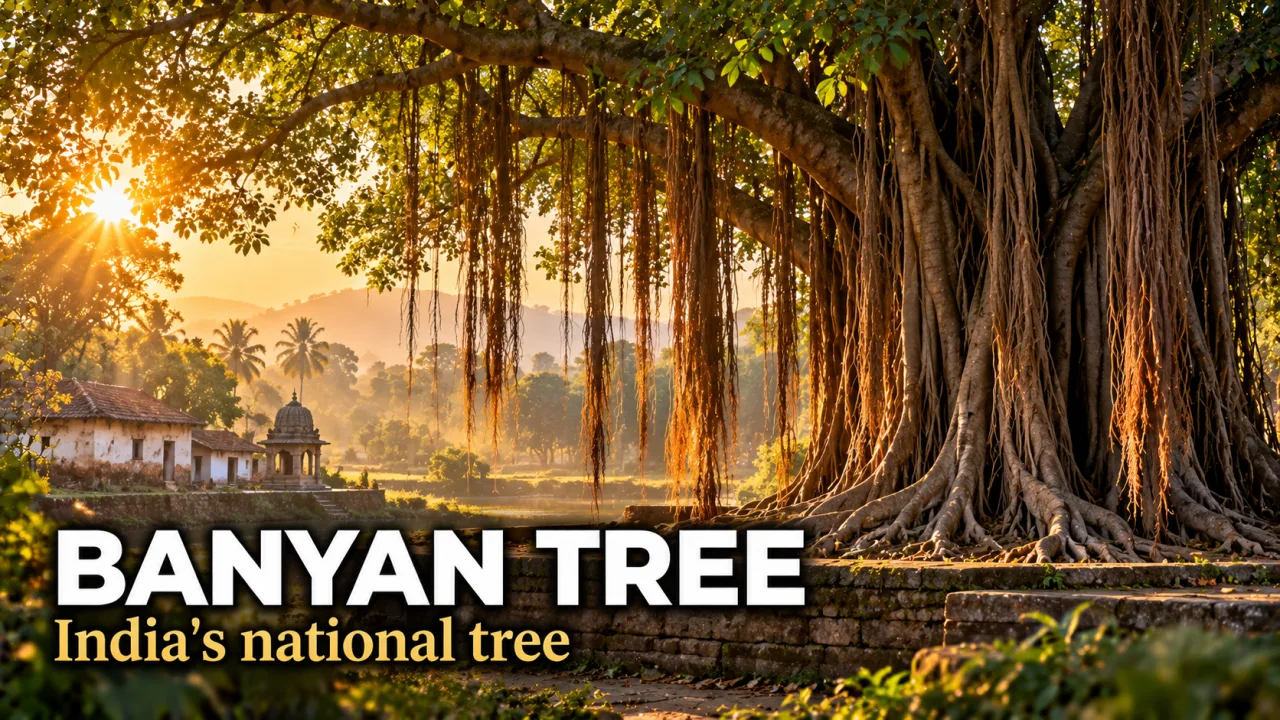
The banyan, Ficus benghalensis, is a large evergreen fig tree native to the Indian subcontinent and the national tree of India.[1][2] It is known for its aerial roots, which grow down from the branches, take root in the soil and thicken into pillar-like trunks. Over time this lets a single tree spread into something that looks like a small forest. The biggest Indian banyans have the largest canopies of any known trees.[1] The banyan is sacred in Hinduism, Jainism and Buddhism, and for centuries it has given shade to village meetings, markets and travellers.[1][3] This Finepedia article covers its botany, life cycle, record trees, uses, research and place in culture. It is general information, not medical advice.
Key Facts
| Attribute | Details |
|---|---|
| Scientific name | Ficus benghalensis L.[4] |
| Common names | Banyan, Indian banyan, banyan fig, bargad (Hindi), vata or vad, ala (Tamil), maha nuga (Sinhala)[1][4] |
| Kingdom | Plantae[4] |
| Clade | Tracheophytes, angiosperms (class Magnoliopsida)[4] |
| Order | Rosales[4] |
| Family | Moraceae (mulberry and fig family)[4] |
| Genus | Ficus[4] |
| Subgenus | Urostigma (strangler figs)[3] |
| Native range | Indian subcontinent, including India, Sri Lanka, Nepal, Pakistan and the eastern Himalaya[1] |
| Height | Up to about 30 m; crown usually wider than the tree is tall[1][5] |
| Pollinator | Fig wasp Eupristina masoni[5][6] |
| Largest canopy | Thimmamma Marrimanu, Andhra Pradesh, about 19,107 m²[1][7] |
| National status | National tree of India[1][2] |
| IUCN Red List | Least Concern[8] |
Etymology
The English word banyan, also spelled banian, was first given to Ficus benghalensis by European travellers in India. They noticed that the shade of these trees was a favourite meeting place for banians, or banias, a community of Hindu traders, and the traders' name passed to the tree.[3] The name later spread to other figs with the same life cycle, and botanists now use it for the strangler figs of the subgenus Urostigma.[3]
The species name benghalensis means "of Bengal". In Indian languages the tree is known as vata or vad, bargad and bar, and in Telugu marri, which appears in the name of the record tree Thimmamma Marrimanu.[4][7] In Sri Lanka it is called nuga or maha nuga.[1] In the Pali texts of Buddhism the banyan is called nigrodha.[3]
Description
Form and size
Ficus benghalensis is an evergreen, fast-growing tree that can reach a height of about 30 m.[1] It does not grow very tall in proportion to its spread. Where banyans are common they spread sideways to fill gaps in the canopy, so the crown is usually much wider than the tree is tall.[1] The World Agroforestry tree database records trees more than 180 m across, with a forest of secondary trunks holding up heavy side branches.[5]
Leaves
The leaves are large, leathery, glossy and broadly oval, with a heart-shaped base. They are usually about 10 to 30 cm long and 7 to 20 cm wide, on a stalk 1.5 to 7 cm long.[5] As in most figs, each leaf bud is wrapped in two large scales that drop off as the leaf opens, and young leaves have a reddish tinge.[3]
Aerial and prop roots
The banyan's best-known feature is its aerial roots. They grow down from the branches, and once they reach the soil they take root and thicken into woody trunks.[1] With age these prop roots can become as thick as the original trunk and hard to tell apart from it.[3] They hold up long side branches, take in water and minerals from the soil, and let the tree keep spreading for centuries.[9]
Figs and flowers
Like all figs, the banyan hides its flowers inside a closed, hollow structure called a syconium, which ripens into the fig.[3] Banyan figs grow in pairs, are about 1.5 to 2 cm across, and ripen from orange to red.[5] Each fig contains male flowers, female flowers and gall flowers in which the pollinating wasp lays its eggs.[5]
Life Cycle and Ecology
Starting life on another tree
Banyan seeds are small and are spread by fruit-eating birds. A seedling that sprouts on a shaded forest floor rarely survives, but many seeds land on the branches of other trees or on buildings and walls.[3] There the young banyan grows as an epiphyte, a plant living on another plant, and sends roots down to the ground.[1][3]
As the roots thicken, they form a mesh around the host tree. This mesh can squeeze the host and kill it, which is why banyans are called strangler figs.[1][3] When the host rots away, the banyan is left with a hollow core, which can become a shelter for animals.[3]
Pollination by fig wasps
Figs and their wasps depend completely on each other. Each Ficus species is usually pollinated by its own partner wasp, and the wasp can breed only inside the figs of its host.[5][6] The pollinator of the banyan is the tiny agaonid wasp Eupristina masoni.[5][6]
A female wasp squeezes into a young fig through a small opening called the ostiole, often losing her wings on the way. Inside, she lays eggs in some flowers, spreads pollen over others and then dies. Her young develop inside the fig. The wingless males mate with the females and chew an exit hole, and the winged females fly off carrying pollen to a new fig.[6] Across the genus, scientists have described about 750 fig species, and their pollinators form a single group of wasps that evolved this partnership only once.[10]
Related: Top 10 Most Famous Trees in the World
Food for wildlife
Ripe banyan figs feed many birds and mammals. Indian mynas, coppersmith barbets and other fruit-eating birds eat them, and seeds that pass through a bird's gut sprout more readily than those that do not.[1][6] Because figs are produced year-round across the genus, fig trees are thought of as keystone species in tropical forests, supporting many animals when other food is scarce.[10]
Distribution and Habitat
The banyan is native to the Indian subcontinent, including India, Sri Lanka, Nepal, Pakistan and the eastern Himalaya, where it grows mainly in monsoon forests and rainforests.[1] It is resistant to drought and to mild frost.[1] The World Agroforestry database lists it from low altitudes up to about 610 m.[5]
People have planted it widely in warm countries for shade and as a curiosity. It is grown in Southeast Asia, Queensland in Australia, the Caribbean, Florida, Hawaii, the United Arab Emirates, Egypt and Israel. One tree planted in Holon, Israel, in 1888 has grown to the size of a small building.[1]
Invasiveness
Outside its home range, a banyan can only spread by seed if its pollinating wasp is also present. In Hawaii the wasp is absent, so the trees cannot make viable seed and are not considered invasive.[1][11] In Florida, banyans became weeds in some areas after the wasp was accidentally introduced, and banyans first found spreading there in the mid-1980s.[6]
Notable Banyan Trees
| Tree | Location | Key figure |
|---|---|---|
| Thimmamma Marrimanu | Anantapur district, Andhra Pradesh, India | Canopy about 19,107 m²; perimeter 846 m[1][7] |
| The Great Banyan | AJC Bose Indian Botanic Garden, Howrah, West Bengal, India | About 19,667 m² (4.86 acres); 4,412 prop roots (2024)[9] |
| Kabirvad | River island in the Narmada, Bharuch, Gujarat, India | Canopy about 17,520 m²; perimeter 641 m[1][12] |
| Dodda Aladha Mara | Kettohalli, Karnataka, India | Canopy about 12,000 m²; about 400 years old[1] |
| Lahaina banyan | Lahaina, Maui, Hawaii, United States | Planted 1873; covered about 0.27 ha before the 2023 fire[13] |
Thimmamma Marrimanu
Thimmamma Marrimanu stands about 25 km from Kadiri in Andhra Pradesh. Its canopy covers about 19,107 m², or 4.72 acres, and it was listed as the largest tree specimen in the world in the Guinness Book of World Records in 1989.[7] Its perimeter of 846 m is also the longest of any known tree.[1] Local legend says the tree grew from a pole of the funeral pyre of Thimmamma, a woman who died by sati, and the tree is revered by Hindus, Buddhists and Jains.[7]
The Great Banyan of Howrah
The Great Banyan grows in the Acharya Jagadish Chandra Bose Indian Botanic Garden at Shibpur, Howrah, near Kolkata, run by the Botanical Survey of India. It is thought to be at least 250 years old.[14] Its main trunk was attacked by fungus after cyclones in 1864 and 1867, and it was removed in 1925, when it had a girth of 16.5 m. The tree has lived on through its prop roots ever since.[9][14]
A 2024 study by garden staff gives the most recent figures. The tree covered about 19,667 m², or 4.86 acres, with a crown circumference of 543 m, a highest branch of 26 m and 4,412 prop roots reaching the ground. The study also found that the air under the canopy is usually 2 to 5 °C cooler than outside it.[9]
Related: Top 10 Oldest Living Trees in the World
Cyclone Amphan damaged a large part of the tree on 20 May 2020.[9][14] Garden staff now guide young aerial roots through split bamboo tubes filled with leaf mould, soil and sand, so that the roots reach the ground where the canopy needs support.[9]
Kabirvad
Kabirvad grows on a small river island in the Narmada River in Bharuch district, Gujarat, and is linked to the 15th-century poet-saint Kabir, with a temple dedicated to him at the site.[12] Nearchus, an admiral of Alexander the Great, described a huge banyan on the banks of the Narmada that was said to shelter 7,000 men, and it may have been this tree.[1][12] James Forbes later described it in his Oriental Memoirs (1813 to 1815) as nearly 610 m around, with more than 3,000 trunks.[12]
The Lahaina banyan
Sheriff William Owen Smith planted an Indian banyan in the courthouse square of Lahaina, Maui, in 1873 to mark 50 years of the first American Protestant mission there. It became the largest banyan in Hawaii, with trunks and aerial roots spread over about 0.27 hectares.[13] It was badly damaged in the Lahaina wildfire of 8 to 9 August 2023.[13]
Arborists removed about 40% of the tree in the year after the fire and have since watered it, fed the soil and pruned dead wood.[15] The tree is regrowing new leaves and aerial roots. In 2026 its caretakers decided to keep it fenced off for about two more years so that new roots can establish.[15][16]
Cultivation
Banyans grow easily from seed or from cuttings, and their aerial roots let them spread from the original planting.[1] They need full sun and are not shade-tolerant.[11] The seeds can be stored, keeping their viability for about two years at room temperature.[5]
Space and care
A banyan needs a great deal of room. Its size and spreading roots make it unsuitable for most city streets, where roots can damage paving, drains and walls.[5] Seedlings that sprout on buildings, bridges or other trees can destroy their host as they grow, so they are often removed while still small.[5]
Bonsai
Because of its strong rooting and branching, the banyan is popular for bonsai and the Chinese art of penjing, especially in styles that show off aerial roots.[3][5] The oldest living bonsai in Taiwan is a banyan about 240 years old, kept in Tainan.[3]
Related: Top 10 Most Bizarre Phobias: Strange Fears That Exist
Uses
Shade and meeting place
The banyan's wide canopy gives deep shade in hot climates, and in India temples are often built close to it.[1] For centuries traders, villagers and teachers have gathered under banyans, which is how the tree got its English name.[3]
Leaves, fodder and wood
In India the leaves are used as plates, and the leaves are cut as fodder for animals, with a crude protein content of about 9.6%.[5] The timber can be used for well-curbs and furniture, the wood is suitable for paper pulp, and the tree is planted for soil conservation and reforestation.[5] The figs are eaten by some people and are traditionally used to make sherbet.[5][14]
Traditional medicine
Different parts of the banyan, including the bark, latex, aerial roots and leaves, are used in Ayurveda, Unani and folk medicine.[5][17] Traditional uses recorded by the World Agroforestry database cover ulcers, fever, inflammation, skin conditions and dysentery.[5] These are traditional uses, not proven treatments.
Chemistry and Medicinal Research
Chemical make-up
Reviews of laboratory studies report that banyan extracts contain many kinds of plant compounds, among them phenols, flavonoids, alkaloids, tannins, saponins, terpenoids, glycosides and steroids.[17] Named compounds reported in the tree are flavonoids such as quercetin, kaempferol, apigenin and leucopelargonidin, triterpenes such as lupeol and ursolic acid, and sterols such as beta-sitosterol and stigmasterol.[18]
What the evidence shows
| Claimed effect | Type of evidence | Evidence grade |
|---|---|---|
| Antioxidant | Test-tube (in vitro) assays[18] | Preliminary |
| Antimicrobial | Test-tube studies of bark and leaf extracts[18] | Preliminary |
| Blood sugar lowering | In vitro, animal and computer studies[18] | Preliminary |
| Anti-inflammatory | In vitro and animal studies[17][18] | Preliminary |
| Anticancer | Studies on cancer cells in the laboratory[18] | Preliminary |
| Wound healing | Laboratory and animal studies[17] | Preliminary |
A 2026 review in Food Science and Nutrition concluded that, despite strong preclinical results, there are still gaps in knowledge about how the compounds behave in the body, how extracts should be standardised, how safe they are, and whether they work in people. No large clinical trials have shown that banyan extracts treat any disease.[18] In this article, "preliminary" means the evidence comes from laboratory or animal work only.
Cultural and Religious Significance
National tree of India
The banyan is the national tree of India.[1][2] The Government of India's national portal explains that because its branches root themselves like new trees and it lives so long, the tree is thought of as immortal and is part of many Indian myths and legends. It notes that the banyan is still the focal point of village life, and village councils meet in its shade.[2]
Hinduism
On Vat Purnima, also called Vat Savitri, married women fast and tie threads around a banyan to pray for their husbands' well-being. The festival falls in the Hindu month of Jyeshtha, in May or June, and recalls the story of Savitri and Satyavan in the Mahabharata, in which Savitri wins her husband back from Yama, the god of death.[19] Many women wind white thread around a banyan seven times.[19]
Related: Top 10 Oldest Buildings in the World
Hindu art often shows Shiva as Dakshinamurthy, the teacher, seated under a banyan tree and facing south while sages receive his instruction.[20] The Akshayavat, the "indestructible banyan", is a sacred tree linked to Prayagraj, where a tree inside the Allahabad Fort is worshipped. Trees at Gaya and Varanasi are also worshipped as the Akshayavat.[21]
Jainism
Jain tradition holds that Rishabhanatha, the first Tirthankara, attained omniscience under a banyan, and the Akshayavat at Prayagraj is linked to this event.[1][21]
Buddhism
In the Pali canon of Buddhism the banyan, called nigrodha, is mentioned many times. One common metaphor compares the way a banyan smothers its host to the way desire overcomes a person.[3] In Theravada Buddhism the banyan is said to be the tree under which Kassapa, a buddha of an earlier age, attained enlightenment.[1]
Gautama Buddha's own enlightenment is linked to a different tree. The Bodhi tree at Bodh Gaya is a sacred fig, or peepal, Ficus religiosa, not a banyan.[22]
Beyond India
In Vietnamese folklore, the dark marks on the Moon are a magic banyan that carried a man named Cuội up to the Moon. In the Philippines the related balete trees are said to be home to spirits, and in Guam the Chamorro people believe that spirits called taotaomona guard banyan trees.[3]
Conservation
Ficus benghalensis is assessed as Least Concern on the IUCN Red List, so the species as a whole is not threatened.[8] It is widely planted and grows readily from seed and cuttings.[1]
Individual heritage trees face more danger than the species itself. Cyclones, fungal rot, fire, building work and heavy visitor traffic all damage old banyans, as the cases of the Great Banyan and the Lahaina banyan show.[9][15] Careful pruning, root training and limiting public access are the main ways these old trees are protected.[9][16]
Trivia
- The Great Banyan has no main trunk; it was removed in 1925 and the tree survives on its prop roots.[9]
- The shape of the banyan's root system inspired the name of Banyan VINES, an early computer network operating system.[3]
- Tradition says the Mughal emperor Jahangir had the Akshayavat cut down and its stump covered with a red-hot iron cauldron, yet the tree grew back within a year.[21]
- Banyans can grow on old walls, temples and bridges, where their roots split stone and concrete.[5]
- The Lahaina banyan was 153 years old in 2026, and its caretakers call it "still a baby" for a species that can live for centuries.[16]
See also
- General Knowledge Facts About the Aloe Vera Plant
- General Knowledge Facts About the Marijuana Plant
- Ficus religiosa (sacred fig or peepal)
- Fig wasp
- ^ [1] "Ficus benghalensis". Wikipedia. Wikipedia: Ficus benghalensis
- ^ [2] "National Tree". Know India: National Portal of India, Government of India. Know India: National Tree
- ^ [3] "Banyan". Wikipedia. Wikipedia: Banyan
- ^ [4] "Ficus benghalensis L.". GBIF Backbone Taxonomy. GBIF: Ficus benghalensis
- ^ [5] Orwa, C. and others (2009). "Ficus benghalensis". Agroforestree Database 4.0, World Agroforestry. World Agroforestry: Ficus benghalensis
- ^ [6] "Ficus benghalensis". Oxford University Plants 400, University of Oxford Herbaria. Oxford Plants 400: Ficus benghalensis
- ^ [7] "Thimmamma Marrimanu". Wikipedia. Wikipedia: Thimmamma Marrimanu
- ^ [8] "Ficus benghalensis, IUCN Red List category". GBIF, citing the IUCN Red List of Threatened Species. GBIF: IUCN status
- ^ [9] "Canopy Management of the Great Banyan Tree in Acharya Jagadish Chandra Bose Indian Botanic Garden, Howrah, India" (2024). Journal of Experimental Agriculture International 46(5). JEAI: Great Banyan canopy study
- ^ [10] Machado, C. A. and others (2005). "Critical review of host specificity and its coevolutionary implications in the fig/fig-wasp mutualism". Proceedings of the National Academy of Sciences. PNAS: fig and fig-wasp review
- ^ [11] "Ficus benghalensis". Plant Pono, Hawaii Pacific Weed Risk Assessment. Plant Pono: Ficus benghalensis
- ^ [12] "Kabirvad". Wikipedia. Wikipedia: Kabirvad
- ^ [13] "Lahaina Banyan Court Park". Wikipedia. Wikipedia: Lahaina Banyan Court Park
- ^ [14] "The Great Banyan". Wikipedia. Wikipedia: The Great Banyan
- ^ [15] "Lahaina's Famed Banyan Tree Still 'In The ICU'" (February 2026). Honolulu Civil Beat. Civil Beat: Lahaina banyan
- ^ [16] "Lahaina banyan tree to remain fenced off for two more years" (August 2026). Aloha State Daily. Aloha State Daily: Lahaina banyan
- ^ [17] Murugesu, S., Selamat, J. and Perumal, V. (2021). "Phytochemistry, Pharmacological Properties, and Recent Applications of Ficus benghalensis and Ficus religiosa". Plants 10(12): 2749. Plants: Ficus review
- ^ [18] Ali, Z. and others (2026). "Pharmacological and Phytochemical Insights Into Ficus benghalensis (Indian Banyan)". Food Science and Nutrition 14(6): e71982. Food Science and Nutrition: banyan review
- ^ [19] "Vat Purnima". Wikipedia. Wikipedia: Vat Purnima
- ^ [20] "Dakshinamurthy". Wikipedia. Wikipedia: Dakshinamurthy
- ^ [21] "Akshayavat". Wikipedia. Wikipedia: Akshayavat
- ^ [22] "Ficus religiosa". Wikipedia. Wikipedia: Ficus religiosa




















Discussion
Log in with