





History of Ancient Egypt: From the First Pharaohs to Cleopatra
 By Dhiraj Sharma · Published
· Updated
Ancient Egypt was one of the world's first civilizations. It grew up along the lower Nile in northeastern Africa and lasted for about three thousand years.[1] It began around 3150 BC, when Upper and Lower Egypt were united under one king. Its end is dated either to Alexander the Great's conquest in 332 BC or to the Roman conquest in 30 BC, when Cleopatra VII, the last active ruler of the Ptolemaic dynasty, died.[1][14]
Over those three millennia the Egyptians built the pyramids of Giza, developed hieroglyphic writing, practised mummification and created one of the richest religious traditions of the ancient world.[1] This Finepedia guide, updated in October 2026, follows the history of ancient Egypt from the first pharaohs to Cleopatra. It covers the Old, Middle and New Kingdoms, the best-known rulers, daily life and belief, and how modern scholars learned to read Egypt's past.
Key Facts
| Topic | Detail |
|---|---|
| Location | Lower reaches of the Nile, northeastern Africa[1] |
| Unification | About 3150 BC, under Menes, usually identified with Narmer[1] |
| Old Kingdom | About 2686–2181 BC, the "Age of the Pyramids"[3] |
| Middle Kingdom | About 2040 to 1782 or 1700 BC[6] |
| New Kingdom | 16th to 11th centuries BC, the height of Egyptian power[7] |
| Great Pyramid | Built about 2600 BC for Khufu; originally 146.6 metres tall[4] |
| Writing | Hieroglyphs, with more than 1,000 distinct characters[15] |
| Last dynasty | The Ptolemies, 305–30 BC[13] |
| Known deities | About 1,500[17] |
The Nile and the Rise of Egypt
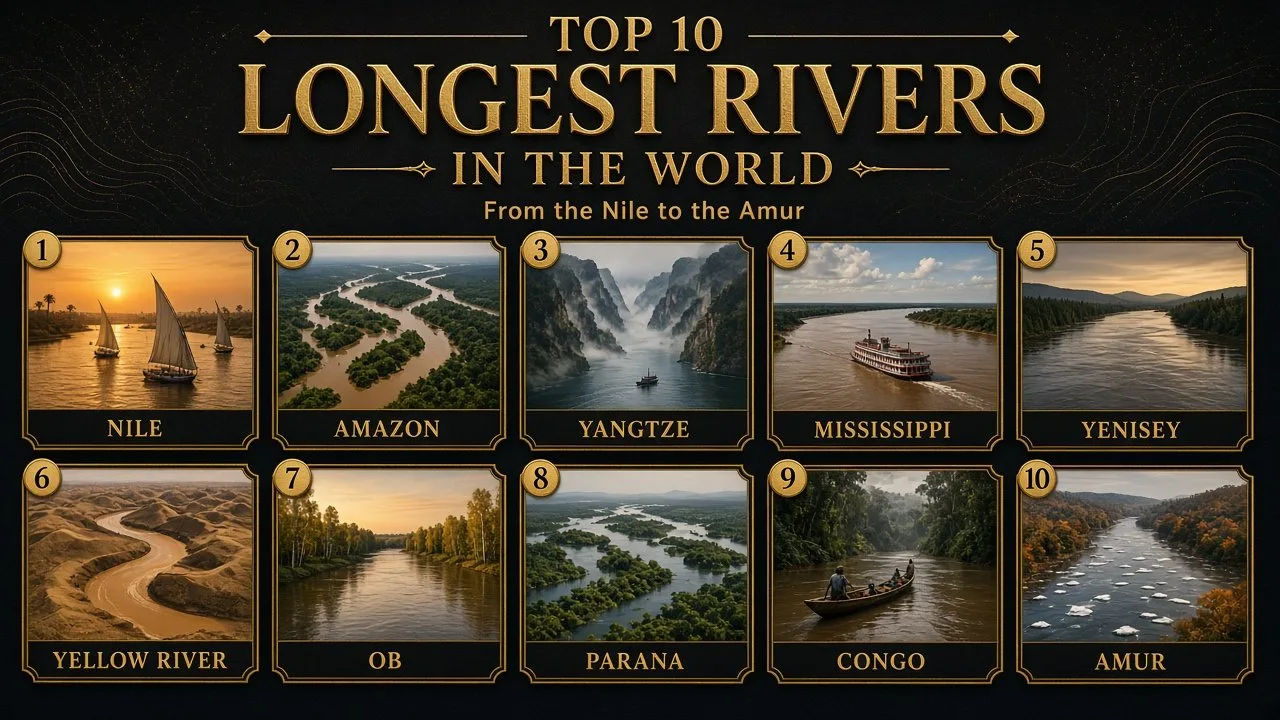
The Nile was the lifeline of Egypt. Its fertile floodplain allowed people to build a settled farming economy.[1] The river flooded on a predictable schedule, and controlled irrigation of the valley produced surplus crops that supported a dense population and allowed society and culture to develop.[1] With resources to spare, the state paid for mining in the valley and the deserts around it, the development of writing, large building projects, trade with neighbouring regions, and an army.[1]
Before unification, Egypt was a land of independent villages.[2] Around 3150 BC, Upper Egypt in the south and Lower Egypt in the Nile Delta were united by a king called Menes, whom most Egyptologists believe to be the same person as Narmer.[1] For much of its history afterwards, the country was known as "The Two Lands".[2]
The Early Dynastic Period
The Early Dynastic Period, which includes the First and Second Dynasties, lasted from unification until about 2686 BC.[2] Under the First Dynasty the capital moved from Thinis to Memphis, and the country was ruled by a god-king.[2] Many of the features that define Egyptian civilization, including its art, architecture and much of its religion, took shape at this time.[2] The earliest hieroglyphs appear just before this period, and the first known complete sentences in hieroglyphs date from the Second Dynasty.[2]
The Old Kingdom: The Age of the Pyramids
The Old Kingdom, usually dated from the Third to the Sixth Dynasty (2686–2181 BC), is also called the "Age of the Pyramids".[3] It was Egypt's first long period of high civilization.[3] The capital remained at Memphis, and the main thing separating the Old Kingdom from what came before was a revolution in architecture and the effect of huge building projects on society and the economy.[3]
Djoser and the First Stone Monuments
The mortuary complex of King Djoser was the world's first large-scale stone building.[1] Its centrepiece, the Step Pyramid, is a series of stone mastabas, or flat-topped tombs, stacked one on top of another.[1]
The Pyramids of Giza
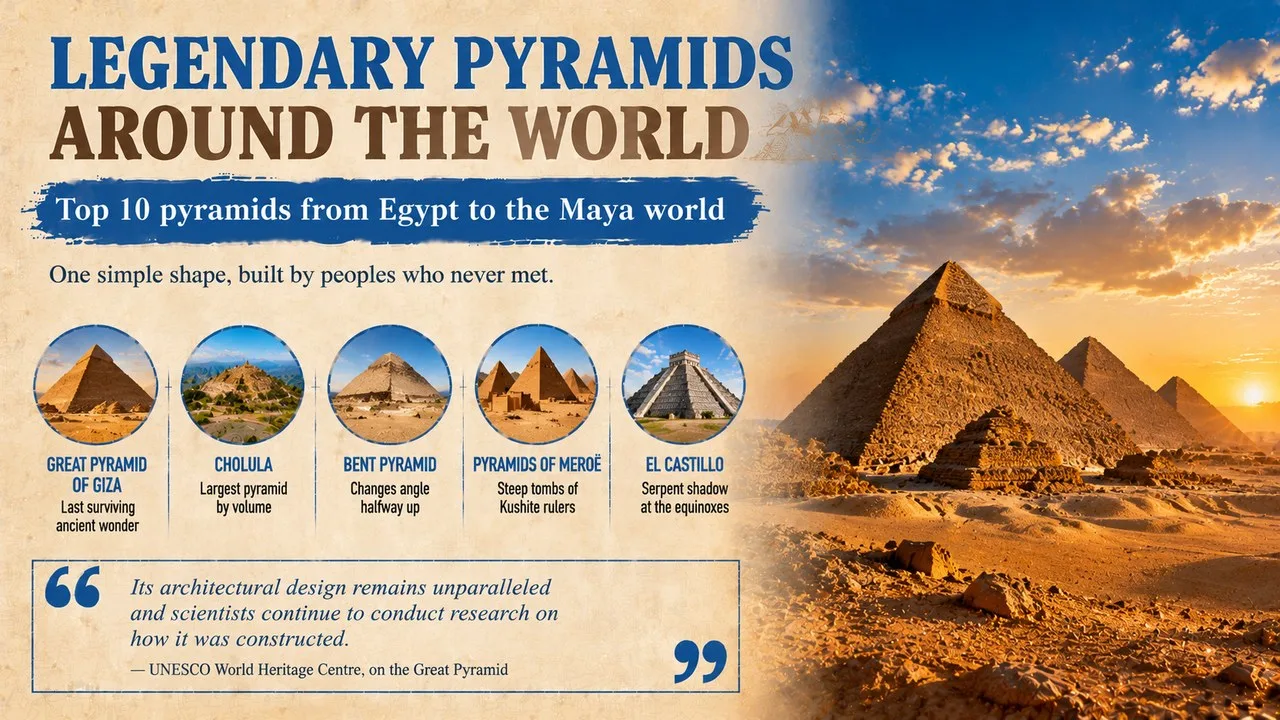
The Fourth Dynasty was the great age of pyramid-building. Under King Sneferu the art was perfected, and his successors Khufu, Khafre and Menkaure built the pyramids at Giza.[3] The Great Pyramid, built for Khufu around 2600 BC over about 26 years, is the largest Egyptian pyramid. It is the oldest of the Seven Wonders of the Ancient World and the only one still largely standing.[4]
The Great Pyramid originally stood 146.6 metres tall and was the tallest human-made structure in the world for more than 3,700 years.[4] Most of its smooth white limestone casing was later stripped away, and it now stands 138.5 metres high.[4] It was built from an estimated 2.3 million large blocks weighing about 6 million tonnes in total.[4]
The Great Sphinx
The Great Sphinx of Giza is a limestone statue of a lying sphinx, with a human head and a lion's body, carved out of the bedrock of the Giza Plateau.[5] It is the oldest known monumental sculpture in Egypt. It is 73 metres long and 20 metres high.[5] Archaeological evidence suggests it was carved during the reign of Khufu or Khafre, but scholars still disagree about whose face it shows.[5] The story that Napoleon's soldiers shot off its nose is a myth; how it was damaged is unknown, though the face shows signs of deliberate work with rods or chisels.[5]
The First Intermediate Period
At the end of the Old Kingdom, central power weakened. Together with severe droughts between 2200 and 2150 BC, this is believed to have led to the 140-year period of famine and conflict known as the First Intermediate Period.[1]
The Middle Kingdom
The Middle Kingdom, sometimes called the Period of Reunification, lasted from about 2040 to 1782 or 1700 BC, depending on the definition.[6] It began when Mentuhotep II of the Eleventh Dynasty reunited the country. The Eleventh Dynasty ruled from Thebes, while the Twelfth and Thirteenth ruled from el-Lisht.[6] During this period Osiris became the most important god in popular religion.[6]
Related: Top 10 Legendary Pyramids Around the World
Around 1785 BC, as the Middle Kingdom kings lost power, a West Asian people called the Hyksos, who had already settled in the Delta, took control of northern Egypt and made Avaris their capital.[1] The native kings retreated to Thebes. This time of division and foreign rule is called the Second Intermediate Period.[1][6]
The New Kingdom: Egypt's Empire
The New Kingdom, sometimes called the Egyptian Empire, ran from the 16th to the 11th century BC and covered the Eighteenth, Nineteenth and Twentieth Dynasties.[7] It was the most prosperous time in Egypt's history and the peak of its power.[7] Possibly in reaction to Hyksos rule, the New Kingdom pharaohs pushed into the Levant, giving Egypt its greatest territorial extent, and they expanded deep into Nubia in the south.[7] Military campaigns under Thutmose I and his grandson Thutmose III built the largest empire Egypt had ever seen.[1]
Hatshepsut
Hatshepsut, the sixth pharaoh of the Eighteenth Dynasty, first ruled as regent for her young stepson Thutmose III and then took the full titles of a pharaoh, ruling from about 1479 to 1458 BC.[8] She was the second confirmed woman to rule Egypt in her own right. To fit into a male role, she was often shown as a male pharaoh with traditionally male clothing.[8] Her reign was a time of prosperity and general peace, and she was one of Egypt's greatest builders. Her best-known work is her mortuary temple at Deir el-Bahari.[8]
Akhenaten and the Amarna Period
Akhenaten, who ruled in the mid-14th century BC, was born Amenhotep IV and took his new name in the fifth year of his reign.[9] He abandoned Egypt's traditional worship of many gods and promoted Atenism, centred on the sun disc Aten. Egyptologists still debate whether this was true monotheism.[9] He moved the capital to a new city, Akhetaten, now known as Amarna.[1] After his death the change was reversed. His monuments were taken apart, his statues destroyed, and his name left out of later king lists.[9]
Tutankhamun
Tutankhamun, born Tutankhaten, ruled from about 1332 to 1323 BC and died at around the age of 19.[10] His government restored the old religion, brought the cult of the god Amun back to prominence, and moved the royal court from Amarna back to Memphis.[10] He is famous today because his tomb in the Valley of the Kings was found in 1922 by excavators led by Howard Carter and his patron, the Earl of Carnarvon.[10]
Ramesses II
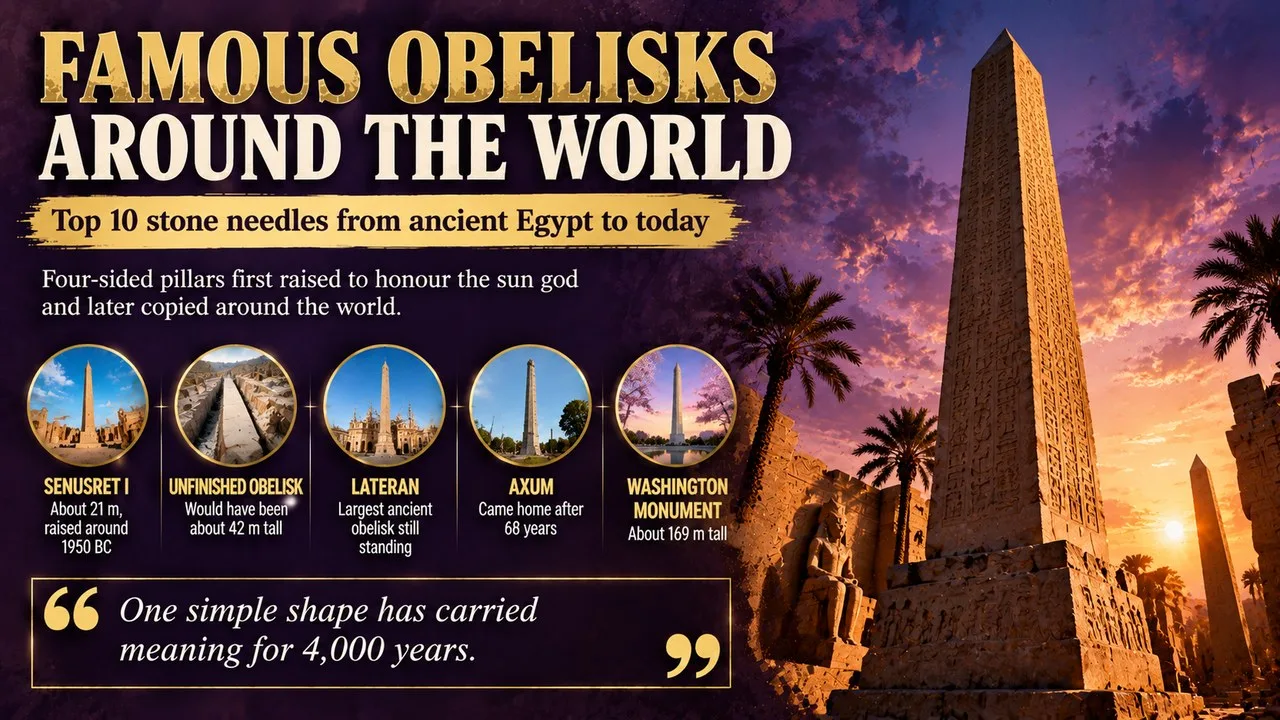
Ramesses II, known as Ramesses the Great, came to the throne around 1279 BC and is often regarded as the greatest and most powerful pharaoh of the New Kingdom.[1][11] His 66-year reign is the longest recorded for any pharaoh, possibly apart from Pepi II.[11] He built more temples, raised more statues and obelisks, and fathered more children than any other pharaoh.[1] The Greeks called him Ozymandias.[11]
Related: Top 10 Famous Obelisks Around the World
In about 1274 BC Ramesses fought the Hittite king Muwatalli II at Kadesh, in what is now the Lebanon–Syria border region. It is the earliest pitched battle in recorded history whose tactics and formations are known in detail, and probably the largest chariot battle ever fought, with 5,000 to 6,000 chariots in all.[12] The result is generally considered a stalemate.[12] In the 21st year of his reign, Ramesses agreed a peace treaty with the Hittites, now known as the Treaty of Kadesh.[11] It is the earliest known peace treaty.[1]
Decline of the New Kingdom
Egypt's wealth made it a target for invaders, especially Libyan Berbers to the west and the Sea Peoples, a confederation of seafarers thought to have come from the Aegean.[1] The high priests of Amun at Thebes built up vast land and wealth, and their growing power split the country during the Third Intermediate Period.[1]
The Late Period and Foreign Rule
Around 727 BC, the Kushite king Piye invaded from the south and took Thebes and then the Delta, founding the 25th Dynasty.[1] The Saite kings later brought a short revival, but in 525 BC the Persian king Cambyses II began his conquest of Egypt, defeating the pharaoh Psamtik III at the Battle of Pelusium.[1] Over its long history, Egypt was invaded or conquered by the Hyksos, the Kushites, the Assyrians, the Persians, the Greeks and the Romans.[1]
The Ptolemies and Cleopatra
Alexander the Great conquered Egypt in 332 BC during his war against the Persian Empire.[13] After his death in 323 BC, his general Ptolemy took control of Egypt and in 305 BC declared himself its ruler, founding the Ptolemaic Kingdom.[13] Alexandria, the city Alexander founded, became the capital and a major centre of Greek culture, learning and trade.[13] The Ptolemies ruled for nearly three centuries, the longest and last dynasty of ancient Egypt. They took the old title of pharaoh to win acceptance from native Egyptians.[13]
Cleopatra VII ruled from 51 to 30 BC and was the last active Hellenistic pharaoh.[14] Her first language was Koine Greek, and she is the only Ptolemaic ruler known to have learned Egyptian.[14] She had a son, Caesarion, with Julius Caesar, and later formed a political and personal alliance with Mark Antony, with whom she had three children.[14] After Octavian defeated their fleet at the Battle of Actium in 31 BC, his forces invaded Egypt in 30 BC. Antony took his own life, and Cleopatra is reported to have killed herself, probably by poison, rather than be paraded in a Roman triumph.[14] Egypt then became a province of the Roman Empire.[14]
Religion and the Afterlife
Ancient Egyptian religion was a complex system of polytheistic beliefs and rituals. About 1,500 deities are known.[17] The pharaoh was believed to have divine powers and acted as the link between the people and the gods. His duty was to sustain the gods with rituals and offerings so that they would maintain Ma'at, the order of the universe, and hold back Isfet, or chaos.[17] The state spent enormous resources on rituals and temple-building.[17]
Related: Top 10 Longest Rivers in the World
The Egyptians took great care to make sure the soul survived after death, providing tombs, grave goods and offerings to preserve both body and spirit.[17] In the judgement of the dead, the gods weighed the deceased person's heart against the feather of Ma'at to decide whether he or she had lived rightly.[17] In the New Kingdom new funerary texts appeared, the best known being the Book of the Dead.[17]
Mummification
Mummification was meant to stop the body from decaying. Embalmers first removed the internal organs and washed the body with spices and palm wine, then dried it inside and out with natron, a natural salt.[18] The Greek historian Herodotus left one of the most detailed descriptions of the process.[18] Animals were mummified too, and more than a million animal mummies have been found in Egypt, many of them cats.[18]
Writing and the Rosetta Stone
Egyptian hieroglyphs combined picture signs, word signs and sound signs, with more than 1,000 distinct characters in all.[15] They are one of only four writing systems thought to have been invented without outside influence, along with cuneiform, Chinese characters and Mayan script.[15] Hieroglyphs are also the distant ancestor of the Phoenician alphabet, which means most living writing systems, including the Latin, Cyrillic and Arabic scripts, ultimately descend from them.[15]
For centuries no one could read hieroglyphs. In July 1799, during France's invasion of Egypt, the officer Pierre-François Bouchard found the Rosetta Stone near the town of Rashid. It carries the same decree of 196 BC in hieroglyphs, Demotic script and Ancient Greek.[16] Because the Greek text could be read, the stone became the key to cracking the Egyptian scripts, and Jean-François Champollion announced his decipherment in Paris in 1822.[16] The stone has been on display at the British Museum almost continuously since 1802, and it is the most visited object there.[16]
Achievements and Legacy
Egypt's achievements include the quarrying, surveying and building methods behind its pyramids, temples and obelisks; a system of mathematics; a practical system of medicine; irrigation and farming techniques; the first known planked boats; faience and glass technology; and new forms of literature.[1] Its doctors were famous across the ancient Near East, and some, such as Imhotep, were remembered long after their deaths.[1] Excavation of the workers' village of Deir el-Medina has produced one of the best-documented records of community life in the ancient world, covering almost four hundred years.[1]
The Grand Egyptian Museum near the Giza pyramids, the largest museum in the world devoted to a single civilization, officially opened on 1 November 2025.[19] It holds more than 100,000 artefacts, including the complete Tutankhamun collection of 5,398 pieces.[19]
Related: Khalistan Movement: History, Operation Blue Star and Today
Key Figures
- Unification of Egypt: about 3150 BC[1]
- Original height of the Great Pyramid: 146.6 metres; today 138.5 metres[4]
- Blocks in the Great Pyramid: about 2.3 million, weighing about 6 million tonnes[4]
- Length of the Great Sphinx: 73 metres[5]
- Reign of Ramesses II: 66 years[11]
- Chariots at the Battle of Kadesh: 5,000–6,000[12]
- Animal mummies found in Egypt: more than one million[18]
- Pieces in the Tutankhamun collection at the Grand Egyptian Museum: 5,398[19]
Frequently Asked Questions
How long did ancient Egypt last?
About three thousand years, from unification around 3150 BC to the Roman conquest in 30 BC.[1]
Who built the pyramids of Giza?
They were built for the Fourth Dynasty kings Khufu, Khafre and Menkaure during the Old Kingdom. The Great Pyramid, for Khufu, dates from about 2600 BC.[3][4]
Was Cleopatra Egyptian?
Cleopatra VII belonged to the Ptolemaic dynasty, which descended from Ptolemy I, a Macedonian Greek general. Her first language was Greek, but she was the only Ptolemaic ruler known to have learned Egyptian.[14]
How were hieroglyphs deciphered?
The Rosetta Stone, found in 1799, carries the same text in hieroglyphs, Demotic and Greek. Using it, Jean-François Champollion announced his decipherment in 1822.[16]
Who was the greatest pharaoh?
Many historians give that title to Ramesses II, who reigned for 66 years and is often regarded as the most powerful pharaoh of the New Kingdom.[11]
See also
- The Search for the Tomb of Cleopatra
- History of Human Civilization
- Top 10 Books that Changed the World
- ^ [1] "Ancient Egypt". Wikipedia. Wikipedia
- ^ [2] "Early Dynastic Period (Egypt)". Wikipedia. Wikipedia
- ^ [3] "Old Kingdom of Egypt". Wikipedia. Wikipedia
- ^ [4] "Great Pyramid of Giza". Wikipedia. Wikipedia
- ^ [5] "Great Sphinx of Giza". Wikipedia. Wikipedia
- ^ [6] "Middle Kingdom of Egypt". Wikipedia. Wikipedia
- ^ [7] "New Kingdom of Egypt". Wikipedia. Wikipedia
- ^ [8] "Hatshepsut". Wikipedia. Wikipedia
- ^ [9] "Akhenaten". Wikipedia. Wikipedia
- ^ [10] "Tutankhamun". Wikipedia. Wikipedia
- ^ [11] "Ramesses II". Wikipedia. Wikipedia
- ^ [12] "Battle of Kadesh". Wikipedia. Wikipedia
- ^ [13] "Ptolemaic Kingdom". Wikipedia. Wikipedia
- ^ [14] "Cleopatra". Wikipedia. Wikipedia
- ^ [15] "Egyptian hieroglyphs". Wikipedia. Wikipedia
- ^ [16] "Rosetta Stone". Wikipedia. Wikipedia
- ^ [17] "Ancient Egyptian religion". Wikipedia. Wikipedia
- ^ [18] "Mummy". Wikipedia. Wikipedia
- ^ [19] "Grand Egyptian Museum". Wikipedia. Wikipedia























Discussion
Log in with