





Khalistan Movement: History, Operation Blue Star and Today
 By Dhiraj Sharma · Published
· Updated
Share Post
Loading…
The Khalistan movement is a separatist movement that seeks a homeland for Sikhs in the form of a sovereign state called Khalistan, meaning "land of the Khalsa", in the Punjab region.[1] Groups disagree on its borders. Some claim only the Sikh-majority Indian state of Punjab, while larger claims also take in Pakistani Punjab and parts of northern India such as Chandigarh, Haryana and Himachal Pradesh.[1]
The idea of a separate Sikh state first came up in the 1930s, as British rule in India was ending. The movement grew in Indian Punjab in the 1970s and 1980s with money and political backing from the Sikh diaspora, and reached its peak in the late 1980s.[1] An armed insurgency in Punjab lasted from the early 1980s to the mid-1990s, and the Indian Army's assault on the Golden Temple in 1984, known as Operation Blue Star, became the movement's defining event.[1][3] The insurgency had died down by the mid-1990s, but the movement keeps some support in India and abroad.[1] This Finepedia guide, updated in October 2026, explains where the movement came from, what happened in 1984, how the insurgency ended and why Khalistan is still a diplomatic issue today.
Key Facts
| Topic | Detail |
|---|---|
| Aim | A sovereign Sikh state called Khalistan in the Punjab region[1] |
| Meaning of the name | "Land of the Khalsa"[1] |
| First explicit call | A 1940 pamphlet titled "Khalistan"[1] |
| Key autonomy document | Anandpur Sahib Resolution (1973)[1] |
| Turning point | Operation Blue Star, June 1984[1][2] |
| Insurgency | Early 1980s to mid-1990s[1][3] |
| Deadliest attack | Air India Flight 182 bombing, 23 June 1985, 329 killed[5] |
| Only recognised pro-Khalistan party | Shiromani Akali Dal (Amritsar)[1] |
| Recent issue | Killing of Hardeep Singh Nijjar in Canada, June 2023[7] |
Origins Before 1950
Sikhs have long been concentrated in the Punjab region of South Asia. In the 18th century the area was ruled by a confederacy of Sikh misls, which Maharaja Ranjit Singh unified into the Sikh Empire. That empire lasted until 1849, when the British dissolved it after the Second Anglo-Sikh War.[1]
As British rule began to weaken in the 1930s, Sikhs made their first call for a homeland of their own. When the Muslim League's Lahore Resolution demanded that Punjab become part of a Muslim state, the Akali Dal, the main Sikh party, saw this as an attempt to take over historically Sikh territory.[1] The first explicit call for Khalistan came in a 1940 pamphlet of that name. In the 1940s, Sikh leaders such as Master Tara Singh also pushed for a Sikh country called "Sikhistan", and on 22 March 1946 the Akali Dal put the demand to the British Cabinet Mission, which rejected it as unrealistic.[1]
Before the 1947 Partition, Sikhs were not a majority in any district of British Punjab except Ludhiana, where they made up 41.6 percent of the population.[1] Partition split Punjab between India and Pakistan, and most Sikhs moved from the Pakistani side into India. Even so, they remained a minority in the Indian state of Punjab as it was then drawn, which had a Hindu majority.[1]
The historian Harjot Singh Oberoi argues that territory was never central to how Sikhs defined themselves. In his view, Khalistan as a separatist movement was not a major issue until it turned militant in the late 1970s and 1980s.[1]
From Punjabi Suba to the Anandpur Sahib Resolution
After independence, the Akali Dal led the Punjabi Suba movement, which demanded a state for Punjabi speakers. Its strongest demand was a sovereign state, and its weakest was an autonomous state within India.[1] The Indian government at first refused, worried that a Punjabi-majority state would be another state drawn along religious lines.[1]
The Punjab Reorganisation Act of 1966 split the old state into Punjab and Haryana, with some areas going to Himachal Pradesh. Chandigarh became a centrally administered union territory, and the outcome fell short of what the movement's leaders had demanded.[1] Water caused more anger. A canal system on the Ravi, Beas and Sutlej rivers sent water to Haryana and Rajasthan, leaving Punjab with only 23 percent of it.[1]
After losing the 1972 Punjab election, the Akali Dal adopted the Anandpur Sahib Resolution in 1973. It asked for much more power for the states, recognition of Sikhism as a religion separate from Hinduism, and the transfer of Chandigarh and other areas to Punjab.[1] The resolution was mostly forgotten until 1982, when the Akali Dal and the preacher Jarnail Singh Bhindranwale launched the Dharam Yudh Morcha, a mass campaign to put it into effect. Thousands of people joined, seeing it as a way to get more irrigation water and to win Chandigarh back for Punjab.[1]
Social and economic change also played a part. The Green Revolution brought new wealth to Punjab, but mechanised farming spread that wealth unevenly, and this, along with factional politics, raised tensions between rural Sikhs and the central government.[3]
Related: 10 Sikh Gurus: The Pillars of Sikhism Who Shaped Faith, Equality, Courage, and Humanity
The Movement in the Diaspora
Another account of the movement's origins places it among Sikhs abroad. Davinder Singh Parmar, who moved to London in 1954, said his first pro-Khalistan meeting drew fewer than 20 people.[1] In 1969 the Indian politician Jagjit Singh Chohan moved to the United Kingdom to campaign for Khalistan. He and Parmar announced the movement at a press conference in London in 1970, although most Sikhs there dismissed them as a fringe group.[1]
After the 1971 Indo-Pakistani War, Chohan visited Pakistan, and coverage of his remarks there introduced the idea of Khalistan to an international audience. On 13 October 1971 he placed an advertisement in The New York Times declaring an independent Sikh state.[1] In 1980 he set up the Council of Khalistan, named himself president of a "Republic of Khalistan", and issued symbolic passports, stamps and "Khalistan dollars".[1] Even so, the movement stayed almost invisible in world politics until June 1984.[1]
The Road to 1984
In November 1982 the Akali leader Harchand Singh Longowal tried to disrupt the Asian Games in Delhi by sending protesters to the capital to court arrest. Haryana sealed its border with Punjab and searched Sikh travellers on their way to Delhi. Many Sikhs found this humiliating, and some who had not supported the Akalis or Bhindranwale began to sympathise with them.[1]
Violence in Punjab rose sharply in the early 1980s. In July 1983 Longowal invited Bhindranwale to live inside the Golden Temple complex in Amritsar, which the government later said he turned into an armoury and headquarters.[1] After six Hindu bus passengers were murdered in October 1983, emergency rule was imposed on Punjab, and it lasted for more than a decade.[1] According to figures cited in the main histories of the period, militants killed 165 Hindus and Nirankaris and 39 Sikhs who opposed Bhindranwale between the start of the Dharam Yudh Morcha and Operation Blue Star. In all, 410 people were killed and 1,180 injured in violence and riots in those years.[1][3]
Operation Blue Star
In early June 1984, Prime Minister Indira Gandhi ordered the Indian Army into the Golden Temple complex, Sikhism's holiest site, to remove Bhindranwale and his armed followers.[1][2] The army, led by Lieutenant General Kuldip Singh Brar, surrounded the complex on 3 June. Brar told his troops: "The action is not against the Sikhs or the Sikh religion; it is against terrorism."[1]
The army had badly underestimated the militants' firepower. Fighters in the fortified Akal Takht had machine guns and rocket-propelled grenade launchers, and it took about 24 hours of fighting to take control of the complex.[1] Bhindranwale was killed in the operation.[1] Official army figures gave 83 soldiers dead and 249 injured, though Rajiv Gandhi later admitted that more than 700 soldiers had died. The government put militant and civilian deaths at 493, while independent estimates say more than 5,000 civilians and only about 200 militants were killed.[1]
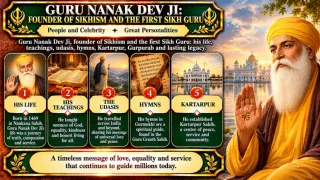
Related: Guru Nanak Dev Ji: Founder of Sikhism and the First Sikh Guru
The operation hurt many Sikhs deeply. The writer Khushwant Singh observed that "considerable Khalistan sentiment seems to have arisen since the raid on the temple", which many Sikhs took as an attack on their religion.[1] A New York Times report a few weeks later said that before the raid, neither the government nor anyone else seemed to take the Khalistan movement very seriously.[1] The operation is now seen as the start of the Punjab insurgency.[2]
Assassination of Indira Gandhi and the 1984 Riots
On the morning of 31 October 1984, Indira Gandhi was shot dead in New Delhi by two of her bodyguards, Satwant Singh and Beant Singh, both Sikhs, in revenge for Operation Blue Star.[1] Her death set off organised attacks on Sikhs across northern India.[4] Government estimates put the deaths at about 2,800 in Delhi and 3,350 nationwide, while other sources estimate between 8,000 and 17,000.[4]
The Nanavati Commission, set up to investigate the riots, concluded that Congress leaders including Jagdish Tytler, H. K. L. Bhagat and Sajjan Kumar had played a direct or indirect role in the violence.[1] Separatists pointed to Blue Star and the riots to argue that Sikhs were not safe in India, and militancy spread.[1]
The Insurgency, 1985–1995
The Rajiv–Longowal Accord
In 1985 Prime Minister Rajiv Gandhi and Longowal signed the Rajiv–Longowal Accord. It agreed to set up commissions and tribunals to settle the Chandigarh and river water disputes, and it helped the Akali Dal win the next state election.[1] Militants who would not give up the demand for Khalistan rejected the accord, and extremists killed Longowal.[1] India also accused Pakistan of giving the militants shelter, weapons and money, though most of the evidence was circumstantial.[1]
Air India Flight 182
On 23 June 1985, Air India Flight 182, a Boeing 747 flying from Montreal to London, was destroyed by a bomb off the coast of Ireland. All 329 people on board were killed, including 268 Canadians.[5] On the same day a second bomb exploded at Narita Airport in Tokyo, killing two baggage handlers.[1] The attack was carried out by militants from Babbar Khalsa. It is still the worst terrorist attack in Canadian history, and until the September 11 attacks it was the deadliest act of aviation terrorism in the world.[5] Inderjit Singh Reyat, who pleaded guilty to manslaughter in 2003, was the only person convicted.[1]
Declaration and Black Thunder
On 29 April 1986, an assembly of separatists at the Akal Takht declared an independent state of Khalistan, and several militant groups then waged a major insurgency.[1] On 30 April 1986, about 300 National Security Guard commandos and 700 Border Security Force troops entered the Golden Temple in Operation Black Thunder and captured about 200 militants. A second operation, in May 1988, ended with the militants surrendering on 18 May.[6]
Attacks continued, including the 1987 Lalru bus massacre and the 1991 Punjab killings in Ludhiana.[1] The scholar Ian Talbot has written that all sides, including the army, the police and the militants, committed crimes such as murder, rape and torture.[1] Human Rights Watch and Amnesty International accused the security forces of torture, disappearances and killings in staged shootouts.[1] Between 1981 and 1994, tens of thousands of young people went missing or were killed in Punjab.[3]
Related: Narendra Modi: The Rise of India's Controversial Prime Minister
The End of the Insurgency
On 31 August 1995, Punjab Chief Minister Beant Singh was killed in a suicide bombing claimed by Babbar Khalsa. It was the last major incident of the insurgency.[1] Tougher police operations under Punjab police chief K. P. S. Gill, government outreach, and the defeat of separatist sympathisers in the 1992 Punjab election had largely ended the rebellion by the mid-1990s.[3]
Historians also point to infighting among militant groups, criminals joining their ranks, the lack of a clear plan for what Khalistan would be, and the loss of support among Sikhs in Punjab.[1] In 2007 Simrat Dhillon of the Institute of Peace and Conflict Studies wrote that "the movement has lost its popular support both in India and within the Diaspora community".[1]
Khalistan Today
Politics in Punjab
The Shiromani Akali Dal (Amritsar) is the only pro-Khalistan party recognised by the Election Commission of India.[1] It won 2.48 percent of the vote in the 2022 Punjab assembly election. Its leader, Simranjit Singh Mann, won the Sangrur by-election in June 2022 but lost the seat in 2024.[1] In the 2024 general election, two candidates linked to the movement won seats in Parliament: Amritpal Singh, a jailed pro-Khalistan preacher, and Sarabjeet Singh Khalsa, the son of one of Indira Gandhi's assassins.[1]
Violence has not disappeared entirely. Amritpal Singh, who led the group Waris Punjab De, evaded police for 35 days in 2023 before his arrest on 23 April 2023.[1] On the night of 5 May 2026 there were twin blasts in Jalandhar, and the Khalistan Liberation Army claimed responsibility.[1]
The Diaspora and the Referendum
Most open support for Khalistan now comes from parts of the Sikh diaspora, which helps the cause with money, publicity and political lobbying.[1] Since 2021 the group Sikhs for Justice, which India banned in 2019, has run an unofficial, non-binding "Khalistan Referendum" in countries such as Canada, Australia, the United Kingdom, Italy, New Zealand and the United States.[1][8] Several of these events and related protests have turned violent, including clashes in Melbourne in January 2023, attacks on Indian missions in London and San Francisco in 2023, and violence outside a Hindu temple in Brampton, Canada, in November 2024.[1]
The Nijjar Case and India–Canada Relations
On 18 June 2023, Hardeep Singh Nijjar, a Canadian Sikh separatist and a leader of the Khalistan Referendum campaign, was shot dead outside a gurdwara in Surrey, British Columbia. India had accused him of terrorism, which he and his supporters denied.[7] In September 2023 Prime Minister Justin Trudeau said Canada was pursuing "credible allegations of a potential link" between Indian government agents and the killing. India denied any involvement, and both countries expelled diplomats.[7]
Related: The Life and Legacy of Mahatma Gandhi: A Journey to India Independence
In May 2024 Canadian police arrested three Indian nationals and charged them with Nijjar's murder.[7] Ties improved under Prime Minister Mark Carney, and the two countries restored diplomatic relations in 2025.[7] In July 2026 the US Department of Justice charged the gangster Lawrence Bishnoi and his associate Goldy Brar over the killing. The indictment does not allege any role for the Indian government, and the United States has said it will seek Bishnoi's extradition from India.[7]
Key Figures
- Sikh share of Ludhiana district before Partition: 41.6 percent[1]
- Punjab's share of river water under the canal scheme: 23 percent[1]
- Deaths in violence before Operation Blue Star: 410, with 1,180 injured[1]
- Official civilian and militant deaths in Operation Blue Star: 493; independent estimates exceed 5,000 civilians[1]
- 1984 anti-Sikh riots: about 3,350 killed by government estimates; 8,000–17,000 by other estimates[4]
- Air India Flight 182: 329 killed, including 268 Canadians[5]
- Operation Black Thunder I: about 200 militants captured[6]
- Vote share of SAD (Amritsar) in the 2022 Punjab election: 2.48 percent[1]
Frequently Asked Questions
What does Khalistan mean?
Khalistan means "land of the Khalsa". It is the name of the proposed independent Sikh state in the Punjab region.[1]
What was Operation Blue Star?
It was the Indian Army's operation in June 1984 to remove Jarnail Singh Bhindranwale and his armed followers from the Golden Temple complex in Amritsar. Bhindranwale was killed, and the operation became the turning point of the Khalistan movement.[1][2]
Is the Khalistan movement still active?
The armed insurgency in Punjab ended in the mid-1990s, but the movement still has some support. Pro-Khalistan candidates won two seats in India's Parliament in 2024, and groups in the diaspora run an unofficial referendum campaign.[1][8]
Why is Khalistan an issue between India and Canada?
Canada has a large Sikh diaspora, and in 2023 Canada linked Indian government agents to the killing of Hardeep Singh Nijjar, which India denied. Relations were restored in 2025, and a 2026 US indictment over the killing does not allege an Indian government role.[7]
Who killed Indira Gandhi?
She was shot by her Sikh bodyguards Satwant Singh and Beant Singh on 31 October 1984, in revenge for Operation Blue Star.[1]
See also
- ^ [1] "Khalistan movement". Wikipedia. Wikipedia
- ^ [2] "Operation Blue Star". Wikipedia. Wikipedia
- ^ [3] "Insurgency in Punjab, India". Wikipedia. Wikipedia
- ^ [4] "1984 anti-Sikh riots". Wikipedia. Wikipedia
- ^ [5] "Air India Flight 182". Wikipedia. Wikipedia
- ^ [6] "Operation Black Thunder". Wikipedia. Wikipedia
- ^ [7] "Killing of Hardeep Singh Nijjar". Wikipedia. Wikipedia
- ^ [8] "Khalistan Referendum". Wikipedia. Wikipedia






















Discussion
Log in with