






 By
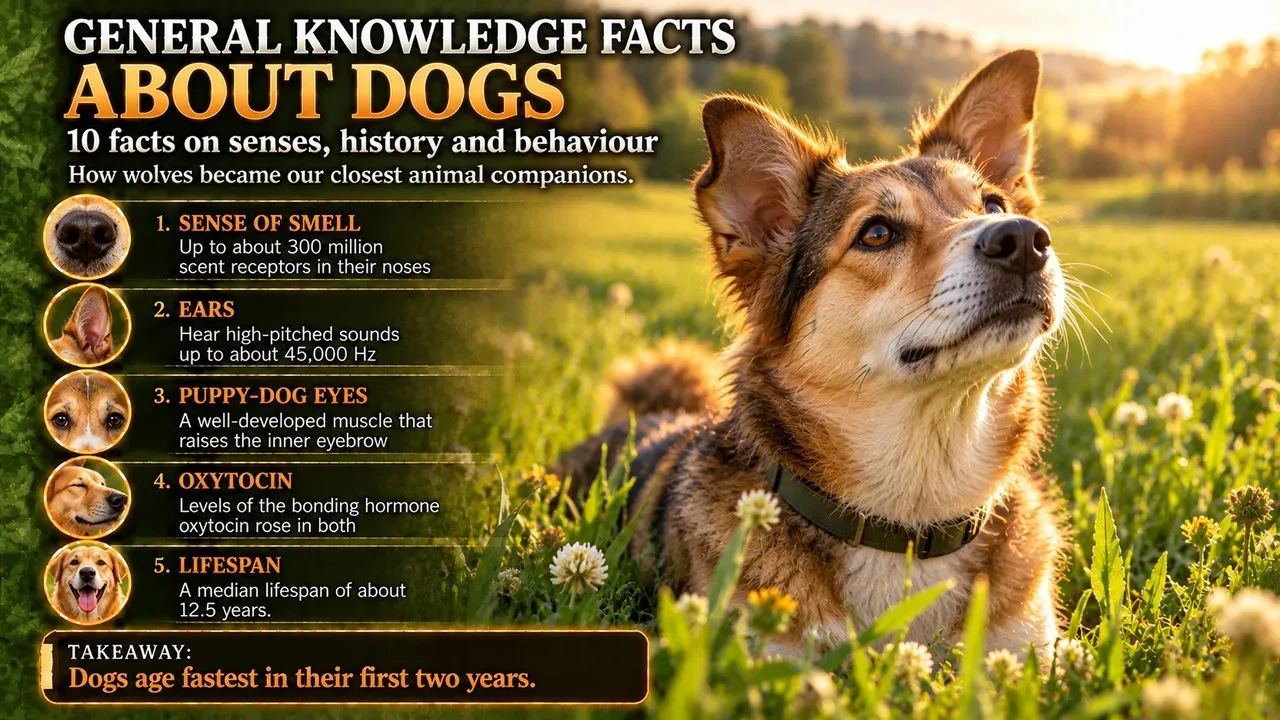
The dog (Canis familiaris or Canis lupus familiaris) is a domesticated descendant of wolves.[1] It was the first species humans domesticated, more than 14,000 years ago and before the development of agriculture. Genetic studies suggest the process may have begun more than 25,000 years ago.[1] Today there are an estimated 700 million to 1 billion dogs around the world.[1] They hunt, herd, pull loads, guard homes, keep people company, offer therapy, assist people with disabilities and support police and military work.[1] Their long partnership with people has earned them the nickname "man's best friend".[1]
This Finepedia list, updated in October 2026, gathers the top 10 facts about dogs, humanity's oldest animal companion. It covers where dogs came from, how many breeds there are, how their senses differ from ours, how many words a dog can learn, what dogs can and cannot eat, how long they live, and some of the most famous dogs in history.
Key Facts
| Feature | Detail |
|---|---|
| Scientific name | Canis familiaris or Canis lupus familiaris[1] |
| Ancestor | Wolves; dogs and the modern grey wolf share a common ancestor[1] |
| First domesticated | More than 14,000 years ago, possibly over 25,000[1] |
| World population | About 700 million to 1 billion[1] |
| Official breeds | Around 450[1] |
| Teeth | About 42[1] |
| Smell receptors | About 125 million to nearly 300 million[1] |
| Gestation | 58 to 68 days, average 63 days[1] |
| Median lifespan | About 12.7 years[1] |
1. Dogs Were the First Animals Humans Domesticated
Dogs were the first species to be domesticated, more than 14,000 years ago, before people began farming.[1] Genetic studies suggest that dogs probably split from wolves between 27,000 and 40,000 years ago.[1] Because this happened in the hunter-gatherer era, the dog was domesticated long before any farm animal.[1]
- About 33,000 years ago: The oldest known dog-like skeletons, found in the Altai Mountains of Siberia and in a cave in Belgium, date from this time.[2]
- 26,000 to 19,700 years ago: A 2021 review of the evidence suggested that dog domestication began in Siberia during this period, among the Ancient North Eurasians. From there dogs spread east into the Americas and west across Eurasia.[2]
- 17,500 years ago: The Erralla dog in Western Europe is among the oldest dog remains found there.[2]
- About 14,500 years ago: The Bonn–Oberkassel dog was buried alongside humans in Germany. It is the oldest known joint burial of a human and a dog.[2] It is also among the earliest remains conclusively identified as a domesticated dog.[1]
The exact wolf population that gave rise to dogs has vanished. In 2014, a genomic study found that no modern wolf from any region was genetically closer to dogs than any other, which implies that the dog's direct ancestor is extinct.[2]
What Domestication Changed
Domestication left its mark in dogs' genes. In 2018, a study identified 429 genes that differ between modern dogs and modern wolves.[1] The same differences appear in ancient dog fossils, so they are thought to date from early domestication rather than from modern breeding.[1] These genes are linked to the development of the neural crest and central nervous system. They can produce tameness, smaller jaws, floppy ears and reduced facial development, a set of traits known as domestication syndrome.[1]
2. They Are Wolves' Closest Cousins
Dogs and the modern grey wolf share a common ancestor.[1] In 1758, the Swedish botanist and zoologist Carl Linnaeus gave the genus name Canis, the Latin word for "dog", to the domestic dog, the wolf and the golden jackal in his book Systema Naturae.[1] Linnaeus treated the dog as a separate species from the wolf because of its upturned tail, which no other canid has.[1] Since then, dogs have sometimes been classed as a subspecies of the wolf and sometimes as a species in their own right.[1]
Dogs inherited complex behaviour from their wolf ancestors, such as bite inhibition. Wolves are pack hunters with complex body language.[1] The domestic dog began as a predator and scavenger.[1] Some dogs also became wild again. The dingo and the related New Guinea singing dog arose when dogs in Oceania were isolated and became feral more than 8,000 years ago.[1]
3. There Are Around 450 Official Breeds
There are around 450 official dog breeds, more than for any other mammal.[1] The Fédération Cynologique Internationale (FCI), founded in 1911 by the kennel clubs of Austria, Belgium, France, Germany and the Netherlands, recognises 356 breeds.[6] The FCI treats each breed as the "property" of one country, usually the country where the breed first appeared.[6]
Related: Indian Pariah Dog: History, Temperament and Care
Breeds vary more in shape than almost any animal. Differences in skull, body and limb proportions between dog breeds are greater than the differences found across the entire order of carnivores.[1] Dogs range from the Great Dane, one of the largest breeds at 50 to 79 kg and 71 to 81 cm tall, to the Chihuahua, one of the smallest at 0.5 to 3 kg and 13 to 20 cm.[1] Even so, all dogs have a similar number of bones. The number varies only with the length of the tail.[1] Dogs have been bred for particular behaviours, such as guarding, herding, hunting, retrieving and scent detection.[1]
How Modern Breeds Began
Most modern dog breeds came from controlled breeding during the Victorian era (1830–1900).[10] Pedigrees began to be recorded carefully after the English Kennel Club was set up in 1873, copying the stud books already kept for cattle and horses.[10] The Kennel Club in the UK was the world's first national kennel club and breed registry.[10] For each breed they recognise, kennel clubs usually publish a breed standard, a written description of the ideal dog of that breed.[10] Before breeds were standardised, there were many types of dog, each defined by its own particular traits.[10] A genetic study found 51 regions of the dog genome linked to differences between breeds in body, skull, teeth and long bone shape and size.[10]
4. A Dog's Nose Has Up to 300 Million Scent Receptors
Dogs have about forty times more smell receptors than humans, from about 125 million to nearly 300 million in some breeds such as bloodhounds.[1] The human brain is dominated by a large visual cortex, but the dog's brain is dominated by a large olfactory cortex, the part that handles smell.[1] The bloodhound is a large scent hound. It was first bred for hunting deer, wild boar and rabbits, and since the Middle Ages it has also been used to track people.[8] It is known for picking up human scent over long distances and long periods of time.[8]
People put this sense to work. Detection dogs, or sniffer dogs, are trained to find explosives, illegal drugs, wildlife scat, currency, blood and contraband electronics such as illicit mobile phones.[9] Some are trained to find bed bugs.[9] Several countries trained dogs to detect COVID-19, and Australia used them at airports in 2021.[9]
5. They See Fewer Colours but Sense Things We Cannot
Compared with humans, dogs have a better sense of smell and hearing but less sharp vision.[1] Their colour vision is dichromatic. They see a world of yellows, blues and greys, and find it hard to tell red from green.[1] This is because a dog's eye has two types of cone cells, while a human's has three.[1] One study found that dogs' visual acuity was up to eight times poorer than a human's.[1]
Dogs have other senses we lack. Their senses include vision, hearing, smell, taste, touch and magnetoreception.[1] One study suggests dogs can feel small changes in Earth's magnetic field, and that in calm magnetic conditions they prefer to defecate with their spines lined up north to south.[1] Dogs also have stiff, deeply rooted whiskers that sense changes in the air, vibrations and objects they cannot see in low light.[1] Their sharp hearing helps them understand cues such as different barking patterns.[1]
Related: Dog Breeds of the World: Ancient to Modern Guide
6. Some Dogs Learn the Names of Over 1,000 Things
Researchers have tested how dogs take in information, remember it and use it to solve problems.[1] A study of Rico, a Border Collie, showed that he knew the names of more than 200 items. He also worked out the names of new items by a process of elimination and still fetched them correctly four weeks later.[1]
Another Border Collie, Chaser, went further. She could identify and retrieve 1,022 toys by name.[11] In 2008, another Border Collie, Betsy, knew more than 345 words in retrieval tests. She could also match an object to a photograph of it, even though she had seen neither before.[3] This was the result of a research project that her owner, John Pilley, began on 28 June 2004. He trained her at his home in Spartanburg, South Carolina, from when she was eight weeks old until his death in June 2018.[11] Dogs have about twice as many neurons in their cerebral cortex as cats, which suggests they could be about twice as intelligent.[1] One study found that dogs' mental abilities are similar to those of horses, chimpanzees or cats.[1]
Dogs are also skilled at reading people. They have strong memories, read human body language such as gestures and pointing, and understand spoken commands.[3] They follow a pointing hand or arm more often when it comes with a glance in the same direction.[3] Studies have found that dogs can learn by inference, much as children do.[3] In his 1994 book The Intelligence of Dogs, Stanley Coren ranked dog breeds by intelligence, using surveys of dog obedience judges.[3]
7. Dogs Adapted to Eat Like Humans
Living alongside people changed what dogs can eat. Dogs can thrive on a diet rich in starch that would not be enough for other canids.[1] Compared with wolves, dogs from farming societies carry extra copies of the amylase gene and other genes involved in digesting starch.[1]
- Xylitol, a sweetener.
- Grapes and raisins.
- Garlic and onions.
8. Most of the World's Dogs Are Not Pets
The world has about 700 million to 1 billion dogs.[1] Developed countries hold only about 20% of them. About 75% are found in developing countries, mostly as feral and street dogs.[1] Free-ranging dogs include street dogs, village dogs, stray dogs and feral dogs, and they may or may not have owners.[7] India alone has an estimated 62 million free-ranging dogs.[7]
Related: Saluki: History, Temperament and Care
Many of these dogs have never been owned by anyone and live as scavengers.[1] One study found that when strangers approach village dogs, the most common response is to run away (52%), while 11% respond aggressively.[1] Pet dogs are common in richer countries. A 2009–2010 survey estimated that 77.5 million people in the United States had pet dogs.[1] The dog is the most abundant large carnivoran living alongside humans.[1]
9. A Dog Pregnancy Lasts About Nine Weeks
Dogs give birth to their litters about 58 to 68 days after fertilisation, an average of 63 days, although the length can vary.[1] Female dogs come into heat about twice a year, when the body prepares for pregnancy.[1] Because the eggs can survive and be fertilised for a week after ovulation, a single litter can have more than one father.[1] Inbreeding harms litters. A study of seven breeds found that it reduces litter size and survival.[1]
How long a dog lives varies widely between breeds, but the median lifespan is about 12.7 years.[1] Obesity shortens life. One study found that obese dogs live about a year and a half less than dogs of healthy weight.[1] A 2024 UK study of 584,734 dogs found that purebred dogs lived longer than crossbreeds. The authors noted that their crossbred group included "designer dogs" and that purebred dogs tended to get better care.[1] Other studies have found that fully mixed-breed dogs live about a year longer on average than pedigree dogs.[1] Adult dogs have powerful jaws with about 42 teeth.[1]
10. Some Dogs Made History
- Laika: A stray mongrel from the streets of Moscow, Laika was one of the first animals in space and the first to orbit Earth. She flew aboard Sputnik 2, launched on 3 November 1957.[4] She died of overheating a few hours into the flight, on the craft's fourth orbit. The true cause and time of her death were not made public until 2002.[4]
- Hachikō: Hachikō was an Akita born in November 1923 near Ōdate, Japan.[5] In 1924, Hidesaburō Ueno, a professor at the Tokyo Imperial University, took him to live in Shibuya, Tokyo. Hachikō met Ueno at Shibuya Station every day when he came home from work.[5] After Ueno died in 1925, Hachikō kept waiting for him for almost ten years, until his own death on 8 March 1935.[5] He is remembered worldwide in statues, films and books.[5]
Dogs That Help People
Many kinds of service and assistance dogs help people with disabilities. They include guide dogs, hearing dogs, mobility assistance dogs and psychiatric service dogs.[1] Dogs may help their owners' health as well. People with pet dogs took considerably more exercise than people with cats or no pets.[1] Dog owners are also significantly less likely to die within a year of a heart attack than people without dogs.[1]
Dogs also carry risks. They are responsible for 99% of rabies cases worldwide, although in some developed countries, such as the UK, dogs no longer carry rabies.[1] In 2018, the World Health Organization reported that 59,000 people died of rabies worldwide, 59.6% of them in Asia and 36.4% in Africa.[1]
Related: Top 10 Best Dog Breeds in the World
Key Figures
- 14,000+ years: How long ago dogs were domesticated.[1]
- 27,000–40,000 years ago: When dogs likely split from wolves.[1]
- 429: Genes that differ between modern dogs and wolves, found in a 2018 study.[1]
- 450: Approximate number of official dog breeds.[1]
- 356: Breeds recognised by the FCI.[6]
- 300 million: Smell receptors in some breeds, such as bloodhounds.[1]
- 1,022: Toys Chaser the Border Collie could name.[11]
- 700 million–1 billion: Estimated dogs in the world.[1]
- 75%: Share of dogs found in developing countries, mostly as street and feral dogs.[1]
- 63 days: Average length of a dog pregnancy.[1]
- 12.7 years: Median dog lifespan.[1]
- 99%: Share of human rabies cases caused by dogs.[1]
Frequently Asked Questions
When were dogs domesticated?
Dogs were domesticated more than 14,000 years ago, and genetic studies suggest the process may have started over 25,000 years ago.[1]
Can dogs see colour?
Yes, but only partly. Their vision is dichromatic, made up of yellows, blues and greys, and they find red and green hard to tell apart.[1]
How good is a dog's sense of smell?
Dogs have about forty times as many smell receptors as humans, up to nearly 300 million in breeds such as bloodhounds.[1]
How many dog breeds are there?
There are around 450 official breeds. The FCI recognises 356 of them.[1][6]
Why is chocolate bad for dogs?
Chocolate contains theobromine, the most common cause of food poisoning in dogs.[1]
How long do dogs live?
The median lifespan is about 12.7 years, though it varies widely between breeds.[1]
See also
- ^ [1] "Dog". Wikipedia. Wikipedia
- ^ [2] "Origin of the domestic dog". Wikipedia. Wikipedia
- ^ [3] "Dog intelligence". Wikipedia. Wikipedia
- ^ [4] "Laika". Wikipedia. Wikipedia
- ^ [5] "Hachikō". Wikipedia. Wikipedia
- ^ [6] "Fédération Cynologique Internationale". Wikipedia. Wikipedia
- ^ [7] "Free-ranging dog". Wikipedia. Wikipedia
- ^ [8] "Bloodhound". Wikipedia. Wikipedia
- ^ [9] "Detection dog". Wikipedia. Wikipedia
- ^ [10] "Dog breed". Wikipedia. Wikipedia
- ^ [11] "Chaser (dog)". Wikipedia. Wikipedia





















Discussion
Log in with