


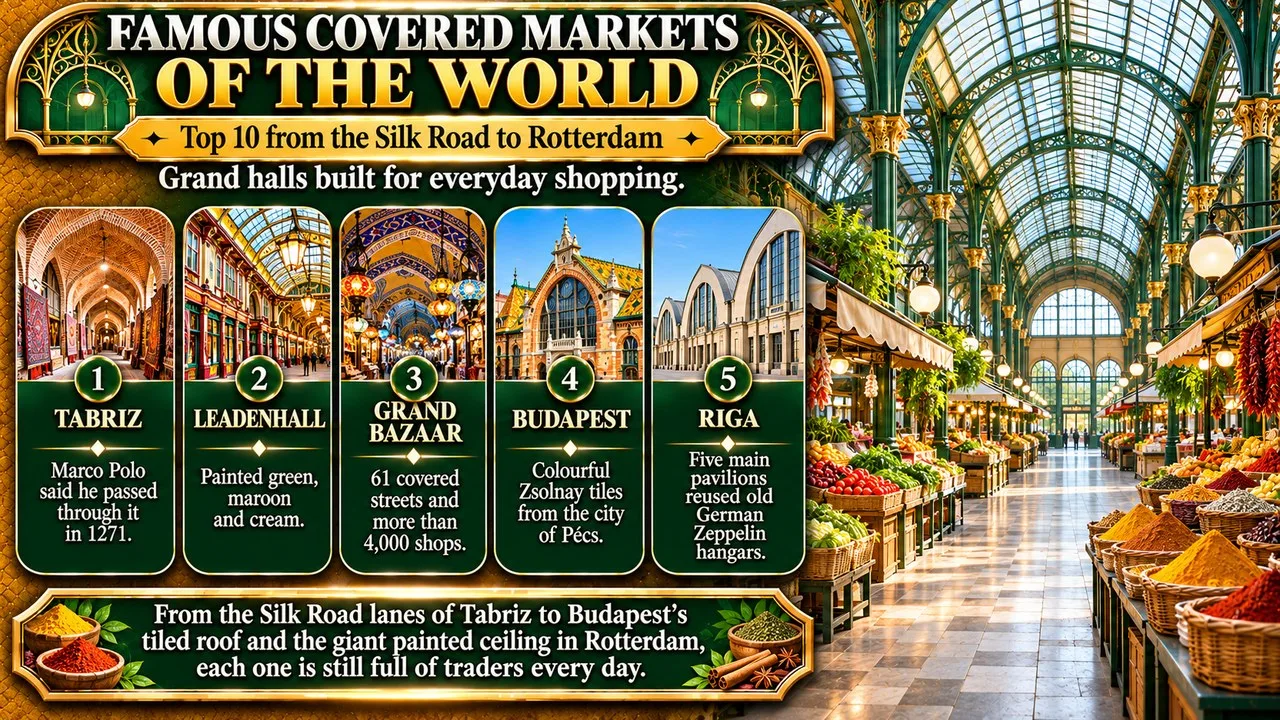
Famous covered markets of the world range from the vast Grand Bazaar in Istanbul to London's Victorian halls and Rotterdam's arch of homes over a market.
This Finepedia guide, written in November 2026, looks at ten of the best-known covered markets on Earth. Each entry explains where the market is, how old it is, what it sells and what makes its building special. The list moves from ancient bazaars on the Silk Road to iron-and-glass halls of the 19th and early 20th centuries and a 21st-century market with flats built into its roof.
Covered markets grew up where towns needed a safe, clean place to sell food and goods out of the rain and sun. Many began as open-air markets that were later roofed over, while others were planned from the start as grand public buildings. Today they are both everyday shops for local people and some of the most popular sights for visitors.
How We Chose These
We chose ten covered markets that are famous for their history, architecture or size and that are still trading today. They are listed in order of when trading began at each market, from the Bazaar of Tabriz, described by travellers in the 10th century, to the Markthal in Rotterdam, which opened in 2014. Dates and figures are taken from official and encyclopaedia sources.
The 10 Famous Covered Markets at a Glance
| No. | Market | City | Trading began | Known for |
|---|---|---|---|---|
| 1 | Bazaar of Tabriz | Tabriz, Iran | by the 10th century | Silk Road trade |
| 2 | Borough Market | London, UK | at least the 12th century | speciality food |
| 3 | La Boqueria | Barcelona, Spain | 1217 | entrance from La Rambla |
| 4 | Leadenhall Market | London, UK | 14th century | painted Victorian roof |
| 5 | Grand Bazaar | Istanbul, Turkey | 1455 to 1456 | 61 covered streets |
| 6 | Mercado Central | Valencia, Spain | 1839 | Art Nouveau domes |
| 7 | Great Market Hall | Budapest, Hungary | 1897 | Zsolnay roof tiles |
| 8 | Mercado de San Miguel | Madrid | 1916 | iron and glass tapas hall |
| 9 | Riga Central Market | Riga, Latvia | 1930 | Zeppelin hangar pavilions |
| 10 | Markthal | Rotterdam, Netherlands | 2014 | homes above the market |
1. The Bazaar of Tabriz Grew on the Silk Road
The Bazaar of Tabriz in north-western Iran is one of the oldest bazaars in the Middle East and one of the most important trading centres on the Silk Road [1][2]. Writers from the 10th century onwards described it, and the Venetian traveller Marco Polo said he passed through it in 1271. The market was at its richest in the 16th century, when Tabriz was the capital of Safavid Iran. Its rows are divided by trade, with separate sections for gold and jewellery, hand-woven rugs, shoes and fresh produce [1].
Key Facts
- Location: Tabriz, Iran
- Described by: travellers from the 10th century
- Richest period: the 16th century
- UNESCO World Heritage Site: since July 2010
Did You Know?
Marco Polo was only one of many famous visitors, and the Moroccan traveller Ibn Battuta also wrote about the bazaar in around 1330 [1].
2. Borough Market Has Fed London for Centuries
Borough Market in Southwark is one of the largest and oldest food markets in London, with a market on the site since at least the 12th century [3]. The market itself claims a history going back to 1014. It once stood at the end of London Bridge, but caused such traffic jams that it was closed by Parliament in 1755 and started again in 1756 on a new site. The present buildings date from the 1850s, and today it mainly sells speciality foods to the public [3].
Key Facts
- Location: Southwark, London
- Market on site: since at least the 12th century
- Present buildings: 1850s
- Speciality: fine and fresh food
Why It Matters
Borough Market and its streets have become a favourite film location, appearing in Bridget Jones's Diary and Harry Potter and the Prisoner of Azkaban [3].
3. La Boqueria Opens Onto La Rambla
La Boqueria is a large public market in the old town of Barcelona, with an entrance from La Rambla close to the city's opera house [4]. It was first mentioned in 1217, when tables were set up near the old city gate to sell meat. Building work on a proper market began on 19 March 1840, and the structure was finally inaugurated in 1853. A fish market was added in 1911, and the metal roof that still covers the market was built in 1914 [4].
Related: Top 10 Tallest TV and Observation Towers
Key Facts
- Location: Barcelona, Spain
- First mentioned: 1217
- Building inaugurated: 1853
- Metal roof: 1914
Did You Know?
The name Boqueria is thought to come from the Catalan word boc, meaning goat, so it may first have been a place where goat meat was sold [4].
4. Leadenhall Market Has a Painted Victorian Roof
Leadenhall Market in the City of London dates from the 14th century and stands on what was the centre of Roman London [5]. It was first a market for meat, game and poultry. Its ornate roof, painted green, maroon and cream, and its cobbled floors were designed in 1881 by Sir Horace Jones, who also designed Billingsgate and Smithfield markets. The Lamb Tavern inside the market dates from 1780 [5].
Key Facts
- Location: City of London
- Market since: the 14th century
- Present roof: 1881, by Sir Horace Jones
- Oldest pub inside: the Lamb Tavern, 1780
Why It Matters
Leadenhall's grand roof has made it a tourist attraction, and it appeared as the area around Diagon Alley in the film Harry Potter and the Philosopher's Stone in 2001 [5].
5. The Grand Bazaar Has 61 Covered Streets
The Grand Bazaar in Istanbul is one of the largest and oldest covered markets in the world, with 61 covered streets and more than 4,000 shops over 30,700 square metres [6]. Its core was begun in the winter of 1455 to 1456 by Sultan Mehmed II, soon after the Ottoman conquest of Constantinople, as a hall for trading cloth and jewels. The bazaar has been damaged many times by fire, starting in 1515, and by the earthquake of 1894. It attracts between 250,000 and 400,000 visitors every day [6].
Key Facts
- Location: Istanbul, Turkey
- Begun: 1455 to 1456
- Shops: more than 4,000
- Visitors: 250,000 to 400,000 a day
Did You Know?
In 2014 the Grand Bazaar was listed first among the world's most-visited tourist attractions, with more than 91 million visitors that year [6].
6. Valencia's Mercado Central Is an Art Nouveau Gem
The Mercado Central in Valencia stands opposite the Silk Exchange in the old town [7]. An open-air market called the Mercat Nou opened on the spot in 1839. The present building was designed by Alexandre Soler March and Francesc Guàrdia Vidal after a contest in 1910, and was built between 1914 and 1928. It covers more than 8,000 square metres, and its roof of domes and sloping sections lets light pour in through coloured glass [7][8].
Related: Top 10 Most Dangerous Bridges in the World
Key Facts
- Location: Valencia, Spain
- Open-air market from: 1839
- Present building: 1914 to 1928
- Area: more than 8,000 square metres
Why It Matters
The Mercado Central is one of the main works of Valencian Art Nouveau and one of the largest markets in Europe, yet it still works as an everyday food market [7].
7. Budapest's Great Market Hall Has a Tiled Roof
The Great Market Hall is the largest and oldest indoor market in Budapest, standing on the Pest side of Liberty Bridge [9]. It was the idea of Károly Kamermayer, the city's first mayor, and was designed by Samu Pecz. It opened on 15 February 1897, and Kamermayer, who had retired the year before, attended the opening ceremony. Its roof is covered in colourful Zsolnay tiles from the city of Pécs [9].
Key Facts
- Location: Budapest, Hungary
- Opened: 15 February 1897
- Architect: Samu Pecz
- Roof: Zsolnay tiles from Pécs
Did You Know?
The market hall stands where Váci utca ends, one of Budapest's best-known shopping streets [9].
8. Mercado de San Miguel Turned Into a Tapas Hall
The Mercado de San Miguel stands next to the Plaza Mayor in the centre of Madrid [10]. It was designed by the Spanish architect Alfonso Dubé, who took the Les Halles market in Paris as his model, and was officially inaugurated on 13 May 1916. The building covers 1,764 square metres and is made of wrought iron and glass. Private investors bought it in 2003, restored the iron structure and reopened it in 2009 as a gourmet tapas market with more than 30 stalls [10].
Key Facts
- Location: Madrid, Spain
- Opened: 13 May 1916
- Architect: Alfonso Dubé
- Reopened: 2009
Why It Matters
San Miguel's makeover gave an old food hall new life as a place to eat and meet, and it is now the Madrid market that tourists visit most [10].
Related: Top 10 Rarest Rock Formations in the World
9. Riga Central Market Was Built From Airship Hangars
Riga Central Market in Latvia is one of the largest markets in Europe, covering 72,300 square metres with more than 3,000 stalls [11]. It was built between 1924 and 1930, and its five main pavilions reused old German Zeppelin hangars, combined with Neoclassical and Art Deco styles. It is one of the most notable 20th-century buildings in Latvia and was included on the UNESCO World Heritage List together with Old Riga in 1998 [11][12].
Key Facts
- Location: Riga, Latvia
- Built: 1924 to 1930
- Area: 72,300 square metres
- Stalls: more than 3,000
Did You Know?
Produce has been sold on the banks of the Daugava River in Riga since 1571, long before the present market was built [11].
10. The Markthal Puts Homes Above a Market
The Markthal in Rotterdam is a horseshoe-shaped building with a market hall underneath and 228 apartments in its arch [13]. Designed by the architects MVRDV, it was opened on 1 October 2014 by Queen Máxima of the Netherlands. Its glass end walls hang from a net of steel cables 34 metres high and 42 metres wide, the largest structure of its kind in Europe. The ceiling is covered by an 11,000-square-metre artwork called Horn of Plenty, showing huge fruits, vegetables, fish and flowers [13].
Key Facts
- Location: Rotterdam, Netherlands
- Opened: 1 October 2014
- Architects: MVRDV
- Apartments: 228
Why It Matters
The Markthal shows a new way to build a market, combining shops, food stalls, homes and parking in a single building in the heart of the city.
Frequently Asked Questions
What is the largest covered market in the world?
The Grand Bazaar in Istanbul is one of the largest, with 61 covered streets and more than 4,000 shops [6].
Related: Top 10 Most Visited Countries in the World
What is the oldest covered market on this list?
The Bazaar of Tabriz, which travellers described from the 10th century onwards, is the oldest [1].
Which market was built from Zeppelin hangars?
Riga Central Market, whose five main pavilions reused old German airship hangars [11].
Which market appeared in Harry Potter?
Leadenhall Market in London was used for the area around Diagon Alley in the first Harry Potter film in 2001 [5].
Conclusion
Famous covered markets of the world show how a simple need, a dry place to buy food, can produce some of a city's finest buildings. From the Silk Road lanes of Tabriz to Budapest's tiled roof and the giant painted ceiling in Rotterdam, each one is still full of traders every day. For more great places to shop and gather, read the Finepedia guides Top 10 Largest Malls in the World and Top 10 Famous City Squares Around the World.
- ^ [1] "Tabriz Bazaar". Wikipedia. Tabriz Bazaar on Wikipedia.
- ^ [2] "Tabriz Historic Bazaar Complex". UNESCO World Heritage Centre. Tabriz Historic Bazaar Complex on the UNESCO website.
- ^ [3] "Borough Market". Wikipedia. Borough Market on Wikipedia.
- ^ [4] "La Boqueria". Wikipedia. La Boqueria on Wikipedia.
- ^ [5] "Leadenhall Market". Wikipedia. Leadenhall Market on Wikipedia.
- ^ [6] "Grand Bazaar, Istanbul". Wikipedia. Grand Bazaar on Wikipedia.
- ^ [7] "Mercado Central, Valencia". Wikipedia. Mercado Central on Wikipedia.
- ^ [8] "Historia del Mercado". Mercado Central de Valencia. Market history on the official website.
- ^ [9] "Great Market Hall (Budapest)". Wikipedia. Great Market Hall on Wikipedia.
- ^ [10] "Mercado de San Miguel". Wikipedia. Mercado de San Miguel on Wikipedia.
- ^ [11] "Riga Central Market". Wikipedia. Riga Central Market on Wikipedia.
- ^ [12] "Historic Centre of Riga". UNESCO World Heritage Centre. Historic Centre of Riga on the UNESCO website.
- ^ [13] "Markthal". Wikipedia. Markthal on Wikipedia.
- [14] "10 Best Indoor Markets in the World". 10 Most Today. Topic reference on 10mosttoday.com.


















Discussion
Log in with