


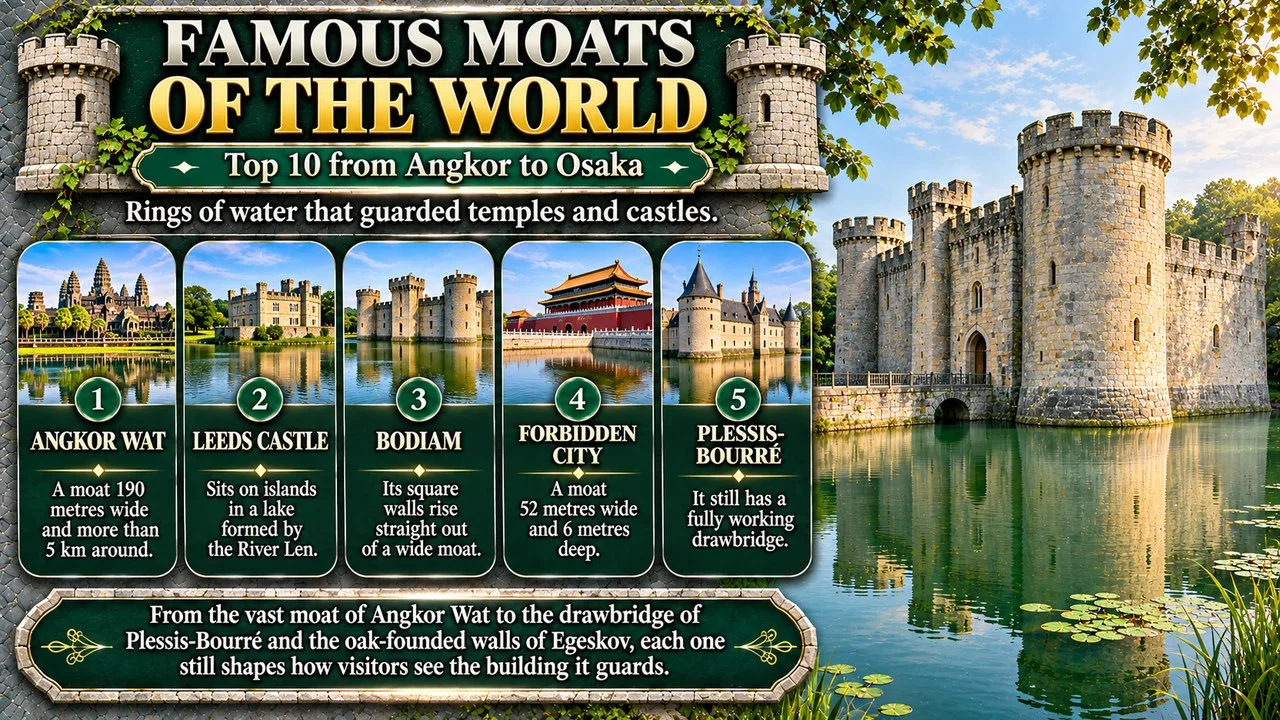
Famous moats of the world include the 190-metre-wide moat of Angkor Wat, the deep water around Beijing's Forbidden City and the lakes of English castles.
This Finepedia guide, written in November 2026, looks at ten of the most famous moats ever dug around temples, palaces, castles and whole cities. Each entry explains when the moat was made, how large it is and what it protected, from a Hindu temple in Cambodia to a Danish castle that stands on oak piles in a lake.
A moat is a deep, wide ditch dug around a castle, fort, town or other building to keep attackers out. Many moats were filled with water, but some were dry. Dug soil was often piled up on the inner side to make a bank or wall, so the ditch and the wall worked together as one defence [1]. Moats could also store water, carry boats and show off the power of a ruler.
How We Chose These
We picked moats that are well known around the world, that still hold water or can clearly be seen today and that surround buildings open to visitors. The list runs in order of age, from the oldest to the youngest, using the date when the main building or moat was begun. Many of these places were later repaired or rebuilt. Some of the moats are on UNESCO World Heritage Sites, and several are famous mainly for their beauty rather than their defence.
The 10 Famous Moats at a Glance
| No. | Site | Country | Begun | Known for |
|---|---|---|---|---|
| 1 | Angkor Wat | Cambodia | 1113 | moat 190 m wide |
| 2 | Leeds Castle | England | 1119 | castle on islands in a lake |
| 3 | Caerlaverock Castle | Scotland | 13th century | triangular moated castle |
| 4 | Muiderslot | Netherlands | 1280 | moated castle near Amsterdam |
| 5 | Chiang Mai Old City | Thailand | 1296 | square city moat |
| 6 | Bodiam Castle | England | 1385 | castle rising from its moat |
| 7 | Forbidden City | China | 1406 | moat 52 m wide and 6 m deep |
| 8 | Château du Plessis-Bourré | France | 1468 | working drawbridge |
| 9 | Egeskov Castle | Denmark | 1554 | castle on oak piles in a lake |
| 10 | Osaka Castle | Japan | 1583 | inner and outer moats |
1. Angkor Wat Has a Moat Wider Than a Football Field Is Long
Angkor Wat in Cambodia was built between 1113 and 1150 for the Khmer king Suryavarman II as a Hindu temple dedicated to Vishnu [2]. It is encircled by a 30-metre apron of open ground and a moat 190 metres wide and more than 5 km around. The temple represents Mount Meru, the home of the gods, and the moat stands for the ocean around the world [2]. The moats were also part of the great water network of Angkor and stored water between the wet and dry seasons. The Angkor area became a World Heritage Site in 1992 [3].
Key Facts
- Location: Siem Reap, Cambodia
- Built: 1113 to 1150
- Moat width: 190 metres
- Moat length: more than 5 km around
Did You Know?
The main entrance to Angkor Wat is a sandstone causeway across the western moat, which may have replaced an earlier wooden bridge [2].
2. Leeds Castle Stands on Islands in a Lake
Leeds Castle in Kent sits on islands in a lake formed by the River Len. In 1119 Robert de Crevecoeur rebuilt it in stone as a Norman stronghold [4]. In the 13th century it passed to King Edward I, who made it a favourite home and probably created the lake that surrounds it. Henry VIII transformed the castle in 1519 for Catherine of Aragon, the first of his six wives. Its last private owner, Olive, Lady Baillie, left it in trust so that the public could visit [4].
Key Facts
- Location: near Maidstone, Kent, England
- Stone castle: 1119
- Lake: probably created under Edward I
- Status: Grade I listed
Why It Matters
Leeds Castle shows how a moat could grow from a defensive ditch into a wide lake that made a castle both safer and more beautiful.
3. Caerlaverock Is a Triangle Ringed by Water
Caerlaverock Castle, near Dumfries in south-west Scotland, is a triangular castle with a moat, begun in the 13th century [5]. Although it was knocked down and rebuilt several times, it keeps its unusual three-sided plan, with a bridge over the moat facing north. In July 1300 King Edward I of England besieged it with a large army, and his heralds wrote a poem in Old French, the Siege of Caerlaverock, naming the knights who took part [5]. The castle belonged to the Maxwell family for about four hundred years.
Related: Top 10 Spectacular Fountains of the World
Key Facts
- Location: near Dumfries, Scotland
- Built: 13th century
- Shape: triangular
- Famous siege: July 1300
Did You Know?
The stone for the castle was probably quarried when the moat was dug, so the ditch and the walls came from the same piece of ground.
4. Muiderslot Guarded the Mouth of the Vecht
Muiderslot, or Muiden Castle, stands where the River Vecht meets the old Zuiderzee, east of Amsterdam. Count Floris V of Holland built a stone castle here in 1280, and a large moat surrounded it [6]. In 1296 nobles plotting against him held him at the castle, and he was killed while trying to escape. The castle was later rebuilt on the same spot and to the same plan between about 1370 and 1386 by Albert I, Duke of Bavaria. Today it is a national museum [6].
Key Facts
- Location: Muiden, North Holland, Netherlands
- First stone castle: 1280
- Rebuilt: about 1370 to 1386
- Today: a national museum
Why It Matters
Muiderslot shows how a castle could be rebuilt on its old plan after its first lord fell, keeping the moat that defined it.
5. Chiang Mai Is Still Framed by Its Square Moat
Chiang Mai, whose name means new city, was founded in 1296 by King Mangrai as the new capital of the Lan Na kingdom [7]. Its old centre is a square of about 1.6 km on each side, bordered by the remains of red brick walls and surrounded by a moat that still holds water. The moat once protected the city from attack and now forms a ring of water around the busy old town, and the city's central district holds 117 Buddhist temples [7].
Key Facts
- Location: Chiang Mai, northern Thailand
- Founded: 1296 by King Mangrai
- Old city: a square about 1.6 km across
- Walls: red brick, now partly in ruins
Did You Know?
Chiang Mai is famous for its Songkran festival in mid-April, the Thai New Year, when a citywide water fight fills the streets [7].
6. Bodiam Castle Seems to Float on Its Moat
Bodiam Castle in East Sussex was built in 1385 by Sir Edward Dalyngrigge, with permission from King Richard II, to guard the area against French attack during the Hundred Years' War [8]. Its square walls rise straight out of a wide moat, which is only about 1.5 metres deep on average, and its corners and entrance are marked by towers topped by battlements. The castle has no keep, and its rooms are built around the inner walls. Lord Curzon restored the castle and left it to the National Trust, which has owned it since 1925 [8].
Related: Top 10 Great Roman Amphitheatres Still Standing
Key Facts
- Location: near Robertsbridge, East Sussex, England
- Built: 1385
- Builder: Sir Edward Dalyngrigge
- Owner: the National Trust since 1925
Why It Matters
Bodiam is protected as a Grade I listed building and is often used as the classic picture of a moated castle from the Middle Ages [8].
7. The Forbidden City Is Ringed by a 52-Metre Moat
The Forbidden City in Beijing was built between 1406 and 1420 and was the palace of 24 Ming and Qing emperors until 1924 [9]. It covers about 72 hectares and is enclosed by a wall 7.9 metres high and by a moat 52 metres wide and 6 metres deep. To the north lies Jingshan Park, an artificial hill made partly from the soil dug out to create the moat [9]. The palace became a World Heritage Site in 1987 as part of the Imperial Palaces of the Ming and Qing Dynasties [10].
Key Facts
- Location: Beijing, China
- Built: 1406 to 1420
- Moat: 52 metres wide and 6 metres deep
- Wall: 7.9 metres high
Did You Know?
The palace was long said to have 9,999 rooms, but modern surveys count about 8,886.
8. Plessis-Bourré Still Has a Working Drawbridge
The Château du Plessis-Bourré in the Loire Valley of France was built in less than five years, from 1468 to 1472, by Jean Bourré, a finance minister and close adviser to King Louis XI [11]. The château stands within its moat in the commune of Écuillé. Its outside has not been changed since it was built, and it still has a fully working drawbridge [11].
Related: Top 10 Oldest Surviving Buildings on Earth
Key Facts
- Location: Écuillé, Maine-et-Loire, France
- Built: 1468 to 1472
- Builder: Jean Bourré, adviser to Louis XI
- Feature: a working drawbridge
Why It Matters
Plessis-Bourré gives a rare picture of a late 15th-century French moated château that has kept its original outside appearance.
9. Egeskov Castle Rests on Oak Piles
Egeskov Castle on the island of Funen in Denmark was built by Frands Brockenhuus in 1554 [12]. It stands in a small lake up to 5 metres deep, on foundations of oak piles. Legend says a whole forest of oak trees was needed for the foundations, which is why the castle is called Egeskov, meaning oak forest. Egeskov is the best-preserved Renaissance water castle in Denmark, and its gardens include four hedge mazes [12].
Key Facts
- Location: near Kværndrup, Funen, Denmark
- Built: 1554
- Builder: Frands Brockenhuus
- Foundations: oak piles in a lake
Did You Know?
A water castle, or moated castle, uses a lake or wide moat on every side as its main defence, and Egeskov is one of the finest examples in Europe.
10. Osaka Castle Has Inner and Outer Moats
Toyotomi Hideyoshi began building Osaka Castle in 1583, and it was completed in 1597 [13]. It stands on two raised platforms of landfill held up by sheer walls of cut stone, each overlooking a moat. The castle has an inner moat and an outer one. The inner moat is partly wet and partly dry [13]. Japanese castles often had very elaborate moats, with up to three rings laid out around the castle, and these also served as waterways for the city [1]. The castle has been destroyed and rebuilt more than once, and the keep seen today is a later reconstruction.
Key Facts
- Location: Osaka, Japan
- Built: 1583 to 1597
- Builder: Toyotomi Hideyoshi
- Moats: an inner and an outer moat
Why It Matters
Osaka Castle's giant stone walls and moats show the scale of building in Japan at the end of the 16th century, when great lords raced to build ever stronger castles.
Related: Top 10 Legendary Pyramids Around the World
Frequently Asked Questions
What was the purpose of a moat?
A moat made it hard for attackers to reach the walls, dig under them or bring siege towers close. Moats also stored water and showed the wealth of their owners [1].
Which moat on this list is the widest?
The moat around Angkor Wat is the widest here, at 190 metres [2].
Did all moats hold water?
No. Some were dry ditches. Osaka Castle's inner moat has both a wet section and a dry section [13].
Can you visit these moated sites?
Yes. All ten are open to visitors, although opening times and access to the grounds change with the seasons.
Conclusion
Famous moats show how water and earth were used to protect people and to impress them. From the vast moat of Angkor Wat to the drawbridge of Plessis-Bourré and the oak-founded walls of Egeskov, each one still shapes how visitors see the building it guards. For more great buildings with long histories, read the Finepedia guides Top 10 Famous Bell Towers of the World and Top 10 Monuments Rebuilt After War.
- ^ [1] "Moat". Wikipedia. Moat on Wikipedia.
- ^ [2] "Angkor Wat". Wikipedia. Angkor Wat on Wikipedia.
- ^ [3] "Angkor". UNESCO World Heritage Centre. UNESCO listing 668.
- ^ [4] "Leeds Castle". Wikipedia. Leeds Castle on Wikipedia.
- ^ [5] "Caerlaverock Castle". Wikipedia. Caerlaverock Castle on Wikipedia.
- ^ [6] "Muiderslot". Wikipedia. Muiderslot on Wikipedia.
- ^ [7] "Chiang Mai". Wikipedia. Chiang Mai on Wikipedia.
- ^ [8] "Bodiam Castle". Wikipedia. Bodiam Castle on Wikipedia.
- ^ [9] "Forbidden City". Wikipedia. Forbidden City on Wikipedia.
- ^ [10] "Imperial Palaces of the Ming and Qing Dynasties in Beijing and Shenyang". UNESCO World Heritage Centre. UNESCO listing 439.
- ^ [11] "Château du Plessis-Bourré". Wikipedia. Château du Plessis-Bourré on Wikipedia.
- ^ [12] "Egeskov Castle". Wikipedia. Egeskov Castle on Wikipedia.
- ^ [13] "Osaka Castle". Wikipedia. Osaka Castle on Wikipedia.
- [14] "10 Most Amazing Moats in the World". 10 Most Today. Topic reference on 10mosttoday.com.

















Discussion
Log in with