









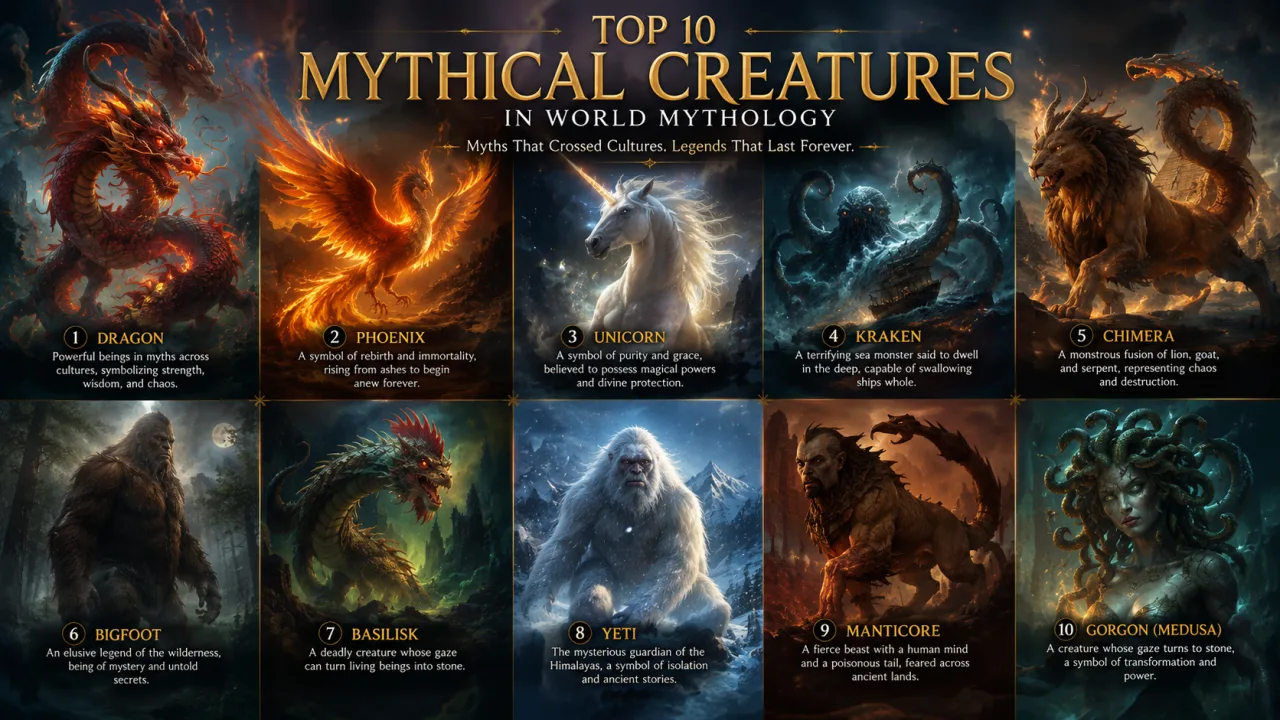
Top 10 Mythical Creatures in World Mythology - That Inspired Myths Across Civilizations
Introduction
Mythical creatures have fascinated humanity since the earliest civilizations. Long before scientific explanations could describe natural phenomena, ancient cultures created legendary beings to explain the mysteries of the world, teach moral lessons, symbolize human virtues and fears, and preserve cultural traditions. These extraordinary creatures appear in myths, religious texts, folklore, epic poems, and oral traditions spanning thousands of years.
Unlike ordinary animals, mythical creatures often possess supernatural abilities, combining characteristics of multiple species or displaying magical powers beyond the natural world. Some were worshipped as divine beings, others feared as monstrous forces of destruction, while many served as guardians of sacred places or symbols of wisdom, immortality, courage, and transformation.
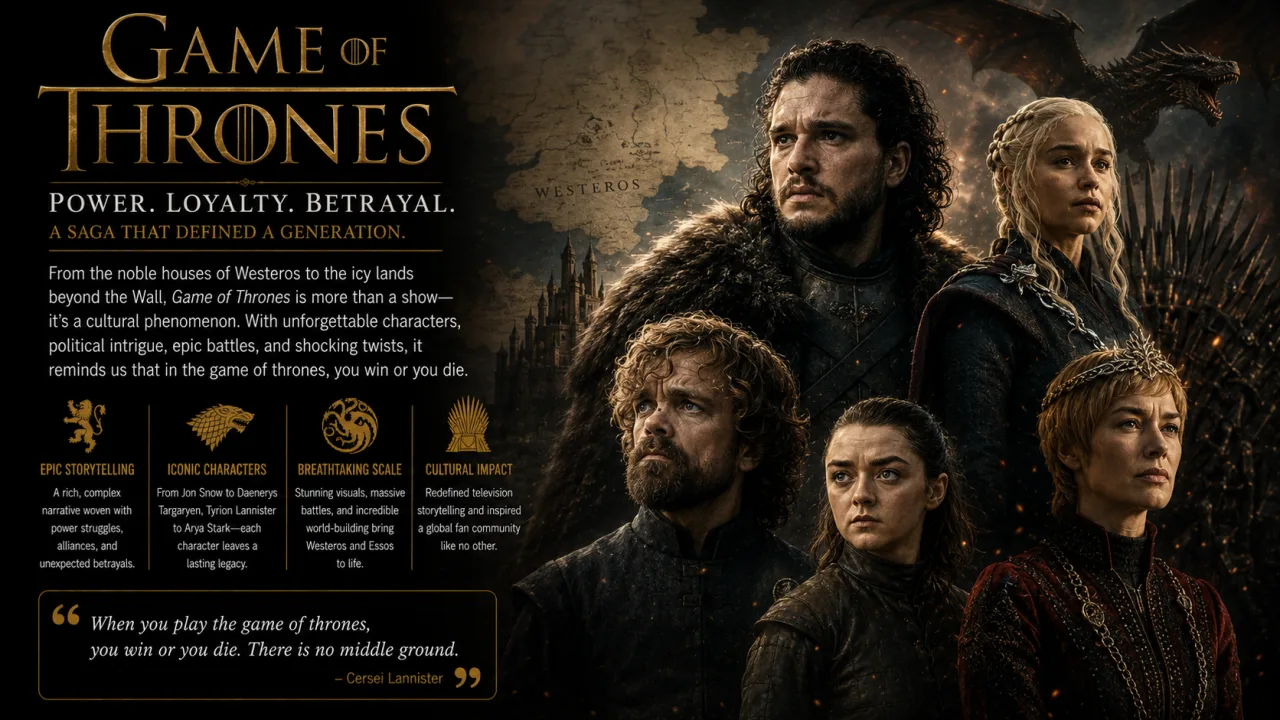
From the fire-breathing dragons of Europe and Asia to the immortal phoenix rising from its ashes, these legendary beings continue to inspire literature, films, television series, video games, and fantasy art. Modern franchises such as ''Harry Potter'', ''The Lord of the Rings'', ''Game of Thrones'', ''The Witcher'', and ''Dungeons & Dragons'' have introduced ancient myths to new generations, proving that these timeless legends remain as captivating today as they were thousands of years ago.
This encyclopedia explores ten of history's most famous mythical creatures, examining their origins, physical characteristics, legendary powers, cultural significance, and enduring legacy in mythology and popular culture.
1. Dragon
Quick Facts
| Attribute | Details |
|---|---|
| Mythology | Chinese, Japanese, Korean, Greek, Norse, European |
| Habitat | Mountains, caves, rivers, oceans, skies |
| Symbolism | Power, wisdom, protection, destruction |
| Abilities | Flight, fire breath, immense strength, magic |
| Moral Role | Benevolent in Asia, often antagonistic in Europe |
Origins and History
The dragon is perhaps the world's most recognizable mythical creature, appearing in the mythology of nearly every major civilization. Archaeological discoveries indicate that dragon-like beings have existed in human imagination for over 5,000 years.
The earliest dragon myths originated in Mesopotamia, where serpent-like monsters represented chaos and primordial forces. Ancient Babylonian mythology featured Tiamat, a monstrous dragon goddess defeated by the storm god Marduk during the creation of the world.
Chinese dragon mythology dates back more than 4,000 years. Unlike their Western counterparts, Chinese dragons were considered divine creatures associated with rainfall, rivers, fertility, prosperity, and imperial authority. Emperors claimed descent from dragons, making them powerful national symbols.
Greek mythology introduced numerous dragon-like monsters, including Ladon, the hundred-headed guardian of the golden apples, and the dragon slain by Cadmus before founding Thebes.
Medieval European dragons evolved into fire-breathing monsters guarding treasure, often serving as formidable opponents for heroic knights.
Appearance
Although dragons vary across cultures, several common characteristics define them.
Western dragons typically possess:
- Massive reptilian bodies
- Four muscular legs
- Large bat-like wings
- Powerful tails
- Razor-sharp claws
- Horned heads
- Fire-breathing capability
- Thick armored scales
Asian dragons differ considerably:
- Long serpentine bodies
- Deer-like antlers
- Flowing whiskers
- Eagle claws
- No wings
- Ability to fly using magic
- Pearl representing wisdom or divine energy
Some dragons reach hundreds of feet in length, while others possess the ability to alter their size magically.
Powers and Abilities
Dragons are among mythology's most powerful creatures.
Common abilities include:
- Fire breathing
- Flight
- Superhuman intelligence
- Magical resistance
- Immense physical strength
- Long lifespan
- Shape-shifting
- Weather manipulation (Asian dragons)
- Control over rivers and rainfall
- Telepathic communication
In Eastern mythology, dragons could summon storms, create floods, and bless harvests.
Western dragons were feared for destroying entire armies with fire and devastating villages.
Symbolism
Dragons symbolize different ideals depending on cultural traditions.
Eastern Symbolism
- Prosperity
- Wisdom
- Good fortune
- Rain
- Fertility
- Imperial authority
- Cosmic balance
Western Symbolism
- Greed
- Chaos
- Destruction
- Pride
- Evil
- Courage (for heroes defeating dragons)
Famous Dragons
Some of mythology's most famous dragons include:
- Tiamat (Babylonian mythology)
- Ladon (Greek mythology)
- Fafnir (Norse mythology)
- Shenlong (Chinese mythology)
- Ryūjin (Japanese mythology)
- Níðhöggr (Norse mythology)
- Smaug ( ''The Hobbit'' )
- Drogon ( ''Game of Thrones'' )
Dragons in Modern Popular Culture
Dragons remain central to fantasy entertainment.
Notable appearances include:
- The Hobbit
- Lord of the Rings
- Game of Thrones
- House of the Dragon
- Harry Potter
- Skyrim
- Dungeons & Dragons
- How to Train Your Dragon
- Dragon Ball
Interesting Facts
- The Chinese zodiac includes the Dragon as its only mythical animal.
- Dragon legends exist on every inhabited continent.
- Many ancient dragon myths may have originated from discoveries of dinosaur fossils.
- Dragon imagery appears in countless national flags, coats of arms, and royal emblems.
Legacy
More than any other mythical creature, dragons represent humanity's fascination with ultimate power. Whether viewed as benevolent guardians or terrifying monsters, dragons continue to dominate mythology, literature, and fantasy, embodying both nature's destructive force and its creative potential.
2. Phoenix
Quick Facts
| Attribute | Details |
|---|---|
| Mythology | Egyptian, Greek, Roman, Persian, Chinese |
| Habitat | Sacred temples, deserts, paradise |
| Symbolism | Rebirth, immortality, hope |
| Powers | Resurrection, healing, longevity |
| Element | Fire |
Origins and History
The phoenix is one of mythology's most inspiring symbols of renewal and eternal life. Stories of a magnificent bird that dies in flames only to rise again have appeared in numerous ancient civilizations.
The earliest known version is the '''Bennu''', a sacred bird from ancient Egyptian mythology closely associated with the sun god Ra. Egyptians believed Bennu represented creation, renewal, and the cyclical nature of existence. According to legend, Bennu emerged from the primordial waters at the beginning of creation and announced the birth of the world with its cry.
Greek historians later adapted this legend into the phoenix myth. The Greek phoenix was described as a brilliantly colored bird that lived for several centuries before constructing a nest of aromatic wood, spices, and incense. At the end of its life, it ignited itself in flames, reducing its body to ashes. From those ashes, a young phoenix emerged, beginning the cycle anew.
Roman writers embraced the phoenix as a symbol of the eternal Roman Empire, while Persian and early Christian traditions interpreted it as a representation of resurrection, hope, and spiritual rebirth.
Appearance
The phoenix is typically portrayed as an exceptionally beautiful bird resembling an eagle or peacock, though its exact appearance varies among traditions.
Common characteristics include:
- Brilliant crimson and scarlet plumage
- Golden feathers that shimmer like sunlight
- Long flowing tail feathers
- A radiant golden crest
- Eyes glowing like burning embers
- Wings capable of producing sparks and flames
- Majestic wingspan stretching several meters
Many artistic depictions show the bird surrounded by an aura of fire without suffering harm, emphasizing its supernatural connection to flames.
3. Unicorn
Quick Facts
| Attribute | Details |
|---|---|
| Mythology | European, Greek, Indian, Persian, Chinese |
| Habitat | Enchanted forests, sacred meadows, hidden valleys |
| Symbolism | Purity, innocence, grace, divine protection |
| Magical Ability | Healing, purification, immortality |
| Appearance | White horse with a spiraling horn |
Origins and History
The unicorn is among the oldest mythical creatures in human history, with references dating back more than 2,500 years. Contrary to popular belief, unicorn legends did not originate in medieval Europe alone. Similar one-horned creatures appeared independently across several ancient civilizations, including Mesopotamia, India, Persia, Greece, and China.
One of the earliest written descriptions comes from the Greek physician '''Ctesias''', who, around the 5th century BCE, described a wild one-horned animal living in India. Although his account was likely based on travelers' descriptions of the Indian rhinoceros, later generations interpreted it as evidence of the unicorn's existence.
Ancient Persian mythology also featured magnificent one-horned beasts possessing divine powers. In India, sacred texts referred to the '''Rishyasringa''', a horned sage whose story became intertwined with unicorn-like symbolism.
During the Middle Ages, European scholars believed unicorns were real animals inhabiting distant forests. Numerous medieval bestiaries described unicorns in great detail, often assigning them symbolic Christian meanings. Their horns, known as '''alicorns''', were believed capable of neutralizing poison and curing diseases.
In Chinese mythology, the closest equivalent is the '''Qilin''', a benevolent creature combining characteristics of a deer, dragon, ox, and horse. Although visually different from the European unicorn, the Qilin similarly symbolizes prosperity, wisdom, peace, and the arrival of great leaders.
Appearance
The unicorn is traditionally portrayed as one of mythology's most elegant creatures.
Common characteristics include:
- Pure white horse-like body
- Long flowing silver or golden mane
- Spiraling ivory horn
- Graceful deer-like legs
- Cloven hooves in some traditions
- Bright sapphire or golden eyes
- Long flowing tail
- Radiant, almost glowing appearance
Some medieval illustrations gave unicorns goat beards, lion tails, or cloven hooves, emphasizing their supernatural rather than biological nature.
Magical Powers
The unicorn's magical abilities made it one of mythology's most revered creatures.
Among its legendary powers are:
- Healing wounds
- Purifying poisoned water
- Detecting evil intentions
- Curing deadly diseases
- Granting blessings
- Protecting sacred forests
- Communicating with nature
- Dispelling dark magic
Its horn—the '''alicorn'''—was believed to be the most valuable magical object in medieval Europe. Monarchs paid enormous sums for objects claimed to be unicorn horns, many of which were actually narwhal tusks.
Symbolism
Throughout history, the unicorn has represented some of humanity's highest ideals.
It symbolizes:
- Purity
- Innocence
- Grace
- Hope
- Wisdom
- Divine protection
- Healing
- Spiritual enlightenment
- Nobility
- Freedom
In Christian symbolism, the unicorn became associated with Christ, representing purity and divine sacrifice.
The Legend of the Virgin
One of the most famous unicorn legends claims that the creature could never be captured by force.
Instead, hunters relied upon a young maiden of pure heart. Drawn by innocence, the unicorn would voluntarily approach her and gently rest its head upon her lap, allowing hunters to capture it.
This story became one of the most popular subjects in medieval European art and literature.
Unicorns in Heraldry
The unicorn became an important symbol in European royal traditions.
Most notably:
- National animal of Scotland
- Featured in the Royal Coat of Arms of the United Kingdom
- Symbolizes strength restrained by wisdom
- Represents independence and courage
Unicorns in Modern Culture
Today, unicorns remain among the world's most beloved mythical creatures.
Popular appearances include:
- Harry Potter
- The Last Unicorn
- Chronicles of Narnia
- My Little Pony
- Dungeons & Dragons
- The Witcher
- Numerous fantasy novels and video games
Modern interpretations often emphasize magic, wonder, friendship, and imagination.
Interesting Facts
- Medieval Europeans believed powdered unicorn horn could cure poison.
- Narwhal tusks were frequently sold as genuine unicorn horns.
- Scotland chose the unicorn—not the lion—as its national animal.
- Unicorn imagery appears in countless coats of arms, royal seals, and religious artworks.
Legacy
The unicorn has evolved from an ancient legend into one of the world's most recognizable symbols of purity, hope, and magic. Across cultures, it represents humanity's enduring belief in goodness, beauty, and the possibility of miracles.
4. Kraken
Quick Facts
| Attribute | Details |
|---|---|
| Mythology | Norse, Scandinavian |
| Habitat | Deep oceans of the North Atlantic |
| Symbolism | Fear of the unknown, power of the sea |
| Appearance | Giant squid or octopus |
| Threat Level | Capable of destroying ships |
Origins and History
The Kraken is one of the most terrifying sea monsters in maritime folklore. Originating in Scandinavian legends, particularly those of Norway and Iceland, it was believed to inhabit the cold waters of the North Atlantic Ocean between Norway, Greenland, and Iceland.
Early sailors described encounters with an enormous sea creature whose immense body resembled a floating island. When ships unknowingly sailed over it, the beast would suddenly dive beneath the surface, creating gigantic whirlpools capable of dragging entire vessels into the depths.
The first detailed written descriptions appeared during the 13th century in Norse sagas. Later, 18th-century naturalists—including Bishop Erik Pontoppidan—documented the Kraken as though it were a genuine marine animal, reflecting how widely the legend was accepted.
Modern researchers believe sightings of giant squids (''Architeuthis dux''), which can exceed 13 meters (43 feet) in length, may have inspired these enduring stories.
Appearance
Descriptions of the Kraken vary across historical accounts, but several features remain consistent.
It is typically depicted as:
- A colossal octopus or squid
- Countless enormous tentacles
- Eyes as large as ship sails
- Thick, rubbery skin
- Massive beak capable of crushing wood
- Body spanning hundreds of feet in some legends
- Dark gray or black coloration blending into deep ocean waters
Some medieval illustrations exaggerated its size to such an extent that entire islands were believed to be resting on its back.
Powers and Abilities
The Kraken's legendary abilities made it the ultimate terror of ancient sailors.
It was believed capable of:
- Pulling entire ships underwater
- Creating devastating whirlpools
- Crushing vessels with massive tentacles
- Swallowing whales whole
- Generating enormous tidal waves
- Remaining hidden beneath the sea for years
- Camouflaging itself as an island
Its immense strength symbolized humanity's helplessness against the unpredictable forces of the ocean.
Mythological Significance
For generations of sailors, the sea represented both livelihood and danger. Storms, reefs, and unexplained disappearances often gave rise to supernatural explanations.
The Kraken came to embody:
- Nature's overwhelming power
- Fear of unexplored oceans
- Human vulnerability
- Maritime superstition
- The mysteries of the deep sea
Rather than simply being a monster, the Kraken represented the unknown frontiers that ancient civilizations could neither map nor fully understand.
Historical Basis
Many historians believe Kraken legends were inspired by real marine animals, including:
- Giant squid
- Colossal squid
- Large octopuses
- Whale carcasses mistaken for monsters
- Massive schools of fish causing turbulent waters
Ancient sailors, lacking modern scientific knowledge, naturally interpreted these extraordinary encounters through mythology.
Kraken in Modern Popular Culture
The Kraken has become a staple of fantasy and adventure stories.
Notable appearances include:
- ''Pirates of the Caribbean''
- ''Clash of the Titans''
- ''Sea of Thieves''
- ''God of War''
- ''Assassin's Creed Valhalla''
- Numerous fantasy novels and tabletop games
The famous phrase '''"Release the Kraken!"''' has become one of popular culture's most recognizable references to mythical sea monsters.
Interesting Facts
- The Kraken was once considered a real animal by several respected European scholars.
- Giant squids were not photographed alive until the 21st century.
- Some sailors believed seeing the Kraken foretold violent storms.
- The creature remains one of the largest legendary monsters in world mythology.
Legacy
The Kraken continues to symbolize humanity's fascination with the unexplored oceans. Even in an age of satellites and deep-sea exploration, the legend reminds us that much of Earth's oceans remain mysterious, preserving the Kraken's place among the greatest mythical creatures ever imagined.
5. Chimera
Quick Facts
| Attribute | Details |
|---|---|
| Mythology | Greek |
| Habitat | Lycia (Ancient Anatolia) |
| Symbolism | Chaos, destruction, unnatural creation |
| Appearance | Lion, goat, and serpent combined |
| Powers | Fire breathing, immense strength |
Origins and History
The Chimera is one of the most fearsome monsters in Greek mythology and one of the earliest examples of a hybrid creature. Ancient Greek poets described the Chimera as a terrifying beast composed of multiple animals, representing chaos and the violation of nature's order.
The earliest literary references appear in Homer's ''Iliad'' (8th century BCE), where the Chimera is described as "lion in front, serpent behind, and goat in the middle, breathing dreadful fire."
According to Greek mythology, the Chimera was the offspring of two of mythology's most terrifying monsters:
- '''Typhon''' – the father of monsters
- '''Echidna''' – the half-woman, half-serpent mother of monsters
Its siblings included several legendary creatures:
- Cerberus
- Hydra
- Orthrus
- Sphinx
- Nemean Lion
This monstrous family represented the greatest threats faced by Greek heroes.
Appearance
The Chimera's appearance is unlike any natural animal.
It possessed:
- Head and forequarters of a lion
- Body of a mountain goat
- Tail ending in a venomous serpent or dragon
- Large claws
- Razor-sharp teeth
- Fire emerging from its mouth
- Thick golden mane
- Powerful muscular frame
Some artistic depictions also show the goat's head emerging from the creature's back.
Powers and Abilities
The Chimera possessed numerous supernatural abilities.
These included:
- Fire breathing
- Incredible speed
- Venomous serpent tail
- Massive physical strength
- Extraordinary endurance
- Ability to terrify entire armies
- Near invulnerability
Its combination of three dangerous animals made it nearly impossible to defeat through conventional means.
The Legend of Bellerophon
The Chimera's most famous story centers on the Greek hero '''Bellerophon'''.
King Iobates ordered Bellerophon to slay the monster, believing the task impossible.
Instead, Bellerophon sought the aid of '''Pegasus''', the winged horse.
Flying above the beast, Bellerophon avoided its flames and eventually defeated it using a spear tipped with lead. When the Chimera breathed fire, the lead melted and flowed into its throat, suffocating the monster.
This victory became one of the greatest heroic achievements in Greek mythology.
Symbolism
The Chimera represents:
- Chaos
- Hybridization
- Fear of the unnatural
- Destructive forces
- Human courage overcoming impossible odds
Its unnatural combination of animals symbolized disorder within the natural world.
Chimera in Science
Interestingly, the word '''chimera''' has entered modern science.
Today it refers to:
- Organisms containing genetically distinct cells
- Genetic engineering
- Human-animal research
- Developmental biology
Thus, an ancient mythological monster has inspired terminology in modern genetics.
Modern Popular Culture
The Chimera frequently appears in:
- Dungeons & Dragons
- Percy Jackson
- God of War
- Final Fantasy
- World of Warcraft
- The Witcher
- Numerous fantasy novels
Modern depictions often make the creature even larger and more powerful than ancient descriptions.
Interesting Facts
- Homer's ''Iliad'' provides one of the earliest written descriptions of the Chimera.
- Scientists borrowed the creature's name for genetic chimerism.
- The Chimera influenced countless fantasy monsters throughout history.
- It remains one of Greek mythology's most recognizable beasts.
Legacy
The Chimera represents humanity's fascination with impossible creatures. Its terrifying blend of multiple animals has inspired artists, scientists, and storytellers for over 2,500 years, making it one of mythology's most enduring monsters.
6. Bigfoot (Sasquatch)
Quick Facts
| Attribute | Details |
|---|---|
| Mythology | North American folklore |
| Habitat | Dense forests and mountains |
| Symbolism | Mystery, wilderness, the unknown |
| Appearance | Large ape-like humanoid |
| Status | Cryptid (unproven creature) |
Origins and History
Unlike most mythical creatures that originated in ancient civilizations, '''Bigfoot''', also known as '''Sasquatch''', occupies a unique position between mythology and modern folklore.
For thousands of years, Indigenous peoples across North America have told stories of enormous hairy forest beings living deep within remote mountain ranges. These stories predate European colonization by centuries and differ among tribes, although many describe intelligent, elusive humanoids inhabiting untouched wilderness.
The term '''Sasquatch''' originates from the Halkomelem language spoken by Indigenous peoples of British Columbia.
The modern name '''Bigfoot''' emerged in 1958 after enormous footprints were reportedly discovered at a logging site in Bluff Creek, California. Newspaper coverage sparked worldwide interest, transforming Bigfoot into one of history's most famous cryptids.
Since then, thousands of alleged sightings have been reported across North America.
Appearance
Descriptions remain remarkably consistent across eyewitness accounts.
Bigfoot is commonly described as:
- Height between 7–10 feet (2–3 meters)
- Weight exceeding 500 pounds (225 kilograms)
- Thick brown, black, or reddish hair
- Broad shoulders
- Long muscular arms
- Large feet measuring up to 24 inches
- Human-like facial features
- Deep-set eyes
- Powerful build
Witnesses often describe a strong, unpleasant odor accompanying the creature.
Habitat
Bigfoot is believed to inhabit:
- Pacific Northwest forests
- Rocky Mountains
- Canadian wilderness
- Appalachian Mountains
- Alaska
- Northern California
- Washington State
- Oregon
These regions contain dense forests and remote mountain ranges with minimal human activity.
Reported Behavior
According to folklore and eyewitness accounts, Bigfoot:
- Avoids human contact
- Walks upright
- Travels alone or in small family groups
- Leaves enormous footprints
- Makes unusual vocalizations
- Throws rocks or tree branches
- Moves silently through forests
- Displays remarkable intelligence
Many reports describe the creature disappearing almost instantly despite its enormous size.
Scientific Investigation
Bigfoot has become one of cryptozoology's most studied creatures.
Researchers have examined:
- Footprints
- Hair samples
- Audio recordings
- Photographs
- Videos
- DNA evidence
- Eyewitness testimony
The most famous evidence remains the '''1967 Patterson-Gimlin Film''', which appears to show a large hairy humanoid walking through Bluff Creek, California.
Despite decades of investigation, no conclusive scientific evidence has confirmed Bigfoot's existence.
Mythological Significance
Bigfoot symbolizes:
- Humanity's fascination with unexplored wilderness
- The mystery of nature
- Survival beyond civilization
- Respect for forests
- The possibility that unknown species still exist
For many Indigenous communities, Bigfoot is more than a monster—it is a spiritual guardian of the forest deserving respect rather than fear.
Bigfoot Around the World
Similar legends exist globally:
- Yeti (Himalayas)
- Yowie (Australia)
- Almas (Central Asia)
- Orang Pendek (Indonesia)
- Skunk Ape (Florida)
- Yeren (China)
These similarities suggest that stories of giant wild humanoids have independently developed across many cultures.
Bigfoot in Popular Culture
Bigfoot has become a global cultural icon.
Notable appearances include:
- Harry and the Hendersons
- Finding Bigfoot
- The X-Files
- Scooby-Doo
- Numerous documentaries
- Video games
- Comic books
- Children's literature
Entire festivals celebrating Bigfoot are held annually across North America.
Interesting Facts
- More than '''10,000''' Bigfoot sightings have reportedly been documented.
- Numerous museums dedicated to Bigfoot exist across the United States.
- Bigfoot is considered a '''cryptid''' , not a traditional mythological creature, because some people actively search for evidence of its existence.
- Several U.S. counties have enacted regulations protecting Bigfoot from hunting as a precaution.
Legacy
Whether viewed as folklore, cryptozoology, or modern mythology, Bigfoot continues to capture the public imagination. It represents humanity's enduring curiosity about the unexplored corners of our planet and the possibility that extraordinary creatures may still remain hidden within Earth's vast wilderness.
7. Basilisk
Quick Facts
| Attribute | Details |
|---|---|
| Mythology | Greek, Roman, Medieval European |
| Habitat | Deserts, caves, ruins, abandoned castles |
| Symbolism | Death, fear, corruption, forbidden power |
| Appearance | Giant serpent or serpent-rooster hybrid |
| Powers | Petrifying gaze, deadly venom, poisonous breath |
Origins and History
The '''Basilisk''' is one of Europe's most feared mythical creatures and has long been known as the '''"King of Serpents."''' Its legend originated in Ancient Greece and was later expanded by Roman naturalists and medieval European scholars.
The earliest written account appears in the works of '''Pliny the Elder''' (1st century CE), who described the basilisk as a small but extraordinarily deadly serpent capable of killing humans and animals simply through its presence.
During the Middle Ages, European folklore transformed the basilisk into a far more terrifying monster. Medieval legends claimed it hatched from an egg laid by an old rooster and incubated by either a serpent or a toad—an unnatural birth that symbolized the inversion of nature's laws.
As Christianity spread across Europe, the basilisk came to represent sin, corruption, and the destructive power of evil. Churches, illuminated manuscripts, and bestiaries often depicted the creature as a warning against pride and temptation.
Appearance
Descriptions of the basilisk vary across myths, but several features remain consistent.
It is commonly portrayed as:
- A gigantic serpent
- Crown-shaped crest on its head
- Glowing yellow or emerald eyes
- Sharp venomous fangs
- Long muscular body
- Golden or black scales
Medieval versions often combine several animals, depicting the basilisk with:
- Rooster's head
- Serpent's body
- Dragon-like wings
- Lizard legs
- Long spiked tail
Its unusual appearance emphasized its unnatural and terrifying origin.
Powers and Abilities
The basilisk was considered nearly unstoppable because of its supernatural powers.
Its legendary abilities include:
- Killing with a single glance
- Turning victims into stone
- Extremely poisonous venom
- Toxic breath capable of withering vegetation
- Contaminating rivers and wells
- Killing animals instantly
- Exceptional speed
- Thick protective scales
Unlike ordinary snakes, the basilisk required no physical attack to defeat its enemies. Simply making eye contact was believed to be fatal.
Weaknesses
Despite its terrifying reputation, mythology also describes several weaknesses.
The basilisk could supposedly be defeated by:
- A rooster's crow, which frightened it to death.
- A weasel, believed to be naturally immune to its venom.
- Mirrors, which reflected its deadly gaze back upon itself.
- Holy relics or divine intervention in Christian legends.
These weaknesses became recurring elements in medieval folklore and later fantasy literature.
Mythological Significance
The basilisk symbolizes:
- Fear of invisible dangers
- Corruption
- Deadly temptation
- Divine punishment
- Unchecked pride
- The destructive nature of evil
Its petrifying gaze represents the idea that fear itself can immobilize people before physical danger even arrives.
Historical Beliefs
During the Middle Ages, many Europeans genuinely believed basilisks existed.
Travelers claimed to discover:
- Basilisk skeletons
- Eggs
- Fossilized remains
Some museums even displayed fabricated "basilisk" specimens made from dried fish, reptiles, and birds.
These curiosities became popular attractions during the Renaissance.
Basilisk in Modern Popular Culture
The basilisk has become one of fantasy literature's most recognizable monsters.
It appears in:
- '''Harry Potter and the Chamber of Secrets'''
- Dungeons & Dragons
- The Witcher
- Pathfinder
- Final Fantasy
- Magic: The Gathering
- Numerous fantasy novels and RPGs
J.K. Rowling's enormous basilisk beneath Hogwarts introduced the creature to millions of modern readers.
Interesting Facts
- The word ''basilisk'' comes from the Greek '''basiliskos''' , meaning '''"little king."'''
- Ancient writers believed its venom could kill trees merely by touching them.
- Mirrors were traditionally considered one of its greatest weaknesses.
- Many medieval castles displayed basilisk carvings to symbolize protection against evil.
Legacy
The basilisk remains one of mythology's ultimate symbols of lethal supernatural power. Its terrifying gaze, venom, and royal status among serpents have made it a timeless monster whose influence continues throughout literature, gaming, and fantasy cinema.
8. Yeti
Quick Facts
| Attribute | Details |
|---|---|
| Mythology | Himalayan, Tibetan, Nepalese |
| Habitat | Himalayas |
| Symbolism | Mystery, wilderness, spirituality |
| Appearance | Large ape-like humanoid |
| Status | Legendary cryptid |
Origins and History
The '''Yeti''', commonly known as the '''Abominable Snowman''', is one of the world's most famous legendary creatures. Unlike dragons or phoenixes, the Yeti occupies the fascinating boundary between folklore and cryptozoology, where mythology meets modern exploration.
For centuries, Sherpa communities living in Nepal and Tibet have spoken of mysterious beings inhabiting the snowy Himalayan mountains. These stories describe enormous hairy creatures living at extreme altitudes far beyond permanent human settlements.
The word '''Yeti''' is believed to derive from Tibetan languages, while the term '''"Abominable Snowman"''' was popularized by Western newspapers in the 1920s following reports from British explorers.
As mountaineering expeditions increased during the 20th century, reports of unusual footprints, strange sounds, and distant sightings fueled worldwide fascination with the mysterious mountain dweller.
Appearance
Most descriptions portray the Yeti as:
- Height between 6–10 feet (1.8–3 meters)
- Thick white, gray, or brown fur
- Muscular humanoid body
- Broad shoulders
- Long powerful arms
- Large flat feet
- Human-like face
- Deep-set dark eyes
- Thick chest adapted for cold climates
Its heavy fur allows survival in temperatures far below freezing.
Habitat
The Yeti is believed to inhabit some of Earth's most remote landscapes.
Reported habitats include:
- Mount Everest region
- Nepal
- Tibet
- Bhutan
- Himalayan glaciers
- Alpine forests
- Snow-covered valleys
- Rocky mountain caves
Legends place the creature at elevations exceeding 15,000 feet (4,500 meters).
Behavior
According to folklore, the Yeti is:
- Extremely shy
- Solitary
- Intelligent
- Nocturnal
- Highly territorial
- Capable of moving silently across snow
- Skilled climber
Unlike many monsters, the Yeti is rarely portrayed as deliberately aggressive. Most stories describe it avoiding humans whenever possible.
Expeditions and Investigations
The Yeti became internationally famous during the "Golden Age of Himalayan Exploration."
Notable expeditions include:
1921 Everest Reconnaissance
British explorers discovered enormous footprints high on the mountain. Local Sherpas attributed them to the Yeti.
1951 Eric Shipton Expedition
One of the most famous Yeti footprint photographs was taken near Mount Everest. The image remains among the most debated pieces of cryptozoological evidence ever recorded.
Sir Edmund Hillary Investigation
Following his successful ascent of Mount Everest, Sir Edmund Hillary conducted an expedition specifically investigating Yeti reports. He concluded that most evidence could be explained by known animals or local folklore.
Scientific Explanations
Scientists have proposed several explanations for Yeti sightings.
These include:
- Himalayan brown bears
- Tibetan blue bears
- Asian black bears
- Snow-distorted animal tracks
- Optical illusions
- Human misidentification
- Folklore influenced by environmental conditions
Modern DNA studies of alleged Yeti hair samples have consistently identified them as belonging to known animal species.
Mythological Significance
For Himalayan cultures, the Yeti is more than a mysterious animal.
It represents:
- Guardianship of sacred mountains
- Respect for nature
- Spiritual balance
- Isolation
- Mystery
- The hidden world beyond human civilization
Many Buddhist traditions regard the Yeti as a spiritual being rather than a monster.
Yeti in Popular Culture
The Yeti has inspired countless stories.
It appears in:
- Monsters, Inc.
- Tintin in Tibet
- Smallfoot
- Doctor Who
- Scooby-Doo
- Tintin comics
- Numerous documentaries
- Video games
- Adventure novels
The creature has become an international symbol of Himalayan mystery.
Interesting Facts
- Thousands of tourists visit Himalayan museums displaying alleged Yeti artifacts.
- Some monasteries preserve "Yeti scalps" and relics, though scientific analysis has found them to be made from known animal materials.
- The famous 1951 Yeti footprint photograph remains one of cryptozoology's iconic images.
- Similar snow-creature legends exist throughout Central Asia.
Legacy
The Yeti continues to inspire explorers, scientists, and storytellers alike. Whether viewed as folklore, spiritual tradition, or an undiscovered species, it embodies humanity's enduring fascination with the unknown wilderness and the mysteries hidden among the world's highest mountains.
9. Manticore
Quick Facts
| Attribute | Details |
|---|---|
| Mythology | Persian, Greek, Medieval European |
| Habitat | Deserts, mountains, dense forests |
| Symbolism | Savagery, deception, untamed power |
| Appearance | Lion's body, human head, scorpion tail |
| Powers | Poisonous tail, immense strength, human intelligence |
Origins and History
The '''Manticore''' is one of the most terrifying mythical creatures in ancient Persian mythology. Unlike dragons or griffins, the manticore was feared primarily as a relentless predator that hunted humans.
Its name originates from the Old Persian word '''Martiya-khvara''', meaning '''"man-eater."''' This frightening title perfectly reflects the creature's legendary appetite for human flesh.
The earliest written descriptions appeared in the works of the Greek physician '''Ctesias''' during the 5th century BCE. While serving in the Persian court, Ctesias recorded stories of extraordinary creatures said to inhabit the distant wilderness of India and Persia. Although many of his accounts blended observation with folklore, the Manticore quickly became one of antiquity's most famous monsters.
Greek and Roman writers later expanded these stories, describing the Manticore as a terrifying hybrid creature possessing human intelligence and unmatched ferocity. During the Middle Ages, European bestiaries adopted the Manticore as a symbol of evil, deception, and the dangers lurking beyond civilization.
Appearance
The Manticore is one of mythology's most unusual hybrid creatures.
It is traditionally described as having:
- The muscular body of a lion
- A human head
- Bright blue or green eyes
- Three rows of razor-sharp teeth
- Large bat-like wings in some depictions
- A long scorpion-like tail
- Poisonous spines capable of being launched like arrows
- Thick reddish-brown fur
Some medieval illustrations also portray the Manticore with dragon wings or horn-like protrusions, emphasizing its supernatural origins.
Its human face was said to possess an unsettling smile, making the creature appear intelligent and deceptively calm before attacking.
Powers and Abilities
The Manticore was considered nearly impossible to escape once it targeted its prey.
Its legendary abilities include:
- Exceptional speed
- Incredible jumping ability
- Human-level intelligence
- Poisonous scorpion tail
- Ability to launch venomous spines over long distances
- Powerful claws capable of tearing armor
- Extraordinary hearing and vision
- Nearly insatiable appetite for human flesh
Unlike many mythical monsters that relied solely on brute strength, the Manticore was often portrayed as a cunning hunter capable of planning ambushes.
Hunting Behavior
Ancient legends describe the Manticore as an apex predator.
According to mythology, it would:
- Lure travelers into isolated areas
- Attack suddenly with poisonous tail spikes
- Chase victims over great distances
- Devour entire bodies, leaving no remains
- Hunt alone rather than in packs
Its combination of intelligence and physical strength made it one of mythology's most feared creatures.
Mythological Significance
The Manticore represents several enduring themes in mythology.
It symbolizes:
- Humanity's fear of unknown wilderness
- Deception disguised behind intelligence
- The dangers of unchecked aggression
- Survival through strength
- The unpredictability of nature
Its human face serves as a reminder that appearances can be misleading and that intelligence without compassion can become monstrous.
Medieval Bestiaries
During the Middle Ages, scholars included the Manticore in illustrated bestiaries—books describing both real and imaginary animals.
Christian writers interpreted the creature as a symbol of:
- Satan
- False prophets
- Deception
- Tyranny
- Moral corruption
Its frightening appearance reinforced religious lessons about resisting temptation and evil.
Manticore in Modern Popular Culture
The Manticore remains a popular fantasy monster.
It appears in:
- Dungeons & Dragons
- Pathfinder
- The Witcher
- Heroes of Might and Magic
- Final Fantasy
- Magic: The Gathering
- Percy Jackson
- Disney's ''Onward''
Modern depictions often portray the Manticore as either a fearsome beast or a wise but dangerous guardian.
Interesting Facts
- The word ''Manticore'' literally means '''"man-eater."'''
- Medieval artists frequently exaggerated its human facial expressions.
- Ancient travelers believed the creature lived in India and Persia.
- The Manticore inspired numerous monsters in modern fantasy role-playing games.
Legacy
The Manticore remains one of mythology's most unsettling creatures because it combines the intelligence of humans with the strength and instincts of the world's deadliest predators. Its enduring popularity demonstrates humanity's fascination with hybrid creatures that blur the boundary between man and beast.
10. Gorgon (Medusa)
Quick Facts
| Attribute | Details |
|---|---|
| Mythology | Greek |
| Habitat | Remote islands, caves, underworld |
| Symbolism | Protection, transformation, vengeance |
| Appearance | Woman with living snakes for hair |
| Powers | Petrifying gaze, supernatural strength |
Origins and History
Among all creatures in Greek mythology, '''Medusa''' is perhaps the most recognizable. She was one of the three '''Gorgon sisters''', alongside '''Stheno''' and '''Euryale''', daughters of the ancient sea deities '''Phorcys''' and '''Ceto'''.
Unlike her immortal sisters, Medusa was mortal, a distinction that would ultimately determine her fate.
According to the most widely known version of the myth, Medusa was originally an extraordinarily beautiful young woman who served as a priestess in the Temple of Athena. After being violated by Poseidon within Athena's sacred temple, Athena transformed Medusa into a monstrous creature with venomous snakes for hair and a gaze capable of turning any living being into stone.
Earlier Greek traditions portray Medusa simply as a terrifying monster, while later Roman poets, particularly Ovid, introduced the tragic backstory that has shaped modern interpretations.
Her story has become one of mythology's most powerful narratives of transformation, punishment, and resilience.
Appearance
The Gorgons were terrifying beings whose appearance inspired immediate fear.
Medusa is traditionally depicted with:
- Living venomous snakes instead of hair
- Golden wings in some myths
- Bronze hands
- Sharp tusks
- Glowing eyes
- Scaly skin
- Serpentine features
- Long fangs
- Fearsome expression
Despite her monstrous transformation, many modern artistic interpretations preserve elements of her former beauty, emphasizing the tragedy of her story.
Powers and Abilities
Medusa possessed extraordinary supernatural abilities.
These included:
- Turning living beings into stone with eye contact
- Superhuman strength
- Immense endurance
- Venomous snake hair capable of attacking independently
- Magical blood with both healing and deadly properties
- Terrifying presence capable of frightening enemies
According to mythology, blood from the left side of Medusa's body was deadly poison, while blood from the right side possessed miraculous healing powers.
The Story of Perseus
Medusa's most famous legend involves the Greek hero '''Perseus'''.
King Polydectes assigned Perseus the seemingly impossible task of bringing back Medusa's head.
The gods aided Perseus with several magical gifts:
- Athena's polished bronze shield
- Hermes' winged sandals
- Hades' Helm of Invisibility
- A magical sword
- A special pouch to carry Medusa's head
Rather than looking directly at Medusa, Perseus watched her reflection in Athena's shield, allowing him to avoid her petrifying gaze. While she slept, he beheaded her with a single strike.
From Medusa's severed neck emerged two remarkable beings:
- '''Pegasus''' , the winged horse
- '''Chrysaor''' , a giant warrior
Even after her death, Medusa's head retained its petrifying power and was later placed upon Athena's shield, known as the '''Aegis'''.
Symbolism
Medusa has become one of mythology's most complex symbols.
She represents:
- Transformation
- Divine justice
- Female power
- Protection
- Fear
- Vengeance
- Wisdom
- Survival
- Trauma
- Resilience
Ancient Greeks often placed Gorgon images on shields, temples, and buildings as protective symbols intended to ward off evil spirits.
Medusa in Art and Literature
Few mythological figures have inspired as much artistic expression as Medusa.
She appears in:
- Ancient Greek pottery
- Roman mosaics
- Renaissance paintings
- Baroque sculptures
- Modern literature
- Graphic novels
- Contemporary feminist art
Artists such as '''Caravaggio''', '''Benvenuto Cellini''', and '''Antonio Canova''' created some of history's most celebrated representations of Medusa.
Modern Popular Culture
Medusa remains one of the most recognizable figures in fantasy.
She appears in:
- Clash of the Titans
- Percy Jackson series
- Wonder Woman
- God of War
- Assassin's Creed Odyssey
- Dungeons & Dragons
- Fate series
- Numerous anime, films, and video games
Modern portrayals often reinterpret Medusa as either a tragic antihero or a misunderstood victim rather than a simple monster.
Interesting Facts
- The word '''Gorgon''' comes from the Greek word meaning '''"terrible"''' or '''"fearsome."'''
- Medusa was the only mortal Gorgon.
- Ancient Greek soldiers decorated shields with Medusa's face to frighten enemies.
- The image of Medusa remains one of the most recognizable symbols in Western art.
Legacy
More than two thousand years after her story was first told, Medusa continues to fascinate audiences worldwide. Her legend has evolved from a tale of heroic conquest into a powerful symbol of transformation, resilience, justice, and the complexity of human experience.
Conclusion
From the majestic '''Dragon''' soaring across ancient skies to the immortal '''Phoenix''' rising from its ashes, the graceful '''Unicorn''', the monstrous '''Kraken''', the fearsome '''Chimera''', the elusive '''Bigfoot''' and '''Yeti''', the deadly '''Basilisk''', the savage '''Manticore''', and the unforgettable '''Gorgon Medusa''', mythical creatures have shaped the imagination of civilizations for thousands of years.
These legendary beings are more than fictional monsters—they are reflections of humanity's deepest fears, greatest aspirations, and enduring curiosity about the unknown. Across cultures and generations, they have symbolized courage, wisdom, transformation, mortality, justice, chaos, and the mysterious forces of nature.
Today, these myths continue to thrive through literature, cinema, television, video games, art, and popular culture. Their timeless appeal demonstrates that while civilizations evolve, humanity's fascination with extraordinary creatures remains unchanged. Whether viewed as symbols, allegories, or captivating legends, these mythical beings continue to inspire wonder and remind us of the limitless power of storytelling.

















Log in with