






Top 25 Interesting Facts About the Solar System
 By Dhiraj Sharma · Published
· Updated
Share Post
Loading…
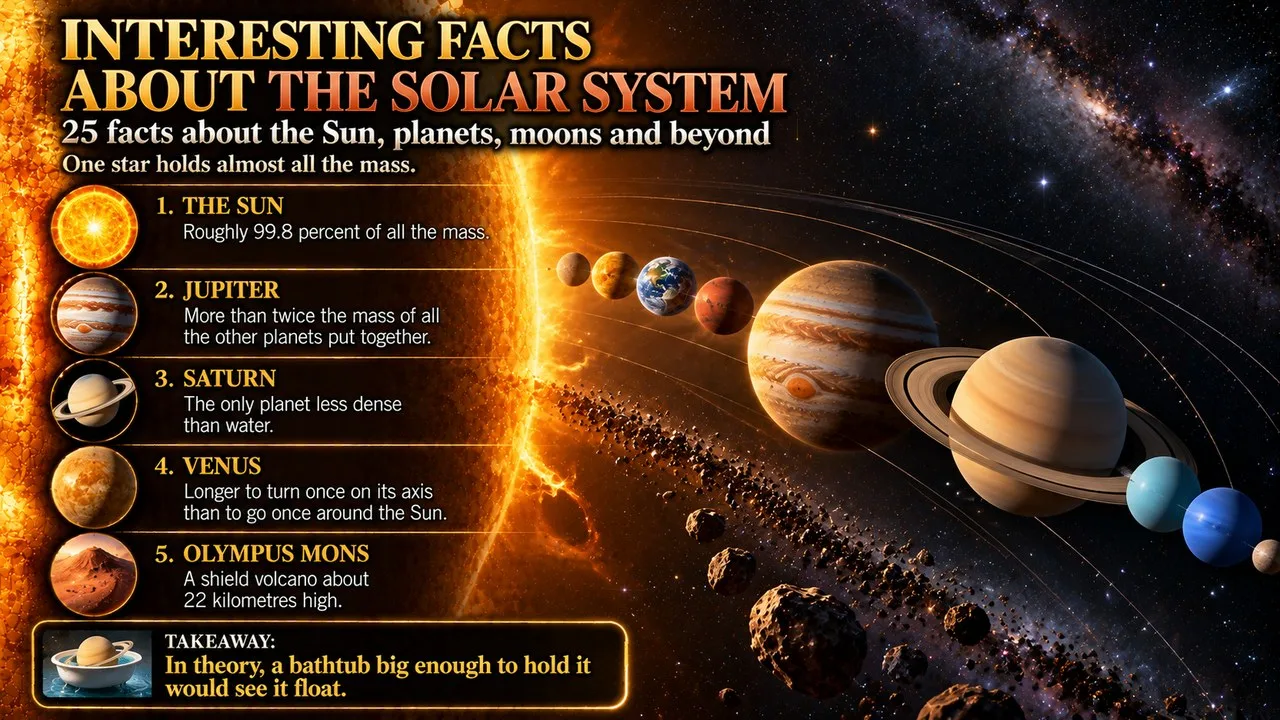
The Solar System is the gravitationally bound system of the Sun and everything that orbits it, most notably its eight planets, of which Earth is one.[1] It formed about 4.6 billion years ago, when a dense region of a molecular cloud collapsed into the Sun and a disc of material from which the planets grew.[1] The Sun holds 99.86 percent of the system's mass, and its solar wind blows out a bubble called the heliosphere that surrounds the planets.[1]
Introduction
This Finepedia guide, updated in October 2026, collects the top 25 interesting facts about the Solar System. It starts with the Sun, moves outward planet by planet, visits the most remarkable moons, and ends at the Kuiper belt, the Oort cloud and the Solar System's long journey around the galaxy. Every figure is cited.
Key Facts
| Property | Value |
|---|---|
| Age | About 4.6 billion years |
| Central star | The Sun, a G-type main-sequence star |
| Sun's share of mass | 99.86 percent |
| Planets | 8 |
| Largest planet | Jupiter |
| Hottest planet | Venus, about 464 °C |
| Tallest mountain | Olympus Mons on Mars, about 21.3 km |
| Largest moon | Ganymede |
| Most distant spacecraft | Voyager 1, 172.52 AU in October 2026 |
| Orbit around the galaxy | About 225 million years |
Sources: the articles on the Solar System, Venus, Olympus Mons, Ganymede, Voyager 1 and the galactic year.[1][7][10][13][23][24]
How the Facts Were Chosen
The list moves outward from the Sun, through the eight planets and their moons, to the icy outer regions, and finishes with facts about the whole Solar System. Only facts with a current source are included. Numbers that change as new moons are found, such as moon counts, are given with the latest value from the source.
The 25 Facts at a Glance
| No. | Fact |
|---|---|
| 1 | The Sun holds 99.86 percent of the mass |
| 2 | Sunlight takes about eight minutes to reach Earth |
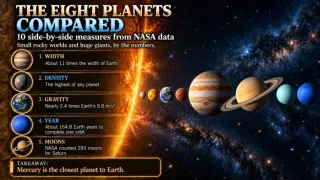
| 3 | There are eight planets |
| 4 | Pluto was reclassified in 2006 |
| 5 | Jupiter outweighs all the other planets combined |
| 6 | Saturn is less dense than water |
| 7 | Venus is the hottest planet |
| 8 | A day on Venus is longer than its year |
| 9 | Mercury has huge temperature swings |
| 10 | Mars has the tallest volcano |
| 11 | Uranus rotates on its side |
| 12 | Neptune has the fastest winds |
| 13 | Ganymede is bigger than Mercury |
| 14 | Io is the most volcanic world |
| 15 | Titan has lakes, but not of water |
| 16 | Several moons may hide oceans |
| 17 | The Moon is slowly moving away |
| 18 | The asteroid belt is mostly empty space |
| 19 | The Kuiper belt lies beyond Neptune |
| 20 | The Oort cloud may reach 3 light-years out |
| 21 | Comets are dirty snowballs |
| 22 | Planetary orbits are ellipses |
| 23 | Voyager 1 has entered interstellar space |
| 24 | The Solar System orbits the galaxy |
| 25 | The Sun will become a red giant |
1. The Sun Holds 99.86 Percent of the Mass
The Sun is a G-type main-sequence star that holds 99.86 percent of the Solar System's known mass and dominates it gravitationally.[1] It is the largest and most massive object in the system, with a diameter of about 1,391,400 kilometres, around 109 times that of Earth.[2]
Its visible surface is mostly hydrogen, about 73 percent, and helium, about 25 percent.[2] Every second, its core fuses about 600 billion kilograms of hydrogen into helium and turns four billion kilograms of matter into energy.[2]
2. Sunlight Takes About Eight Minutes to Reach Earth
The Sun's average distance from Earth is about 149.6 million kilometres, or about eight light-minutes.[2] This means the Sun we see in the sky is the Sun as it was about eight minutes earlier.[2]
The Sun is by far the biggest thing in the Solar System. Its mass is about 330,000 times that of Earth, and it makes up about 99.86 percent of the total mass of the Solar System.[2] Its gravity holds the planets, dwarf planets, asteroids and comets in their orbits, and its light and heat make life on Earth possible.[1][2]
3. There Are Eight Planets
The eight planets are, by definition, the objects that dominate the orbits they occupy.[1] In order from the Sun, they are Mercury, Venus, Earth, Mars, Jupiter, Saturn, Uranus and Neptune.[1] In August 2006 the International Astronomical Union adopted a definition stating that a planet in the Solar System orbits the Sun, has enough mass to be round, and has cleared the neighbourhood around its orbit.[3]
The new definition meant that Pluto, counted as the ninth planet since its discovery in 1930, became a dwarf planet, because it has not cleared its orbit of the other icy bodies in the Kuiper belt.[3][4] Pluto now sits in a group of dwarf planets with Haumea, Makemake and Eris in the outer Solar System and Ceres in the asteroid belt.[3]
4. Pluto Was Reclassified in 2006
Clyde Tombaugh discovered Pluto in 1930, making it the first known object in the Kuiper belt.[4] In 2006 the IAU formally redefined the term planet to exclude dwarf planets such as Pluto, although many planetary scientists still consider dwarf planets to be planets.[4] Part of the reason was the discovery of Eris, which a first measurement in 2006 wrongly suggested was slightly larger than Pluto.[3]
NASA's New Horizons was the first spacecraft to visit Pluto, flying past it on 14 July 2015.[4] Pluto has five known moons. The largest, Charon, is just over half Pluto's diameter, and the two are sometimes called a binary system because their centre of mass lies outside both bodies.[4]
5. Jupiter Outweighs All the Other Planets Combined
Jupiter is a gas giant with nearly 2.5 times the mass of all the other planets in the Solar System combined, and slightly less than one-thousandth the mass of the Sun.[5] It is about eleven times wider than Earth and 318 times as massive.[5]
Its Great Red Spot is a long-lasting storm 22 degrees south of the equator.[5] At least 115 moons orbit Jupiter, and the four largest, Io, Europa, Ganymede and Callisto, can be seen with ordinary binoculars.[5]
Related: Top 10 Surprising Facts About Our Solar System
6. Saturn Is Less Dense Than Water
Saturn is the only planet in the Solar System that is less dense than water, by about 30 percent.[6] It has one-eighth of Earth's average density but is more than 95 times as massive.[6]
Its bright rings are made mainly of ice particles, with smaller amounts of rock and dust.[6] Saturn has 293 known moons, 63 of which have formal names, not counting hundreds of moonlets in the rings.[6]
7. Venus Is the Hottest Planet
Venus is closer to the Sun than Earth, but it is not the closest planet, yet it is the hottest. Its average surface temperature is 464 °C, and its surface pressure is 92 times that of Earth at sea level.[7]
Its atmosphere, rich in carbon dioxide, creates the strongest greenhouse effect in the Solar System.[7] Venus has no moons.[7]
8. A Day on Venus Is Longer Than Its Year
Venus spins very slowly and backwards. Unlike most planets, it rotates clockwise, opposite to the direction of its orbit around the Sun.[7]
Its sidereal day, one full turn measured against the stars, lasts 243 Earth days, which is longer than its year of 224.7 Earth days.[7] Its solar day, from one sunrise to the next, is 116.75 Earth days, about half a Venusian year.[7]
9. Mercury Has Huge Temperature Swings
Mercury is the closest planet to the Sun and the smallest planet in the Solar System, with an equatorial radius of 2,439.7 kilometres.[8] Its equatorial regions range from −170 °C at night to 420 °C in sunlight.[8] Mariner 10 made the first successful flyby of Mercury in 1974, and the MESSENGER and BepiColombo orbiters have since studied it.[8]
Mercury has almost no atmosphere to trap heat, so the night side cools quickly after sunset.[8] It also rotates unusually. Mercury spins exactly three times for every two orbits of the Sun, a 3:2 spin-orbit resonance, so one solar day from sunrise to sunrise lasts about 176 Earth days, twice as long as its year.[8]
10. Mars Has the Tallest Volcano
Olympus Mons is the tallest volcano on Mars and the tallest planetary mountain in the Solar System. It is roughly tied with Rheasilvia on the asteroid Vesta as the tallest mountain found so far.[10]
The Mars Orbiter Laser Altimeter measured it at 21.287 kilometres high, about 2.5 times the height of Mount Everest above sea level.[10] The volcano is about 600 kilometres wide.[10]
11. Uranus Rotates on Its Side
The axis of Uranus lies almost parallel to the plane of the Solar System. Its tilt can be given as 82.23 degrees or 97.77 degrees, depending on which pole is called north.[11] A day on Uranus lasts 17 hours and 14 minutes, and it rotates in the retrograde direction.[11]
Related: Top 10 Asteroids That Passed Closer Than Many Satellites
William Herschel first observed it as a planet on 13 March 1781. It was the first planet discovered in recorded history.[11] Only one spacecraft has visited it: Voyager 2, which flew past in 1986.[11]
12. Neptune Has the Fastest Winds
Neptune has the strongest sustained winds of any planet, reaching up to 2,100 kilometres per hour.[12] It is more than 50 percent farther from the Sun than Uranus and gets only about 40 percent as much sunlight, but its internal energy still drives the fastest planetary winds in the Solar System.[12]
Neptune was found by mathematics. John Couch Adams and Urbain Le Verrier independently predicted its position, and Johann Gottfried Galle saw it on 23 September 1846, within a degree of Le Verrier's prediction.[12] Its largest moon, Triton, holds more than 99.5 percent of the mass orbiting Neptune.[12]
13. Ganymede Is Bigger Than Mercury
Ganymede, a moon of Jupiter, is the largest and most massive moon in the Solar System. Like Saturn's moon Titan, it is larger than the planet Mercury.[13]
It is the only moon known to have its own internally generated magnetic field.[13] Its underground ocean may hold more water than all of Earth's oceans combined. The Galileo spacecraft discovered both the ocean and the magnetic field.[13]
14. Io Is the Most Volcanic World
Jupiter's moon Io has more than 400 active volcanoes, making it the most geologically active object in the Solar System.[14] Its volcanic plumes and lava flows keep changing the surface, painting it yellow, red, white, black and green, mostly with sulfur compounds.[14]
Io's heat does not come from radioactive decay, as on Earth, but from tidal heating. As Io orbits, it is constantly pulled between Jupiter and two other large moons, Europa and Ganymede, and the flexing creates friction inside it.[14] Its volcanoes were discovered in 1979, when the Voyager 1 and Voyager 2 probes flew past and revealed a young surface with no obvious impact craters.[14]
15. Titan Has Lakes, but Not of Water
Titan, Saturn's largest moon, was discovered in 1655 by the Dutch astronomer Christiaan Huygens.[15] It is the only moon known to have a dense atmosphere, denser than Earth's, and the only object besides Earth with clear evidence of stable liquid on its surface.[15]
Its atmosphere is mainly nitrogen and methane. The Cassini–Huygens mission, which arrived in 2004, discovered lakes of liquid hydrocarbons.[15]
16. Several Moons May Hide Oceans
Europa, another moon of Jupiter, has a young, smooth surface because of a water ocean beneath it, which could possibly support life.[16] Heat from tidal flexing probably keeps the ocean liquid.[16]
On Saturn's moon Enceladus, the Cassini spacecraft discovered water-rich plumes venting from the south polar region.[17] Ganymede's underground ocean may hold more water than all of Earth's oceans.[13]
Related: The Phenomenon of Solar Flares: Unlocking Solar Mysteries
17. The Moon Is Slowly Moving Away
Tides raised by the Moon transfer energy that pushes the Moon slowly outward. Lunar laser ranging, which bounces laser pulses off reflectors on the Moon, tracks its motion to within a few centimetres.[18]
Tidal deposits show that 620 million years ago a day lasted about 21.9 hours.[18] The Moon has receded at an average of 2.17 centimetres per year since then, about half the present rate.[18]
18. The Asteroid Belt Is Mostly Empty Space
The asteroid belt lies between Mars and Jupiter, but it is far emptier than films suggest. Its asteroids are, on average, about one million kilometres apart.[19]
The belt's total mass is only about 3 percent of the Moon's, and about 60 percent of it is in the four largest objects: Ceres, Vesta, Pallas and Hygiea.[19] About 99.9 percent of the belt's original mass was lost in the first 100 million years of the Solar System.[19]
19. The Kuiper Belt Lies Beyond Neptune
The Kuiper belt is a disc in the outer Solar System. It stretches from the orbit of Neptune, at 30 astronomical units, to about 50 AU from the Sun.[20]
It is like the asteroid belt but far larger, 20 times as wide and 20 to 200 times as massive.[20] It holds most of the generally accepted dwarf planets: Orcus, Pluto, Haumea, Quaoar and Makemake.[20]
20. The Oort Cloud May Reach 3 Light-Years Out
The Oort cloud is a theorised cloud of billions of icy bodies surrounding the Sun at distances of 2,000 to 200,000 AU, or 0.03 to 3.2 light-years.[21] Long-period comets, which travel on very large orbits thousands of AU from the Sun and arrive from all directions, are thought to come from it.[21]
The Dutch astronomer Jan Oort proposed the cloud in 1950 to explain where long-period comets come from.[21] Astronomers think its icy bodies formed much closer to the Sun, in the disc of material that formed the planets, and were then scattered far out into space by the gravity of the giant planets.[21]
21. Comets Are Dirty Snowballs
A comet's nucleus is a loose collection of ice, dust and small rocky particles, from a few hundred metres to tens of kilometres across.[22] Because they contain frozen gases, comets are popularly called "dirty snowballs", after Fred Whipple's model.[22]
Near the Sun, the ice heats up and forms a coma, which can be up to 15 times Earth's diameter, and a tail of gas and dust.[22] The Giotto probe found that the nucleus of Halley's Comet reflects only about four percent of the light falling on it.[22]
22. Planetary Orbits Are Ellipses
Johannes Kepler published his three laws of planetary motion between 1609 and 1621.[9] The first law says that the orbit of a planet is an ellipse with the Sun at one of its two foci.[9] Because of this, every planet's distance from the Sun changes during its year.[9]
Related: Top 10 Mythical Creatures in World Mythology - That Inspired Myths Across Civilizations (unchanged)
Kepler's second law says that a line joining a planet and the Sun sweeps out equal areas in equal times, so a planet moves faster when it is close to the Sun and more slowly when it is far away.[9] His third law links the size of an orbit to the time a planet takes to complete it, and Isaac Newton later showed that the laws follow from his law of universal gravitation.[9]
23. Voyager 1 Has Entered Interstellar Space
NASA launched Voyager 1 on 5 September 1977, 16 days after its twin, Voyager 2.[23] On 25 August 2012 it crossed the heliopause and became the first spacecraft to enter interstellar space.[23]
As of October 2026 it was 172.52 AU, or 25.8 billion kilometres, from Earth, making it the most distant human-made object. It is projected to reach a distance of one light-day from Earth on 18 November 2026.[23]
24. The Solar System Orbits the Galaxy
The Solar System travels around the centre of the Milky Way at an average speed of 230 kilometres per second, or 828,000 kilometres per hour.[24] One full orbit, called a galactic year, takes about 225 million Earth years.[24]
The Sun follows a nearly circular orbit around the Galactic Center, where the supermassive black hole Sagittarius A* lies, at a distance of about 26,660 light-years.[1] The Solar System sits in the Orion Arm of the Milky Way, which contains most of the stars that can be seen with the unaided eye.[1]
25. The Sun Will Become a Red Giant
In about four to seven billion years, hydrogen fusion in the Sun's core will slow so much that the core will grow denser and hotter, and the Sun will swell into a red giant.[2] After that phase, models suggest it will shed its outer layers and become a white dwarf, a dense, cooling star that no longer makes energy by fusion.[2]
The Sun formed about 4.6 billion years ago from the collapse of part of a large molecular cloud, so it is roughly halfway through its life as a main-sequence star.[2] It does not have enough mass to explode as a supernova, so it will end its life far more quietly than the giant stars that forged many of the elements in the Solar System.[2]
Key Figures
- 99.86 percent: The Sun's share of the Solar System's mass.[1]
- 4.6 billion years: Age of the Solar System.[1]
- 8 minutes: Time sunlight takes to reach Earth.[2]
- 2.5 times: Jupiter's mass compared with all other planets combined.[5]
- 464 °C: Average surface temperature of Venus.[7]
- 2,100 km/h: Top wind speed on Neptune.[12]
- 400+: Active volcanoes on Io.[14]
- 172.52 AU: Distance of Voyager 1 from Earth in October 2026.[23]
- 225 million years: Length of one galactic year.[24]
Frequently Asked Questions
How many planets are in the Solar System?
Eight: Mercury, Venus, Earth, Mars, Jupiter, Saturn, Uranus and Neptune.[1]
Why is Pluto no longer a planet?
In 2006 the IAU redefined the term planet to exclude dwarf planets such as Pluto.[4]
Which is the hottest planet?
Venus, with an average surface temperature of 464 °C.[7]
What is the largest moon?
Ganymede, a moon of Jupiter, which is larger than Mercury.[13]
What is the most distant spacecraft?
Voyager 1, which entered interstellar space in 2012.[23]
Conclusion
The Solar System is a family of very different worlds held together by one star. The Sun contains almost all of its mass, yet the planets range from scorching Mercury and cloud-covered Venus to the gas giants Jupiter and Saturn and the cold ice giants Uranus and Neptune.[1][2][5][7][8] Beyond them stretch the Kuiper belt and the far larger Oort cloud, whose outer edge may lie more than three light-years away.[20][21]
Spacecraft have changed how we see our neighbourhood. Probes have shown volcanoes on Io, signs of oceans hidden under the ice of Europa and Enceladus, and lakes on Titan, and Voyager 1 has become the first spacecraft to reach interstellar space.[14][15][16][17][23] Each new mission adds detail to the picture, and some of the figures in this list, such as the number of known moons, are likely to keep changing.[1]
See also
- Interesting Facts About the Solar System
- Top 25 Interesting Facts About the Universe
- Top 25 Interesting Facts About Earth
- ^ [1] "Solar System". Wikipedia. Wikipedia
- ^ [2] "Sun". Wikipedia. Wikipedia
- ^ [3] "IAU definition of planet". Wikipedia. Wikipedia
- ^ [4] "Pluto". Wikipedia. Wikipedia
- ^ [5] "Jupiter". Wikipedia. Wikipedia
- ^ [6] "Saturn". Wikipedia. Wikipedia
- ^ [7] "Venus". Wikipedia. Wikipedia
- ^ [8] "Mercury (planet)". Wikipedia. Wikipedia
- ^ [9] "Kepler's laws of planetary motion". Wikipedia. Wikipedia
- ^ [10] "Olympus Mons". Wikipedia. Wikipedia
- ^ [11] "Uranus". Wikipedia. Wikipedia
- ^ [12] "Neptune". Wikipedia. Wikipedia
- ^ [13] "Ganymede (moon)". Wikipedia. Wikipedia
- ^ [14] "Io (moon)". Wikipedia. Wikipedia
- ^ [15] "Titan (moon)". Wikipedia. Wikipedia
- ^ [16] "Europa (moon)". Wikipedia. Wikipedia
- ^ [17] "Enceladus". Wikipedia. Wikipedia
- ^ [18] "Tidal acceleration". Wikipedia. Wikipedia
- ^ [19] "Asteroid belt". Wikipedia. Wikipedia
- ^ [20] "Kuiper belt". Wikipedia. Wikipedia
- ^ [21] "Oort cloud". Wikipedia. Wikipedia
- ^ [22] "Comet". Wikipedia. Wikipedia
- ^ [23] "Voyager 1". Wikipedia. Wikipedia
- ^ [24] "Galactic year". Wikipedia. Wikipedia





















Discussion
Log in with