





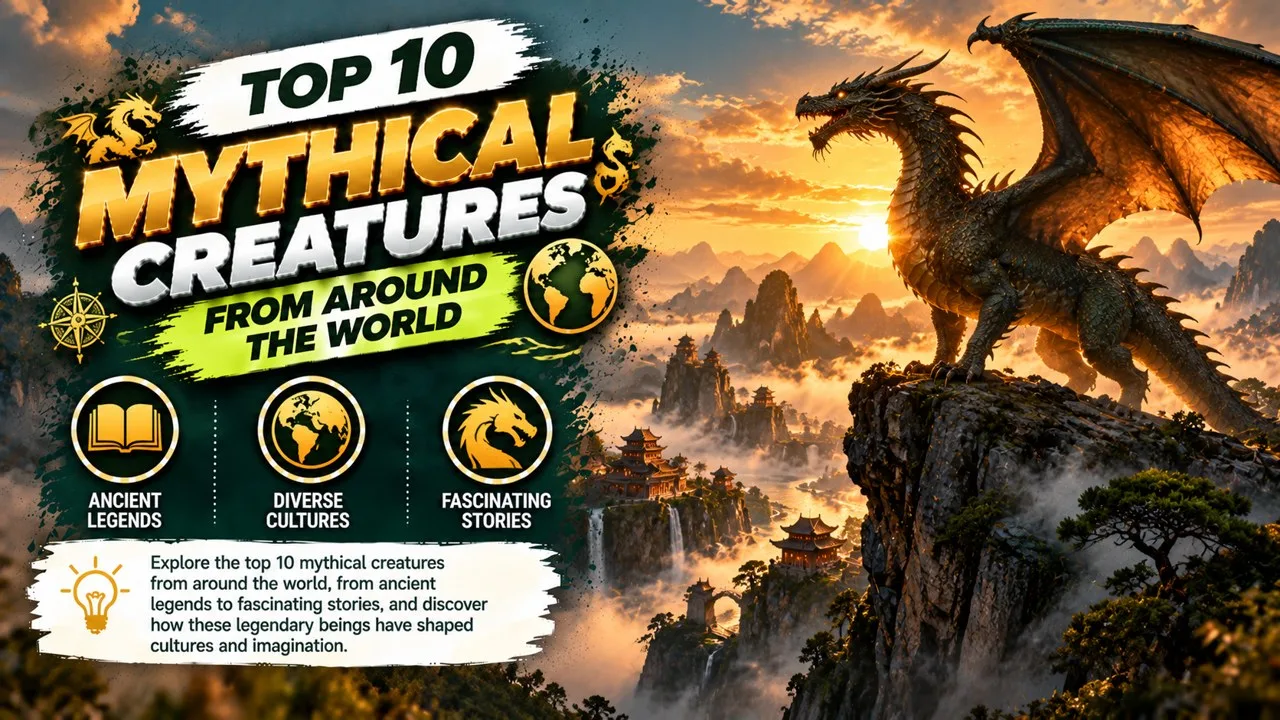
Mythical creatures have captured human imagination for centuries. From ancient legends to modern-day fantasy, these creatures embody the unknown, the mysterious, and often the supernatural. They have played crucial roles in folklore, religion, and even art, acting as symbols of fear, wisdom, or wonder. Some of these creatures have been believed to exist in times past, while others remain purely fantastical.
In this article, we will explore the top ten mythical creatures from different cultures across the globe. These creatures range from terrifying monsters to wise and powerful beings. Each of them has a unique place in the mythologies and stories that have been passed down through generations.
1. Dragon
Origins and Appearance
The dragon is one of the most iconic mythical creatures in global folklore. While the appearance and nature of dragons vary significantly across cultures, they are typically depicted as large, serpentine creatures with the ability to fly and breathe fire.
- Chinese Dragons: In Chinese mythology, dragons are considered symbols of strength, power, and good fortune. They are often shown as long, snake-like creatures with antler-like horns and are believed to control water, rainfall, and the rivers. Unlike Western dragons, which are usually antagonistic, Chinese dragons are benevolent and bring prosperity.
- Western Dragons: In contrast, Western dragons are often viewed as evil and destructive creatures, hoarding treasure in their caves and terrorizing villages. They are typically depicted with massive, bat-like wings and the ability to spew fire. The famous tale of Saint George and the Dragon is a quintessential example of the Western dragon’s role in mythology, where a hero defeats the beast to save a princess and the village.
Mythological Significance
In many cultures, dragons symbolize a balance between good and evil, with some cultures focusing on their role as protectors of sacred places, while others emphasize the chaos and destruction they bring. Regardless of their moral alignment, dragons have always been symbols of immense power, representing both the dangers of nature and the wisdom of ancient times.
2. Phoenix
Origins and Appearance
The phoenix is a mythological bird, found in several cultures, including Greek, Egyptian, and Chinese mythology. This majestic creature is known for its fiery death and rebirth cycle, symbolizing immortality, renewal, and resurrection.
- Greek and Roman Mythology: In ancient Greece and Rome, the phoenix was said to live for several hundred years before setting itself on fire and being reborn from its own ashes. The bird was often depicted with red and gold feathers, resembling flames.
- Egyptian Mythology: The Egyptian version of the phoenix, known as the Bennu, was associated with the sun god Ra. It was said to rise from the ashes of the old world, signaling a new dawn. In this version, the phoenix represents cycles of life and death, linked to the sun’s daily journey across the sky.
Mythological Significance
The phoenix’s story of resurrection represents hope, change, and transformation. It’s a symbol of overcoming adversity and emerging stronger from challenges, making it a powerful figure in cultures worldwide. The phoenix has been associated with cycles of life, death, and renewal, making it a symbol of eternal life and the resilience of the human spirit.
3. Unicorn
Origins and Appearance
The unicorn is a mythical creature, often depicted as a white horse with a single spiral horn growing from its forehead. It has appeared in various ancient myths and legends, with its earliest known depictions coming from ancient Mesopotamia, India, and China.
- European Mythology: In European folklore, the unicorn was often seen as a symbol of purity and grace. It was said to be impossible to capture unless it willingly surrendered itself to a virgin, a tale that likely stems from the creature’s symbolism as a representation of innocence and chastity.
- Chinese Mythology: In China, the unicorn is represented by the "Qilin," a hybrid creature with features of a dragon, deer, and horse. Known as a bringer of good fortune, it is not necessarily a horse but a symbolic creature of great importance.
Mythological Significance
Unicorns are often seen as symbols of purity, beauty, and rarity. The belief in their existence spans many cultures, and they have been used in religious and royal symbols, representing divine protection and a connection to the heavenly realm. In many ways, the unicorn symbolizes the unattainable or the ideal, a perfect creature that cannot be easily reached.
4. Kraken
Origins and Appearance
The kraken is a legendary sea monster said to dwell off the coast of Norway and Greenland. This enormous creature is often described as resembling a giant octopus or squid, capable of dragging entire ships and their crew beneath the waves.
- Norse Mythology: The kraken is deeply rooted in Scandinavian folklore. Descriptions vary, but the creature is often depicted as having numerous long tentacles and a terrifying presence that strikes fear into sailors.
- Modern Depictions: The kraken has since been popularized in modern stories, including works like Pirates of the Caribbean, where the beast terrorizes ships at sea. Its portrayal as a massive, multi-tentacled creature has become a common archetype in monster stories.
Mythological Significance
The kraken represents the unknown terror of the sea. Sailors, in ancient times, relied heavily on the sea for their livelihoods, and the kraken embodied the dangers of this mysterious and unpredictable world. It serves as a reminder of humanity’s frailty when faced with the power of nature.
5. Chimera
Origins and Appearance
The chimera is a monstrous creature from Greek mythology, often depicted as a hybrid of several animals. It typically has the head of a lion, the body of a goat, and a serpent’s tail.
- Greek Mythology: The chimera is often described as a fire-breathing creature that terrorized the land until it was slain by the hero Bellerophon. It was said to be an omen of destruction and a symbol of chaos and unnatural combinations.
Mythological Significance
The chimera symbolizes the idea of hybridization, or unnatural unions of different creatures. It also represents chaos and the breaking of natural laws, embodying the fears of monstrous or unholy creatures that disrupt the balance of nature.
6. Bigfoot
Origins and Appearance
Bigfoot, also known as Sasquatch, is a legendary ape-like creature said to inhabit forests in North America. Descriptions of Bigfoot vary, but it is typically described as a large, human-like figure covered in hair, with footprints that resemble those of a giant.
- North American Folklore: Stories of Bigfoot have been passed down through indigenous tribes for centuries, with numerous sightings reported over the years, particularly in the Pacific Northwest. The creature is often associated with wilderness areas and is believed to be elusive and solitary.
Mythological Significance
Bigfoot has become a modern symbol of the unknown and the wild. While many dismiss the creature as mere folklore or misidentification of other animals, the stories persist as a testament to the mysterious and unexplored parts of the world. Bigfoot represents the idea of a hidden, intelligent being living just out of sight from humans, feeding into our fascination with the unexplained.
7. Basilisk
Origins and Appearance
The basilisk is a legendary reptilian creature that originated in European folklore. It is often described as a serpent or lizard with the ability to kill with its gaze. In some versions, it is said to be a hybrid of a rooster and a snake.
- European Folklore: According to legend, the basilisk’s mere stare could cause death, turning people and animals to stone. In some tales, the creature’s breath and venom were equally lethal. The basilisk was often considered the king of serpents, feared for its deadly powers.
Mythological Significance
The basilisk represents the fear of deadly, unseen forces. Its myth embodies the idea of a creature so powerful that it can cause death with no physical contact, symbolizing the dangers of the unknown. The basilisk’s power and mystique have made it a popular figure in literature, particularly in works like Harry Potter, where its gaze is just as lethal as its venom.
8. Yeti
Origins and Appearance
The yeti, or "abominable snowman," is a creature from Himalayan folklore. Descriptions of the yeti vary, but it is typically portrayed as a large, ape-like being that lives in the snowy regions of the Himalayas.
- Himalayan Mythology: The yeti is often considered a spiritual being by indigenous people, and sightings of the creature have been reported by explorers and climbers for decades. However, no definitive evidence of the creature’s existence has ever been found.
Mythological Significance
The yeti represents the mysteries of the high mountains and the unknown lands. It is also a symbol of humanity’s search for hidden knowledge and discovery. The creature remains a powerful myth, embodying the allure of unexplored places and the danger of venturing too far into the wilderness.
9. Manticore
Origins and Appearance
The manticore is a legendary creature from Persian mythology, often depicted with the body of a lion, the head of a man, and a tail that can shoot poisonous spines.
- Persian Mythology: The manticore was feared for its deadly attacks, which included both physical and venomous assaults. It was said to be a terrifying predator, capable of consuming humans and other animals alike.
Mythological Significance
The manticore represents the blending of different creatures into a fearsome beast, embodying both the power of nature and the horror of the unknown. It is a symbol of both strength and unpredictability, often used to represent untamable forces in the world.
10. Gorgon
Origins and Appearance
The gorgon is a fearsome creature from Greek mythology, often depicted as a woman with snakes for hair. The most famous gorgon is Medusa, whose gaze could turn people to stone.
- Greek Mythology: Gorgons were generally seen as malevolent beings, often portrayed as grotesque and terrifying. Medusa, the most well-known gorgon, was transformed into a monster as punishment, and her gaze was so deadly that it turned anyone who looked at her into stone.
Mythological Significance
The gorgon represents the power of transformation and the terrifying aspects of female power. In many ways, it symbolizes the fear of the unknown and the consequences of crossing boundaries, with Medusa's story especially reflecting themes of punishment and revenge.
Conclusion
From fire-breathing dragons to shape-shifting manticores, mythical creatures have fascinated us for centuries. Each of these beings embodies a particular cultural fear, belief, or desire, and they have inspired countless stories, art, and even modern fantasy works. Whether they are representations of natural disasters, human traits, or the unknown, these creatures continue to captivate our imagination, serving as reminders of the worlds beyond our own.





















Log in with