






Top 25 Interesting Facts About the Universe
 By Dhiraj Sharma · Published
· Updated
Share Post
Loading…
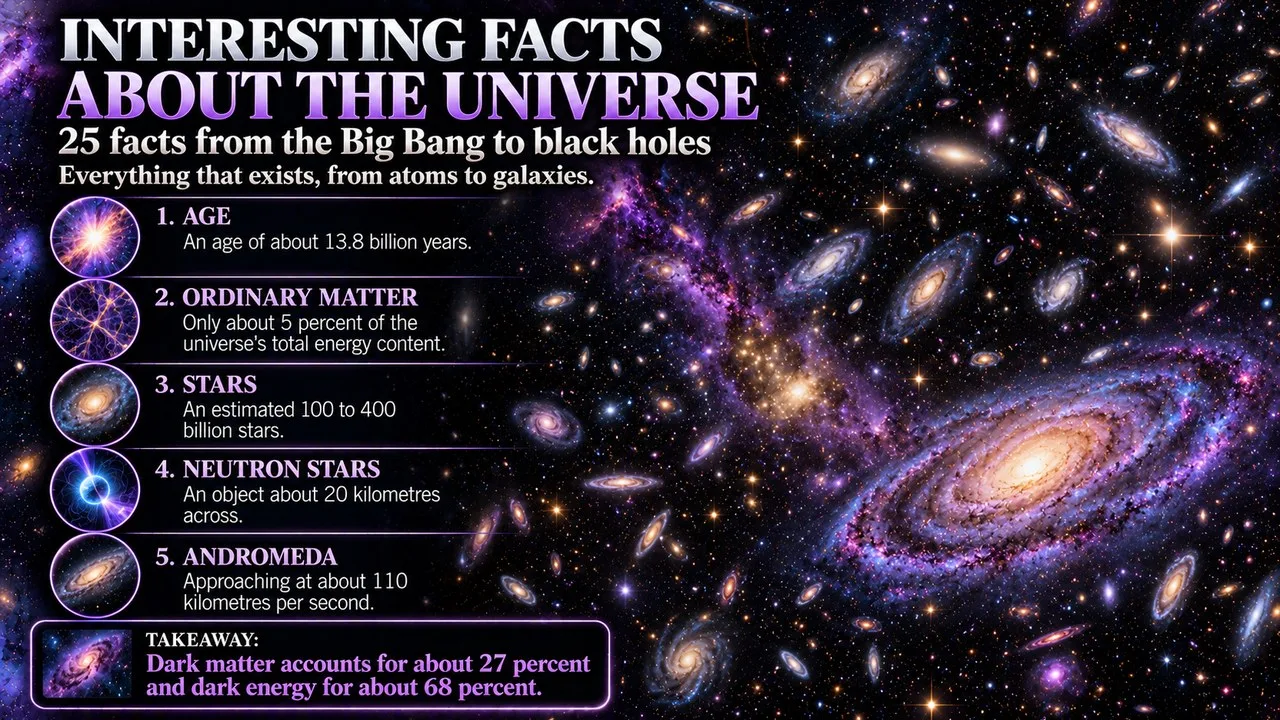
The universe is all of existence: every form of matter and energy in space and time, and the structures they make, from subatomic particles to vast galaxy filaments.[1] Cosmology has shown that it has been expanding for 13.8 billion years, since a hot, dense beginning called the Big Bang.[1] The part we can observe is about 93 billion light-years across, and nobody knows the size of the whole universe.[1]
Introduction
This Finepedia guide, updated in October 2026, collects the top 25 interesting facts about the universe. It covers the universe's age, size and invisible ingredients, its strangest objects, such as black holes and neutron stars, and the ways it might end. Each fact is cited, and where a famous figure has been revised, the article gives the current value.
Key Facts
| Property | Value |
|---|---|
| Age | About 13.8 billion years |
| Observable diameter | About 93 billion light-years |
| Galaxies in the observable universe | Up to about 2 trillion |
| Stars | Up to about 10^24 |
| Dark energy | About 68 percent of mass-energy |
| Ordinary matter | About 4.84 percent |
| Temperature of the cosmic microwave background | About 2.725 K |
| Speed of light | 299,792,458 m/s |
| Confirmed exoplanets | 6,445 (8 October 2026) |
Sources: Universe, Dark energy, Cosmic microwave background, Speed of light and Exoplanet.[1][6][9][20][10]
How the Facts Were Chosen
Cosmology changes quickly, and many popular facts about the universe are out of date. This list keeps only facts backed by current measurements. It runs from the universe's age and size, through what it is made of and its most extreme objects, to its large-scale structure and possible futures. Facts about the Sun and planets are covered in the Finepedia guide to the Solar System.
The 25 Facts at a Glance
| No. | Fact |
|---|---|
| 1 | The universe is about 13.8 billion years old |
| 2 | The universe is expanding |
| 3 | The expansion is speeding up |
| 4 | The observable universe is about 93 billion light-years wide |
| 5 | Ordinary matter is less than 5 percent of the universe |
| 6 | Dark matter makes up 85 percent of all mass |
| 7 | There may be 2 trillion galaxies |
| 8 | Stars outnumber grains of sand on Earth |
| 9 | The cosmic microwave background is the oldest light |
| 10 | More than 6,400 exoplanets have been confirmed |
| 11 | Rogue planets drift without a star |
| 12 | Black holes have now been photographed |
| 13 | Time runs slower near strong gravity |
| 14 | Neutron stars are as dense as atomic nuclei |
| 15 | Space ripples with gravitational waves |
| 16 | The biggest stars dwarf the Sun |
| 17 | Some galaxies are enormous |
| 18 | Galaxies are arranged in a cosmic web |
| 19 | The Milky Way may merge with Andromeda |
| 20 | Light sets the cosmic speed limit |
| 21 | Most elements were forged in stars |
| 22 | The Boomerang Nebula is the coldest known natural place |
| 23 | Looking far away means looking back in time |
| 24 | Our universe may not be the only one |
| 25 | The universe has several possible endings |
1. The Universe Is About 13.8 Billion Years Old
The universe has been expanding for 13.8 billion years.[1] Using the latest models and data from the Planck mission, the age of the universe is 13.8 billion years.[2]
The ages of the oldest known stars broadly agree. Estimates for the Methuselah star give 14.27 billion years, give or take 0.80 billion, which overlaps with the age of the universe once the uncertainty is included.[2]
2. The Universe Is Expanding
Hubble's law, officially the Hubble–Lemaître law, is the observation that galaxies are moving away from Earth at speeds proportional to their distance.[3] The discovery is usually credited to Edwin Hubble's work published in 1929. Alexander Friedmann had derived an expanding universe from the equations of general relativity in 1922, and in 1927 Georges Lemaître noticed that the speed of distant galaxies was proportional to their distance.[3]
Measurements of the current expansion rate made in different ways have produced two precise values that do not agree. The difference, now highly statistically significant, is known as the Hubble tension.[3]
3. The Expansion Is Speeding Up
In 1998, two independent teams, the Supernova Cosmology Project and the High-Z Supernova Search Team, discovered that the expansion of the universe is accelerating.[4] They used distant type Ia supernovae, which all have almost the same true brightness.
By comparing how dim the supernovae look with how much their light is redshifted, the teams could measure the expansion over time.[4] Three members of the two groups later received Nobel Prizes for the discovery.[4] The cause of the acceleration is called dark energy, and its main candidate explanation is a cosmological constant, an energy density that fills space evenly.[6]
4. The Observable Universe Is About 93 Billion Light-Years Wide
The universe is 13.8 billion years old, yet the observable universe is much wider than 13.8 billion light-years. That is because space has kept expanding while light has been travelling towards us.[1]
The proper distance from Earth to the edge of the observable universe is about 46 billion light-years, so its diameter is about 93 billion light-years.[1] The radius is estimated at about 46.5 billion light-years.[5] In the far future, the limit of what could ever be seen is calculated at 62 billion light-years.[5]
5. Ordinary Matter Is Less Than 5 Percent of the Universe
Ordinary, or baryonic, matter makes up only about 4.84 percent of the universe.[1] Stars, planets and visible gas clouds make up only about 6 percent of that ordinary matter.[1] If the standard lambda-CDM model of cosmology is correct, dark energy makes up 68 percent of the mass-energy of the present observable universe.[6]
The rest of the universe cannot be seen with telescopes at all. Dark energy accounts for about 68 percent of its mass-energy and dark matter for most of the remainder, so everything made of atoms, from people to galaxies, is a small minority.[1][6][7] Ordinary matter that is not in stars or planets is thought to be spread mainly as thin gas between galaxies.[1]
6. Dark Matter Makes Up 85 Percent of All Mass
Dark matter makes up 85 percent of the total mass of the universe. Together, dark energy and dark matter make up 95 percent of its total mass-energy.[7]
Related: Top 10 Cosmic Puzzles Science Has Not Fully Solved
In 1933 the Swiss astrophysicist Fritz Zwicky studied the Coma Cluster and found evidence of unseen mass, which he called dunkle Materie, or dark matter.[7] Later, Vera Rubin and Kent Ford measured how fast stars orbit in spiral galaxies. Their rotation curves showed more mass than the visible stars could explain.[7]
7. There May Be 2 Trillion Galaxies
The observable universe may contain as many as 2 trillion galaxies.[1] Galaxies are classified by appearance as elliptical, spiral or irregular, and the Milky Way is a spiral galaxy.[8]
The Milky Way is a large disc-shaped barred spiral galaxy about 30 kiloparsecs, or roughly 100,000 light-years, across and about a kiloparsec thick.[8] The Sun is one of a few hundred billion stars in the Milky Way.[1]
8. Stars Outnumber Grains of Sand on Earth
The observable universe may hold as many as 10^24 stars. That is more stars, and more Earth-like planets, than all the grains of beach sand on Earth.[1]
Estimates like this are rough because nobody can count the stars one by one. Astronomers estimate how many galaxies there are and how many stars a typical galaxy contains, then multiply.[1] From Earth, only about 4,000 stars can be seen with the naked eye, and every one of them is in the Milky Way.[25]
9. The Cosmic Microwave Background Is the Oldest Light
When the universe was about 379,000 years old and had cooled to about 3,000 K, atoms formed and light could travel freely for the first time. This event is called recombination.[9]
That light still fills the universe as the cosmic microwave background, which has a black-body spectrum with a temperature of 2.72548 K.[9] The American radio astronomers Arno Penzias and Robert Woodrow Wilson discovered it by accident in 1964, using a radiometer at Bell Telephone Laboratories in New Jersey.[9]
10. More Than 6,400 Exoplanets Have Been Confirmed
As of 8 October 2026, 6,445 exoplanets had been confirmed in 4,834 planetary systems, and 1,070 of those systems have more than one planet.[10] The first confirmed exoplanets were found in 1992, when Aleksander Wolszczan and Dale Frail announced two planets orbiting the pulsar PSR B1257+12.[10] The first planet around a main-sequence star, like the Sun, was found in 1995.[10]
Most exoplanets have been found indirectly. The transit method looks for the tiny dip in a star's light when a planet passes in front of it, and the radial-velocity method looks for the slight wobble a planet's gravity causes in its star.[10] The Kepler space telescope, launched in 2009, found thousands of candidate planets with the transit method.[10]
11. Rogue Planets Drift Without a Star
Some planets do not orbit any star. The Milky Way alone may have billions to trillions of these rogue planets, and the Nancy Grace Roman Space Telescope is expected to narrow that range.[11] One study suggested up to 100,000 times more rogue planets than stars in the Milky Way, though it counted hypothetical objects much smaller than Jupiter.[11]
Rogue planets may form around a star and later be thrown out of their system, or they may form on their own, outside any planetary system.[11] Because they give off very little light, astronomers usually find them through gravitational microlensing, when a passing planet briefly magnifies the light of a more distant star.[11]
Related: Top 10 Ideas That Changed How We Think About Black Holes
12. Black Holes Have Now Been Photographed
A black hole is a region of space from which nothing can escape, not even light. In 1916, a few months after Einstein published the equations of general relativity, Karl Schwarzschild found the first solution that describes one.[12]
On 10 April 2019 the Event Horizon Telescope published the first direct image of a black hole, the supermassive black hole at the centre of the galaxy Messier 87.[12] In 2022 it released an image of Sagittarius A*, the black hole at the centre of the Milky Way, which has about 4.3 million times the mass of the Sun.[12]
13. Time Runs Slower Near Strong Gravity
Clocks far from massive bodies run faster, and clocks close to massive bodies run more slowly. This is called gravitational time dilation.[13] It has been shown by comparing atomic clocks at different heights, which eventually show different times.[13]
The effect is small on Earth but real enough to matter in daily life. The atomic clocks on the satellites of the Global Positioning System had to be permanently corrected for it, because they sit higher in Earth's gravity than clocks on the ground.[13] Near a black hole the effect becomes extreme, and to a distant observer time near the event horizon appears almost to stand still.[12][13]
14. Neutron Stars Are as Dense as Atomic Nuclei
A neutron star forms when the core of a massive star collapses in a supernova and is crushed past the density of a white dwarf to the density of atomic nuclei.[14] Contraction stops at a nuclear density of about 4 × 10^17 kilograms per cubic metre.[14]
Neutron stars have a radius of about 10 kilometres yet a mass of about 1.4 Suns.[14] Jocelyn Bell Burnell and Antony Hewish discovered pulsars in 1967, the first sign that neutron stars exist.[14] The fastest-spinning one known, PSR J1748−2446ad, rotates 716 times per second.[14]
15. Space Ripples With Gravitational Waves
Albert Einstein predicted gravitational waves, ripples in the curvature of spacetime, from his general theory of relativity.[15] The first direct detection came on 14 September 2015, when the LIGO detectors in Livingston, Louisiana, and Hanford, Washington, picked up a signal named GW150914.[15]
It came from two black holes, of 29 and 36 solar masses, merging about 1.3 billion light-years away. In the final fraction of a second, the merger released more than 50 times the power of all the stars in the observable universe combined.[15] Rainer Weiss, Kip Thorne and Barry Barish won the 2017 Nobel Prize in Physics for the detection.[15]
16. The Biggest Stars Dwarf the Sun
UY Scuti is considered one of the largest known stars. Its radius is estimated at 909 times that of the Sun, or 632 million kilometres, giving it a volume 750 million times the Sun's.[16] Older estimates gave a radius of 1,708 solar radii, which shows how hard it is to measure the edges of such swollen stars.[16]
UY Scuti is a red supergiant or hypergiant about 5,900 light-years away in the constellation Scutum.[16] Stars this large burn through their fuel quickly. The most massive stars end their lives in supernova explosions that leave behind a neutron star or a black hole.[14]
17. Some Galaxies Are Enormous
Alcyoneus is a radio galaxy first reported in February 2022 by Martijn Oei and colleagues using the LOFAR radio telescope.[17] Its radio lobes span 5 megaparsecs, or 16 million light-years, the second-largest radio structure of any known radio galaxy as of 2024.[17]
Related: Quasars: Distant Beacons or Local Oddballs?
The visible galaxy itself is about 242,700 light-years across.[17] By comparison, the Milky Way's diameter is at least 87,400 light-years.[8]
18. Galaxies Are Arranged in a Cosmic Web
Galaxy filaments are the largest known structures in the universe. They are made of walls of galaxy superclusters and form the cosmic web that shapes the observable universe.[18]
They commonly reach 50 to 80 megaparsecs, or 160 to 260 million light-years. The largest found so far, Quipu, spans 400 megaparsecs.[18]
19. The Milky Way May Merge With Andromeda
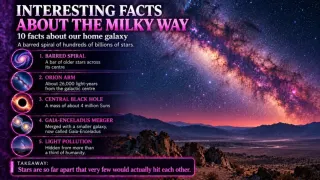
The Milky Way and the Andromeda Galaxy, the two largest galaxies in the Local Group, may collide in about 4.5 billion years.[19] The stars are so far apart that it is extremely unlikely any two of them would collide, though some stars may be thrown out.[19] The galaxy formed by the merger has been nicknamed Milkomeda or Milkdromeda.[19]
Even if the galaxies do merge, the Solar System would probably survive, although the Sun could end up in a different part of the new galaxy.[19] The outcome is still uncertain, because the sideways motion of Andromeda is hard to measure and the result also depends on other galaxies in the Local Group.[19]
20. Light Sets the Cosmic Speed Limit
The speed of light in a vacuum is exactly 299,792,458 metres per second, about 1 billion kilometres per hour.[20] A light-year, the distance light travels in a year, is nearly 10 trillion kilometres.[20] Distant galaxies can seem to move away faster than light because of the expansion of the universe, but only local speeds can be uniquely defined, so this does not break the limit.[20]
According to special relativity, nothing with mass can reach the speed of light, and information cannot travel faster than it.[20] The delay is noticeable even close to home. Radio signals take more than a second to cross the distance to the Moon, so during Apollo 8 mission control had to wait at least three seconds for each answer from the crew.[20]
21. Most Elements Were Forged in Stars
The Big Bang made hydrogen, helium and lithium. Stars have made heavier elements ever since through stellar nucleosynthesis.[21]
Fred Hoyle proposed the theory in 1946 and refined it in 1954.[21] In 1957 Margaret and Geoffrey Burbidge, William Alfred Fowler and Hoyle explained how elements heavier than iron form by neutron capture in their famous B2FH paper.[21] The final burning of a massive star, called supernova nucleosynthesis, happens during its explosion.[21]
22. The Boomerang Nebula Is the Coldest Known Natural Place
The Boomerang Nebula is a young planetary nebula about 5,000 light-years from Earth in the constellation Centaurus.[22] Measurements published in 1997 by Sahai and Nyman showed that its outflowing gas is colder than the cosmic microwave background, which makes it the coldest natural place currently known.[22]
The nebula is so cold because its gas is flowing away from the central star at about 164 kilometres per second, and gas cools as it expands rapidly.[22] Its temperature is about 1 kelvin, below the roughly 2.7 kelvin of the cosmic microwave background that fills the rest of space.[22][9]
Related: Top 25 Interesting Facts About the Solar System
23. Looking Far Away Means Looking Back in Time
Light takes time to travel, so we see distant objects as they were when the light left them. Proxima Centauri, the nearest star after the Sun, is about 4.2 light-years away, so we see it as it was about four years ago.[20] Light from the edge of the observable universe has travelled for nearly the whole age of the universe.[1]
The same idea explains why the cosmic microwave background shows the universe as it was only about 379,000 years after the Big Bang.[9] When telescopes observe very distant galaxies, they see them as they were when they were young, which helps astronomers study how galaxies formed and changed over time.[8]
24. Our Universe May Not Be the Only One
Some theories suggest there could be many universes, together called a multiverse. Max Tegmark sorts the ideas into four levels: an extension of our universe; universes with different physical constants; the many-worlds interpretation of quantum mechanics; and an ultimate ensemble.[23] Critics argue that the multiverse cannot be tested or falsified, which science normally requires.[23]
Some multiverse ideas come from cosmic inflation, which in some versions produces many separate bubble universes, and from string theory, which allows a huge number of possible universes with different physical laws.[23] Supporters say these ideas follow from well-tested theories, but so far there is no direct observational evidence for any universe other than our own.[23]
25. The Universe Has Several Possible Endings
How the universe ends depends on its expansion. In a closed universe, gravity would stop the expansion and pull everything back into a Big Crunch.[24]
In an open universe with dark energy, it could end in heat death or a Big Rip, in which accelerating expansion tears everything apart.[24] Current evidence favours endless expansion and the Big Freeze, or heat death, in which the universe slowly approaches absolute zero.[24]
Key Figures
- 13.8 billion years: Age of the universe.[2]
- 93 billion light-years: Diameter of the observable universe.[1]
- 2 trillion: Possible number of galaxies in the observable universe.[1]
- 68 percent: Share of dark energy in the universe's mass-energy.[6]
- 4.84 percent: Share of ordinary matter.[1]
- 2.72548 K: Temperature of the cosmic microwave background.[9]
- 6,445: Confirmed exoplanets as of 8 October 2026.[10]
- 299,792,458 m/s: Speed of light.[20]
- 4.5 billion years: Time until the Milky Way and Andromeda may collide.[19]
Frequently Asked Questions
How old is the universe?
About 13.8 billion years, based on Planck data.[2]
How big is the observable universe?
About 93 billion light-years in diameter. The size of the whole universe is unknown.[1]
What is the universe made of?
About 68 percent dark energy, with most of the rest dark matter. Ordinary matter is only about 4.84 percent.[6][1]
Is the expansion of the universe speeding up?
Yes. Two supernova teams discovered the acceleration in 1998.[4]
How will the universe end?
Current evidence favours endless expansion ending in the Big Freeze.[24]
Conclusion
The universe is old, vast and still growing. It began about 13.8 billion years ago, it has been expanding ever since, and that expansion is now speeding up for reasons scientists still do not fully understand.[2][3][4] Almost everything in it is invisible: ordinary matter makes up less than 5 percent, and dark matter and dark energy make up the rest.[1][7]
Many of the facts on this list are recent discoveries. The accelerating expansion was found in 1998, the first gravitational waves were detected in 2015, and the first image of a black hole was published in 2019.[4][12][15] With new telescopes and detectors coming online, the next decade is likely to add new facts and may finally explain what dark matter and dark energy really are.[6][7]
See also
- Interesting Facts About the Milky Way Galaxy
- Interesting Facts About the Solar System
- Top 25 Interesting Facts About Earth
- ^ [1] "Universe". Wikipedia. Wikipedia
- ^ [2] "Age of the universe". Wikipedia. Wikipedia
- ^ [3] "Hubble's law". Wikipedia. Wikipedia
- ^ [4] "Accelerating expansion of the universe". Wikipedia. Wikipedia
- ^ [5] "Observable universe". Wikipedia. Wikipedia
- ^ [6] "Dark energy". Wikipedia. Wikipedia
- ^ [7] "Dark matter". Wikipedia. Wikipedia
- ^ [8] "Galaxy". Wikipedia. Wikipedia
- ^ [9] "Cosmic microwave background". Wikipedia. Wikipedia
- ^ [10] "Exoplanet". Wikipedia. Wikipedia
- ^ [11] "Rogue planet". Wikipedia. Wikipedia
- ^ [12] "Black hole". Wikipedia. Wikipedia
- ^ [13] "Gravitational time dilation". Wikipedia. Wikipedia
- ^ [14] "Neutron star". Wikipedia. Wikipedia
- ^ [15] "Gravitational wave". Wikipedia. Wikipedia
- ^ [16] "UY Scuti". Wikipedia. Wikipedia
- ^ [17] "Alcyoneus (galaxy)". Wikipedia. Wikipedia
- ^ [18] "Galaxy filament". Wikipedia. Wikipedia
- ^ [19] "Andromeda–Milky Way collision". Wikipedia. Wikipedia
- ^ [20] "Speed of light". Wikipedia. Wikipedia
- ^ [21] "Stellar nucleosynthesis". Wikipedia. Wikipedia
- ^ [22] "Boomerang Nebula". Wikipedia. Wikipedia
- ^ [23] "Multiverse". Wikipedia. Wikipedia
- ^ [24] "Ultimate fate of the universe". Wikipedia. Wikipedia
- ^ [25] "Star". Wikipedia. Wikipedia






















Discussion
Log in with