






 By
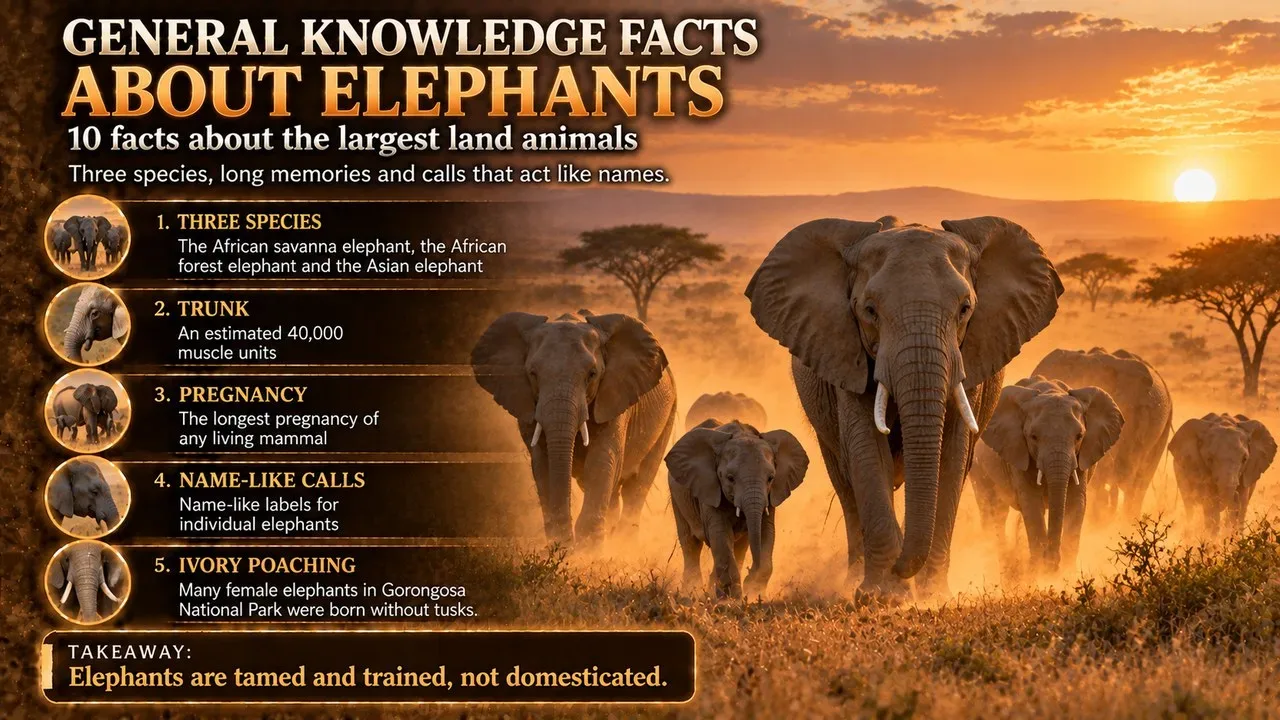
Elephants are the largest living land animals.[1] Three living species are recognised today: the African bush elephant, the African forest elephant and the Asian elephant.[1] They are the only surviving members of the family Elephantidae and the order Proboscidea, a group that once included mammoths and mastodons.[1] An elephant is easy to recognise by its long trunk, its tusks, its large ear flaps, its pillar-like legs and its tough but sensitive grey skin.[1] Elephants live in sub-Saharan Africa, South Asia and Southeast Asia, in habitats ranging from savannah and forest to desert and marsh.[1]
This Finepedia list, updated in October 2026, gathers the top 10 facts about elephants. It covers their size, their remarkable trunks and teeth, how much they eat, how their families work, how they talk over long distances, how clever they are, the way they reshape the land around them, and the threats they face today.
Key Facts
| Feature | Detail |
|---|---|
| Living species | African bush elephant, African forest elephant, Asian elephant[1] |
| Order | Proboscidea, family Elephantidae[1] |
| Largest species | African bush elephant, bulls 3.04–3.36 m at the shoulder and 5.2–6.9 tonnes[2] |
| Lifespan | Up to 70 years in the wild[1] |
| Gestation | About 18 to 24 months[1] |
| Muscle units in the trunk | Up to 150,000 muscle fascicles, with no bone[1] |
| Daily food | Up to 300 kg of food and 40 litres of water[1] |
| Sleep | About 3 to 4 hours a day[1] |
| Conservation status | Bush and Asian elephants endangered; forest elephant critically endangered[1] |
1. They Are the Largest Land Animals on Earth
Elephants are the largest living land animals, and the African bush elephant is the biggest of them all.[1][2] Fully grown bulls stand 3.04 to 3.36 metres at the shoulder on average and weigh 5.2 to 6.9 tonnes.[2] The largest specimen ever recorded had a shoulder height of 3.96 metres.[2] Asian elephants are smaller. Adult males average about 4 tonnes and females about 2.7 tonnes.[4] The African forest elephant is considerably smaller than the bush elephant.[3]
The species are easy to tell apart. African elephants have larger ears and concave backs, while Asian elephants have smaller ears and convex or level backs.[1] The African forest elephant was once thought to be a kind of bush elephant, but studies of its body shape and DNA showed that the two are separate species.[3] Both sexes of forest elephant have straight, down-pointing tusks.[3]
An Ancient Family
Today's elephants come from a long line. The earliest known members of Proboscidea, such as Eritherium, lived in Africa about 60 million years ago and weighed only about 3 to 8 kg.[1] By the late Eocene, some, such as Barytherium, had grown to about 2 tonnes.[1] When Afro-Arabia collided with Eurasia about 18 to 19 million years ago, proboscideans spread out of Africa across Eurasia. Later, about 16 to 15 million years ago, they reached North America across the Bering land bridge.[1] Mammoths, their best-known extinct relatives, lived from around 6.2 million years ago until about 4,000 years ago.[6] Mammoths are in fact more closely related to Asian elephants than to African elephants.[1] Their last survivors lived on Wrangel Island, near the Bering Strait, until about 4,000 years ago.[1] Today the order has only three species left.[1]
2. The Trunk Has Up to 150,000 Muscle Units and No Bone
The trunk is a long, versatile appendage. It contains up to 150,000 separate muscle fascicles, with no bone and little fat.[1] It works as a muscular hydrostat. It moves through finely controlled muscle contractions that work both with and against each other.[1] The trunk can even bend at different points by forming stiffened "pseudo-joints".[1] Objects grasped at the tip can be carried to the mouth by curling the trunk inward.[1]
The trunk is also a powerful breathing and smelling tool. Elephants can widen their nostrils by 30%, giving 64% more nasal volume. They can breathe in almost 30 times faster than a human sneeze, at over 150 metres per second.[1] An elephant's sense of smell may be four times stronger than a bloodhound's.[1] Elephants suck up water with the trunk and then squirt it into the mouth or over the body.[1] Young calves have to learn all this. After its first month, a calf's trunk can grab and hold objects but cannot yet suck, so it has to bend down to drink.[1]
Related: Top 10 Most Dangerous Amphibians in the World
3. Tusks Are Teeth That Never Stop Growing
An elephant's tusks are modified second incisors in the upper jaw.[1] Tusks in general are long, continuously growing front teeth that stick out well beyond the mouth.[7] In elephants, the tusks replace milk teeth at 6 to 12 months of age and then keep growing at about 17 cm a year.[1] The dentine that makes up the tusk is known as ivory. Its cross-section shows a pattern of intersecting lines called "engine turning", which form diamond shapes.[1] At least one-third of the tusk contains pulp, and some tusks have nerves running through them.[1]
Elephants use their tusks both as weapons and as tools for moving objects and digging.[1] Humans have changed them too. Hunting for ivory in Africa and Asia has selected for shorter tusks and for elephants born with no tusks at all.[1]
4. They Get Six Sets of Chewing Teeth
Elephants usually have 26 teeth: the tusks, 12 deciduous premolars and 12 molars.[1] Unlike most mammals, they do not grow replacement teeth vertically from the jaw. Instead, new teeth form at the back of the mouth and push the old ones forward and out.[1] The first chewing tooth on each side of the jaw falls out when the elephant is two to three years old.[1] Four more replacements follow, at the ages of four to six, 9 to 15, 18 to 28, and finally in the early 40s.[1] The final set, usually the sixth, must last the elephant for the rest of its life.[1] Elephant teeth have loop-shaped ridges, which are more diamond-shaped in African elephants.[1]
5. They Eat Up to 300 kg of Food a Day
Elephants are herbivores, and they need a great deal of food. An elephant can eat as much as 300 kg of food and drink 40 litres of water in a day.[1] They tend to stay near water when they can. They feed in the morning, in the afternoon and at night, and rest under trees at midday, sometimes dozing while standing.[1] They sleep at night lying down, and average only 3 to 4 hours of sleep a day.[1]
Elephants can also cover long distances. Males and family groups usually move no more than 20 km a day, but journeys of up to 180 km have been recorded in Namibia's Etosha region.[1] In northern Botswana, elephants travel 325 km to the Chobe River after local waterholes dry up in late August.[1] They are capable swimmers as well. They can swim for up to six hours without touching the bottom, at 2.1 km/h, and cover up to 48 km in one go.[1] On land, elephants can move forwards and backwards, but they cannot trot, jump or gallop.[1]
6. Their Families Are Led by the Oldest Female
Elephants live in a fission–fusion society, in which several family groups come together to socialise.[1] Females, called cows, live in family groups. A group may be one female with her calves or several related females with their young.[1] The group is led by the matriarch, who is usually the oldest cow.[1] Males, called bulls, leave their family groups when they reach puberty and may live alone or with other males. Adult bulls mostly meet family groups when looking for a mate.[1] Bulls enter a state of raised testosterone and aggression called musth, which helps them gain dominance over other males and improves their chances of breeding.[1]
Related: Top 10 Unique Animals Found Only in Africa
The Longest Wait for a Baby
Elephant pregnancies are very long. Gestation usually lasts between one and a half and two years, and a female will not give birth again for at least four years.[1] The long pregnancy gives the foetus more time to develop, especially its brain and trunk.[1] A newborn draws the whole herd. Adults and most of the other young gather round, touching and stroking it with their trunks.[1] In some groups, a calf is also looked after by females other than its mother, a practice called alloparenting. These allomothers are usually aged two to twelve.[1] Calves are the centre of attention in their family groups and depend on their mothers for as long as three years.[1] Elephants can live up to 70 years in the wild.[1]
7. They Talk Through the Ground and with Sounds Too Low to Hear
Elephants communicate by touch, sight, smell and sound. Over long distances, they use infrasound and seismic signals.[1] They can make rumbles too deep for humans to hear. In African elephants, these calls range from 15 to 35 Hz and can be as loud as 117 dB, which lets them carry for many kilometres, possibly more than 10 km.[1] An elephant stamping its foot or making a mock charge can send seismic signals through the ground that can be picked up up to 32 km away.[1] The large ear flaps also play a part in communication, and they help keep the body at a steady temperature.[1]
8. They Are Among the Most Intelligent Animals
Elephant intelligence has been compared with that of primates and cetaceans.[1] An elephant's brain weighs 4.5 to 5.5 kg, compared with about 1.6 kg for a human brain.[1] It has about 257 billion neurons, around three times as many as a human brain, although the cerebral cortex has only about a third as many neurons as a human's.[5]
- Self-awareness: They recognise themselves in a mirror, something also shown by some apes and dolphins.[1]
- Tool use: An Asian elephant has been seen trimming branches to use as flyswatters.[1]
- Memory: Elephants are popularly believed to have an excellent memory. They may carry mental maps that give them long-lasting memories of their surroundings, and may remember where their family members are.[1]
- Response to death: They are drawn to the bones of their own kind, whether related or not. A dying or dead elephant may receive attention and help from others, even from other groups.[1]
Scientists studying elephant behaviour have recorded signs of grief, learning, mimicry, play, altruism, compassion and cooperation.[5] They still debate how far elephants feel emotions.[1]
9. They Shape the Land Around Them
Because they are so large, elephants have a huge impact on their surroundings and are considered keystone species.[1] By uprooting trees and undergrowth, they can turn savannah into grassland, and smaller plant-eaters can then reach trees the elephants have knocked down.[1] In droughts they dig for water, creating waterholes that other animals use, and when they use waterholes they make them bigger.[1] At Mount Elgon, elephants dig through caves and open the way for hoofed animals, hyraxes, bats, birds and insects.[1] They are also important seed dispersers. African forest elephants eat many seeds and drop them far away.[1]
Related: Top 10 Most Dangerous Birds on Earth
Their skin needs care. It is about 2.5 cm thick on the back and parts of the head, yet it is very sensitive. Elephants take mud baths to keep it moist and to protect it from sunburn and insect bites.[1] After bathing, an elephant usually blows dust over its body with its trunk, and the dust dries into a protective crust.[1]
10. All Three Species Are Threatened
African bush elephants and Asian elephants are listed as endangered on the IUCN Red List, and African forest elephants as critically endangered.[1] One of the biggest threats is the ivory trade, with elephants poached for their tusks. Habitat loss and conflict with local people are also major problems.[1]
- Africa: In 1979, Africa had an estimated 1.3 to 3.0 million elephants. A decade later, the estimate was 609,000.[1] Between 1977 and 1989, populations in East Africa fell by 74%.[1] The IUCN estimated a total of 415,000 African elephants of both species as of 2016.[1]
- African bush elephant: Rangers across 29 range countries reported the illegal killing of 14,606 bush elephants between 2003 and 2015.[2]
- African forest elephant: Overhunting in the 20th century caused a steep decline, and by 2013 fewer than 30,000 were estimated to remain.[3]
- Asian elephant: It has been listed as endangered since 1986, after its population fell by at least 50% over three generations, about 60 to 75 years.[4] The total population is estimated at around 40,000 to 50,000, though this may be a loose estimate.[1]
In 1989, the African elephant was listed under Appendix I of the Convention on International Trade in Endangered Species of Wild Fauna and Flora (CITES), which made international trade illegal.[1]
Elephants in Human Culture
Elephants hold an iconic place in human culture, appearing in art, folklore, religion, literature and popular culture.[1] The elephant-headed Ganesha is one of the most important Hindu deities, ranked equal with Shiva, Vishnu and Brahma in some traditions.[1] Elephants were also used in war. The Carthaginian general Hannibal famously took African elephants across the Alps during his war with Rome.[1] Today, elephants still work in parts of Asia, and there were 13,000 to 16,500 working elephants there in 2000.[1] The word elephant comes from the Latin elephas, from the ancient Greek ἐλέφας, which probably came from a non-Indo-European language, most likely Phoenician.[1]
Key Figures
- 3: Living species of elephant.[1]
- 6.9 tonnes: Upper average weight of an adult African bush elephant bull.[2]
- 3.96 m: Shoulder height of the largest elephant ever recorded.[2]
- 150,000: Muscle fascicles in an elephant's trunk.[1]
- 17 cm: Yearly growth of an elephant's tusks.[1]
- 6: Usual number of sets of chewing teeth in a lifetime.[1]
- 300 kg: Food an elephant can eat in a day.[1]
- 18–24 months: Usual length of pregnancy.[1]
- 32 km: Distance at which an elephant's foot stamp can be detected.[1]
- 257 billion: Neurons in an elephant's brain.[5]
- 415,000: Estimated African elephants in 2016.[1]
- 40,000–50,000: Estimated Asian elephants.[1]
Frequently Asked Questions
What is the largest elephant species?
The African bush elephant is the largest. Bulls average 3.04 to 3.36 metres at the shoulder and weigh 5.2 to 6.9 tonnes.[2]
Related: Top 10 Remarkable Frogs of the World
How long are elephants pregnant?
Gestation usually lasts between one and a half and two years. A female will not give birth again for at least four years.[1]
How long do elephants live?
Elephants can live up to 70 years in the wild.[1]
Do elephants really have good memories?
They are popularly thought to, and there may be a basis for it. They possibly have mental maps that give them long-lasting memories of their environment.[1]
What are elephant tusks made of?
Tusks are modified upper incisor teeth. The dentine that forms them is known as ivory.[1]
Why are elephants endangered?
The main threats are poaching for ivory, habitat destruction and conflict with people.[1]
See also
- ^ [1] "Elephant". Wikipedia. Wikipedia
- ^ [2] "African bush elephant". Wikipedia. Wikipedia
- ^ [3] "African forest elephant". Wikipedia. Wikipedia
- ^ [4] "Asian elephant". Wikipedia. Wikipedia
- ^ [5] "Elephant cognition". Wikipedia. Wikipedia
- ^ [6] "Mammoth". Wikipedia. Wikipedia
- ^ [7] "Tusk". Wikipedia. Wikipedia





















Discussion
Log in with