






 By
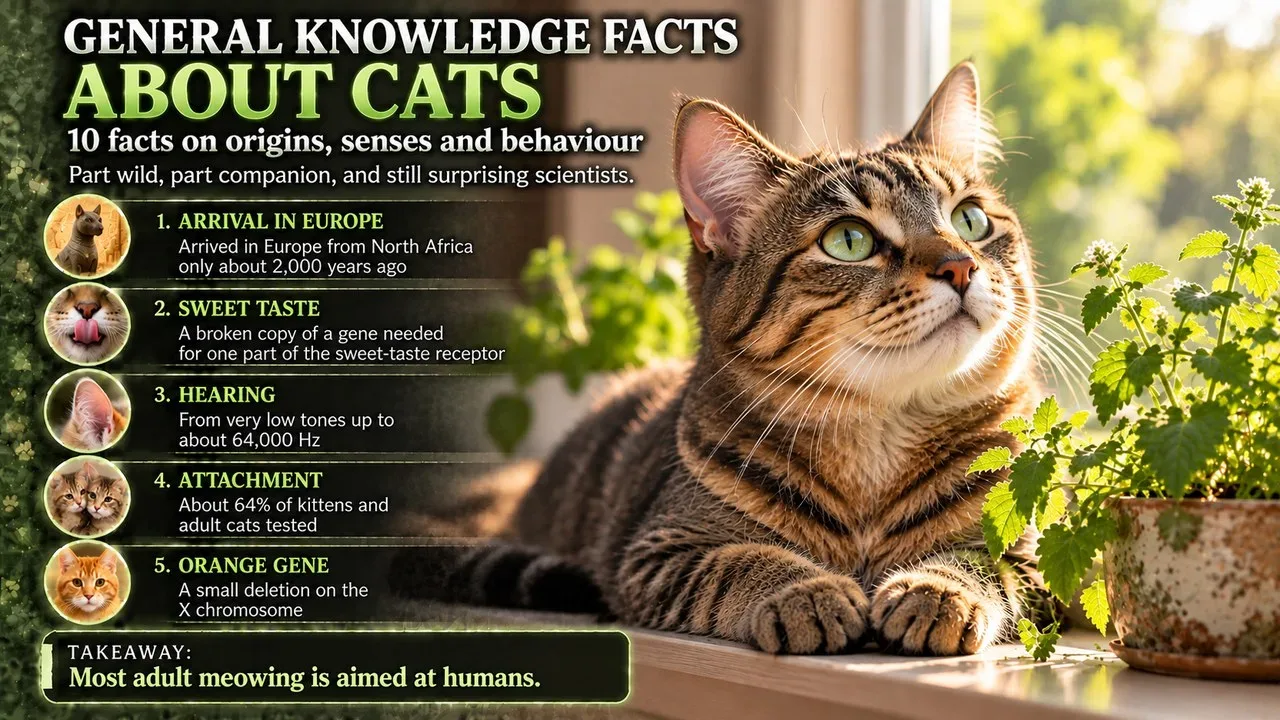
The cat (Felis catus), also called the domestic cat or house cat, is a small domesticated carnivorous mammal. It is the only domesticated species in the family Felidae.[1] Cats are valued as companions and for their ability to kill vermin. They are kept as pets, as working cats and as pedigreed animals shown at cat fancy events.[1] There are an estimated 600 million domestic cats in the world, and 400 million of them live in Asia.[1] Cats have strong, flexible bodies, quick reflexes, sharp teeth, good night vision and a keen sense of smell.[1]
This Finepedia list, updated in October 2026, gathers the top 10 facts about cats. It covers where cats came from, their sharp senses, why they always seem to land on their feet, how they purr, how long they sleep and live, and the part they played in ancient Egypt.
Key Facts
| Feature | Detail |
|---|---|
| Scientific name | Felis catus[1] |
| Wild ancestor | African wildcat (Felis lybica)[1] |
| Domestication began | Near East, around 7500 BCE[1] |
| World population | About 600 million[1] |
| Typical adult weight | 4–5 kg[1] |
| Daily sleep | Usually 12–16 hours, average 13–14[1] |
| Hearing range | Up to 64 kHz[3] |
| Gestation | 64–67 days, average 65[1] |
| Average lifespan | About 13 years (2014 and 2023)[1] |
1. Cats Tamed Themselves Near the First Farms
Advances in archaeology and genetics have shown that cat domestication began in the Near East around 7500 BCE.[1] Scientists believe African wildcats were drawn to early human settlements in the Fertile Crescent by rodents, especially the house mouse, and were tamed by Neolithic farmers.[1] This partnership between early farmers and tamed cats lasted thousands of years.[1] As farming spread, tame and domesticated cats spread with it.[1]
The earliest known sign of a tamed African wildcat was found next to a Neolithic human grave at Shillourokambos in southern Cyprus. It dates to about 7500–7200 BCE.[1] Cyprus has no native cat species, so the island's people most likely brought African wildcats over from the West Asian mainland.[1] The African wildcat (Felis lybica) is a small wild cat with sandy grey fur and pale vertical stripes on its sides and around its face.[5] The domestic cat and its closest wild ancestor both have 19 pairs of chromosomes and about 20,000 genes.[1]
How Cats Reached the World
During the Age of Discovery, domestic cats spread across much of the world. They sailed as ships' cats to control rodents on board and were kept as good-luck charms.[1] By the end of the Western Roman Empire in the 5th century, the Egyptian domestic cat lineage had reached a Baltic Sea port in northern Germany.[1] The scientific name Felis catus was proposed by Carl Linnaeus in 1758 for a domestic cat.[1]
2. Ancient Egypt Revered Cats
It was long thought that cat domestication began in ancient Egypt, where cats were venerated from around 3100 BCE.[1] Egyptian wildcats did add to the domestic cat's maternal gene pool, but at a later date.[1] Egyptians praised cats for killing venomous snakes, rodents and birds that damaged crops, and for protecting the Pharaoh, from at least the First Dynasty.[2] According to Diodorus Siculus, killing a cat was treated as a serious crime.[2]
Several Egyptian deities were shown with cat-like heads, including Mafdet, Bastet and Sekhmet, who stood for justice, fertility and power.[2] Bastet was worshipped as early as the Second Dynasty (2890 BCE).[8] She was first honoured at Bubastis in Lower Egypt as a lioness goddess, and over time she was increasingly shown as a cat, representing a gentler side than the warrior Sekhmet.[8] In the mid-5th century BC, Herodotus described the yearly festival at the temple of Bubastis as the largest in Egypt, attended by several hundred thousand pilgrims.[2] Cat cemeteries at Speos Artemidos, Bubastis and Saqqara were used for centuries. They held huge numbers of cat mummies and cat statues, which are now displayed in museums around the world.[2]
3. Cats See in Near Darkness
Cats have excellent night vision and can see at one-sixth of the light level that humans need.[1] One reason is the tapetum lucidum, a layer in the eye that reflects light passing through the retina back into the eye and makes it more sensitive in dim light.[1] Large pupils are another adaptation to low light. The domestic cat has slit pupils, which let it focus bright light without chromatic aberration. In low light, the pupils widen to cover most of the visible surface of the eye.[1]
Related: Top 10 Cutest Cat Breeds in the World
There are trade-offs. The domestic cat has fairly poor colour vision, with only two types of cone cells tuned to blue and yellowish green, so it has trouble telling red from green.[1] Its visual acuity is between 20/100 and 20/200. This means a cat has to be 6 metres away to see what an average person sees at 20 or 30 metres.[3] Cats do have a wider view, with a visual field of 200° compared with 180° in humans, although their binocular field is narrower.[3] Like many low-light hunters, they are generally crepuscular, most active near dawn and dusk.[1]
4. They Hear Far Higher Sounds Than Humans or Dogs
A cat can hear sounds too faint or too high-pitched for human ears, such as those made by small mammals.[1] Its hearing is sharpest between 500 Hz and 32 kHz.[1] At the low end, humans and cats hear a similar range, but cats can hear much higher sounds, up to 64 kHz. That is 1.6 octaves above the top of human hearing and 1 octave above a dog's.[3]
Smell matters too. Cats have a keen sense of smell, partly because of a well-developed olfactory bulb and about 5.8 cm² of olfactory mucosa, roughly twice the area in humans.[1] Like many other animals, cats have a Jacobson's organ in the mouth, which they use in a behaviour called flehmening.[1] Cats also have about twenty-four movable whiskers, in four sets on each upper lip on either side of the nose. Some cats have more.[3] The whiskers help them find their way and sense their surroundings.[1]
5. Cats Cannot Taste Sweetness
Domestic and wild cats share a mutation in a taste receptor gene that stops their sweet taste buds from binding to sugary molecules, so they cannot taste sweetness at all.[1] Cats have about 470 taste buds, compared with more than 9,000 on the human tongue.[1] It is a common myth that all cats like milk or cream. In fact, they tend to avoid sweet food and milk.[1]
- Plants: Lilies, tulips and philodendrons.
- Human medicines: Acetaminophen and aspirin, as well as vitamin capsules.
- Pet products: Flea treatments designed for dogs.
- Foods: Grapes and onions, among others.
6. The Righting Reflex Helps Cats Land on Their Feet
A falling cat twists by reflex to right itself and land on its feet, using its sharp sense of balance and flexibility. This is called the cat righting reflex.[1] A cat falling from up to 3 m can right itself and land on its paws.[1] Its flexible skeleton helps. Cats have 13 thoracic vertebrae (humans have 12) and seven lumbar vertebrae (humans have five), and these extra vertebrae give the spine its mobility.[1]
Cats' claws are also unusual. They can be extended and retracted, and when relaxed they are sheathed by the skin and fur around the toe pads.[1] Cats can extend their claws at will when hunting, fighting, climbing or kneading, or to get extra grip on soft surfaces.[1] An adult cat is on average about 46 cm long from head to body and 23–25 cm tall, with a tail about 30 cm long.[1]
Related: Top 10 Animals That Can Live Without Food for Months
7. Purring Happens While Breathing In and Out
A purr is a soft buzzing sound, like a rolled "r" in human speech, with a basic frequency of around 25 Hz.[4] Domestic cats purr at 20 to 30 vibrations per second.[4] The sound comes with vibrations that can be felt on the body. In cats, it continues through both breathing in and breathing out, while other animals such as foxes purr only when they exhale.[4]
Scientists are still not sure exactly how cats purr.[4] One hypothesis, supported by electromyographic studies, is that cats use their vocal folds or the muscles of the larynx to open and close the glottis rapidly, which makes the air vibrate.[4] Animals purr mostly to show happiness but also as a defence mechanism against pain.[4] Cats that have finished nursing often purr when they are content, such as when being petted, relaxing or eating.[1]
Meows Are Mostly for People
Cats communicate by meowing, purring, trilling, hissing, growling and grunting, and through body language and scent marking.[1] Studies show that domestic cats meow far more than feral cats. They rarely meow to communicate with other cats or other animals.[7] In 1944, Mildred Moelk published the first phonetic study of cat sounds and sorted 16 different vocal patterns into three main classes.[7] Body language matters as well. Rather than staring directly, cats lower their eyelids or blink slowly to show trust and affection to their owners.[7] A confident cat may walk around with its tail held high.[7]
8. Cats Sleep Most of the Day
Cats save energy by sleeping more than most animals, especially as they grow older.[1] How long they sleep each day varies, usually between 12 and 16 hours, with 13 to 14 hours on average. Some cats sleep as much as 20 hours.[1] House cats are also influenced by people and may partly adjust to their owners' sleeping patterns.[1]
When awake, cats spend a lot of time keeping clean. Their thorough grooming habits and instinct to bury their waste make them much less messy than most other domesticated animals.[1] The cat is a social species but hunts alone.[1] When cats greet each other, they often touch noses, and this may be followed by social grooming.[1] A group of cats can be called a clowder, a glaring or a colony.[1]
Related: Top 10 Most Extreme Hearing Animals
Cat social life ranges from widely scattered individuals to feral cat colonies that gather around a food source, built on groups of females that cooperate.[1] Some of the best-known feral colonies live in Rome, around the Colosseum and the Forum Romanum, where volunteers feed some of the cats and give them medical care.[1] Adult cats also live in a kind of extended kittenhood, a form of behavioural neoteny.[1]
9. Cat Lifespans Have Nearly Doubled Since the 1980s
The average lifespan of pet cats has risen in recent decades. It was about 7 years in the early 1980s, rose to 9.4 years in 1995, and reached about 13 years in 2014 and 2023.[1] Neutering increases life expectancy. A 2024 study found that neutered cats lived one year longer than cats that were not neutered.[1] In the United States, about 80% of household cats are neutered.[1]
Female cats, called queens, have several breeding cycles a year, each usually lasting 21 days.[1] Pregnancy lasts 64 to 67 days, an average of 65 days.[1] A study of 2,300 free-ranging queens from May 1998 to October 2000 found litters of one to six kittens, three on average. The queens had an average of 1.4 litters a year and at most three.[1] Because a female may mate with more than one male while in heat, kittens in one litter can have different fathers.[1] Cats also have long memories and can hold on to information for a decade or more.[6] A cat's brain is about five centimetres long and weighs 25 to 30 grams. Its cerebral cortex has around 250 million neurons.[6]
Learning by Trial and Error
Research on cat intelligence goes back to the late 19th and early 20th centuries, when psychologists such as Edward Thorndike used puzzle boxes to study how animals learn.[6] Thorndike's experiments showed that cats could learn to work levers and latches by trial and error, which revealed their capacity for associative learning.[6] Cats are good at learning by watching and at solving problems. Studies have found, however, that they do not grasp cause and effect in the way humans do.[6] Cats also show neuroplasticity, meaning their brains can reorganise in response to experience.[1]
10. They Are Beloved Pets and an Invasive Species
As of 2024, the domestic cat was the second most popular pet in the United States. There were 73.8 million pet cats, and around 42.2 million households owned at least one.[1] The UK has about 10.9 million cats, and China has 58 million.[1] Cat breeds began to be developed in the mid-19th century.[1] As of 2023, the International Cat Association (TICA) recognised 75 standardised breeds, the Fédération Internationale Féline (FIFe) 50, and the Cat Fanciers' Association (CFA) 45.[9] At cat shows, owners enter their cats to be judged against a breed standard and compete for titles.[1]
Related: Top 10 Most Dangerous Wild Animals in Canada
Cats also have a darker side. Because they can thrive in almost any land habitat, they are among the world's most invasive species.[1] Domestic cats are major predators of wildlife in the United States, killing an estimated 1.3 to 4.0 billion birds and 6.3 to 22.3 billion mammals every year.[1] Pet abandonment adds to the global feral cat population, which has driven declines in bird, mammal and reptile species. Spaying and neutering are used to control cat numbers.[1]
Key Figures
- 7500 BCE: Approximate start of cat domestication in the Near East.[1]
- 600 million: Estimated domestic cats worldwide.[1]
- 400 million: Cats living in Asia.[1]
- One-sixth: The light level a cat needs to see, compared with humans.[1]
- 64 kHz: Highest pitch a cat can hear.[3]
- 200°: A cat's visual field, compared with 180° in humans.[3]
- 470: Taste buds on a cat's tongue.[1]
- 25 Hz: Basic frequency of a purr.[4]
- 13–14 hours: Average daily sleep.[1]
- 65 days: Average pregnancy length.[1]
- 13 years: Average lifespan of pet cats in 2014 and 2023.[1]
- 1.3–4.0 billion: Birds killed by cats in the US each year.[1]
Frequently Asked Questions
Where do domestic cats come from?
They descend from the African wildcat and were domesticated in the Near East around 7500 BCE.[1]
Can cats see in the dark?
Not in total darkness, but they can see at one-sixth of the light level that humans need.[1]
Why do cats always land on their feet?
The cat righting reflex lets a falling cat twist round to land on its paws, helped by its balance and flexible spine.[1]
Do cats like milk?
Not all of them. Cats cannot taste sweetness and tend to avoid sweet food and milk.[1]
How long do cats sleep?
Usually 12 to 16 hours a day, and some sleep as much as 20 hours.[1]
How long do cats live?
The average lifespan of pet cats was about 13 years in 2014 and 2023.[1]
See also
- ^ [1] "Cat". Wikipedia. Wikipedia
- ^ [2] "Cats in ancient Egypt". Wikipedia. Wikipedia
- ^ [3] "Cat senses". Wikipedia. Wikipedia
- ^ [4] "Purr". Wikipedia. Wikipedia
- ^ [5] "African wildcat". Wikipedia. Wikipedia
- ^ [6] "Cat intelligence". Wikipedia. Wikipedia
- ^ [7] "Cat communication". Wikipedia. Wikipedia
- ^ [8] "Bastet". Wikipedia. Wikipedia
- ^ [9] "Cat breed". Wikipedia. Wikipedia























Discussion
Log in with