



General Knowledge Facts About the Marijuana Plant: Botany, Uses and Law
 By Dhiraj Sharma · Published
· Updated
Share Post
Loading…
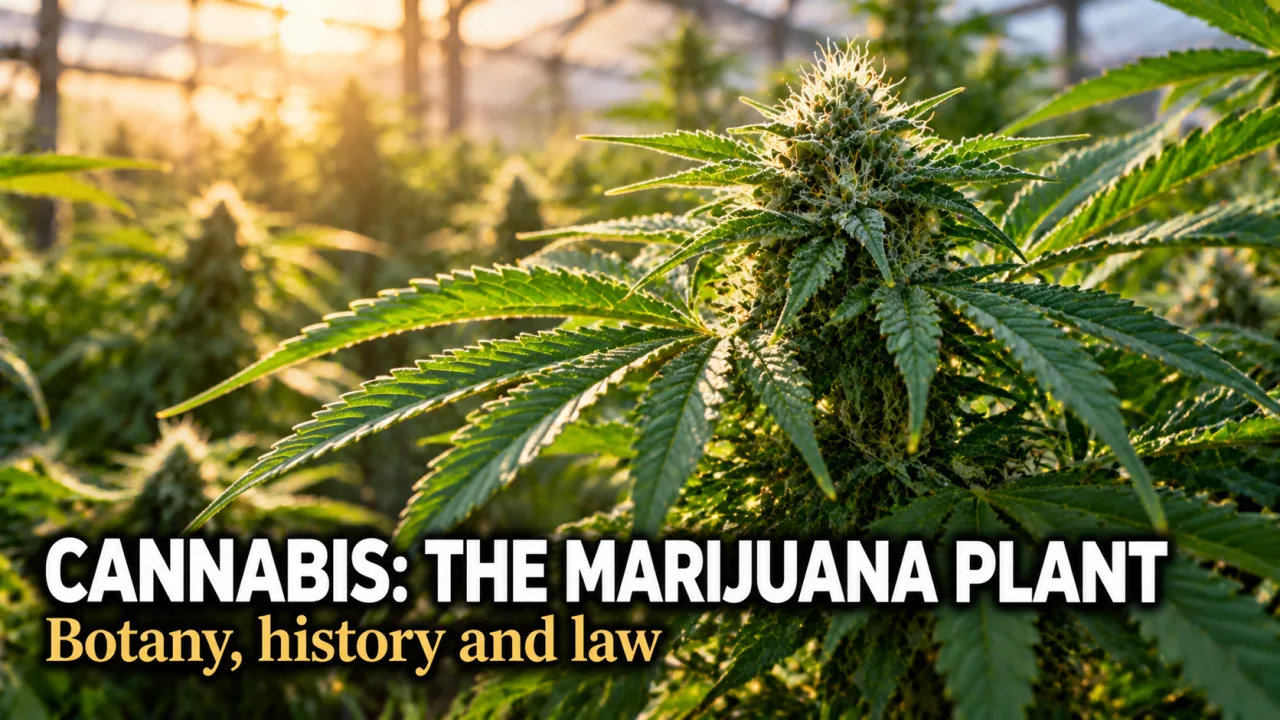
Marijuana is the common name for the dried flowers and leaves of the cannabis plant, Cannabis sativa, when they contain large amounts of the compound tetrahydrocannabinol, or THC.[1][4] Cannabis is an annual flowering herb native to Asia and one of the oldest plants grown by people.[1][2] The same species gives hemp fibre and seed, several medicines approved by regulators, and the most widely used illegal drug in the world.[4][5][16] This Finepedia article covers the plant's botany, history, chemistry, uses, the research on its medical effects and risks, its place in culture and religion, and its legal status in major countries as of October 2026. It is general information, not medical or legal advice. Laws change often, so check the current rules where you live.
Key Facts
| Attribute | Details |
|---|---|
| Scientific name | Cannabis sativa L.[3] |
| Common names | Cannabis, marijuana or marihuana, hemp, ganja, bhang, weed[2][19] |
| Kingdom | Plantae[3] |
| Clade | Tracheophytes, angiosperms (class Magnoliopsida)[3] |
| Order | Rosales[3] |
| Family | Cannabaceae (hemp family, which includes hops)[2][3] |
| Genus | Cannabis[3] |
| Named by | Carl Linnaeus, 1753[1] |
| Native range | Asia; first domesticated in East Asia[1][6] |
| Life cycle | Annual; usually separate male and female plants; wind-pollinated[2] |
| Chromosomes | 2n = 20; genome about 820 Mb, first sequenced in 2011[2] |
| Main compounds | THC (intoxicating) and CBD (not intoxicating), plus more than 100 other cannabinoids[4] |
| IUCN Red List | Not evaluated[3] |
Etymology
The word cannabis comes through Latin from the Greek kannabis. Ancient Greek writers learned of the plant from the Scythians, a horse-riding people of the Eurasian steppe, and the word is often traced back to a Scythian source.[2] The specific name sativa means "cultivated".[1]
The word marijuana, also spelled marihuana, is thought to have come into English from Mexican Spanish. Its deeper origin is uncertain. One theory links it to a Nahuatl word, and another to Mexican slang.[36] In the United States, government agencies use "marijuana" for cannabis that contains substantial THC, while plants with very little THC are classed as industrial hemp.[4]
The English word hemp has relatives in other Germanic languages, such as German Hanf and Dutch hennep.[5] In India the plant's preparations have their own names. Ganja is the dried flower, charas is the hand-rubbed resin, and bhang is made from the leaves and seeds.[19] In Chinese, the oldest recorded name for the plant is ma.[31]
Taxonomy
Botanists still disagree about how many species of Cannabis there are. Some recognise three species, Cannabis sativa, C. indica and C. ruderalis. Others treat them all as subspecies or varieties of a single, highly variable species, C. sativa.[2] One widely cited framework recognises a single species split into hemp-type and drug-type subspecies, each with wild and domesticated varieties.[2]
The genus was once placed in the nettle family or the mulberry family. Today it sits in the Cannabaceae, together with Humulus, the hops used to flavour beer. Genetic studies have also merged the former hackberry family, Celtidaceae, into the Cannabaceae.[2]
In shops, cannabis is often sold as "sativa" or "indica". These labels describe the plant's shape and the region it was bred in. "Sativa" is used for tall, loosely branched plants from warm lowlands, and "indica" for short, bushy plants from cooler highlands.[2] These labels do not reliably predict a product's chemistry or effects.[2]
Description
Form
Cannabis is an annual herb, which means it completes its life cycle in a single growing season.[2] Fibre types have long stems with few branches and can grow more than 6 m tall, while drug types are bred to branch heavily so they carry more flowers.[1][2]
Leaves
The leaves are palmately compound, meaning several leaflets spread out from one point like the fingers of a hand. Each leaflet has a toothed, or serrated, edge. The first leaves have a single leaflet, and later leaves have up to about 13, usually seven or nine.[2] The vein pattern of the leaflets is distinctive enough to tell cannabis apart from unrelated plants with similar leaves.[2]
Flowers and sex
Most cannabis plants are either male or female, a condition botanists call dioecious. Some varieties carry both male and female flowers on one plant.[2] Male plants are usually taller and less sturdy than female plants. They shed their pollen and die several weeks before the seeds ripen on the female plants.[1] Cannabis is pollinated by wind, and its fruit is a small, hard, one-seeded nut called an achene, which is the "hemp seed" used as food.[2][5]
The plant's resin is made in tiny glands, called trichomes, which are concentrated on the female flowers.[2] Most drug-type cannabis is grown from female plants kept away from males. Unpollinated flowers keep making resin instead of setting seed, a crop known by the Spanish word sinsemilla, "without seed".[1]
Related: Top 10 Most Bizarre Phobias: Strange Fears That Exist
Flowering and day length
Most cannabis is a short-day plant. It grows leaves while the days are long and starts to flower when nights become long. Indoor growers keep plants growing leaves with more than 16 to 18 hours of light a day, and they trigger flowering by giving at least 12 hours of darkness. The flowering stage usually lasts seven to 15 weeks.[1] Plants described as C. ruderalis, or "auto-flowering" cannabis, may flower at a set age whatever the day length.[2]
History
Domestication
A 2021 genetic study in Science Advances, based on the genomes of 110 plants, concluded that cannabis was first domesticated in East Asia in the early Neolithic, about 12,000 years ago. It suggested that early farmers grew it for several uses before separate hemp and drug types were bred.[6] In Japan, hemp has been grown since the prehistoric Jōmon period and was a main source of fibre for clothing, cordage and items for Shinto rituals.[31]
Early use as a drug
The earliest clear chemical evidence of cannabis smoking comes from the Jirzankal Cemetery in the Pamir Mountains of western China. Wooden braziers about 2,500 years old held burned stones with cannabis residue that had high levels of THC.[7] The plants were stronger than typical wild cannabis, which suggests that people were choosing or growing more potent plants.[7] The Greek historian Herodotus, writing in about 440 BCE, described the Scythians throwing hemp seeds onto red-hot stones and breathing in the smoke.[2]
In India
Bhang, a preparation of cannabis leaves, has been used in food and drink in India for many centuries.[19][33] The Atharvaveda lists bhanga among five sacred plants that relieve anxiety, although scholars still debate whether this ancient bhanga was the same plant as modern cannabis.[19] In 1894 the government of British India completed a wide-ranging study of cannabis use, the report of the Indian Hemp Drugs Commission.[19]
Chemistry
Cannabinoids
The cannabis plant contains about 540 chemical substances.[4] The best known are cannabinoids, a group of compounds found in the plant. The main ones are THC and cannabidiol, or CBD, and more than 100 other cannabinoids have been identified.[4] THC is mainly responsible for the effects of cannabis on a person's mental state.[4] CBD does not cause a "high", and some plants produce it in large amounts.[1][4]
THC was first isolated from cannabis in 1964 by the Israeli chemists Yechiel Gaoni and Raphael Mechoulam.[8] The levels of THC and CBD vary greatly from plant to plant and from product to product. Hemp usually contains less than 0.3% THC, while drug-type cannabis can contain from 2% to more than 20%.[5]
Aroma
The smell of cannabis comes mainly from volatile terpenes and sesquiterpenes. Examples are myrcene, limonene, pinene and caryophyllene, which are also found in plants such as citrus, pine and pepper.[1] Its skunk-like note comes from very small amounts of sulfur compounds, chief among them prenylthiol.[1]
Related: Top 10 Oldest Buildings in the World
Rising potency
A 2016 study of cannabis seized in the United States found that average THC rose from about 4% in 1995 to about 12% in 2014. Average CBD fell over the same period, so the ratio of THC to CBD rose sharply.[12]
The endocannabinoid system
Cannabinoids act in the body by binding to cannabinoid receptors. The CB1 receptor, found mainly in the brain and nervous system, was cloned in 1990, and the CB2 receptor in 1993.[9] The body also makes its own cannabis-like signalling molecules. The first to be discovered was anandamide, whose name comes from the Sanskrit word ananda, meaning joy or bliss.[10] Together, these receptors and signalling molecules are called the endocannabinoid system.[9]
Cultivation
Cannabis grows outdoors in many climates and is also widely grown indoors under lights and in hydroponic systems.[1] In soil it grows best at a pH of about 6.3 to 6.8. In hydroponic growing the nutrient solution is kept at about 5.2 to 5.8, a range that most harmful bacteria and fungi dislike.[1]
Three broad groups of cultivars are grown today.[1]
- Fibre hemp, with long stems and little branching
- Seed hemp, grown for food and hempseed oil
- Drug-type cannabis, bred to branch heavily and carry many flowers
Seed is still the most common way to multiply the plant, but tissue culture is now used to produce uniform clones of medical cultivars.[1] Growing cannabis is legal only under licence, or within personal limits, in the countries that allow it. Unlicensed cultivation is a crime in most of the world, including India.[17][20]
Uses
Fibre, seed and industry
Hemp is among the fastest-growing plants and was one of the first plants spun into usable fibre.[5] Its fibre is used for rope, textiles, paper and building materials, and its seeds are eaten as food or pressed into oil for cooking, cosmetics and paints.[5] Hemp seed is also used as bird feed.[1]
Medicine
The US Food and Drug Administration has not approved the cannabis plant itself for any medical use. It has approved several medicines that contain single cannabinoids.[4][14] The medicines in that group are as follows:
- Epidiolex, a purified CBD oral solution, approved in 2018 for seizures in Lennox-Gastaut syndrome and Dravet syndrome, two rare forms of childhood epilepsy, and in 2020 also for tuberous sclerosis complex[4][13]
- Marinol and Syndros, which contain dronabinol, a synthetic form of THC, for chemotherapy-related nausea and vomiting and for appetite and weight loss in HIV/AIDS[4]
- Cesamet, which contains nabilone, a synthetic substance similar to THC, for chemotherapy-related nausea and vomiting[4]
Nabiximols, sold as Sativex, is a mouth spray containing both THC and CBD. It is approved in some countries, including for muscle stiffness in multiple sclerosis, but not in the United States.[4]
Related: 10 Sikh Gurus: The Pillars of Sikhism Who Shaped Faith, Equality, Courage, and Humanity
Recreational use
The UN Office on Drugs and Crime estimates that 256 million people used cannabis in 2024, making it by far the most widely used drug in the world.[16] The share of people aged 15 to 64 who use it rose from 3.8% in 2014 to 4.8% in 2024.[16] In India, a 2019 national survey by the Ministry of Social Justice and Empowerment found that 2.83% of people aged 10 to 75, about 31 million people, were current users of cannabis products.[19]
Medical Research and Health Effects
Evidence by condition
The table below grades the evidence for common medical claims. It is based on reviews by the US National Center for Complementary and Integrative Health (NCCIH) and the US National Academies of Sciences, Engineering, and Medicine.[4][11]
| Condition | What the research shows | Evidence grade |
|---|---|---|
| Rare childhood epilepsies (Lennox-Gastaut, Dravet) | Purified CBD (Epidiolex) reduces seizures and is FDA-approved[4][13] | Strong |
| Chemotherapy nausea and vomiting | Dronabinol and nabilone work better than placebo and about as well as older anti-nausea drugs[4][11] | Strong |
| Chronic pain in adults | Small benefit in reviews of many trials; the difference from placebo may be too small to matter to patients[4][11] | Moderate |
| Multiple sclerosis muscle stiffness | Patients report improvement with oral cannabinoids[4][11] | Moderate |
| Appetite and weight loss in HIV/AIDS | Dronabinol is approved, but overall evidence is limited[4] | Limited |
| Anxiety | A few small studies, such as one of 24 people with social anxiety given CBD[4] | Limited |
| PTSD nightmares | One very small study of 10 people found nabilone helped[4] | Limited |
| Reducing opioid use | High-quality trials did not show that cannabinoids reduce opioid use[4] | Not supported |
| Glaucoma | Lowers eye pressure only briefly and less well than standard treatments[4] | Not supported |
A 2017 report by the National Academies reviewed more than 10,000 study abstracts and found conclusive or substantial evidence of benefit only for chronic pain in adults, chemotherapy nausea and vomiting, and patient-reported muscle stiffness in multiple sclerosis.[11] For many other popular claims it found limited evidence or none.[11]
Risks
Cannabis carries real health risks, and these are summarised by US health agencies.[4][15]
- The CDC estimates that about 3 in 10 people who use cannabis have cannabis use disorder, a condition in which use continues despite causing harm.[15]
- Adolescents who use cannabis are four to seven times more likely than adults to develop cannabis use disorder.[4]
- Frequent use, especially of high-THC cannabis, is linked to a higher risk of schizophrenia and other psychoses in people who are predisposed to them.[4]
- Cannabis use is linked to a higher risk of motor vehicle crashes.[4]
- Smoking cannabis during pregnancy is linked to lower birth weight.[4]
- Long-term frequent use can cause cannabinoid hyperemesis syndrome, with repeated bouts of severe nausea and vomiting. The only known cure is to stop using cannabis.[35]
- CBD can interact with other medicines, and the FDA has ruled that products containing THC or CBD cannot be sold as dietary supplements in the United States.[4]
Cultural and Religious Significance
Hinduism and Indian festivals
In Hindu tradition, cannabis is linked to the god Shiva. Legends say that Shiva chose the plant as his favourite food, and some devotees offer bhang to Shiva, although many do not.[19] Bhang is traditionally drunk at the festivals of Maha Shivaratri and Holi, often mixed into the drinks bhang lassi and thandai.[19][33] Among Sikh Nihangs, bhang is popular during Hola Mohalla, and some Indian Sufis also consume it.[19]
Other traditions
In Japan, hemp fibre has long been linked to purity, and Shinto priests still use it in ritual cleansing.[31] In modern times, the Rastafari movement, which began in Jamaica, has adopted cannabis as a sacrament.[2] Several other 20th-century religious groups also treat it as sacred.[2]
Legal Status
International treaties
Most national cannabis laws follow three United Nations treaties, chief among them the 1961 Single Convention on Narcotic Drugs.[17] In December 2020 the UN Commission on Narcotic Drugs voted to remove cannabis from Schedule IV, the treaty's strictest list. Cannabis stays under international control in Schedule I, which allows medical use.[17][18]
Related: Top 10 Tallest Buildings in the World
By country
The table gives the position in major countries as of October 2026. It is a summary, not legal advice.
| Country | Medical use | Adult non-medical use |
|---|---|---|
| India | Limited exceptions for medical and scientific use under licence[19][20] | Illegal for ganja and charas; bhang from leaves is outside the NDPS Act and regulated by states[19][20] |
| United States | Legal in 41 states; FDA-approved and state-licensed medical products in federal Schedule III since April 2026[17][27] | Legal in 24 states and Washington, DC; still illegal under federal law[17][27] |
| Canada | Legal since 2001 | Legal nationwide since 17 October 2018[25] |
| Uruguay | Legal | Legal since December 2013, the first country to do so[26] |
| Germany | Legal on prescription since 2017 | Legal for adults since 1 April 2024, with personal limits[23][24] |
| Thailand | Legal since 2018, the first in Asia | Decriminalised in 2022; flower sales limited to medical prescriptions since June 2025[22] |
| United Kingdom | Legal on specialist prescription since November 2018 | Illegal; Class B drug[29] |
| Netherlands | Legal | Illegal but tolerated; small sales in licensed coffeeshops[32] |
| South Africa | Legal | Private adult use legal; Cannabis for Private Purposes Act 2024[34] |
| Japan | Law to allow cannabis-based medicines passed in 2023 | Illegal, with strict penalties[30] |
| China | Some medicines only | Illegal; industrial hemp allowed[31] |
India
Cannabis is controlled in India by the Narcotic Drugs and Psychotropic Substances (NDPS) Act, 1985.[20] The Act defines cannabis as charas, the resin, and ganja, the flowering or fruiting tops, and it leaves out the seeds and leaves when they are not mixed with the tops.[19][20] This is why bhang, made from leaves, is outside the Act. India kept this definition from the 1961 Single Convention, which allowed it to continue the tradition of drinking bhang at Holi.[19]
Under Section 20 of the Act, a person caught with a small quantity of ganja, defined as up to 1 kg, faces rigorous imprisonment of up to one year, a fine of up to ₹10,000, or both. Larger amounts carry much heavier penalties.[20] The Act lets state governments allow and regulate the cultivation of cannabis for medical, scientific and industrial purposes.[19][21]
State rules on bhang vary. Assam bans ganja and bhang under a 1958 law, Maharashtra requires a licence under the Bombay Prohibition Act, and Gujarat removed bhang from its list of intoxicating drugs in 2017.[19] Uttarakhand allowed industrial hemp cultivation in 2015. In January 2025, Himachal Pradesh approved a pilot study on controlled cannabis cultivation for medical and industrial use, with industrial hemp kept below 0.3% THC.[19][21]
United States
US federal law still lists most marijuana in Schedule I of the Controlled Substances Act.[27] On 23 April 2026 the Justice Department placed FDA-approved cannabis products and products made under a state medical marijuana licence in Schedule III.[27] A wider proposal to move all marijuana to Schedule III went through a formal hearing at the Drug Enforcement Administration in June and July 2026. As of late October 2026 that case was paused while the parties filed extra briefs, and no final decision had been made.[28]
Germany
Germany legalised cannabis for adults aged 18 and over on 1 April 2024, becoming the first major EU member state to do so nationwide.[23] Adults may carry up to 25 g and keep up to 50 g and three plants at home. Non-profit cannabis social clubs have been allowed since July 2024, while licensed commercial shops are not allowed.[23][24]
Conservation
Cannabis sativa has not been assessed for the IUCN Red List.[3] As a crop and as a plant that escapes from fields, it grows across much of the world, and it is not considered threatened.[1] Scientists value wild and traditional local varieties, called landraces, as sources of genetic diversity for breeding.[6]
Trivia
- Hops, used to flavour beer, belong to the same plant family as cannabis.[2]
- The word canvas comes from the same root as cannabis, because sails and heavy cloth were long made from hemp.[5]
- Cannabis was one of the first plants to have its chromosomes studied, and its genome was first sequenced by a Canadian team in 2011.[2]
- In May 2022, as it prepared to decriminalise the plant, Thailand's government announced it would give away one million free cannabis plants to households.[22]
- In 1980 the musician Paul McCartney was held in a Japanese jail for nine days after cannabis was found in his luggage at Narita Airport.[30]
See also
- General Knowledge Facts About the Aloe Vera Plant
- General Knowledge Facts About the Banyan Tree
- Hemp
- Cannabidiol (CBD)
- Bhang
- ^ [1] "Cannabis sativa". Wikipedia. Wikipedia: Cannabis sativa
- ^ [2] "Cannabis". Wikipedia. Wikipedia: Cannabis
- ^ [3] "Cannabis sativa L.". GBIF Backbone Taxonomy, with IUCN Red List category. GBIF: Cannabis sativa
- ^ [4] "Cannabis (Marijuana) and Cannabinoids: What You Need To Know". National Center for Complementary and Integrative Health, US National Institutes of Health. NCCIH: Cannabis and cannabinoids
- ^ [5] "Hemp". Wikipedia. Wikipedia: Hemp
- ^ [6] Ren, G. and others (2021). "Large-scale whole-genome resequencing unravels the domestication history of Cannabis sativa". Science Advances 7. Science Advances: cannabis domestication
- ^ [7] Ren, M. and others (2019). "The origins of cannabis smoking: Chemical residue evidence from the first millennium BCE in the Pamirs". Science Advances 5. Science Advances: Jirzankal cannabis
- ^ [8] "Tetrahydrocannabinol". Wikipedia. Wikipedia: Tetrahydrocannabinol
- ^ [9] "Endocannabinoid system". Wikipedia. Wikipedia: Endocannabinoid system
- ^ [10] "Anandamide". Wikipedia. Wikipedia: Anandamide
- ^ [11] National Academies of Sciences, Engineering, and Medicine (2017). "The Health Effects of Cannabis and Cannabinoids: The Current State of Evidence and Recommendations for Research". National Academies Press. National Academies: Health Effects of Cannabis
- ^ [12] ElSohly, M. A. and others (2016). "Changes in Cannabis Potency Over the Last 2 Decades (1995-2014)". Biological Psychiatry 79(7). Biological Psychiatry: cannabis potency
- ^ [13] "Epidiolex". Wikipedia. Wikipedia: Epidiolex
- ^ [14] "FDA Regulation of Cannabis and Cannabis-Derived Products, Including Cannabidiol (CBD)". US Food and Drug Administration. FDA: Cannabis regulation
- ^ [15] "Cannabis Use Disorder". US Centers for Disease Control and Prevention. CDC: Cannabis use disorder
- ^ [16] "UNODC World Drug Report 2026" (June 2026). UN Office on Drugs and Crime. UNODC: World Drug Report 2026
- ^ [17] "Legality of cannabis". Wikipedia. Wikipedia: Legality of cannabis
- ^ [18] "UN commission reclassifies cannabis, yet still considered harmful" (December 2020). UN News. UN News: cannabis reclassified
- ^ [19] "Cannabis in India". Wikipedia. Wikipedia: Cannabis in India
- ^ [20] "The Narcotic Drugs and Psychotropic Substances Act, 1985". Department of Revenue, Ministry of Finance, Government of India. Government of India: NDPS Act 1985
- ^ [21] "Himachal approves controlled cannabis cultivation" (January 2025). The Indian Express. Indian Express: Himachal cannabis
- ^ [22] "Cannabis in Thailand". Wikipedia. Wikipedia: Cannabis in Thailand
- ^ [23] "Cannabis in Germany". Wikipedia. Wikipedia: Cannabis in Germany
- ^ [24] "Frequently asked questions on the Cannabis Act". German Federal Ministry of Health. BMG: Cannabis Act FAQ
- ^ [25] "Cannabis in Canada". Wikipedia. Wikipedia: Cannabis in Canada
- ^ [26] "Cannabis in Uruguay". Wikipedia. Wikipedia: Cannabis in Uruguay
- ^ [27] "Cannabis in the United States". Wikipedia. Wikipedia: Cannabis in the United States
- ^ [28] "DEA Judge Rejects Anti-Rescheduling Plea to Reopen Cannabis Hearing, Allows New Briefs" (22 October 2026). Cannabis Business Times. Cannabis Business Times: rescheduling hearing
- ^ [29] "Cannabis in the United Kingdom". Wikipedia. Wikipedia: Cannabis in the United Kingdom
- ^ [30] "Cannabis in Japan". Wikipedia. Wikipedia: Cannabis in Japan
- ^ [31] "Cannabis in China". Wikipedia. Wikipedia: Cannabis in China
- ^ [32] "Cannabis in the Netherlands". Wikipedia. Wikipedia: Cannabis in the Netherlands
- ^ [33] "Bhang". Wikipedia. Wikipedia: Bhang
- ^ [34] "Cannabis in South Africa". Wikipedia. Wikipedia: Cannabis in South Africa
- ^ [35] "Cannabinoid hyperemesis syndrome". Wikipedia. Wikipedia: Cannabinoid hyperemesis syndrome
- ^ [36] "Marijuana (word)". Wikipedia. Wikipedia: Marijuana (word)






















Discussion
Log in with