






 By
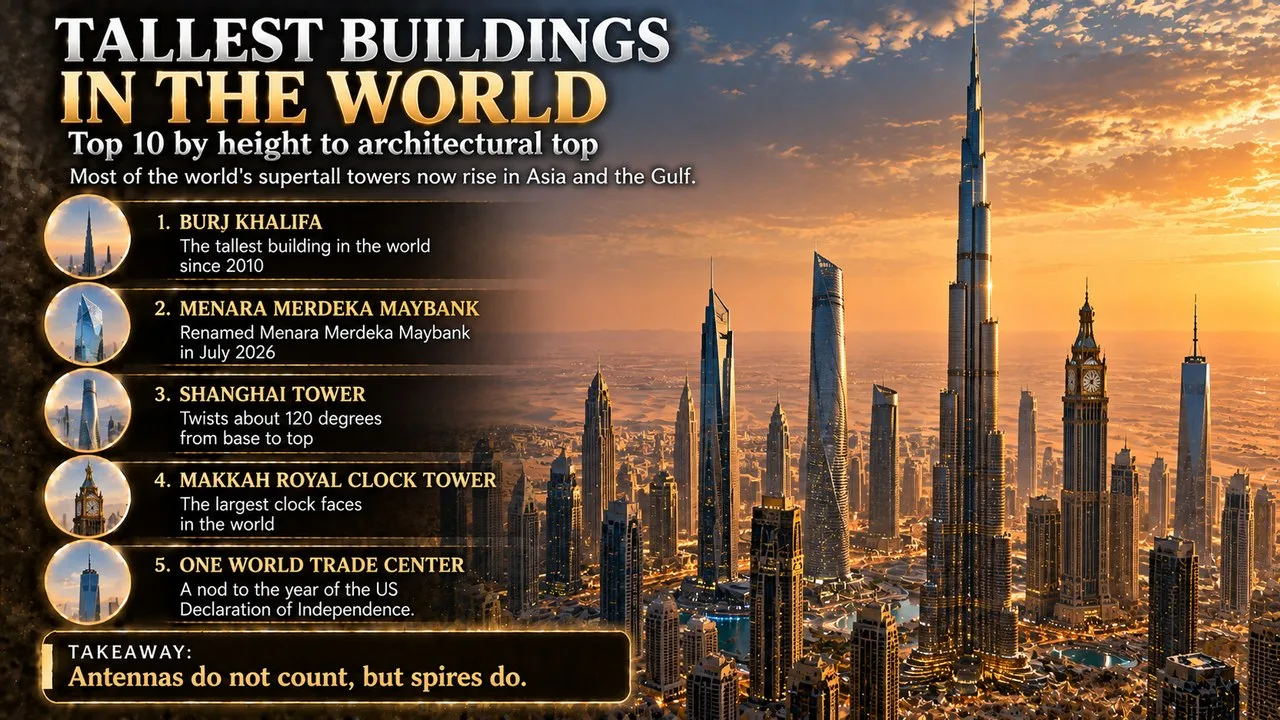
The tallest buildings in the world are led by the Burj Khalifa in Dubai, which rises 828 metres above the desert city and has held the title of world's tallest building since 2009.[1][2] The rest of the top 10 is made up of towers in Kuala Lumpur, Shanghai, Mecca, Shenzhen, Seoul, New York City, Guangzhou, Tianjin and Beijing, and half of the ten stand in China.[1] This guide ranks the ten tallest completed buildings by architectural height, explains how that height is measured, and looks at the history, design and records of each tower.
Introduction
For most of history the tallest structures people built were tombs, temples and cathedrals. The skyscraper changed that in the late 19th century, and since 2000 the race for height has moved from North America to Asia and the Middle East.[1] Today every building in the top 10 is more than 520 metres tall, and the leader, the Burj Khalifa, is taller than the next tallest building by about 150 metres.[1][2]
This guide ranks the ten tallest completed buildings in the world by height to their architectural top. Each entry explains how tall the building is, who designed it and what makes it stand out, followed by a short history of the title of world's tallest building and a look at the tower expected to break the record next.[1]
How This List Is Ranked
For this list, tall buildings are enclosed structures with continuously occupiable floors. Non-building structures, such as radio towers, are excluded.[1] The buildings are ranked by height to their highest architectural feature, which includes spires but not antennas.[1] Spires are treated as an integral part of a building's design, while antennas can be added or removed without changing how the building looks.[1]
Heights are measured from the level of the lowest significant open-air pedestrian entrance.[1] The council that sets these standards was formed in 1969 and keeps a list of the 100 tallest completed buildings in the world. It counts only buildings that are complete.[1] As of 2026, the wider list of buildings that are 350 metres or taller has 98 entries, and almost half of them are in China.[1]
Key Facts
The table below sums up the ten tallest buildings on this list, with the city, country, height, floor count and completion year of each.[1]
The 10 Tallest Buildings at a Glance
| Rank | Building | City | Country | Height (m) | Floors | Completed |
|---|---|---|---|---|---|---|
| 1 | Burj Khalifa | Dubai | United Arab Emirates | 828 | 163 | 2010 |
| 2 | Merdeka Maybank Tower | Kuala Lumpur | Malaysia | 678.9 | 118 | 2024 |
| 3 | Shanghai Tower | Shanghai | China | 632 | 128 | 2015 |
| 4 | Mecca Royal Clock Tower | Mecca | Saudi Arabia | 601 | 120 | 2012 |
| 5 | Ping An Finance Centre | Shenzhen | China | 599.1 | 115 | 2017 |
| 6 | Lotte World Tower | Seoul | South Korea | 554.5 | 123 | 2017 |
| 7 | One World Trade Center | New York City | United States | 541.3 | 104 | 2014 |
| 8 (tie) | Guangzhou CTF Finance Centre | Guangzhou | China | 530 | 111 | 2016 |
| 8 (tie) | Tianjin CTF Finance Centre | Tianjin | China | 530 | 97 | 2019 |
| 10 | CITIC Tower (China Zun) | Beijing | China | 527.7 | 109 | 2018 |
Floor counts are above ground.[1]
1. Burj Khalifa
The Burj Khalifa in Dubai, United Arab Emirates, is the world's tallest structure. It reaches 828 metres to its architectural top, including a 242.6-metre spire, and 829.8 metres in total height.[2] It has 163 floors above ground and two below.[1] It took the title of world's tallest building from Taipei 101, which had held it since 2004.[2][13] The Burj Khalifa tops the list whichever height measure is used, though its lead is much smaller when buildings are measured to their highest occupied floor.[1] Among its records are the world's highest New Year display of fireworks.[2]
Skidmore, Owings & Merrill of Chicago designed the tower, with Adrian Smith as chief architect and Bill Baker as a chief structural engineer.[2] The design draws on the Islamic architecture of the region, such as the Great Mosque of Samarra. Its Y-shaped, three-part floor plan is designed to make the best use of residential and hotel space, and a buttressed central core and wings support the building's height.[2] Construction began in 2004, and the exterior was finished five years later. The main structure is reinforced concrete, and some of its structural steel was salvaged from the demolished Palace of the Republic in East Berlin.[2]
The building opened in 2010 as the centrepiece of a new development called Downtown Dubai, and it became fully operational in 2011.[2] A 304-room Armani Hotel occupies 15 of the lower 39 floors, and the sky lobbies on the 43rd and 76th floors house swimming pools.[2] The tower has 57 elevators and 8 escalators.[2]
The tower was known as Burj Dubai until its inauguration. The developer, Emaar Properties, ran into financial problems during the Great Recession, and the UAE president, Sheikh Khalifa bin Zayed Al Nahyan, organised federal financial support. In return, Mohammed bin Rashid, Ruler of Dubai, renamed the tower Burj Khalifa at the inauguration.[2]
2. Merdeka Maybank Tower
The Merdeka Maybank Tower in Kuala Lumpur, Malaysia, is a 118-storey megatall skyscraper and, at 678.9 metres, the second tallest building in the world.[3] Its spire was completed in December 2022, which set its final height, 700.9 metres above sea level.[3] It is the tallest building in Malaysia, beating the 451.9-metre Petronas Twin Towers, and the tallest in Southeast Asia, beating the 462-metre Landmark 81.[3] It is taller than the Shanghai Tower because of its much longer spire, although it has fewer floors and its highest occupied floor is lower.[4]
The building was formerly known as Merdeka 118, Menara Warisan Merdeka, KL 118 and PNB 118. On 30 July 2026 it was officially renamed after one of its anchor tenants, Maybank.[3] Merdeka means "independence" in Malay, and the name comes from the tower's closeness to Stadium Merdeka.[3] The design was inspired by Tunku Abdul Rahman's outstretched hand as he chanted "Merdeka!" when he proclaimed the independence of Malaya on 31 August 1957. Its diamond-shaped glass facades stand for the diversity of Malaysians.[3]
Related: Top 10 Architectural Wonders of the Modern World
The structure was completed in November 2023 and had its grand opening on 10 January 2024, but it did not open to the public as scheduled.[3] On 7 August 2025, the Park Hyatt Kuala Lumpur hotel began operating on levels 75 to 112. As of 1 July 2026, the rest of the project was still under construction, and most areas were closed to the public.[3] The building also has the highest observation deck in Southeast Asia.[3]
3. Shanghai Tower
The Shanghai Tower is a 128-storey, 632-metre megatall skyscraper in Lujiazui, Pudong, Shanghai.[4] It is the tallest building in China and the third tallest in the world by height to its architectural top. Measured to its highest occupied floor, it ranks second.[4] It had the world's fastest elevators, at a top speed of 20.5 metres per second, until 2017.[4]
The tower was designed by the international firm Gensler and is owned by the Shanghai Municipal Government.[4] Its glass facade twists through 120 degrees as it rises, a design intended to cut wind loads on the building by 24%.[4] Inside the outer layer, nine indoor zones provide public space for visitors.[4] It is the tallest of the world's first group of three adjacent supertall buildings in Pudong, alongside the Jin Mao Tower and the Shanghai World Financial Center.[4]
From 2016 to 2025, it was the tallest and largest LEED-CS Platinum-certified building in the world.[4] There are 270 vertical-axis wind turbines in the facade and near the top of the tower, and they can generate up to 350,000 kWh of extra electricity a year.[4]
4. Mecca Royal Clock Tower
The Mecca Royal Clock Tower, completed in 2012, is the central hotel tower of the Clock Towers complex in Mecca, Saudi Arabia. It is the fourth tallest building in the world.[1][5] At 601 metres, it is the tallest building in Saudi Arabia, and Guinness World Records lists it as the tallest clock tower in the world.[5]
There are clock faces on all four sides of the main hotel tower. They are the largest clock faces in the world and can be seen from 25 kilometres away.[5] The top four floors of the clock tower house the Clock Tower Museum, which is the highest museum in the world.[1][5]
The complex, formerly known as Abraj al-Bait, is a government-owned group of seven skyscraper hotels. It is part of the King Abdulaziz Endowment Project, which aims to modernise the city for its pilgrims.[5] It stands 300 metres from the Great Mosque of Mecca, Islam's most sacred site and the largest mosque in the world.[5] The developer and contractor was the Saudi Binladin Group, and construction cost US$15 billion. The complex was built after the Ajyad Fortress, an 18th-century Ottoman citadel overlooking the Grand Mosque, was demolished.[5] The main tower contains a five-star hotel run by Fairmont Hotels and Resorts, which lodges some of the millions of pilgrims who come to Mecca each year for the Hajj.[5]
5. Ping An Finance Centre
The Ping An Finance Centre is a 115-storey, 599.1-metre supertall skyscraper in Shenzhen, Guangdong, China. It was completed in 2017.[6] It is the tallest building in Shenzhen and the fifth tallest in the world, and it is the world's tallest all-office building.[1][6] Its observation deck, Free Sky, is on floor 116. At 562.5 metres, it broke the record for the highest observation deck in a building.[6]
Ping An Insurance commissioned the building for its headquarters, and the American firm Kohn Pedersen Fox Associates designed it.[6] It has a stainless-steel facade of about 1,700 tonnes, and it is the second largest skyscraper in the world by floor area, after the Azabudai Hills Main Tower in Tokyo.[6]
The tower has a gross floor area of 378,600 square metres and a width-to-height ratio of 1:10.[6] The 620,000-tonne tower is held up by eight main columns. At the lowest level they measure about 6 by 3.2 metres, narrowing to 2.9 by 1.4 metres at the top.[6]
Related: Top 10 Greatest Engineering Achievements
6. Lotte World Tower
Lotte World Tower is a 123-storey supertall skyscraper in Sincheon-dong, Songpa District, Seoul. It is the tallest building in South Korea and in the OECD countries.[1][7] It was the first building in South Korea with more than 100 storeys, and it was the fifth tallest in the world when it was completed.[7] It opened to the public on 3 April 2017.[7]
After 13 years of planning and site preparation, the government gave final approval for construction in November 2010. Piling and frame assembly began on site in March 2012.[7]
The Seoul Sky observatory occupies the top seven levels. Floors 117 and 118 are the entrance and viewing floors, and floor 118 has a glass floor.[7] A lounge bar is on the top floor, at 499 metres. The Sky Bridge Tour on the roof, at 541 metres, is about the same height as One World Trade Center in New York.[7]
7. One World Trade Center
One World Trade Center, also known as the Freedom Tower, is the main building of the rebuilt World Trade Center complex in Lower Manhattan, New York City.[8] It is the tallest building in the United States and the Western Hemisphere, and the seventh tallest in the world.[8] It is also the tallest building outside Asia and the tallest on an island.[1] Its height of 1,776 feet (541 metres) refers to 1776, the year the United States Declaration of Independence was signed.[8]
The tower has the same name as the North Tower of the original World Trade Center, which was destroyed in the attacks of 11 September 2001.[8] Work on its foundations began on 27 April 2006. It became the tallest structure in New York City on 30 April 2012, when it passed the Empire State Building, and its steel structure topped out on 30 August 2012.[8] The last piece of its spire was installed on 10 May 2013, and the building opened on 3 November 2014. The One World Observatory opened on 29 May 2015.[8]
David Childs of Skidmore, Owings & Merrill designed a symmetrical tower that tapers on its upper floors.[8] It has 94 storeys, but the top floor is numbered 104.[8]
8. Guangzhou CTF Finance Centre
The Guangzhou Chow Tai Fook Finance Centre, also called the East Tower, is a 530-metre supertall skyscraper in Guangzhou, completed in October 2016.[9] It has 111 floors above ground and five below. Inside are a shopping mall, offices, apartments and a hotel.[9] Its elevators can reach 21 metres per second, and in 2017 they took the record for the world's fastest from the Shanghai Tower.[4][9]
The tower has a square core 32 metres wide and eight concrete mega columns. The columns are thicker than usual to meet Chinese seismic codes.[9] It stands in Zhujiang New Town, Guangzhou's central business district. It forms the Guangzhou Twin Towers with the 439-metre Guangzhou International Finance Center, and both are close to the 604-metre Canton Tower.[9]
9. Tianjin CTF Finance Centre (Joint Eighth)
The Tianjin CTF Finance Centre shares eighth place, also at 530 metres. It stands in the business district of the Tianjin Economic-Technological Development Area in Binhai New Area, Tianjin.[1][10] Construction started in 2013 and finished in 2019. With 97 floors, it is the tallest building in the world with fewer than 100 floors.[10]
Skidmore, Owings & Merrill designed the tower with Ronald Lu & Partners.[10] It has a gently curving glass facade with eight sloping mega columns, which make the building more resistant to earthquakes. In 2021 the Institution of Structural Engineers gave it the Tall/Slender Structure award.[10]
Related: Top 10 Tallest TV and Observation Towers
10. CITIC Tower (China Zun)
CITIC Tower, also known as China Zun, is a 109-storey, 528-metre skyscraper in the Central Business District of Beijing.[11] It is the tallest building in the city. It passed the China World Trade Center Tower III on 18 August 2016, topped out fully on 18 August 2017, and was the tallest building completed in 2018.[11] As of 2024, it is the tallest building in the world with a rooftop helipad.[11]
The nickname comes from the zun, an ancient Chinese wine vessel that inspired the design.[11] Kohn Pedersen Fox completed the concept design. The building has 60 floors of offices, 20 floors of luxury apartments and 20 floors of hotel with 300 rooms.[11]
A Short History of the World's Tallest Building
From pyramids to cathedrals
For more than 3,800 years, the tallest man-made structure was the Great Pyramid of Giza in Egypt. It lost the title when Lincoln Cathedral was completed in 1311.[1] Strasbourg Cathedral in France, completed in 1439, was the world's tallest building until 1874.[1]
The skyscraper age
The first building considered to be a skyscraper was the 42.1-metre Home Insurance Building, built in Chicago in 1885.[1] The United States had the world's tallest building for the rest of the 20th century, until the Petronas Towers were completed in 1998. Since then, Taipei 101 has taken the title in 2004 and the Burj Khalifa in 2009.[1]
Spires against antennas
In 1930, a dispute over what counts as height led to a rivalry between the Bank of Manhattan Building and the Chrysler Building.[1] The Chrysler Building won with its ornamental spire. The Bank of Manhattan's architects then argued that their building was taller, because it had the world's highest usable floor, at 255 metres.[1] In 1996, a similar argument over whether the Petronas Towers or the Sears Tower was taller led the council to rank buildings in four categories. The Petronas Towers' spires counted as architecture, but the Sears Tower's antennas did not.[1]
Taipei 101
Taipei 101 is a 508-metre, 101-storey skyscraper in Taipei, Taiwan. It was officially the world's tallest building from its opening on 31 December 2004 until the Burj Khalifa passed it in 2009.[13] The building stands just 200 metres from a major fault line, so it is braced by outrigger trusses every eight floors. A 660-tonne steel pendulum acts as a tuned mass damper.[13]
The World Trade Center
Six of the last seven buildings to hold the record as tallest building are still on the list of buildings over 350 metres. The exception is the North Tower of the original World Trade Center, which was 417 metres tall and was destroyed in 2001.[1]
The Next Record: Jeddah Tower
Jeddah Tower in Saudi Arabia is planned to be the first building 1 kilometre tall. When completed, it would be the world's tallest building or structure, at least 180 metres taller than the Burj Khalifa.[12] It was designed by Adrian Smith and Gordon Gill of AS+GG Architecture. The project is led by Prince Al-Waleed bin Talal, chairman of Kingdom Holding Company.[12] Work stopped in January 2018, when the owner halted structural concrete work. Construction restarted in January 2025, and the building is expected to be completed around mid-2028.[12]
What the Tallest Buildings Have in Common
Most of the top 10 are mixed-use towers that combine offices, hotels, homes and shopping, as the Burj Khalifa, Guangzhou CTF Finance Centre and CITIC Tower do.[2][9][11] Several were designed by the same few firms. Skidmore, Owings & Merrill designed the Burj Khalifa, One World Trade Center and Tianjin CTF Finance Centre, and Kohn Pedersen Fox worked on the Ping An Finance Centre and CITIC Tower.[2][8][10][6][11] All ten were completed in the 21st century, and the oldest is the Burj Khalifa, opened in 2010.[1]
Related: Top 10 Most Remarkable Elevators in the World
Building this high has to deal with wind and earthquakes. The Shanghai Tower's twist reduces wind loads. In Guangzhou and Tianjin, the mega columns are designed to meet Chinese seismic codes.[4][9][10]
Records at a Glance
- Tallest building: Burj Khalifa, 828 m to architectural top and 829.8 m total height.[2]
- Second tallest: Merdeka Maybank Tower, 678.9 m.[3]
- Tallest in China: Shanghai Tower, 632 m.[4]
- Tallest clock tower: Mecca Royal Clock Tower, 601 m.[5]
- Highest observation deck in a building when opened: Ping An Finance Centre, 562.5 m.[6]
- Tallest in the Western Hemisphere: One World Trade Center, 541.3 m. [1][8]
- Tallest with fewer than 100 floors: Tianjin CTF Finance Centre, 530 m.[10]
- Fastest elevators: Guangzhou CTF Finance Centre, 21 m per second.[9]
- Buildings 350 m or taller: 98, as of 2026.[1]
- Planned first 1-kilometre building: Jeddah Tower.[12]
Frequently Asked Questions
What is the tallest building in the world?
The Burj Khalifa in Dubai is the tallest, at 828 metres. It has held the title since 2009.[1][2]
What is the second tallest building in the world?
The Merdeka Maybank Tower in Kuala Lumpur, formerly Merdeka 118, is second at 678.9 metres.[3]
Which country has the most of the tallest buildings?
China. Five of the top 10 are in China, and almost half of all buildings 350 metres or taller are there.[1]
What is the tallest building in the United States?
One World Trade Center in New York City, at 541.3 metres. It is the seventh tallest in the world.[1][8]
How is building height measured?
The main ranking measures height to the highest architectural feature, from the lowest significant open-air pedestrian entrance. Spires count, but antennas do not.[1]
Will the Burj Khalifa lose its title?
Jeddah Tower is planned to be at least 180 metres taller. It is expected to be completed around mid-2028.[12]
Why are the Guangzhou and Tianjin towers both eighth?
Both are 530 metres tall, so they tie for eighth place.[1]
Conclusion
The ten tallest buildings in the world are spread across seven countries, but the pattern is clear. Five are in China, and since the Petronas Towers took the title in 1998 the record has stayed in Asia and the Middle East.[1] Most are mixed-use towers that stack offices, hotels, homes and observation decks, and a handful of firms, led by Skidmore, Owings & Merrill and Kohn Pedersen Fox, designed several of them.[2][6][8][10][11]
The Burj Khalifa has held the top spot since 2009, longer than many earlier record holders, but its reign may end if Jeddah Tower is completed as the first building a kilometre tall.[2][12] Until then, the list shows how engineers have used new shapes, stronger columns and smarter facades to build safely ever higher against wind and earthquakes.[4][9][10]
See also
- ^ [1] "List of tallest buildings". Wikipedia. Wikipedia
- ^ [2] "Burj Khalifa". Wikipedia. Wikipedia
- ^ [3] "Merdeka 118". Wikipedia. Wikipedia
- ^ [4] "Shanghai Tower". Wikipedia. Wikipedia
- ^ [5] "Abraj Al Bait". Wikipedia. Wikipedia
- ^ [6] "Ping An Finance Centre". Wikipedia. Wikipedia
- ^ [7] "Lotte World Tower". Wikipedia. Wikipedia
- ^ [8] "One World Trade Center". Wikipedia. Wikipedia
- ^ [9] "Guangzhou CTF Finance Centre". Wikipedia. Wikipedia
- ^ [10] "Tianjin CTF Finance Centre". Wikipedia. Wikipedia
- ^ [11] "China Zun". Wikipedia. Wikipedia
- ^ [12] "Jeddah Tower". Wikipedia. Wikipedia
- ^ [13] "Taipei 101". Wikipedia. Wikipedia





















Discussion
Log in with