






Top 10 Longest Suspension Bridges in the World
 By Dhiraj Sharma · Published
· Updated
Share Post
Loading…
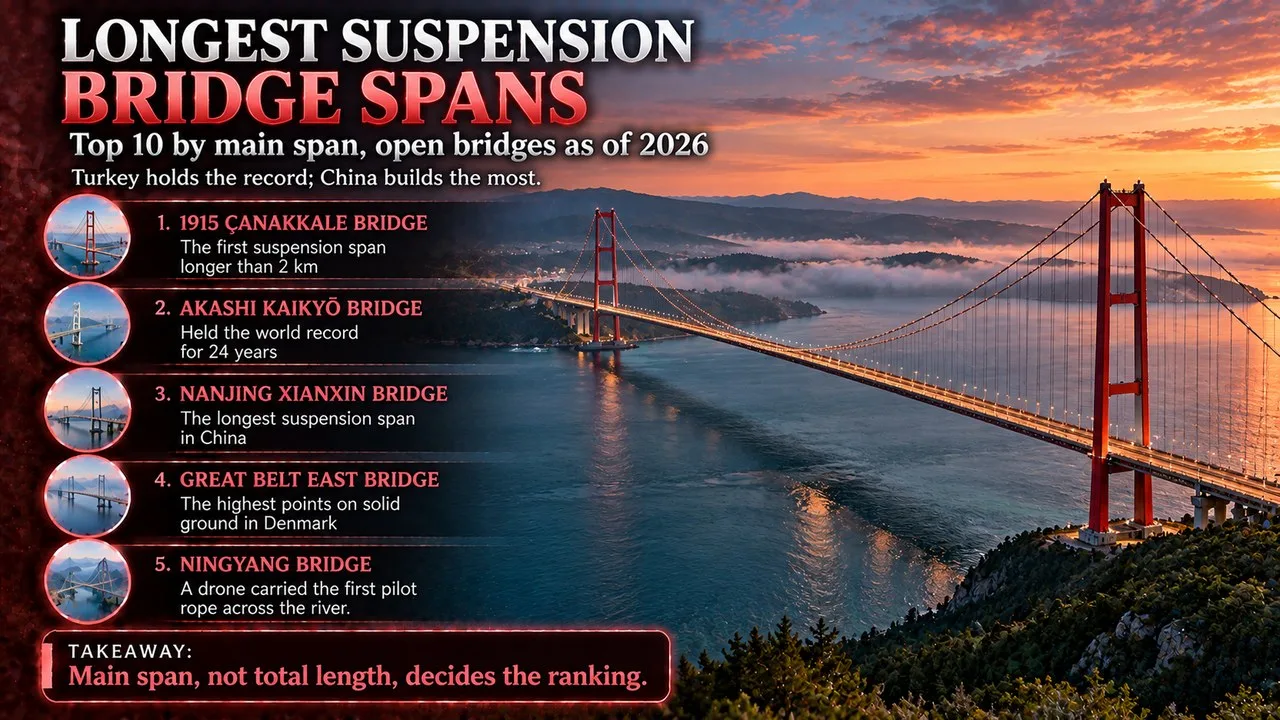
The longest suspension bridges in the world are ranked by main span, the stretch of road hung between the two towers. Since March 2022 the record has belonged to the 1915 Çanakkale Bridge in Turkey, whose main span of 2,023 metres beat Japan's Akashi Kaikyo Bridge by 32 metres.[3] Most of the other bridges in the top 10 are in China, where most of the world's large suspension bridges have been built in recent years.[1] This Finepedia list, updated in October 2026, ranks the top 10 longest suspension bridge spans in the world and explains where each bridge is, when it opened and what makes it stand out.
Introduction
A suspension bridge carries its roadway on cables slung between tall towers, and no other type of bridge can span such long gaps.[1][2] That is why the world's longest bridge spans, over straits, wide rivers and deep bays, are almost all suspension bridges. In the last two decades the record has moved from Japan to Turkey, and most new giants are being built in China.[1]
This guide ranks the ten longest suspension bridge spans that are open to traffic. For each bridge it explains where the crossing is, how big it is and why it was built, before looking at former record holders, the bridges just outside the top 10 and the records likely to fall next.[1]
How This List Is Ranked
Suspension bridges are compared by the length of their main span, the suspended roadway between the bridge's towers.[1] This is the most common way to compare them because it often goes with tower height and engineering difficulty, but a longer span does not always mean a longer bridge from shore to shore.[1] The list covers completed bridges that carry cars or trains and does not include cable-stayed bridges, footbridges or pipeline bridges.[1]
Suspension bridges have the longest spans of any type of bridge.[1] Cable-stayed bridges, the next longest design, are practical for spans up to just over one kilometre, with the record at 1,176 metres, so as of October 2025 the 28 longest bridges on the suspension list were also the 28 longest spans of any type of vehicle bridge.[1]
Key Facts
| Rank | Bridge | Main span | Opened | Country |
|---|---|---|---|---|
| 1 | 1915 Çanakkale Bridge | 2,023 m (6,637 ft) | 2022 | Turkey |
| 2 | Akashi Kaikyo Bridge | 1,991 m (6,532 ft) | 1998 | Japan |
| 3 | Nanjing Xianxin Yangtze River Bridge | 1,760 m | 2025 | China |
| 4 | Yangsigang Yangtze River Bridge | 1,700 m | 2019 | China |
| 5 | Nansha Bridge (east span) | 1,688 m | 2019 | China |
| 6 | Shenzhen–Zhongshan Bridge | 1,666 m | 2024 | China |
| 7 | Xihoumen Bridge | 1,650 m | 2009 | China |
| 8 | Great Belt Bridge (East Bridge) | 1,624 m | 1998 | Denmark |
| 9 | Ningyang Yangtze River Bridge | 1,560 m | 2025 | China |
| 10 | Osman Gazi Bridge | 1,550 m | 2016 | Turkey |
How a Suspension Bridge Works
In a suspension bridge the deck hangs below main cables on vertical suspenders, or hangers.[2] The main cables run between the towers, continue beyond them to deck-level supports and are anchored in the ground at each end, because any load on the bridge becomes tension in those cables.[2] Long decks may need considerable stiffness or aerodynamic shaping to stop them vibrating in high winds.[2]
The idea is old. The Tibetan bridge-builder Thangtong Gyalpo pioneered iron chains in simple suspension bridges, and the Inca used rope bridges documented as early as 1615.[2] The first iron chain suspension bridge in the Western world was Jacob's Creek Bridge in Pennsylvania in 1801, designed by James Finley, the first to include all the parts of a modern suspension bridge.[2] Spans grew quickly in Britain, reaching 176 metres with the Menai Bridge of 1826, described as "the first important modern suspension bridge".[2]
1. 1915 Çanakkale Bridge, Turkey: 2,023 m
The 1915 Çanakkale Bridge is a road suspension bridge in Çanakkale Province in northwestern Turkey, spanning the Dardanelles just southwest of Lapseki and Gelibolu.[3] It is the first fixed crossing over the Dardanelles and the sixth across the Turkish Straits, after three bridges over the Bosphorus and two tunnels under it.[3]
Its main span of 2,023 metres surpasses the Akashi Kaikyo Bridge by 32 metres.[3] The bridge is 3,563 metres long, or 4,608 metres with its approach viaducts, the longest bridge of any type in Turkey.[3] Its two towers are 334 metres high, making it the tallest bridge in Turkey, and its deck, 45.06 metres wide, carries six motorway lanes.[3]
Construction began in March 2017, and the bridge opened on 18 March 2022, earlier than the first planned date of September 2023.[3] President Erdoğan said it cost 2.5 billion euros to build.[3] The year 1915 in its name honours an important Ottoman victory in the Gallipoli campaign.[3] It is the centrepiece of the planned 321 km O-6 motorway linking East Thrace with Anatolia.[3]
Related: Top 10 Highest Bridges in the World
2. Akashi Kaikyo Bridge, Japan: 1,991 m
The Akashi Kaikyo Bridge links the city of Kobe on Honshu with Iwaya on Awaji Island, crossing the busy and turbulent Akashi Strait.[4] It is part of the Kobe-Awaji-Naruto Expressway, one of three routes of the Honshu–Shikoku Bridge Project across the Seto Inland Sea.[4]
Before the bridge, ferries carried passengers across the strait, and in 1955 two ferries sank in a storm in the Shiun Maru disaster, killing 168 people.[4] The tragedy helped persuade the government to plan a crossing.[4] Construction began in May 1988, involved more than 100 contractors and was finished in September 1996; the bridge opened on 5 April 1998.[4]
The Great Hanshin earthquake of January 1995 moved the towers, the only parts then built, so the central span had to be lengthened by 1 metre to 1,991 metres.[4] The bridge is 3,911 metres long overall and was designed to withstand winds of 286 km/h and earthquakes up to magnitude 8.5.[4] Its towers rise 282.8 metres above sea level, and its cables contain 300,000 km of wire.[4] From 1998 until 2022 it held the record for the longest central span in the world.[4]
3. Nanjing Xianxin Yangtze River Bridge, China: 1,760 m
The Nanjing Xianxin Yangtze River Bridge, also called the Nanjing Xinshengwei Yangtze River Bridge, crosses the Yangtze in Nanjing.[5] It lies 4.3 km upstream of the Fourth Nanjing Yangtze Bridge and 6.2 km downstream of the Second Nanjing Yangtze Bridge.[5]
The whole project, including approaches, is 13.17 km long and carries six road lanes, with gate-shaped reinforced concrete towers.[5] It opened in 2025 with a main span of 1,760 metres.[1]
4. Yangsigang Yangtze River Bridge, China: 1,700 m
The Yangsigang Yangtze River Bridge in Wuhan, Hubei, connects the Hanyang and Wuchang districts across the Yangtze.[6] It opened on 8 October 2019 with a span of 1,700 metres.[6]
It is the longest double-deck bridge span in the world.[1][6] The upper deck has six lanes linked to the urban expressway system plus walkways, and the lower deck has four more lanes, lanes for non-motorised vehicles and more walkways.[6] The bridge is 4.134 km long overall and cost CNY 8.5 billion, about US$1.27 billion.[6]
5. Nansha Bridge, China: 1,688 m
The Nansha Bridge is a set of two suspension bridges across the Pearl River in Guangdong, connecting Shatian Town in Dongguan with Nansha District in Guangzhou.[7] Its Nizhou Waterway Bridge has a main span of 1,688 metres, and its Dasha Waterway Bridge, the west span, has a 1,200-metre span.[1][7]
It was named the Humen Second Bridge while under construction and opened to traffic on 2 April 2019.[7] The project is 12,891 metres long and cost about CN¥12 billion.[7]
Related: Top 10 Famous Movable Bridges of the World
6. Shenzhen–Zhongshan Bridge, China: 1,666 m
The Shenzhen–Zhongshan Bridge, with a main span of 1,666 metres, opened in 2024.[1] It is part of the Shenzhen–Zhongshan Link, a 49.7 km bridge–tunnel across the Pearl River Delta that joins Shenzhen on the eastern side with Zhongshan on the western side.[8]
The link includes a 6.7 km tunnel and 19 bridges totalling 43 km, with four lanes in each direction.[8] It opened on 30 June 2024, cut travel time between the two cities to under 30 minutes and saw more than 3 million vehicle crossings in its first month.[8]
7. Xihoumen Bridge, China: 1,650 m
The Xihoumen Bridge links Jintang and Cezi islands in the Zhoushan Archipelago, the largest offshore island group in China.[9] It is part of a project begun in 1999 to connect the archipelago to the mainland through five bridges.[9]
It cost 2.48 billion yuan, about US$363 million, and opened to traffic on a test basis on 25 December 2009.[9] Its central span is 1,650 metres, and when built it was second only to the Akashi Kaikyo Bridge.[9]
8. Great Belt Bridge, Denmark: 1,624 m
The Great Belt link joins the Danish islands of Zealand and Funen through the small island of Sprogø in the middle of the Great Belt.[10] Its East Bridge is a suspension bridge between Halsskov and Sprogø, with a free span of 1,624 metres.[10]
After more than 50 years of debate, the Danish government decided in 1986 to build the link.[10] The East Bridge was built between 1991 and 1998 at a cost of US$950 million and opened to road traffic in 1998, the world's second-longest span at the time after the Akashi Kaikyo Bridge.[10] Its two pylons, 254 metres above sea level, are the highest points on self-supporting structures in Denmark, and its 65-metre clearance lets even the largest cruise ships pass with their smokestacks folded.[10]
9. Ningyang Yangtze River Bridge, China: 1,560 m
The Ningyang Yangtze River Bridge, previously named the Longtan Yangtze River Bridge, crosses the Yangtze in Nanjing.[11] It is a two-way, six-lane steel box girder suspension bridge with a main span of 1,560 metres and a design speed of 100 km/h, and it opened on 1 January 2025.[11] It links the Longtan Port area to the Nanjing metropolitan expressway network and cuts travel time between Longtan and Yizheng.[11]
10. Osman Gazi Bridge, Turkey: 1,550 m
The Osman Gazi Bridge spans the Gulf of İzmit at its narrowest point, linking Gebze with Yalova Province on the O-5 motorway.[12] It opened on 1 July 2016 as the then-longest suspension bridge in Turkey.[12]
Related: Top 10 Longest Vehicle-Carrying Sea Bridges
The bridge has a main span of 1,550 metres and towers 252 metres high.[12] With its highway, it shortened the distance between Istanbul and İzmir by about 140 km and cut the journey from around six hours to five.[12] The US$1 billion privately financed bridge was built by the Japanese firm IHI, with design by the Danish firm COWI.[12]
Former Record Holders
Golden Gate Bridge
The Golden Gate Bridge in San Francisco opened on 27 May 1937 with a main span of 1,280 metres, and until 1964 it had the longest suspension bridge span in the world.[14] Its towers, 227 metres above the water, were the tallest on any suspension bridge until 1993.[14] Joseph Strauss was its chief engineer, and Frommer's called it "possibly the most beautiful, certainly the most photographed, bridge in the world".[14]
Humber Bridge
The Humber Bridge in England, with a span of 1,410 metres, was the longest of its type in the world when it opened to traffic on 24 June 1981.[13] Queen Elizabeth II officially opened it on 17 July 1981.[13] The Akashi Kaikyo Bridge overtook it in 1998, and by 2025 it was the fourteenth-longest.[13]
Just Outside the Top 10
The bridges ranked 11th to 15th show how closely the field is bunched. South Korea's Yi Sun-sin Bridge between Gwangyang and Yeosu, opened in 2012, has a main span of 1,545 metres, only 5 metres short of the Osman Gazi Bridge.[1] China's Runyang Yangtze River Bridge, opened in 2005 between Yangzhou and Zhenjiang, spans 1,490 metres, and the Second Dongting Lake Bridge in Hunan, opened in 2018, spans 1,480 metres.[1] The Shuangliu Yangtze River Bridge between Wuhan and Ezhou, opened in 2026, spans 1,430 metres, and the Huajiang Canyon Bridge in Guizhou, opened in 2025, spans 1,420 metres.[1]
Further down are some of the most famous bridges in the world. New York's Verrazzano–Narrows Bridge, opened in 1964 with a 1,298-metre span, took the world record from the Golden Gate Bridge.[1][14] Hong Kong's Tsing Ma Bridge, opened in 1997, spans 1,377 metres, and Istanbul's first Bosphorus Bridge, opened in 1973, spans 1,074 metres.[1]
Records Still to Come
The record is set to change again. The Zhangjinggao Yangtze River Bridge in China is expected to break it in 2028, and the Strait of Messina Bridge in Italy is expected to top the list in 2032.[1] Most of the suspension bridges now under construction are in China.[1] They include the south span of the Zhangjinggao Yangtze River Bridge and the Second Sutong Yangtze River Bridge, both with planned main spans of 2,300 metres, due in 2028 and 2031, and the Shiziyang Bridge in Guangdong, with a 2,180-metre span due in 2028.[1] The Yanji Yangtze River Bridge, with a 1,860-metre span, is listed for 2026, and the Shuangyumen Bridge, with a 1,768-metre span, for 2027.[1] When these open, the top 10 will change sharply, and the Akashi Kaikyo Bridge, the record holder for 24 years, could drop to fifth place.[1][4]
Other records on the list belong to bridges outside the top 10. The Huajiang Canyon Bridge in China, opened in 2025, is the highest suspension bridge in the world at 625 metres, and the George Washington Bridge in New York, opened in 1931, has the most traffic lanes, fourteen on two levels.[1] Turkey's Yavuz Sultan Selim Bridge, opened in 2016, has the longest span carrying both road and rail traffic, at 1,408 metres.[1]
Records at a Glance
- Longest suspension span: 1915 Çanakkale Bridge, 2,023 m.[3]
- Çanakkale towers: 334 m.[3]
- Akashi Kaikyo record: 1998 to 2022.[4]
- Akashi Kaikyo cable wire: 300,000 km.[4]
- Longest double-deck span: Yangsigang, 1,700 m.[6]
- Great Belt pylons: 254 m, Denmark's highest points on self-supporting structures.[10]
- Longest cable-stayed span: 1,176 m.[1]
- Golden Gate span: 1,280 m, the world record until 1964.[14]
- Highest suspension bridge: Huajiang Canyon Bridge, 625 m.[1]
Frequently Asked Questions
What is the longest suspension bridge in the world?
The 1915 Çanakkale Bridge in Turkey, with a main span of 2,023 metres, opened in March 2022.[3]
Related: Top 10 Famous Stone Bridges of the World
Which bridge held the record before it?
Japan's Akashi Kaikyo Bridge, with a 1,991-metre span, held the record from 1998 until 2022.[1][4]
Why are suspension bridges ranked by main span?
Main span is the most common way to compare them because it often reflects tower height and engineering difficulty.[1]
Why are so many of the longest bridges in China?
Most of the large suspension bridges built in recent years, and most of those under construction, are in China.[1]
Is the Golden Gate Bridge still one of the longest?
Its 1,280-metre span was the world's longest until 1964, but many newer bridges now exceed it.[1][14]
Which bridge will be the next record holder?
China's Zhangjinggao Yangtze River Bridge is expected to break the record in 2028, followed by Italy's Strait of Messina Bridge in 2032.[1]
Conclusion
The ten longest suspension bridges show how fast this kind of engineering has advanced. When the Golden Gate Bridge opened in 1937 its 1,280-metre span was a world record; today every bridge in the top 10 spans more than 1,500 metres, and the 1915 Çanakkale Bridge reaches 2,023 metres.[1][3][14] Japan's Akashi Kaikyo Bridge held the record for almost a quarter of a century and still ranks second.[4]
China now dominates the list, with six of the ten longest spans, and most of the suspension bridges under construction around the world are also Chinese.[1] With the Zhangjinggao Yangtze River Bridge and Italy's Strait of Messina Bridge both expected to pass the current record, this ranking is likely to change again within the next decade.[1]
See also
- ^ [1] "List of longest suspension bridge spans". Wikipedia. Wikipedia
- ^ [2] "Suspension bridge". Wikipedia. Wikipedia
- ^ [3] "1915 Çanakkale Bridge". Wikipedia. Wikipedia
- ^ [4] "Akashi Kaikyo Bridge". Wikipedia. Wikipedia
- ^ [5] "Nanjing Xianxin Yangtze River Bridge". Wikipedia. Wikipedia
- ^ [6] "Yangsigang Yangtze River Bridge". Wikipedia. Wikipedia
- ^ [7] "Nansha Bridge". Wikipedia. Wikipedia
- ^ [8] "Shenzhen–Zhongshan Bridge". Wikipedia. Wikipedia
- ^ [9] "Xihoumen Bridge". Wikipedia. Wikipedia
- ^ [10] "Great Belt Bridge". Wikipedia. Wikipedia
- ^ [11] "Ningyang Yangtze River Bridge". Wikipedia. Wikipedia
- ^ [12] "Osman Gazi Bridge". Wikipedia. Wikipedia
- ^ [13] "Humber Bridge". Wikipedia. Wikipedia
- ^ [14] "Golden Gate Bridge". Wikipedia. Wikipedia























Discussion
Log in with