






 By
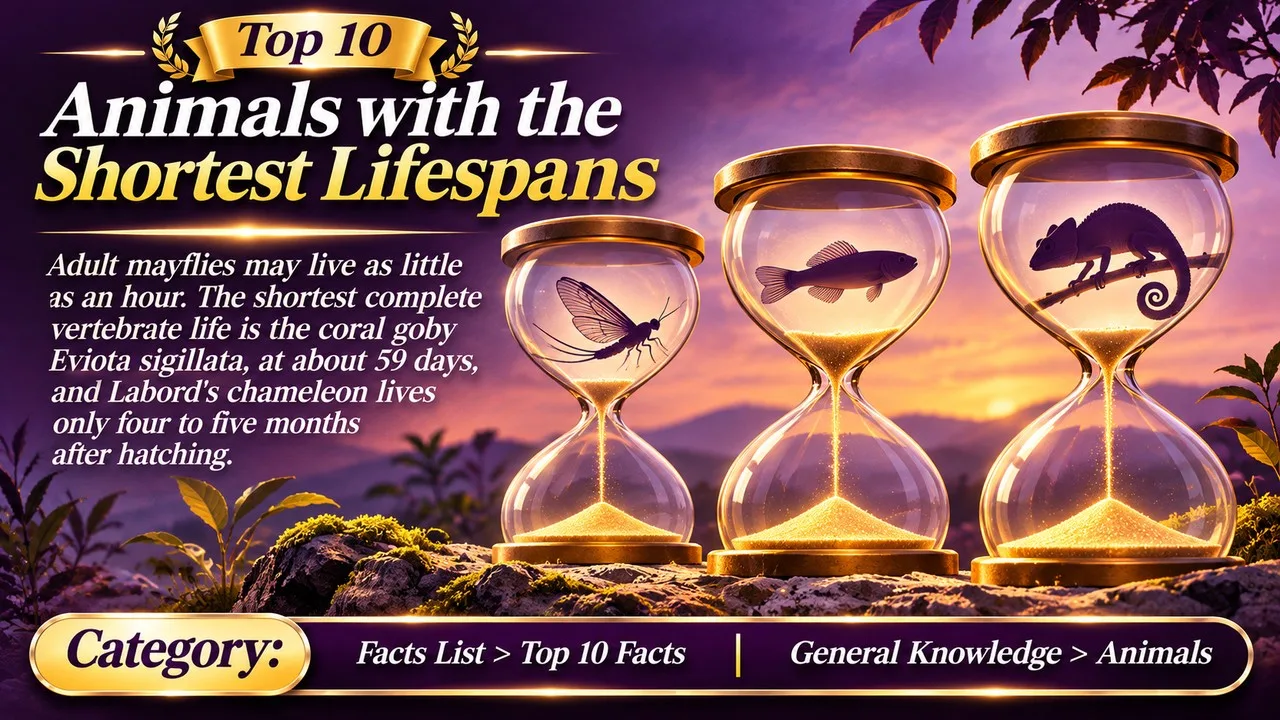
The shortest animal lifespans on this list are labelled by stage, because an adult mayfly may live a few hours while the same insect spent years as a nymph. A ranking that ignored that distinction would compare unlike quantities and would mislead a reader who wanted a complete life, from egg or birth to death, rather than an adult flying stage [1][2].
The ten entries below are therefore a labelled catalogue, not a single number line. Insects with long larval or nymph lives appear for their brief adult stages, and that fact is stated in the table. Vertebrates appear for complete documented lives. Captive maxima are not used where the wild or typical figure is the point of the record, and they are mentioned only when the literature itself draws that contrast, as with Labord's chameleon [3][4]. This list is the counterpart of Finepedia's ranking of the longest-lived animals; the methods are as important here as they are there.
Key Facts
Each row states the measure: adult stage, complete life, or post-hatching life. Rank 1 is the briefest well-documented adult life among animals commonly cited for this record.
Shortest Lifespans at a Glance
| Rank | Animal | Documented short life | What is measured | Notes |
|---|---|---|---|---|
| 1 | Mayflies | As little as about an hour as winged adults | Adult stage | Nymphs may live months to a few years |
| 2 | Gastrotrichs | About 3 to 19 days, averaging around 10 | Complete life | Microscopic aquatic animals |
| 3 | Luna moth | About a week as an adult | Adult stage | Adults do not feed |
| 4 | Fruit flies | On the order of a few weeks in ordinary conditions | Complete adult life | Laboratory strains can live longer |
| 5 | Mosquitoes | Commonly around two weeks as adults | Adult stage | Varies widely by species and sex |
| 6 | Summer worker honeybees | About 40 days in the working season | Adult worker life | Winter workers can live much longer |
| 7 | Seven-figure pygmy goby | Up to about 59 days | Complete life | Shortest documented vertebrate life |
| 8 | Labord's chameleon | Four to five months after hatching | Post-hatching life | Eggs incubate about eight to nine months |
| 9 | Annual killifish | A few months in seasonal pools | Complete life | Used as a laboratory ageing model |
| 10 | House mouse, in the wild | Often only a few months | Typical wild life | Captive mice can live more than two years |
1. Mayflies
Mayflies, the order Ephemeroptera, hold the standard record for the shortest adult life. Guinness World Records notes that they may spend two to three years as nymphs at the bottom of lakes and streams and then live for as little as an hour as winged adults [1]. Some species have even shorter female adult lives, measured in minutes, but the widely cited, conservative public record is the hour-scale adult stage.
They are first because no other well-known animal group has a routinely documented adult life this short. The nymph stage is not short, which is why the table labels the measure. A mayfly larva can be a useful sign of clean, well-oxygenated water, a fact that belongs to freshwater ecology rather than to the adult clock [2].
The name of the order, built on the idea of a day, is a fair popular summary and a poor scientific one. Adult lives range from about an hour to a few days depending on the species, and the aquatic earlier stage can last for seasons [1][2].
2. Gastrotrichs
Gastrotrichs, sometimes called hairybacks, are microscopic aquatic animals whose complete lives are measured in days. A study often cited in popular summaries found lives between about 2.6 and 18.6 days, with an average near 10 days [2]. That is a whole life, not an adult after a long larva, which is why they sit immediately after the mayflies even though a ten-day complete life is longer than a one-hour adult flight.
They are second as the briefest complete lives on this list that are documented for a whole animal, egg to death, rather than for a terminal adult stage. They feed on bacteria and algae in freshwater and marine habitats [2].
Because they are small and easily overlooked, gastrotrichs rarely appear in zoo signage, but they are a better "shortest complete life" example than a mayfly if the reader wants a single number for an entire organism [2].
Related: Top 10 Shortest-Lived Animals on Earth
3. Luna moth
The luna moth (Actias luna) is a familiar North American example of a saturniid moth whose spectacular adult lives only about a week and does not feed. Popular wildlife summaries often give a figure of about seven days for the adult [2]. As with mayflies, the caterpillar and pupa last much longer than the flying adult.
It is third as a short, well-known adult stage that is still longer than a mayfly's hour and longer than a gastrotrich's complete life. The adult has reduced or non-functional mouthparts, so the clock is set at emergence: the moth mates, the female lays eggs, and the adult dies [2].
Other silk moths have a similar adult pattern. The luna moth stands in for that group because it is the species most often used in short-life lists and because the "about a week" adult figure is stable in standard accounts [2].
4. Fruit flies
Common fruit flies, including Drosophila melanogaster, live on the order of a few weeks as adults in ordinary conditions, though laboratory strains used in ageing research can be kept longer, often for a month or more, and wild lives can be shorter [2]. The insect is here as a short-lived complete adult life that people actually encounter, not as a rival for the mayfly hour.
It is fourth because a few weeks is longer than a luna moth's typical adult week and much longer than a gastrotrich's ten-day mean, while still being brief by the standard of almost any vertebrate on this list. The species' scientific importance is out of proportion to its lifespan: it remains a central laboratory animal precisely because a complete generation is short [2].
A reader should not treat a single "12-day" or "40-day" figure as a universal constant. Temperature, food, and whether the measure is wild or laboratory all move the number. The honest summary is weeks, not years, and not hours [2].
5. Mosquitoes
Adult mosquitoes of many common species live on the order of one to several weeks, with a figure of around two weeks often used in popular summaries, and with wide variation by species, sex, and climate [2]. The larval and pupal stages in water are separate, shorter or longer depending on temperature, and are not the figure used here.
Related: Top 10 Longest-Lived Animals
They are fifth as another brief adult insect life that is longer than the moth and fly examples above only in typical mid-range figures, and that matters to people because of disease transmission rather than because it is the shortest clock in nature [2]. Males often live less long than females in some species; the table keeps a conservative "commonly around two weeks" rather than a dramatic minimum.
As with fruit flies, the exact day count is not a single official number. The placement is for a well-known animal whose adult life is measured in weeks [2].
6. Summer worker honeybees
Worker honeybees, the non-reproductive females of the hive, often live about 40 days during the main foraging season, a figure that can stretch to well over 100 days for workers that overwinter [2]. This entry uses the summer working life, which is the short end of the bee's own range, and it is labelled as such.
It is sixth because a 40-day adult worker life is short among familiar insects that people think of as long-lived "bees," yet it is longer than the fly and mosquito figures above. Queens, by contrast, can live for years, which is why a list that said only "bees" would be misleading [2].
The seasonal split is the fact to remember. A colony's summer workers are worn out by foraging in weeks; the winter cohort is a different physiological class with a different clock [2].
7. Seven-figure pygmy goby
The seven-figure pygmy goby (Eviota sigillata), a tiny coral-reef fish of the Indian and west Pacific oceans, has the shortest documented complete lifespan of any vertebrate: up to about 59 days. Research by Depczynski and Bellwood, published in 2005, described a life of roughly three weeks as a larva, about two weeks settling on the reef, and about three weeks as an adult [4][5].
It is seventh overall on this labelled list, and first among vertebrates, because a complete life of eight weeks is longer than the insect adult stages above and shorter than any reptile, mammal, or killifish entry below. The "shortest vertebrate" claim is about the whole life, not about an adult after a long larva [5].
Related: Top 10 Longest-Living Animals on Earth
The fish lives among coral, stays small, and has a rapid turnover. That combination, not a laboratory trick, is why it sits at the bottom of the vertebrate age table [4][5].
8. Labord's chameleon
Labord's chameleon (Furcifer labordi) of southwestern Madagascar is the shortest-lived land vertebrate in standard accounts. After an egg incubation of about eight to nine months, the animals hatch at the start of the wet season, grow rapidly, reproduce, and die as the dry season returns, with a post-hatching life of about four to five months [3][4]. In captivity they can live longer, up to more than a year in some reports, which is why this entry uses the wild post-hatching figure [2][3].
It is eighth because four to five months is longer than the goby's 59 days and shorter than a typical shrew or wild mouse year. During the dry season the living population is essentially eggs, a fact documented in the original field study and in later natural-history accounts [3].
The species is a reminder that "reptiles live a long time" is a slogan, not a law. This chameleon's entire above-ground life is over in a single wet season [3][4].
9. Annual killifish
Annual killifish, especially African species in the genus Nothobranchius such as Nothobranchius furzeri, live in temporary pools that dry out. Their complete lives in the wild are typically a few months, after which the adults die and the next generation survives as drought-resistant eggs [4][6]. Laboratory strains of the turquoise killifish have been shortened further for ageing research, which is a separate, artificial figure and is not used as the wild rank.
They are ninth because a few months is comparable to, and in many populations slightly longer than, Labord's chameleon's post-hatching life, and much shorter than ordinary fish or rodent lives in the same climates. The ecological clock is the pool: when the water goes, the fish are gone [6].
Related: Top 10 Most Bizarre Phobias: Strange Fears That Exist
The honest number is "a few months in seasonal water," not a single official day count for every population. That is still short enough to earn a place among the briefest vertebrate lives [6].
10. House mouse, in the wild
The house mouse (Mus musculus) can live more than two years in captivity, but in the wild a typical life is often only a few months, with predation and weather cutting the span far below the laboratory maximum [2]. Common shrews and pygmy shrews, by contrast, often live less than a year even as a physiological maximum, with figures of about 11 to 13 months cited for the American pygmy shrew [7]. The mouse is placed tenth as the familiar short-lived mammal whose wild life, not its cage life, is the relevant short figure.
It is last because a few months to a year is long beside a 59-day fish and short beside almost any pet mammal people compare it with. A list that used only captive mouse ages would not belong here at all [2][7].
Shrews could have occupied this slot on a physiological-maximum ranking. They are mentioned in the same breath because both are short-lived mammals, and because the wild mouse figure is an ecological life, not a metabolic ceiling [7].
Conclusion
The shortest lives in the animal world are not a single ladder. An adult mayfly may last about an hour after years as a nymph, a gastrotrich may complete its whole life in around ten days, and the shortest documented vertebrate life, that of Eviota sigillata, is about 59 days [1][2][5]. Among land vertebrates, Labord's chameleon and annual killifish compress a complete adult existence into one season [3][6].
The labels matter as much as the numbers. Adult stage, complete life, post-hatching life, wild typical life, and captive maximum are different claims, and this article keeps them separate so that a 2026 reader can use the list without mixing a moth's flying week with a goby's entire existence. For the other end of the same subject, see the companion ranking of the longest-lived animals, where century-scale shell rings and eye-lens dates replace hourglasses.
- ^ [1] "Shortest lifespan". Guinness World Records, mayflies, adult stage as little as an hour. Guinness: shortest lifespan
- ^ [2] "Animals with the shortest lifespans". International Fund for Animal Welfare, species summaries including gastrotrichs, luna moths, flies, bees, and wild mice. IFAW: shortest lifespans
- ^ [3] Karsten, K.B., et al. Field study of Furcifer labordi, an annual chameleon, and later natural-history accounts of a four-to-five-month post-hatching life. PNAS paper on Labord's chameleon
- ^ [4] "Labord's chameleons of Madagascar live fast, die young". BBC Earth News, citing Karsten and noting the pygmy goby's 59-day life. BBC Earth News
- ^ [5] Depczynski, M., and Bellwood, D.R. "Shortest recorded vertebrate lifespan found in a coral reef fish". Current Biology, 2005, Eviota sigillata, about 59 days. Current Biology
- ^ [6] Ageing and natural-history literature on Nothobranchius furzeri and other annual killifish, wild lives of a few months in seasonal pools. National Institutes of Health and primary killifish papers
- ^ [7] "Pygmy Shrew: America's Smallest Mammal—and Its Hungriest". National Wildlife Federation, lifespan about 11 to 13 months. NWF: pygmy shrew



















Discussion
Log in with