






 By
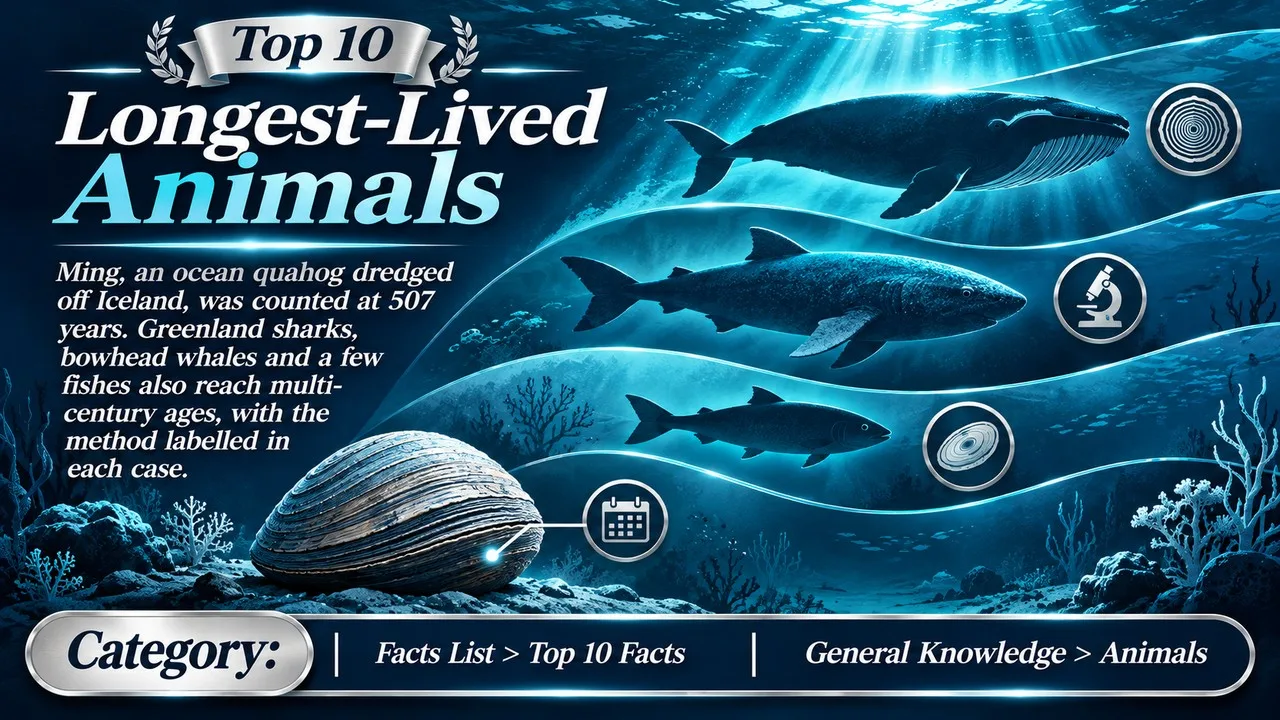
The longest documented non-colonial animal is an ocean quahog whose shell rings were counted at 507 years, and several vertebrates also reach two centuries. That statement needs a method label, because "longest-lived animal" can mean a ring-counted individual, a radiocarbon or chemical age estimate, or a colonial invertebrate whose living tissue has been growing for thousands of years [1][2].
This list ranks ten animals by a clearly described maximum age. It leads with counted or peer-reviewed individual ages, and it treats colonial or modular animals such as certain black corals and barrel sponges in the introduction rather than as a single numbered "winner." Those colonial estimates, some of them more than a thousand years, are real research results, but they are not the same kind of record as a quahog shell or a rockfish otolith [2]. Trees are excluded; Finepedia already has a separate list of the oldest living trees. Estimates are labelled as estimates. A living animal, such as Jonathan the tortoise, is dated to 2026 where the age is an ongoing count [3].
Key Facts
Ranks follow the best documented or published maximum for the species or named individual, not a typical adult life. Where a range is the honest result, the range is the result. Rank 1 is the longest documented non-colonial individual.
Longest-Lived Animals at a Glance
| Rank | Animal | Best documented or published age | Method | Status |
|---|---|---|---|---|
| 1 | Ocean quahog "Ming" | 507 years | Annual shell rings, revised 2013 | Individual, died when collected in 2006 |
| 2 | Greenland shark | At least 272 years; largest specimen 392 plus or minus 120 | Eye-lens radiocarbon | Species estimate, 2016 study |
| 3 | Escarpia laminata tubeworm | Regularly 100 to 300-plus years; some models higher | Growth and protein-age models | Deep-sea species estimate |
| 4 | Bowhead whale | One AAR estimate of 211 years; other evidence 150 to 200 | Eye-lens chemistry; dated hunting artefacts | Individual estimates plus artefacts |
| 5 | Rougheye rockfish | 205 years | Otolith section, Alaska, 2000 | Individual fish |
| 6 | Red sea urchin | On the order of 100 to 200 years | Growth and radiocarbon studies | Species estimate |
| 7 | Jonathan, Seychelles giant tortoise | About 194 years in 2026 | Arrival record, conservative maturity estimate | Living individual |
| 8 | Tu'i Malila, radiated tortoise | 188 years | Hatch year 1777, death 1966 | Historical individual |
| 9 | Freshwater pearl mussel | More than 100 years, some reports above 200 | Shell growth | Species, regional maxima |
| 10 | Orange roughy | About 150 years in several studies; some counts higher | Otoliths and radiometric checks | Species, with uncertainty |
1. Ocean quahog "Ming"
The ocean quahog (Arctica islandica) nicknamed Ming is the longest-lived non-colonial animal yet documented. Researchers from Bangor University's School of Ocean Sciences dredged the clam off northern Iceland in 2006. Growth rings in the shell were first read as about 405 to 410 years, then, with a revised technique announced in 2013, as 507 years [1]. Guinness World Records accepts that revised count as the longest-lived non-colonial animal ever discovered [1].
It is first because 507 is a counted individual age, not a modelled species ceiling. The animal did not survive collection, a fact that later commentary has not softened. The nickname refers to the Ming dynasty, which was in power when the clam settled.
Ocean quahogs as a species are long-lived even aside from this specimen. The Ming count is the record, not a typical life, and it remains the benchmark against which vertebrate estimates are compared [1][2].
2. Greenland shark
The Greenland shark (Somniosus microcephalus) is the longest-lived vertebrate with a published scientific age range. A 2016 study in Science used radiocarbon in eye-lens nuclei from 28 female sharks and reported a lifespan of at least 272 years. The largest animal in the sample, 502 centimetres long, was estimated at 392 plus or minus 120 years, a 95.4 percent range that stretches from 272 to 512 [2]. Sexual maturity was estimated at about 156 plus or minus 22 years.
It is second because the central estimates sit below Ming's 507 counted years, and because the result is a range, not a ring count. NOAA's ocean-service summary of the same work stresses that carbon dating gives a range and that later methods may tighten it, but even the lower bound is far above any other vertebrate in this list [4].
The species lives in cold North Atlantic and Arctic waters and grows slowly. Conservation concern follows directly from the age at maturity: a shark that first reproduces after a century and a half cannot replace itself quickly [2][4].
Related: Top 10 Longest-Living Animals on Earth
3. Escarpia laminata tubeworm
Escarpia laminata is a deep-sea vestimentiferan tubeworm of cold seeps in the Gulf of Mexico. Growth studies have found that individuals commonly reach ages of 100 to 200 years, that some are determined to be more than 300 years old, and that models have been used to discuss even higher possible ages, including figures above 1,000 years in later commentary [5]. Those higher figures are models, not shell-ring counts, which is why this entry sits below the quahog and the shark.
It is third as a well-studied long-lived invertebrate whose published ages overlap the lower shark range and exceed most vertebrates, with the uncertainty clearly stated. The animal lives in a tube at the seep, growing slowly in cold, stable conditions.
A reader should not collapse this species into "the 1,000-year worm" as a fact on the same footing as Ming. The honest claim is extreme longevity measured by growth models, regularly into the second and third centuries [5].
4. Bowhead whale
The bowhead whale (Balaena mysticetus) is the longest-lived mammal with strong published evidence. The International Whaling Commission summarises the evidence as lives of up to 150 years, and perhaps as long as 200 [6]. Aspartic acid racemization of eye-lens tissue, reported by George and colleagues, has produced estimates above 100 years and, in one case, an estimate of 211 years, with a stated uncertainty band around that figure [7][8].
Independent support comes from hunting artefacts recovered from whales taken in Alaska Native hunts: stone and ivory points, and a bomb-lance fragment recovered in 2007 that was of a type manufactured in the late nineteenth century, implying a whale that had carried the fragment for well over a century [7][8]. The North Slope Borough's wildlife programme describes multiple lines of evidence pointing to lives of at least 150 years and possibly as much as 200 [7].
It is fourth because the best individual chemical estimate, 211 years, sits just above the counted rockfish and well below the shark range. The 211-year figure is an estimate with error, not a birthday record, and this article reports it that way [8].
5. Rougheye rockfish
A rougheye rockfish (Sebastes aleutianus) captured in May 2000 in southeastern Alaska was aged from a sagittal otolith transverse section at 205 years, a figure published in the Alaska Fishery Research Bulletin and cited by the Washington Department of Fish and Wildlife as the species maximum, "at least 205 years" [9][10]. The paper describes this as the oldest fish then recorded from Alaska, and possibly for the North Pacific.
Related: Top 10 Shortest-Lived Animals on Earth
It is fifth as a counted hard-part age just below the bowhead's highest chemical estimate and far more precise than most reptile folklore. The age is still an interpretation of otolith zones, which fisheries scientists treat as a learned estimate, but it is one of the best-documented fish ages in the literature [9].
Rougheye rockfish grow slowly in cold northern waters. A maximum of two centuries is a management fact as well as a curiosity, because a fishery that removes old fish removes animals that recruited in the early nineteenth century [10].
6. Red sea urchin
The red sea urchin (Mesocentrotus franciscanus, formerly in the genus Strongylocentrotus) of the northeastern Pacific has been shown in growth and radiocarbon work to reach ages on the order of a century, with some analyses extending toward 200 years [11]. The result overturned earlier assumptions that these urchins were relatively short-lived.
It is sixth because the published ages overlap the lower end of the fish and whale figures but are species estimates rather than a single named individual's birthday. The animal is a harvested species on the Pacific coast, so the longevity has the same management implication as the rockfish: old individuals are not quickly replaced [11].
Readers should treat "200 years" as a documented order of magnitude, not as a certificate for one famous urchin. The contrast with Ming is the method: growth and radiocarbon, not a complete ring count on a named shell [1][11].
7. Jonathan, Seychelles giant tortoise
Jonathan, a Seychelles giant tortoise (Aldabrachelys gigantea hololissa) living on Saint Helena, is the oldest known living terrestrial animal. Guinness World Records states that he is believed to have been born about 1832, making him 194 years old in 2026, based on the conservative estimate that he was already fully mature, and therefore at least 50, when he was brought to the island in 1882 [3]. He may be older.
It is seventh among the maxima in this list, and first among animals that are still alive in 2026. A living age will move; the 194 figure is the 2026 statement of the same arrival record Guinness uses [3]. Claims of still older historic tortoises, including Adwaita, who died in Kolkata in 2006 at a sometimes-quoted age of about 255, are not used as a higher rank here because they are less firmly documented [2].
Related: Top 10 Animals with the Shortest Lifespans
Jonathan's record is a documentary estimate, not a shell-ring count. It is nonetheless one of the best-supported terrestrial ages in the public record [3].
8. Tu'i Malila, radiated tortoise
Tu'i Malila, a radiated tortoise, died in May 1966 at the reported age of 188, with a hatch year given as 1777 [2]. For a long period this animal was treated as the oldest verified vertebrate then known, a title later overtaken by better-dated sharks, whales, and fishes, and by Jonathan's continuing life.
It is eighth as a historical individual whose reported age is just below Jonathan's 2026 figure and well above typical tortoise folklore. The date pair, 1777 to 1966, is the basis of the 188-year claim and should be read as a documented traditional record, not as a radiocarbon result [2].
The contrast with Jonathan is simple: one is living and still accruing years, the other is a closed historical count. Both belong on a list of long-lived reptiles, and neither should be confused with unverified zoo legends [3].
9. Freshwater pearl mussel
The freshwater pearl mussel (Margaritifera margaritifera) is a long-lived bivalve of cool Northern Hemisphere rivers. Shell-growth studies have documented lives of more than 100 years and, in some northern populations, reports of ages above 200 years [12]. Like the ocean quahog, the animal records years in the shell, but no single named specimen in the public record matches Ming's 507-year count.
It is ninth because the reliable published maxima sit in the same century as the tortoises and the lower urchin estimates, not because the species is unimportant. In conservation terms it is one of the most age-sensitive freshwater animals in Europe, with slow growth and a long juvenile stage [12].
Related: Top 10 Strangest Deep-Sea Creatures
A regional maximum should not be inflated into a rival for Ming. The honest placement is among the century-scale animals, with some northern shells read still older [12].
10. Orange roughy
Orange roughy (Hoplostethus atlanticus) is a deep-water fish whose longevity was once disputed and is now accepted as centenarian. An FAO global review reports that the species has been validated to live to about 100 years, that several individuals have been aged at about 150 years, and that some estimates have approached 200, while stressing that age estimation has substantial uncertainty [13]. NOAA has long used a public figure of around 150 years, with maturity often not reached until about 25 to 30 years [14].
It is tenth because the best-supported typical maximum in the recent literature is about 150 years, below the counted rougheye and the better-constrained whale and tortoise figures, even if a few otolith counts run higher [13]. Earlier short ages, based on whole otoliths or scales, are no longer used.
The management lesson is the same as for the rockfish and the urchin. A fish that may not breed until it is decades old, and that may live longer than a human career, is easily overfished, which is why the longevity debate became a stock-assessment debate [13][14].
Conclusion
The longest documented non-colonial animal remains Ming, the 507-year ocean quahog, a counted individual rather than a model [1]. Below that record, Greenland sharks occupy the top of the vertebrate list with a published lower bound of 272 years, bowhead whales and rougheye rockfish supply independent mammal and fish ages around two centuries, and a living tortoise, Jonathan, is about 194 years old in 2026 [2][3][6][9].
The list is only as good as its methods. Ring counts, otolith sections, eye-lens radiocarbon, chemical racemization, and growth models are not interchangeable, and colonial animals with thousand-year estimates sit in a different category [2][7]. A later study can move a range, as the 2013 revision of Ming's own rings already did, but it will not make a typical house pet or a typical farm animal a rival for these ten. For the opposite end of the same subject, see the companion list of animals with the shortest lifespans.
- ^ [1] "Oldest animal ever". Guinness World Records, ocean quahog "Ming", 507 years. Guinness: oldest animal
- ^ [2] Nielsen, J., et al. "Eye lens radiocarbon reveals centuries of longevity in the Greenland shark (Somniosus microcephalus)". Science, 2016. Science paper
- ^ [3] "Oldest tortoise". Guinness World Records, Jonathan of Saint Helena, age in 2026. Guinness: oldest tortoise
- ^ [4] "How long do Greenland sharks live?". NOAA National Ocean Service. NOAA: Greenland shark
- ^ [5] Durkin, A., et al., and later reviews of Escarpia laminata longevity at Gulf of Mexico seeps. Extreme longevity in a deep-sea tubeworm
- ^ [6] "Bowhead whale". International Whaling Commission species account, longevity 150 to perhaps 200 years. IWC: bowhead whale
- ^ [7] "Age Estimation". North Slope Borough Department of Wildlife Management, bowhead studies. North Slope Borough: age estimation
- ^ [8] George, J.C., et al., aspartic acid racemization ages, including a 211-year estimate, and later artefact papers. Science Advances review of balaenid longevity
- ^ [9] Cailliet, G.M., Andrews, A.H., Burton, E.J., et al., and Munk, K.M. "Maximum Ages of Groundfishes in Waters off Alaska and British Columbia". Alaska Fishery Research Bulletin 8(1), 2001, rougheye rockfish 205 years. Alaska Fishery Research Bulletin
- ^ [10] "Rougheye rockfish". Washington Department of Fish and Wildlife. WDFW: rougheye rockfish
- ^ [11] Ebert, T.A., and colleagues, growth and radiocarbon studies of red sea urchin longevity. NOAA / fisheries literature on red sea urchin age
- ^ [12] Growth-ring studies of Margaritifera margaritifera, including northern European populations with century-scale and older shells. IUCN and malacological literature on the freshwater pearl mussel
- ^ [13] "Global review of orange roughy (Hoplostethus atlanticus), their fisheries, biology and management". FAO. FAO orange roughy review
- ^ [14] NOAA Ocean Explorer background on orange roughy longevity, around 150 years. NOAA Ocean Explorer: orange roughy


















Discussion
Log in with