






 By
The love-lock sites ranked here include only places that still exist or that are historically important, and they label removals and bans. Rank is editorial, by documentary fame and official status, not by a count of remaining padlocks and not as advice to attach a lock to a protected structure [1][2]. Pont des Arts in Paris is historically important: the city removed locks in 2015, new locks are prohibited, and a later Guinness World Records retrospect published in April 2026 described a combined weight of about 45 tonnes taken from that bridge and the neighbouring Pont de l'Archeveche, with more than a million locks in the official clearance [1][2]. Cologne's Hohenzollern Bridge still tolerates locks on its railings [3]. N Seoul Tower keeps an official designated Love Tree area in the tower plaza, where official visitor pages still describe hanging locks in 2026 [4]. This article labels removals, bans, and official designated areas, and it is not a how-to for damaging a historic railing.
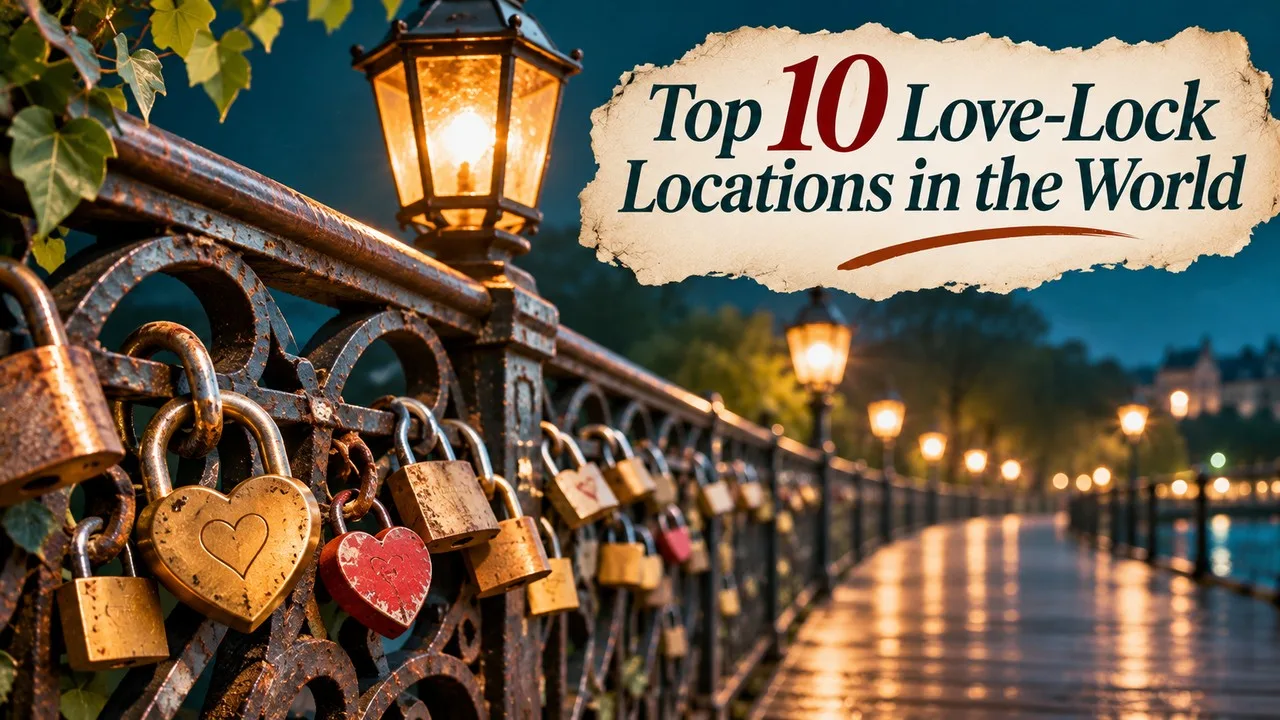
A useful 2026 habit is to use only an official designated fixture where one exists, and to leave a protected bridge alone where locks have been removed or prohibited. The featured image is a still-life of generic rail and padlock shapes, not a copy of a named bridge.
Key Facts
Status notes follow official city, park, and later record accounts [1][2][3][4]. Most Ljubavi in Vrnjacka Banja, Serbia, is an early documented love-lock tradition that local official accounts still preserve [5]. Ponte Milvio in Rome popularised the later European fashion in the early 2000s and then saw official removals in 2012, with attaching locks prohibited [6]. Rank 1 is the outstanding historically important clearance case, which is also the most precisely dated weight figure in this ten.
Brooklyn Bridge and Dublin's Ha'penny Bridge are official prohibition or official-removal sites on protected structures [7][8]. Charles Bridge in Prague is a documented removal-and-discouragement site, not a designated lock fence [9]. Huangshan still has observed locks on railings in 2026 visitor reporting, which is not the same as a legal permit [10]. Moscow's Luzhkov, or Tretyakov, Bridge has official metal Trees of Love as a designated alternative [11].
Love Lock Sites at a Glance
| Rank | Site | Official status | 2026 note |
|---|---|---|---|
| 1 | Pont des Arts, Paris | Locks removed 2015; new locks prohibited | Historically important; 2015 clearance with the neighbouring Pont de l'Archeveche, later given as about 45 tonnes |
| 2 | Most Ljubavi, Vrnjacka Banja | Early documented tradition, still preserved | Official local accounts still treat the bridge as a lock site |
| 3 | Hohenzollern Bridge, Cologne | Locks still tolerated on the railings | The outstanding still-active official European bridge scene |
| 4 | N Seoul Tower | Official designated Love Tree area | Official visitor pages still describe the designated fixture |
| 5 | Ponte Milvio, Rome | Locks removed 2012; attaching prohibited | Historically important later popularisation, not a current lock fence |
| 6 | Huangshan (Yellow Mountain) | Locks still observed on some railings in 2026 reporting | A documented mountain site, not a legal permit to attach a lock |
| 7 | Luzhkov (Tretyakov) Bridge, Moscow | Official metal Trees of Love as a designated alternative | Official city fixtures; trees are replaced when full |
| 8 | Charles Bridge, Prague | Official discouragement; locks regularly removed | A historic bridge, not a designated lock site |
| 9 | Ha'penny Bridge, Dublin | Official removals from a protected structure, from 2012 | The council has continued to take locks off the official bridge |
| 10 | Brooklyn Bridge, New York | Attaching locks is prohibited | Official removals and later fines; not a designated fixture |
1. Pont des Arts, Paris
Pont des Arts is the official Paris footbridge whose love locks became a global famous overload, and it is ranked here as a historically important site, not as a place to add a lock: the city removed the locks in 2015, new locks are prohibited, and a later Guinness World Records retrospect published in April 2026 described a combined weight of about 45 tonnes taken from this bridge and the neighbouring Pont de l'Archeveche, with more than a million locks in that official clearance [1][2]. The neighbouring bridge is part of the same 2015 fact, not a silent second rank. Official glass panels later replaced the overloaded mesh. This article records the clearance; it does not treat a removed lock as a 2026 decoration.
It is first as the outstanding official historical clearance case, dated to 2015 and later summarised in the April 2026 Guinness retrospect, and the documentary centre of this ten [1][2]. A later official weight refinement will belong in a revision of the number, not as a reason to treat the bridge as an open lock fence.
Official Paris and Guinness accounts are the sources [1][2].
2. Most Ljubavi, Vrnjacka Banja
Most Ljubavi, the Bridge of Love in Vrnjacka Banja, Serbia, is an early documented love-lock tradition, a civic bridge whose local official accounts still preserve the custom of attaching locks, and it remains a living official site rather than a removed relic [5]. The early date of the local tradition is the reason it stands beside Paris, not a claim that every later city copied this one bridge. Official local tourism still describes the site. This article records the living tradition; it is not a permit for a protected railing elsewhere.
Related: Top 10 Famous Movable Bridges of the World
It is second as the outstanding official early documented tradition, a still-preserved site, and a necessary origin counterpart to the later Paris clearance [5]. A later local notice will not change the tradition's documentary place.
Official local accounts are the source [5].
3. Hohenzollern Bridge, Cologne
The Hohenzollern Bridge in Cologne is the outstanding still-active official European rail-and-footbridge scene, a documented crossing on which love locks have long been tolerated on the railings, and official city tourism still describes the locks as a visible civic fact in 2026 [3]. Tolerance is not the same as a structural invitation, and later official engineering notices could change the practice. This article records the 2026 tolerated status. It does not copy the cathedral-and-bridge view as a trademark image.
It is third as the outstanding official still-tolerated European bridge, a living counterpart to the Paris removal, and a city-tourism fact rather than a hidden alley [3]. A later official removal would belong in a revision of the status line.
Official Cologne tourism pages are the source [3].
4. N Seoul Tower
N Seoul Tower keeps an official designated Love Tree area in the tower plaza, and official visitor and city pages still describe hanging locks on that designated fixture, with locks sold in official shops, as a 2026 civic fact [4]. This is a designated alternative, not a free-for-all on a historic railing. The tower is an official visitor site. This article records the designated area; it does not treat a lock on a non-designated fence as official.
It is fourth as the outstanding official designated Asian city fixture, a still-active official area, and a necessary counterpart to Cologne's tolerated railings [4]. A later official redesign of the Love Tree will belong in a revision of the fixture line.
Related: Top 10 Tallest TV and Observation Towers
Official N Seoul Tower and Seoul city pages are the source [4].
5. Ponte Milvio, Rome
Ponte Milvio is the official historic Roman bridge whose early-2000s popularisation of love locks, after a later novel and film, made the site internationally famous, and it is ranked here as historically important: locks were removed in 2012 and attaching them is prohibited [6]. The bridge is a historic structure, not a designated lock fence. This article records the official removal. It does not treat a 2006 photograph as a 2026 fact.
It is fifth as the outstanding official Italian historical popularisation, a now-prohibited site, and a necessary counterpart to the still-preserved Serbian tradition [6]. A later official redesign will not change the 2012 removal.
Official Roman and later city accounts are the source [6].
6. Huangshan (Yellow Mountain)
Huangshan, also called Yellow Mountain, is a documented official scenic mountain on which love locks have long been observed on railings and chains, and 2026 visitor reporting still describes locks on some of those fixtures, while official 2026 scenic-area notices reviewed for this article do not themselves announce a general ban [10]. Observation is not a legal permit. Official mountain tickets and path rules remain the way into the scenic area. This article records a documented mountain custom and a 2026 observation; it does not advise attaching a lock.
It is sixth as the outstanding official mountain site in this ten, a still-observed custom, and a necessary non-bridge counterpart to the city railings [10]. A later official ban would belong in a revision of the status line.
Official scenic-area context and 2026 visitor reporting are the sources [10].
7. Luzhkov (Tretyakov) Bridge, Moscow
The Luzhkov Bridge, officially also the Tretyakov Bridge in Moscow, has official metal Trees of Love, designated city fixtures on which couples are directed to attach locks rather than load the bridge railings, and official city descriptions say that full trees are moved and replaced [11]. This is a designated alternative, a counterpart to N Seoul Tower's Love Tree, and a still-active official site. This article records the official fixtures; it does not treat a lock on a non-designated railing as official.
Related: Top 10 Most Dangerous Bridges in the World
It is seventh as the outstanding official designated European tree-fixture, a city-provided alternative, and a necessary counterpart to Cologne's tolerated railings [11]. A later official relocation of the trees will belong in a revision of the fixture line.
Official Moscow city pages are the source [11].
8. Charles Bridge, Prague
Charles Bridge is the official historic Prague crossing, and official city tourism asks visitors not to put locks on bridges, while city authorities have regularly removed locks from this and related railings over many years because of weight and damage [9]. The bridge is a historic monument, not a designated lock site. This article records the official discouragement and the removals. It does not treat a remaining lock as permission.
It is eighth as the outstanding official Central European discouragement case, a historic bridge, and a necessary counterpart to the Paris and Rome removals [9]. A later official designated alternative, if one is created, would belong in a revision of the status line.
Official Prague City Tourism and later removal reports are the sources [9].
9. Ha'penny Bridge, Dublin
The Ha'penny Bridge is an official protected Dublin footbridge, and Dublin City Council began removing love locks in 2012 because they damaged the protected structure, then continued to take locks off as they reappeared [8]. The bridge is a historic official crossing, not a designated lock fence. This article records the official removals. Finepedia's Dublin attractions list already treats the bridge as a city visit; this entry is the lock-policy fact.
It is ninth as the outstanding official Irish protected-structure removal, dated from 2012, and a necessary counterpart to Brooklyn Bridge as a prohibited or removed English-language site [8]. A later official notice will not change the protected status of the bridge.
Related: Top 10 Most Visited Countries in the World
Official and contemporaneous Irish reports are the sources [8].
10. Brooklyn Bridge, New York
The Brooklyn Bridge is an official protected New York crossing on which attaching love locks is prohibited, with official removals and later fines, and it is ranked here as a historically important prohibition case, not as a designated fixture [7]. The bridge is a monument and a roadway, already treated as a New York visit in Finepedia's city list. This article records the official ban. A lock on the railing is not an official souvenir.
It is tenth as the outstanding official United States prohibition case, a protected structure, and a necessary counterpart to the still-designated sites above [7]. A later official fine schedule will belong in a revision of the enforcement line, not as a change to the prohibition itself.
Official New York enforcement and later city accounts are the sources [7].
Conclusion
A 2026 love-lock list has to keep Pont des Arts as a 2015 official clearance, with the neighbouring Pont de l'Archeveche in the same combined weight of about 45 tonnes later summarised by Guinness in April 2026, and it has to rank living official or tolerated sites beside prohibited ones [1][2]. Most Ljubavi, the Hohenzollern Bridge, N Seoul Tower's Love Tree, Huangshan's observed railings, and Moscow's official Trees of Love still exist as documented scenes; Ponte Milvio, Charles Bridge, the Ha'penny Bridge, and Brooklyn Bridge are official removal or prohibition cases [3][4][5][6][7][8][9][10][11]. The useful habit is an official designated fixture where one exists, and a refusal to load a protected railing.
A later official ban or a later designated tree will belong in a revision of a status line; it will not change the method. Those labelled statuses are the spine of the list, and they will still be the spine after a city has honestly removed, or officially replaced, a fixture in a later season in the same place.
- ^ [1] Official and contemporaneous accounts of the 2015 Paris love-lock removals from Pont des Arts and the neighbouring Pont de l'Archeveche. BBC News
- ^ [2] Guinness World Records retrospect, April 2026, on the Paris clearance, including the combined weight of about 45 tonnes and the later record for most love-locks removed from a bridge. Guinness World Records, April 2026
- ^ [3] Official Cologne tourism information on love locks at the Hohenzollern Bridge. Official Cologne tourism
- ^ [4] Official N Seoul Tower and Seoul city information on the designated Love Tree area. N Seoul Tower FAQ Seoul Metropolitan Government
- ^ [5] Documented official local accounts of Most Ljubavi, the Bridge of Love in Vrnjacka Banja. Most Ljubavi
- ^ [6] Official and contemporaneous accounts of the 2012 removal of love locks from Ponte Milvio, Rome, and the later prohibition.
- ^ [7] Official New York information and later enforcement accounts on the prohibition of love locks on the Brooklyn Bridge.
- ^ [8] Contemporaneous Irish reports on Dublin City Council's 2012 and later removals of love locks from the protected Ha'penny Bridge. The Irish Times
- ^ [9] Official Prague City Tourism advice not to put locks on bridges, and later reports of official removals from Charles Bridge. Prague City Tourism
- ^ [10] Official Huangshan scenic-area context and 2026 visitor reporting on locks still observed on some railings. Huangshan Scenic Area Management Committee
- ^ [11] Official Moscow city information on the Trees of Love at Luzhkov (Tretyakov) Bridge. Official Moscow city site





















Discussion
Log in with