





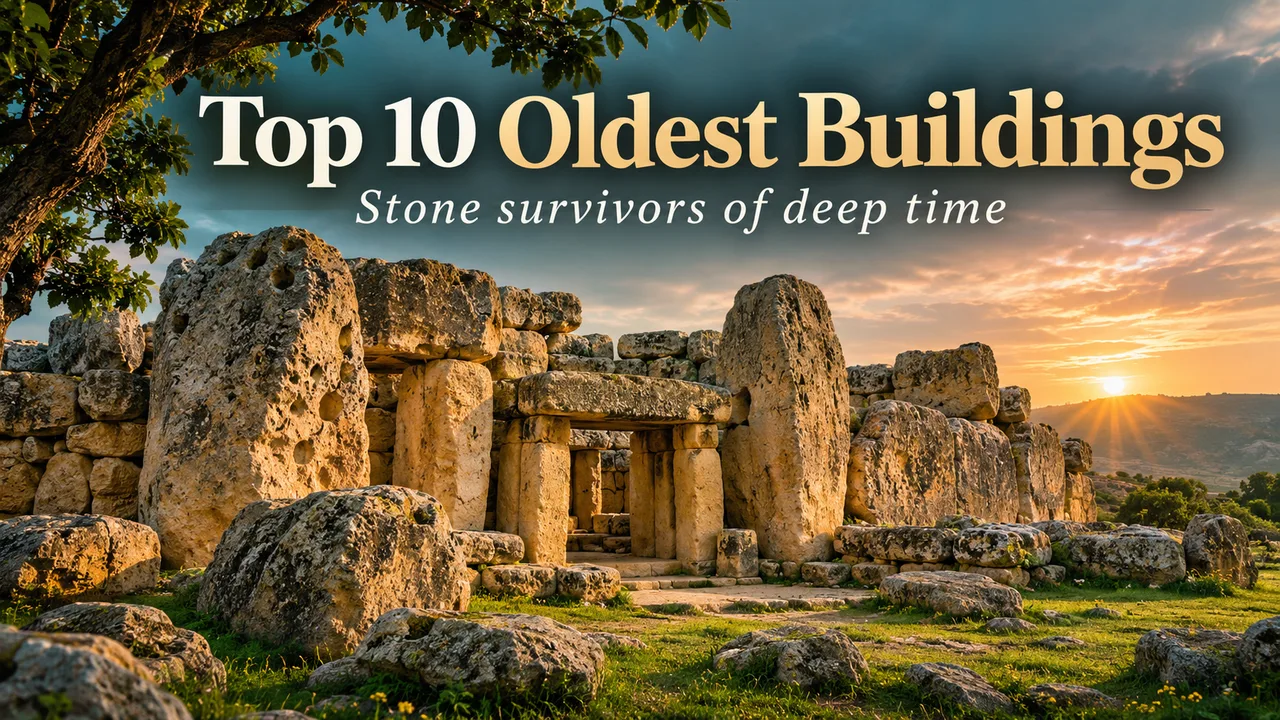
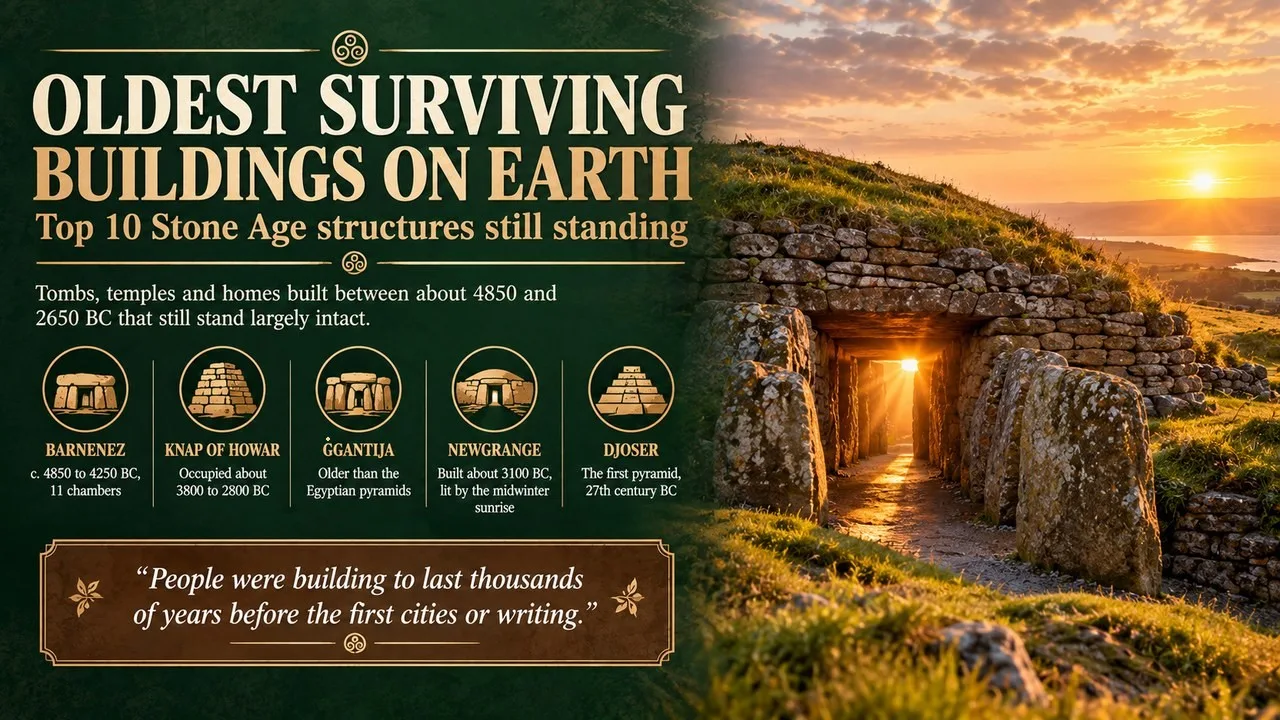
Human beings have built shelters and monuments for more than ten thousand years, but only a fraction of early structures still stand in recognisable form. Many of the oldest survivors are stone tombs and temples in western Europe, dated by radiocarbon samples and careful excavation.
This Finepedia list follows a widely cited set of early freestanding buildings that remain visible today, centred on Neolithic monuments such as the Cairn of Barnenez, the Bougon tumuli, Saint-Michel tumulus, Wayland's Smithy, the Knap of Howar, Ggantija, West Kennet Long Barrow, Listoghil, Sechin Bajo and La Hougue Bie [1][2]. Approximate dates below use conventional BCE figures from archaeological summaries; new digs can revise them. The focus is on early built chambers and platforms that visitors can still see, not on every older post hole or tell mound worldwide.
Göbekli Tepe in Turkey and other Southwest Asian sites are older still as ritual complexes, but this article stays with the freestanding tomb-and-temple tradition highlighted in classic "oldest buildings" roundups, while noting that absolute "first" claims remain debated [3].
Key Facts
The table below summarizes ten of the world's oldest surviving buildings or monumental tombs, with location and approximate earliest date.
Oldest Buildings at a Glance
| Rank | Site | Location | Approx. earliest date | Type |
|---|---|---|---|---|
| 1 | Cairn of Barnenez | Brittany, France | c. 4800 BCE | Neolithic passage grave |
| 2 | Tumulus of Bougon | Deux-Sèvres, France | c. 4800 BCE | Neolithic barrow complex |
| 3 | Tumulus Saint-Michel | Carnac, France | c. 4500 BCE | Large megalithic mound |
| 4 | Wayland's Smithy | Oxfordshire, England | c. 3700 BCE | Neolithic long barrow |
| 5 | Knap of Howar | Papa Westray, Scotland | c. 3700 BCE | Stone houses |
| 6 | Ggantija | Gozo, Malta | c. 3600–3700 BCE | Megalithic temples |
| 7 | West Kennet Long Barrow | Wiltshire, England | c. 3650 BCE | Neolithic tomb |
| 8 | Listoghil (Carrowmore) | County Sligo, Ireland | c. 3550 BCE | Passage tomb |
| 9 | Sechin Bajo | Ancash, Peru | c. 3500 BCE | Stone plaza / platform |
| 10 | La Hougue Bie | Jersey | c. 3500 BCE | Passage chamber under mound |
1. Cairn of Barnenez
The Cairn of Barnenez stands in northern Finistère, Brittany, France. Radiocarbon work places parts of this enormous stone cairn around 4800 BCE, making it one of the oldest large freestanding monuments in Europe [1][2].
The structure is roughly 72 metres long, 25 metres wide and more than 8 metres high, containing multiple passage graves under a stepped dry-stone mound. André Malraux once nicknamed it a "prehistoric Parthenon" for its scale and presence.
Visitors walk around restored sections and peer into passages lined with carefully set slabs. Barnenez shows that Atlantic Europe's Neolithic communities could organise massive building projects millennia before the Egyptian pyramids.
Tour paths keep foot traffic off fragile stonework while still allowing a clear sense of the cairn's length. On misty days the mound looks almost like a natural hill until the kerb stones come into view.
2. Tumulus of Bougon
The Tumulus of Bougon (Necropole de Bougon) in western France is a group of five Neolithic barrows. The oldest structures in the complex date to about 4800 BCE, contemporary with early phases at Barnenez [1].
Chambers and mounds of different shapes sit in a museum landscape that helps explain how burial architecture evolved. Dry-stone walls and capstones show the same Atlantic megalithic skill found across Brittany and beyond.
Bougon's value is as a cluster rather than a single pile of rock. Walking the site reveals how one community reused and expanded sacred ground over centuries.
Related: Top 10 Oldest Surviving Buildings on Earth
Museum displays nearby present skeletons, pottery and tools that place the tombs in a farming society already capable of long-term planning. That context turns abstract dates into a human story of ancestors and territory.
3. Tumulus Saint-Michel
The Tumulus of Saint-Michel rises east of Carnac in Brittany. Often dated around 4500 BCE, it is among the largest grave mounds in continental Europe, about 125 metres long, 60 metres wide and 10 metres high [1].
A chapel dedicated to Saint Michael was later built on top, layering Christian use over a Neolithic monument. Excavations in the nineteenth and twentieth centuries found burial chambers and rich grave goods that are now largely in museums.
Standing on the mound, visitors look out over the Carnac stone alignments. Saint-Michel links Brittany's famous standing stones with the less photographed but equally ancient burial architecture of the region.
The sheer volume of stone and earth, tens of thousands of cubic metres, hints at seasonal labour gathered from a wide area. Monument building was a social event as much as an engineering one.
4. Wayland's Smithy
Wayland's Smithy is a Neolithic long barrow and chamber tomb near Ashbury on the Ridgeway in Oxfordshire, England. Human remains indicate burials between roughly 3590 and 3550 BCE, with construction phases around the thirty-seventh century BCE [1][4].
Later legend linked the site to Wayland the smith of Germanic myth, which gave the monument its popular name. Today English Heritage cares for the stone facade and tree-ringed mound beside the ancient trackway.
The site is smaller than Barnenez but vivid: a stone-lined entrance faces the open chalk landscape. It stands for Britain's early farming communities who invested heavily in collective tombs.
Walkers on the Ridgeway often reach Wayland's Smithy after visiting the Uffington White Horse. The pairing of hill figure and long barrow makes the chalk downs feel like an outdoor museum of prehistoric belief.
5. Knap of Howar
The Knap of Howar on Papa Westray in Orkney, Scotland, preserves what many guides call the oldest standing stone houses in north-west Europe, occupied around 3700 BCE and afterward [1][5].
Related: Top 10 Most Bizarre Phobias: Strange Fears That Exist
Two adjacent oblong buildings with thick dry-stone walls still show doorways, cupboards and hearths. Unlike tombs built only for the dead, these were dwellings, which makes them precious evidence of daily Neolithic life.
Atlantic storms and isolation helped freeze the farmstead in time. Reaching Papa Westray takes planning, but the reward is walking through doorways opened more than five thousand years ago.
Nearby farmland and bird cliffs remind visitors that Neolithic Orkney was already a skilled maritime world. The houses feel intimate compared with the great tombs farther south.
6. Ggantija
Ggantija on Gozo, Malta, is a megalithic temple complex dated to roughly 3600–3700 BCE, older than the Egyptian pyramids and part of a UNESCO World Heritage listing for Maltese temples [1][6].
Local folklore credited the massive limestone blocks to giants, which inspired the name. Two temple units with apsed rooms share a common boundary wall, and altars and libation holes hint at ritual use.
Malta's temple culture produced several related sites, but Ggantija is among the earliest and most imposing. Limited visitor numbers help protect soft limestone from wear.
From the temples, views open across Gozo's countryside toward the sea that carried ideas and people between Mediterranean islands. Ggantija anchors Malta's claim as a cradle of prehistoric monumental religion.
7. West Kennet Long Barrow
West Kennet Long Barrow sits on a chalk ridge near Avebury and Silbury Hill in Wiltshire, England. Construction is usually placed around 3650 BCE, with the chambers used for burials over centuries [1][7].
The long earth mound and stone chambers form one of Britain's best-known Neolithic tombs. Antiquarians recorded the site from the seventeenth century onward, and modern conservation keeps the chambers accessible.
Related: The Evolution of Stranger Things: Seasons, Themes, and Characters
Paired with Avebury's stone circles and Silbury's mysterious hill, West Kennet anchors a ritual landscape that still shapes how visitors understand prehistoric Wessex.
Sheep graze around the mound, and the short walk from the roadside keeps the site popular with families. Inside, cool stone chambers make the age of the place feel immediate.
8. Listoghil
Listoghil is the central monument in the Carrowmore cemetery in County Sligo, Ireland. Dates around 3550 BCE place it among Ireland's early passage tombs, on a rise about 50 metres above sea level with a kerb roughly 34 metres across [1][8].
Carrowmore holds dozens of satellite tombs, making Listoghil the focal point of a wider ritual field with views toward Knocknarea and other Neolithic landmarks.
Ireland's passage-tomb tradition later produced Newgrange and Knowth; Listoghil shows an earlier stage of that architectural story in the west.
Guided walks explain how quartz, boulder circles and landscape sightlines worked together. The open setting contrasts with the enclosed passages of later, more elaborate tombs.
9. Sechin Bajo
Sechin Bajo lies in the Casma Valley of Peru, about 330 kilometres northwest of Lima. Excavations announced publicly around 2008 revealed a stone plaza with phases carbon-dated to about 3500 BCE, among the oldest monumental buildings known in the Americas [1][9].
Platforms and ceremonial architecture here belong to a coastal Andean tradition that predates later cultures such as Chavin. The find widened global "oldest building" lists beyond Europe and the Mediterranean.
Ongoing research continues to refine dates and functions. Sechin Bajo reminds readers that early monumentality was a worldwide impulse, not only an Atlantic European one.
Related: Chernobyl Miniseries: Stories of Tragedy of a Nuclear Catastrophe, Heroism and Sacrifice
Desert conditions helped preserve adobe and stone elements that would have vanished in wetter climates. Future digs in the valley may push American monumental dates earlier still.
10. La Hougue Bie
La Hougue Bie on Jersey shelters an 18.6-metre passage chamber under a mound, with phases around 3500 BCE [1][10]. A medieval chapel later crowned the hill, so the site stacks prehistoric and Christian sacred architecture.
Equinox sunlight alignments have been studied in the passage, linking Jersey's monument to wider European interests in sky and season. Museums on site explain both Neolithic and later history.
As one of the Channel Islands' premier prehistoric attractions, La Hougue Bie closes this list with a building that has remained a landmark for five and a half millennia.
Visitors climb to the chapel for views across the island, then descend into the passage where Neolithic builders set slabs with striking precision. Few places make deep time so easy to feel in a single afternoon.
Conclusion
The oldest buildings still standing are mostly stone tombs, houses and ceremonial platforms raised by early farming societies. Brittany's cairns, Britain's long barrows, Malta's temples, Ireland's passage tombs, Jersey's mound and Peru's plaza show how widely humans invested in lasting architecture.
Dates will keep shifting as laboratories refine radiocarbon curves and as new sites emerge. What will not change is the feeling of ducking into a passage cut by hands that lived before cities, writing or metal tools.
Travellers who seek these places should tread lightly, follow local conservation rules and remember that every polished photograph rests on fragile stone laid without mortar or machines.
- ^ [1] "List of oldest extant buildings". Wikipedia. Wikipedia: oldest extant buildings
- ^ [2] "Cairn of Barnenez". Wikipedia. Wikipedia: Barnenez
- ^ [3] "Göbekli Tepe". Encyclopaedia Britannica. Britannica: Göbekli Tepe
- ^ [4] "Wayland's Smithy". English Heritage. English Heritage: Wayland's Smithy
- ^ [5] "Knap of Howar". Wikipedia. Wikipedia: Knap of Howar
- ^ [6] "Ggantija". UNESCO / Wikipedia summaries. Wikipedia: Ggantija
- ^ [7] "West Kennet Long Barrow". English Heritage. English Heritage: West Kennet
- ^ [8] "Carrowmore". Wikipedia. Wikipedia: Carrowmore
- ^ [9] "Sechin Bajo". Wikipedia. Wikipedia: Sechin Bajo
- ^ [10] "La Hougue Bie". Wikipedia. Wikipedia: La Hougue Bie





















Discussion
Log in with