





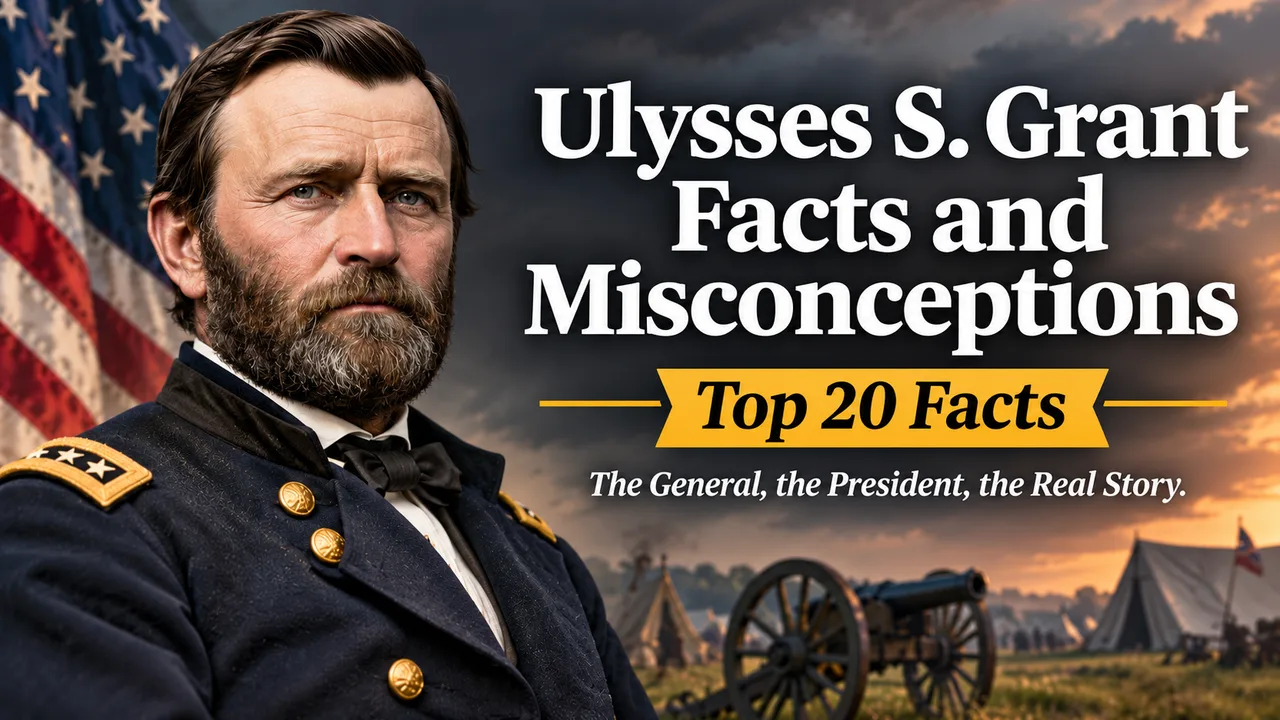
Ulysses S. Grant is one of the most important and most debated figures in American history. He rose from a failed civilian career to command the Union armies that won the Civil War, then served two terms as the 18th president of the United States. For much of the 20th century his reputation suffered, shaped by stories of drinking, corruption and reckless generalship.
This Finepedia list brings together the top 20 Ulysses S. Grant facts and misconceptions. The first ten entries cover well-documented facts about his life and career. The second ten examine popular claims about him and explain what the historical record really supports.
Historians have reassessed Grant a great deal in recent decades, partly by looking past the Lost Cause writing of former Confederates that dominated early accounts. The picture that emerges is of a capable, determined and sometimes flawed leader whose achievements were larger than his old reputation suggested.
Key Facts
The table below sums up all 20 entries on this list, with whether each is a fact or a misconception and the evidence behind it.
The 20 Grant Facts and Misconceptions at a Glance
| No. | Entry | Type | What the record shows |
|---|---|---|---|
| 1 | Born Hiram Ulysses Grant | Fact | Born in Point Pleasant, Ohio, on 27 April 1822 |
| 2 | West Point was his father's idea | Fact | Graduated 21st of 39 in 1843 |
| 3 | Fought in the Mexican–American War | Fact | Served under Taylor and Scott |
| 4 | Left the Army in 1854 | Fact | Struggled as a farmer and businessman |
| 5 | Rose fast after 1861 | Fact | Won at Fort Donelson in February 1862 |
| 6 | Vicksburg split the Confederacy | Fact | The city surrendered on 4 July 1863 |
| 7 | Lincoln made him general-in-chief | Fact | Promoted lieutenant general in March 1864 |
| 8 | Accepted Lee's surrender | Fact | Appomattox, 9 April 1865 |
| 9 | Served two terms as president | Fact | 1869 to 1877 |
| 10 | His memoirs are a classic | Fact | Finished days before his death in 1885 |
| 11 | The S stood for Simpson | Misconception | A clerical error gave him the initial |
| 12 | He was always drunk | Misconception | Episodes of drinking were exaggerated by rivals |
| 13 | His presidency was a total failure | Misconception | It had real achievements and real failures |
| 14 | He ran the Whiskey Ring | Misconception | He was never charged |
| 15 | He took bribes in office | Misconception | Aides and officials did, not Grant himself |
| 16 | He won the war alone | Misconception | Sherman, Sheridan, Thomas and others were vital |
| 17 | He was simply a butcher | Misconception | Losses were heavy on both sides |
| 18 | His record on slavery was simple | Misconception | It shifted from slaveholding family ties to enforcing Black rights |
| 19 | His Native policy was only benevolent | Misconception | The Peace Policy ended in war |
| 20 | He died broke through his own fault | Misconception | A partner's fraud ruined him |
1. His Birth Name Was Hiram Ulysses Grant
Grant was born on 27 April 1822 in Point Pleasant, Ohio, the son of Jesse Root Grant, a tanner, and Hannah Simpson Grant. He was named Hiram Ulysses Grant but was known in the family by his middle name, Ulysses.[1]
He grew up in Georgetown, Ohio, where he showed an unusual talent for handling horses. As a boy he drove supply wagons for his father's business, and his skill with horses stayed with him for life.[1]
2. West Point Was His Father's Idea
Grant did not set out to become a soldier. In 1839 his father arranged for Representative Thomas L. Hamer to nominate him to the United States Military Academy at West Point, and Grant went largely because he was told to.[1]
He was an average student but an outstanding rider, and he graduated on 30 June 1843, ranked 21st out of 39 in his class.[1] He planned to serve only his required years and then teach mathematics. Events would carry him in a very different direction.
3. He Served in the Mexican–American War
Grant's first combat came in the Mexican–American War of 1846 to 1848. He served as a quartermaster but also fought under Zachary Taylor and Winfield Scott, and he was praised for bravery at Monterrey and in the fighting for Mexico City.[2]
He learned a great deal about logistics, movement and leadership by watching both generals. Yet he later described the war as one of the most unjust ever waged by a stronger nation against a weaker one, a view he set down in his memoirs.[3]
4. He Left the Army Before the Civil War
After the war Grant was posted to the Pacific coast, far from his wife Julia and their children. Lonely and frustrated, he resigned his commission in 1854 while serving at Fort Humboldt in California, amid rumours about his drinking.[1]
The next six years were hard. He tried farming near St. Louis, worked in real estate and finally became a clerk in his father's leather goods store in Galena, Illinois.[1] When the Civil War began in 1861, few would have predicted that this struggling shop clerk would become the Union's leading general.
5. He Rose Quickly After the Civil War Began
Grant helped raise volunteer troops in Illinois and was soon made colonel of the 21st Illinois Infantry, then brigadier general.[1] His experience as a professional officer gave him an advantage over many political appointees.
In February 1862 he captured Fort Henry and Fort Donelson in Tennessee, the Union's first major victories of the war. At Donelson he demanded "unconditional and immediate surrender", and the press turned his initials into the nickname "Unconditional Surrender" Grant.[4]
Related: Abraham Lincoln: The 16th President Who Preserved the Union
6. Vicksburg Was a Pivotal Campaign
Vicksburg, Mississippi, controlled a key stretch of the Mississippi River. After several failed attempts, Grant in 1863 marched his army down the west bank, crossed the river below the city, won a string of battles inland and then laid siege to Vicksburg.[5]
The city surrendered on 4 July 1863, the day after the Union victory at Gettysburg. The fall of Vicksburg gave the Union control of the Mississippi and split the Confederacy in two.[5] Many historians regard the campaign as Grant's finest.
The campaign also showed traits that defined his generalship: a willingness to try new approaches after failure, a readiness to cut loose from supply lines and live off the land for a time, and a refusal to retreat after setbacks. These qualities caught Lincoln's attention and shaped the rest of Grant's war.
7. Lincoln Made Him General-in-Chief
After further success at Chattanooga in late 1863, Grant was promoted in March 1864 to lieutenant general, a rank revived by Congress, and placed in command of all Union armies.[1]
He coordinated offensives across several theatres at once, aiming to stop the Confederacy from shifting troops to meet each threat. He travelled with the Army of the Potomac, fighting Robert E. Lee in the Overland Campaign and then pinning his army down at Petersburg.[6]
8. Lee Surrendered to Grant at Appomattox
On 9 April 1865, after Lee's army was trapped near Appomattox Court House in Virginia, Lee met Grant in the McLean house and surrendered the Army of Northern Virginia.[7]
Grant offered generous terms. Confederate soldiers were paroled and allowed to go home, officers kept their side arms, men who claimed horses could take them home, and Union rations were sent to the hungry Confederates.[7] He wanted reconciliation, not humiliation, and the terms set a pattern for other surrenders.
9. He Served Two Presidential Terms
Grant was elected president in 1868 and re-elected in 1872, serving from 1869 to 1877. He was the most popular man in the North and, at 46, one of the youngest presidents up to that time.[8]
His administration saw the ratification of the Fifteenth Amendment, the creation of the Department of Justice and the settlement of the Alabama claims with Britain through the Treaty of Washington in 1871.[8] It also faced economic crisis after the Panic of 1873 and a series of scandals involving appointees.
After leaving office, Grant and Julia set out on a two-year tour of the world, meeting monarchs, statesmen and huge crowds in Europe, Africa and Asia. He was considered for a third nomination in 1880 but narrowly lost the Republican contest to James Garfield.[1]
Related: Top 10 Most Bizarre Phobias: Strange Fears That Exist
10. His Memoirs Became a Major Literary Work
In 1884 Grant was left nearly bankrupt and soon learned he had throat cancer. To provide for his family, he began writing his memoirs, published by Mark Twain's firm.[3]
He finished the work only days before his death on 23 July 1885. The Personal Memoirs of U. S. Grant were a huge success and earned his family about 450,000 dollars.[3] Critics and writers have since praised them as among the finest military memoirs ever written, clear, modest and direct.
11. Misconception: His Middle Initial Stood for a Real Middle Name
Grant's famous "S" was an accident. When Thomas Hamer nominated him to West Point, he wrote the name as Ulysses S. Grant, apparently confusing the boy's names and adding the initial from his mother's maiden name, Simpson.[1]
Grant kept the name because the Army's records used it. Fellow cadets joked that U. S. stood for "Uncle Sam", and he was nicknamed Sam.[1] He never legally took Simpson as a middle name and said the S stood for nothing.
12. Misconception: He Was Constantly Drunk
The image of Grant as a hopeless drunk owes much to his rivals and later critics. There is evidence that he drank at times, especially when separated from his family, and the rumours followed him from his first career into the Civil War.[1]
Yet there is no reliable evidence that drinking affected his command in battle, and those closest to him described long periods of sobriety.[1] A popular story that Lincoln asked what brand Grant drank so he could send it to his other generals is probably apocryphal. Historians now see the problem as real but greatly exaggerated.
13. Misconception: His Presidency Was a Complete Failure
For decades historians ranked Grant among the worst presidents, focusing on scandals and economic trouble. That verdict was shaped partly by writers sympathetic to the Lost Cause, who disliked his support for Black civil rights.[8]
More recent historians give a more balanced view. They credit his enforcement of civil rights in the South, his use of federal power against the Ku Klux Klan and his diplomacy, while still criticising the corruption among his appointees and his handling of the economy.[8] His rankings have risen significantly in the 21st century.
Related: Narendra Modi: The Rise of India's Controversial Prime Minister
14. Misconception: Grant Was Personally Guilty in the Whiskey Ring
The Whiskey Ring was a large conspiracy, exposed in 1875, in which distillers and Treasury officials diverted liquor tax revenue. Grant's private secretary, Orville Babcock, was indicted.[9]
Grant at first supported the prosecution, saying "Let no guilty man escape." He later gave a deposition in Babcock's defence, and Babcock was acquitted.[9] Grant himself was never charged, though his loyalty to Babcock damaged his reputation.
15. Misconception: Scandals Prove He Took Bribes
Grant's administration had several scandals, including the Black Friday gold panic of 1869 and the resignation of Secretary of War William Belknap in 1876 over kickbacks.[8] These episodes reflected poor judgement in appointments and too much trust in friends.
There is no evidence that Grant enriched himself through bribes. He left office with relatively modest savings and later lost much of his wealth through a business fraud.[1] Historians generally conclude he was personally honest but too loyal to dishonest associates.
16. Misconception: Grant Won the Civil War Alone
Grant was the Union's most important general, but victory depended on many others. William Tecumseh Sherman, Philip Sheridan and George Thomas led crucial campaigns, and Lincoln provided political direction.[6]
The war was also won by the North's larger population, industry and railways, by naval blockade and by the contribution of nearly 180,000 Black soldiers.[1] Grant's achievement was to coordinate these strengths into a strategy that wore down the Confederacy on every front.
17. Misconception: High Casualties Mean He Was Just a Butcher
The Overland Campaign of 1864 produced terrible Union losses at battles such as the Wilderness, Spotsylvania and Cold Harbor, and critics called Grant a butcher.[6]
The label leaves out important context. Lee's army also suffered heavy losses, and as a share of their forces they were often as high or higher, losses the Confederacy could not replace.[6] Grant's strategy of constant pressure was costly, but it prevented Lee from regaining the initiative and helped end the war within a year.
18. Misconception: His Record on Slavery Was Simple
Grant's personal history with slavery was complicated. His wife's family, the Dents of Missouri, held enslaved people, and in 1858 Grant acquired a man named William Jones from his father-in-law. He freed Jones in 1859, at a time when he badly needed money.[1]
Related: Dev Anand: The Eternal Charmer of Bollywood
During the war he enforced emancipation and came to support Black enlistment. As president he pushed for the Fifteenth Amendment and used federal power against white supremacist violence.[8] He also issued a notorious wartime order in 1862 expelling Jews from his military district, which Lincoln revoked and which Grant later regretted.[1]
19. Misconception: His Native Policy Was Simply Benevolent
Grant launched a Peace Policy intended to reduce violence by placing reservations under religious groups and reformers. He appointed Ely S. Parker, a Seneca, as the first Native American Commissioner of Indian Affairs.[10]
But the policy still aimed to move Native nations onto reservations and assimilate them. Pressure for land and the discovery of gold in the Black Hills led to the Great Sioux War of 1876.[10] Historians see good intentions mixed with policies that caused great harm.
The Peace Policy reflected a wider belief among reformers of the time that Native peoples should adopt farming, Christianity and English-language schooling. Many Native leaders resisted these pressures, and the long-term effects on Native land, culture and sovereignty were severe.[10]
20. Misconception: He Died Broke Because of His Own Extravagance
In 1884 Grant invested heavily in the Wall Street firm Grant & Ward, run by his son and Ferdinand Ward. Ward was running a fraudulent scheme, and when the firm collapsed Grant lost nearly everything.[1]
He was a victim of fraud rather than reckless spending. Facing poverty and cancer, he wrote his memoirs to secure his family's future, and their success did exactly that.[3] His final battle with illness and debt became one of the most admired chapters of his life.
Conclusion
The top 20 Ulysses S. Grant facts and misconceptions show a man who was neither a flawless hero nor the drunken, corrupt figure of older stories. He was a gifted strategist, a determined commander and a president who fought for civil rights while failing to control corruption around him.
Grant's reputation has risen as historians have looked more carefully at the evidence and set aside the distortions of the Lost Cause. Today he is remembered at Grant's Tomb in New York City, one of the largest mausoleums in North America, and on the American 50-dollar bill. His memoirs remain the best way to hear him in his own words. They explain his decisions plainly and give credit generously to the officers and soldiers who served with him.
- ^ [1] "Ulysses S. Grant". Wikipedia. Wikipedia
- ^ [2] "Mexican–American War". Wikipedia. Wikipedia
- ^ [3] "Personal Memoirs of U. S. Grant". Wikipedia. Wikipedia
- ^ [4] "Battle of Fort Donelson". Wikipedia. Wikipedia
- ^ [5] "Siege of Vicksburg". Wikipedia. Wikipedia
- ^ [6] "Overland Campaign". Wikipedia. Wikipedia
- ^ [7] "Battle of Appomattox Court House". Wikipedia. Wikipedia
- ^ [8] "Presidency of Ulysses S. Grant". Wikipedia. Wikipedia
- ^ [9] "Whiskey Ring". Wikipedia. Wikipedia
- ^ [10] "Native American policy of the Grant administration". Wikipedia. Wikipedia
















Discussion
Log in with