






 By
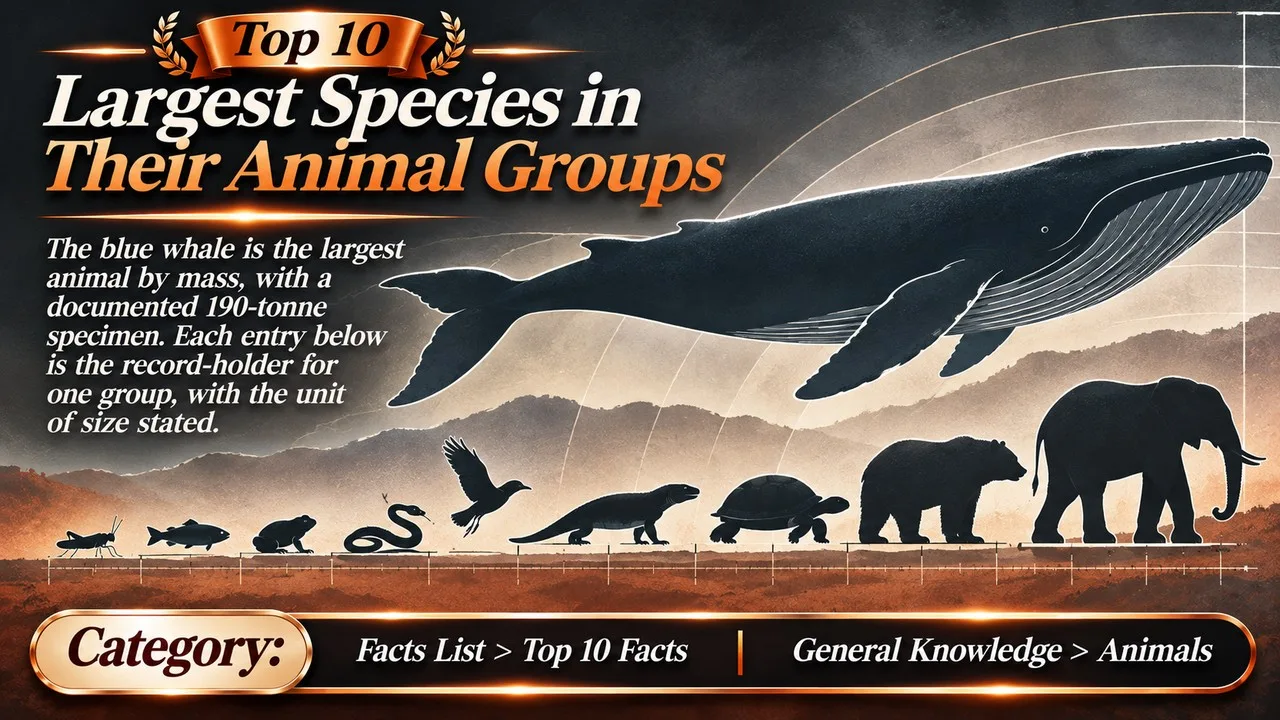
The largest species in ten animal groups are ranked here with the unit of size labelled, because mass, length and wingspan do not produce the same winner. A blue whale is the largest animal by mass; a bootlace worm can be longer and a wandering albatross can outspan a bird that is far heavier [1][2]. This list therefore picks one record-holder in each of ten familiar groups and states the measure, rather than pretending that "largest" is a single number.
Colonial or modular organisms, and extinct animals, are left out. Historical specimens are dated. Where a famous old measurement is doubted, the doubt is stated, as with the longest python claims [3]. The order of the ten is by the public importance of the group, starting with the largest animal overall, not by a single comparable unit across unlike bodies.
Key Facts
Each row names the group, the living record-holder, the principal unit, and a documented figure or typical range from a standard record source. Rank 1 is the largest animal by mass.
Largest Species by Group at a Glance
| Rank | Group | Record-holder | Principal unit | Documented figure |
|---|---|---|---|---|
| 1 | Animals as a whole | Blue whale | Mass, with length as a second measure | Heaviest documented: 190 tonnes, 1947; longest documented: 33.57 metres, 1909 |
| 2 | Land mammals | African bush elephant | Shoulder height and mass | Typical adult males 3 to 3.7 metres, 4 to 7 tonnes |
| 3 | Fishes | Whale shark | Length | Largest scientifically documented: 18.8 metres, 2001 |
| 4 | Living crocodilians | Saltwater crocodile | Length and mass | Largest well-measured captive: 6.17 metres, about 1,075 kilograms |
| 5 | Snakes | Reticulated python | Length; mass is a separate title | Longest living species; a 2026 wild female measured 7.22 metres |
| 6 | Living turtles | Leatherback turtle | Mass and total length | Largest living turtle; exceptional animals approach a tonne |
| 7 | Living birds, by mass | Common ostrich | Mass and height | Heaviest living bird; wingspan record is a different species |
| 8 | Lizards | Komodo dragon | Length and mass | Largest living lizard, typically up to about 3 metres |
| 9 | Living amphibians | Chinese giant salamanders | Length | Largest reported about 1.75 metres, 1920s |
| 10 | Cephalopods, by mass | Colossal squid | Mass; length is often a different squid | Heaviest documented squid group |
1. Blue whale, largest animal
The blue whale (Balaenoptera musculus) is the largest animal, living or extinct, on the measure that matters most here: mass. Guinness World Records gives a typical adult range of about 20 to 30 metres and around 160 tonnes, a heaviest documented specimen of 190 tonnes at 27.6 metres, taken in the Southern Ocean on 20 March 1947, and a longest documented specimen of 33.57 metres, a female measured as "107 fot" at Grytviken, South Georgia, in 1909 [1].
It is first because no other living or fossil animal has a comparably well-supported claim to greater bulk. Longer animals exist, including the bootlace worm, and colonial siphonophores can be longer still, but they are not heavier in a way that displaces the whale [1]. Calves are already several metres long and weigh a few tonnes at birth.
The species is listed as Endangered. Commercial whaling reduced it to a fraction of its former numbers before protection in the mid-1960s. A size record taken from a hunted whale is a historical measurement, not an invitation to hunt [1].
2. African bush elephant, largest land mammal
The African bush elephant (Loxodonta africana) is the largest living land mammal. Adult males typically stand 3 to 3.7 metres at the shoulder and weigh 4 to 7 tonnes [4]. The largest recorded specimen in the Guinness account is a bull shot at Mucusso, Angola, on 7 November 1974, with a computed mass of 12.24 tonnes and an estimated standing height of about 3.96 metres [4].
It is second as the terrestrial counterpart of the blue whale, still an order of magnitude lighter than a large whale, which is the point of putting the two side by side. Giraffes are taller, and that is a different record: height, not mass [1][4].
A computed weight from a shot animal is not the same as a living scale reading, and typical bulls are in the 4-to-7-tonne band, not in the 12-tonne outlier. Both figures belong in a careful list [4].
Related: Top 10 Largest Animals of Their Kind
3. Whale shark, largest fish
The whale shark (Rhincodon typus) is the largest living fish. Guinness records a scientifically documented female of 18.8 metres, caught in the Arabian Sea off Veraval, Gujarat, on 8 May 2001, and notes that measured animals have commonly fallen in a much wider and usually smaller range, about 4 to 12 metres, with maturity often around 9 metres [2]. A separate heavy specimen is often cited at about 21.5 tonnes, at a shorter length than the 18.8-metre fish [5].
It is third as the record-holder for fishes, a group defined here in the everyday sense that includes sharks. The whale shark is a filter-feeder, not a hunter of large prey, which is why a fish can be this long without being a predatory rival to a sperm whale [2][5].
Measurements of such a large, soft-bodied swimmer are difficult at sea. This list uses the documented 18.8-metre scientific record rather than larger unverified sightings [2].
4. Saltwater crocodile, largest living crocodilian
The saltwater crocodile (Crocodylus porosus) is the largest living crocodilian. Well-measured modern animals include Lolong, a captive male in the Philippines, at 6.17 metres and about 1,075 kilograms, long recognised among the largest crocodiles accurately measured in captivity [6]. Wild claims of about 7 metres appear in older literature; they are harder to verify than a crocodile that was placed on a tape in public view.
It is fourth as the living record-holder for its group, far shorter than a whale shark but heavier, metre for metre, than almost any other reptile. The species ranges through northern Australia and parts of South-east Asia, in both salt and fresh water [6].
A "largest crocodile ever" story without a dated, measured animal is not used as a rank figure here. The 6.17-metre measurement is the benchmark a 2026 reader can actually check [6].
5. Reticulated python, longest snake
The reticulated python (Malayopython reticulatus) is the longest living snake species. Typical adults are often in the 3-to-6-metre range, with larger females recorded from time to time [3]. A historical 10-metre claim from Sulawesi in 1912 is treated with doubt in later reviews, which put a realistic maximum nearer 8 to 9 metres [3]. A wild female from Maros, Sulawesi, measured 7.22 metres on 18 January 2026, with a mass of 96.5 kilograms, is a recent, corroborated field measurement; the longest captive python recorded by Guinness, Medusa, was 7.67 metres in 2011 [3].
Related: Top 10 Extraordinary Lizards of the World
It is fifth as the length record-holder for snakes. The heaviest snake is a different animal: the green anaconda, whose large females can outweigh a python of greater length [3]. Both facts are required, because a list that said only "largest snake" would hide the split unit.
The 2026 Sulawesi measurement is included because it is dated and witnessed. It does not reopen the 10-metre 1912 story as a proven fact [3].
6. Leatherback turtle, largest living turtle
The leatherback turtle (Dermochelys coriacea) is the largest living turtle, a marine species whose shell is a ridged, leathery carapace rather than a hard scute shell. Exceptional documented individuals have approached a tonne in mass and about 3 metres in total length; typical adults are smaller, still far larger than any tortoise [7].
It is sixth as the record-holder for living turtles and tortoises. Extinct marine turtles and the fossil Archelon were larger still, and they are outside this living-species list [7].
The leatherback is a pelagic traveller, feeding largely on jellyfish, and it is listed as vulnerable. Size here is a biological fact, not a reason to handle or land the animal [7].
7. Common ostrich, heaviest living bird
The common ostrich (Struthio camelus) is the heaviest and tallest living bird, with large males reaching heights in the region of 2.7 metres and masses of about 150 kilograms in standard record accounts [8]. The bird with the largest wingspan is not the ostrich. That title belongs to the wandering albatross (Diomedea exulans), whose wings can exceed 3.5 metres across [8].
It is seventh as the mass record-holder for birds. Putting the ostrich and the albatross in the same sentence is the whole point of labelling the unit: a flightless bird can be the heaviest, and a long-winged seabird can be the widest, without either claim cancelling the other [8].
Related: Top 10 Most Bizarre Phobias: Strange Fears That Exist
Ratites as a group, including emus and cassowaries, are all large, and none approaches the ostrich in mass. The ostrich is the clear living maximum for that measure [8].
8. Komodo dragon, largest lizard
The Komodo dragon (Varanus komodoensis), a monitor lizard of several Indonesian islands, is the largest living lizard. Typical large adults approach 2.5 to 3 metres in length, with the heaviest animals well above 70 kilograms and some record accounts citing still higher masses for exceptional individuals [9].
It is eighth as the living size record in its group. Crocodilians are not lizards, which is why the saltwater crocodile has its own row and is not allowed to occupy this one [6][9]. Extinct monitor lizards, including Megalania, were larger, and they are not living species.
The dragon is a protected species in its remaining range. A size figure from a weighed or measured animal is the right kind of evidence; a tourist photograph is not [9].
9. Chinese giant salamanders, largest living amphibians
The world's largest living amphibians are the Chinese giant salamanders of the genus Andrias. Guinness reports a largest documented individual of 1.75 metres, captured near Guiyang, Guizhou, in the 1920s, and a more typical modern wild length around 1.15 metres [10]. A 2019 genetic study showed that animals long treated as one species, Andrias davidianus, include at least the South China giant salamander, Andrias sligoi, and another lineage; the 1920s giant may belong to A. sligoi rather than to A. davidianus [10].
It is ninth as the amphibian record, far shorter than the reptiles above and still the clear maximum in its class. The Japanese giant salamander and the North American hellbender are smaller members of the same family [10].
Related: Top 10 Oldest Buildings in the World
Habitat loss, pollution, and a luxury food trade have reduced these animals. A. davidianus is listed as Critically Endangered. A 1920s length is a historical maximum, not a typical animal in 2026 [10].
10. Colossal squid, heaviest cephalopod
The colossal squid (Mesonychoteuthis hamiltoni) of the Southern Ocean is the heaviest documented squid, and on present evidence the heaviest living invertebrate in its league, with large specimens in the hundreds of kilograms. A well-known animal examined at the Museum of New Zealand Te Papa Tongarewa after a 2007 capture is a standard reference point for a weighed colossal squid [11]. The giant squid (Architeuthis) can be longer when the tentacles are included, which is why this row is labelled by mass, not by total length [11].
It is tenth as the invertebrate counterweight to the vertebrate giants above. A soft-bodied squid measured at sea or after death can shrink or stretch, so mass, when it has been recorded, is the sturdier claim [11].
The two deep-ocean squids should not be collapsed into one "largest squid." Length and mass split the title, just as they split the python and the anaconda [3][11].
Conclusion
"Largest in its group" is a usable ranking only when the group and the unit are named. The blue whale is the largest animal by mass, the African bush elephant is the largest land mammal, the whale shark is the longest scientifically documented fish, and a handful of reptiles, a bird, an amphibian and a squid hold the remaining titles, each on a stated measure [1][2][4].
A later measurement can move a row, as the January 2026 Sulawesi python already illustrates, but it will not make an ostrich heavier than an elephant or a salamander longer than a crocodile [3][8]. The useful habit is the one this list practises: say whether you mean mass, length, height or wingspan, date the specimen, and leave extinct giants and unverified sightings out of the official figure. For a different kind of animal ranking, see the companion lists of the longest-lived and shortest-lived animals.
- ^ [1] "Largest animal". Guinness World Records, blue whale, 190-tonne and 33.57-metre specimens. Guinness: largest animal
- ^ [2] "Largest fish". Guinness World Records, whale shark, 18.8 metres, 8 May 2001. Guinness: largest fish
- ^ [3] "Longest species of snake". Guinness World Records, reticulated python, including the January 2026 Sulawesi measurement. Guinness: longest snake
- ^ [4] "Largest mammal on land". Guinness World Records, African bush elephant. Guinness: largest land mammal
- ^ [5] Guinness and fisheries accounts of whale-shark mass, including a heavy specimen near 21.5 tonnes. Guinness: heaviest fish
- ^ [6] "Largest crocodilian species (living)" and records for Lolong, 6.17 metres. Guinness: largest crocodilian
- ^ [7] Standard accounts of the leatherback as the largest living turtle, including exceptional masses approaching a tonne. IUCN / sea-turtle literature
- ^ [8] Record accounts of the common ostrich as the heaviest living bird, and of the wandering albatross as the living bird with the largest wingspan. Guinness bird size records
- ^ [9] Record and field accounts of the Komodo dragon as the largest living lizard. Guinness / park literature on Varanus komodoensis
- ^ [10] "Largest living amphibian". Guinness World Records, Chinese giant salamanders (Andrias), 1.75-metre 1920s specimen, 2019 species split. Guinness: largest amphibian
- ^ [11] Museum of New Zealand Te Papa Tongarewa and scientific accounts of the colossal squid, with giant squid as the longer form. Te Papa: colossal squid





















Discussion
Log in with