



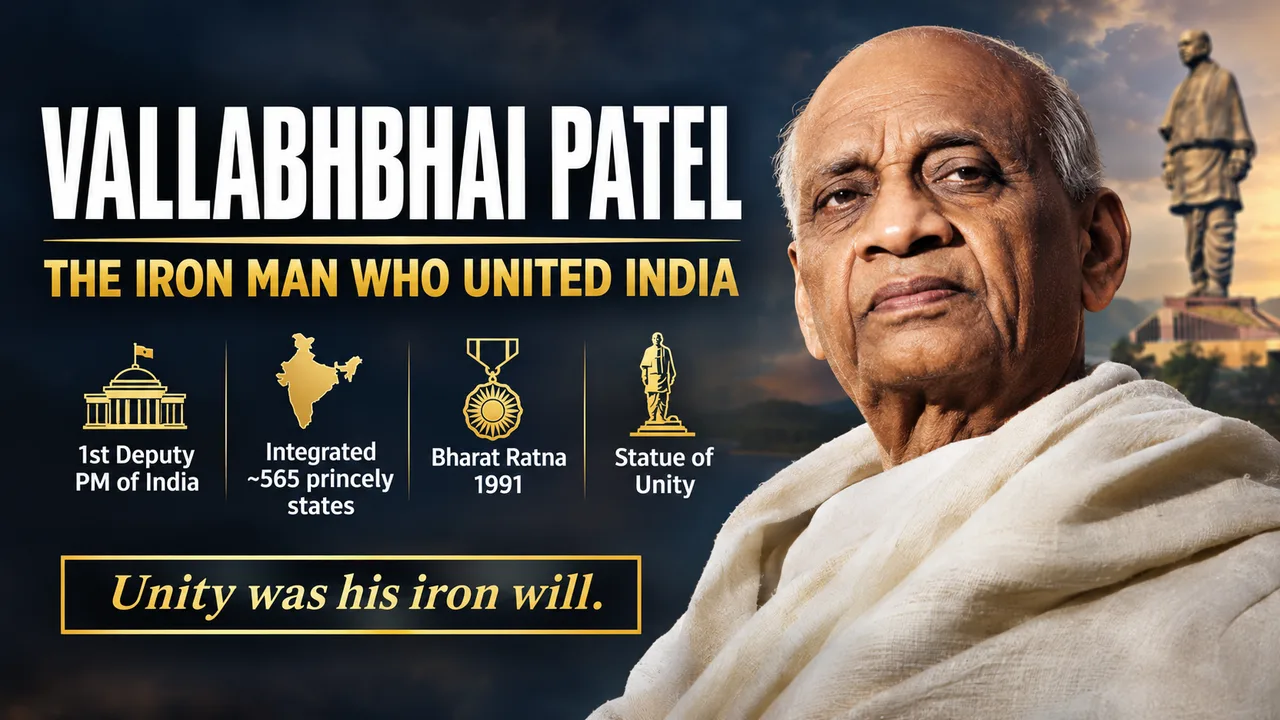
Vallabhbhai Patel, widely known as Sardar Patel, was an Indian lawyer, independence leader and statesman who served as independent India's first Deputy Prime Minister and Home Minister from 1947 to 1950.[1] He is best remembered for bringing hundreds of princely states into the Indian Union after independence, an achievement that earned him the title "Iron Man of India".[1][5]
This Finepedia guide covers Patel's early life and legal career, the peasant campaigns in Gujarat that made him a national figure, his role in the Quit India movement and partition, the integration of the princely states, his work on the Constitution and the civil services, and the legacy that includes the Statue of Unity and National Unity Day.
Quick Facts
The table below summarises the main facts of Patel's life.
Vallabhbhai Patel at a Glance
| Attribute | Details |
|---|---|
| Full name | Vallabhbhai Jhaverbhai Patel |
| Born | 31 October 1875, Nadiad, Gujarat (date as he recorded it) |
| Died | 15 December 1950, Birla House, Bombay |
| Profession | Lawyer, trained at the Middle Temple, London |
| Party | Indian National Congress |
| Key offices | First Deputy Prime Minister and Home Minister of India, 1947 to 1950 |
| Known for | Kheda and Bardoli satyagrahas, integration of the princely states, All India Services |
| Titles | Sardar, Iron Man of India |
| Honours | Bharat Ratna (1991, posthumous) |
| Memorials | Statue of Unity (182 metres), National Unity Day on 31 October |
Early Life and Family
Patel was born in Nadiad, in present-day Gujarat, one of six children of Jhaverbhai Patel and Ladba, and grew up in the family's home village of Karamsad. His date of birth was never officially recorded; he himself wrote 31 October on his matriculation papers, and that date is now marked as his birthday.[1] He came from the Leva Patel community of central Gujarat.
He attended schools in Nadiad, Petlad and Borsad and finished his matriculation late, at about 22. Many elders expected little of him, but he quietly planned to qualify as a lawyer, save money and travel to England to become a barrister.[1] Studying largely from borrowed books, he passed his pleader's examinations and set up practice in Godhra, later working in Borsad and Anand, where he built a reputation as a sharp and fearless advocate.
Patel married Jhaverba, and the couple had a daughter, Maniben, in 1903 and a son, Dahyabhai, in 1905.[1] Around 1909 (Britannica gives 1908) Jhaverba died in a Bombay hospital after surgery for cancer.[1][8] A well-known account says Patel was handed the news while cross-examining a witness in court and finished the case before telling anyone. He never remarried and raised his children with help from his family.
His long-planned journey to England was delayed when his travel papers, addressed to "V. J. Patel", were claimed by his elder brother Vithalbhai, who shared the same initials and went in his place.[1] Vallabhbhai finally sailed at the age of 36 and enrolled at the Middle Temple in London, completing the 36-month course in 30 months and finishing at the top of his class. On his return he settled in Ahmedabad and became one of the city's most successful barristers.
Entry into the Freedom Struggle
Meeting Gandhi
Patel's turn to politics came in 1917. In September of that year he spoke in Borsad in support of Gandhi's petition for self-rule, and a month later he met Gandhi for the first time at the Gujarat Political Conference in Godhra.[1] He became secretary of the Gujarat Sabha, the body that would become the Gujarat branch of the Congress, and took up causes such as opposing forced labour and organising plague and famine relief.
The Kheda Satyagraha
In 1918 peasants in Kheda district, hit by crop failure and plague, asked for relief from land revenue and were refused. Gandhi backed a campaign of resistance but was busy in Champaran, so Patel volunteered to lead it, giving up his lucrative legal career.[1][4] He toured village after village, explaining the hardships ahead and urging total unity and non-violence.
When the authorities seized cattle and land from farmers who refused to pay, Patel organised volunteers to help villages protect their property. The government eventually negotiated, suspending the tax for the year and reducing the rate.[1][4] The campaign made Patel a hero in Gujarat, and in 1920 he became president of the new Gujarat Pradesh Congress Committee, a post he held until 1945.
Municipal Leader in Ahmedabad
During the Non-cooperation movement Patel recruited members and raised funds across Gujarat, and he gave up his European-style clothes for khadi.[1] Through the 1920s he led the Ahmedabad municipality, serving as its elected president and overseeing better electricity supply, drainage and sanitation, and school reforms. In 1927 he led relief work when heavy floods struck Ahmedabad and Kheda district, setting up refugee centres and arranging food, medicine and funds.
Related: Sarojini Naidu: The Nightingale of India and Political Pioneer
Bardoli and the Title "Sardar"
In 1928 the farmers of Bardoli taluka faced a steep rise in land revenue during a time of hardship. Patel led a disciplined campaign of non-payment, with camps, volunteers and an information network covering the affected villages.[1][3] Despite arrests and seizures, the resistance held firm.
In August 1928 a settlement was reached that cancelled the increase, reinstated village officials who had resigned in protest and returned seized land and property.[1][3] It was during this struggle that the women of Bardoli began calling him Sardar, meaning chief, the name by which he is still known.
National Leadership
Congress President and the Karachi Session
Patel was a leading candidate for the Congress presidency in 1929, but withdrew under pressure from Gandhi, and Jawaharlal Nehru was elected instead.[8] He was arrested in 1930 during the Salt Satyagraha. After the Gandhi–Irwin Pact, he presided over the Congress session at Karachi in 1931, which ratified the pact and adopted the resolution on Fundamental Rights and Economic Policy.[1] That resolution committed the party to civil liberties, a secular state, a minimum wage and the abolition of untouchability.
When the civil disobedience campaign resumed in 1932, Patel and Gandhi were imprisoned together in Yerwada Central Jail. The months they spent there deepened their bond, and Gandhi is said to have taught Patel Sanskrit.[1] Patel was not released until July 1934, and he declined a brief parole to attend the cremation of his brother Vithalbhai, who died in Geneva in October 1933.
Party Organiser
From 1934, when the Congress ended its boycott of elections, Patel became its chief organiser and fundraiser. As chairman of the Central Parliamentary Board he selected and financed candidates for the 1934 central and 1936 provincial elections, and then supervised the Congress ministries that took office.[1] He also clashed with colleagues, opposing a formal socialist turn in 1936 and leading senior leaders against Subhas Chandra Bose's leadership of the party, which ended with Bose's resignation as Congress president in 1939. His critics called this stand authoritarian.
Quit India
Patel was jailed again in 1940 for individual civil disobedience. In 1942 he was among the strongest supporters of an all-out campaign to force British withdrawal, and on 7 August 1942 he addressed a crowd of more than 100,000 people at Gowalia Tank in Bombay.[1] Historians credit his speeches and organisation with helping to rally support for the Quit India movement.
He was arrested on 9 August 1942 and held with the Congress Working Committee in Ahmednagar Fort until 1945. In prison he spun cloth, played bridge, read and gardened, and supported colleagues through news such as the deaths of Mahadev Desai and Kasturba Gandhi.[1]
Partition and Independence
Patel was again the leading candidate for the Congress presidency in 1945 and 1946, and Britannica notes that had Gandhi not intervened for Nehru, Patel would likely have become India's first prime minister.[8] After the 1946 elections, Patel pushed the Congress to accept the Cabinet Mission plan so that the party would not be shut out of government. In the interim government led by Nehru he took charge of home affairs and of information and broadcasting.[1]
Related: Narendra Modi: The Rise of India's Controversial Prime Minister
Patel was one of the first Congress leaders to accept partition. Rising communal violence convinced him that a weak, divided central government would lead to even wider fragmentation, and he insisted that Punjab and Bengal themselves be divided rather than handed whole to Pakistan.[1] At the All India Congress Committee meeting he argued that the choice was between one division and many.
The violence that followed partition exceeded what any leader had expected. Estimates put the deaths at between half a million and a million, with over 15 million people displaced.[1] Patel organised refugee camps and relief, deployed the army to restore order in Delhi and Punjab, and personally went to Amritsar to persuade Sikh and Hindu leaders to stop attacks on Muslim refugee convoys. His handling of these months drew both strong praise and criticism from different quarters, including over the allocation of property left by Muslims who migrated.
Integration of the Princely States
The Challenge
When British rule ended, roughly 565 princely states, covering a large share of the subcontinent, were released from British authority and left free to join India or Pakistan, or in theory to stay independent.[1][5] Many feared the new country would be broken into fragments.
Patel took charge of the new States Ministry with the civil servant V. P. Menon as its secretary. Beginning in 1947 he met rulers informally over lunch and tea, appealed to their patriotism, and offered generous terms including privy purses, while making clear that force was not ruled out.[1][5] Through instruments of accession, almost every state joined India by 15 August 1947.
Junagadh, Hyderabad and Kashmir
Three states were left outside. The Nawab of Junagadh in Gujarat, a mainly Hindu state, acceded to Pakistan. Patel combined diplomatic pressure with a show of force, the Nawab fled to Karachi, and a later plebiscite produced a vote of over 99 percent for India.[1][5]
Hyderabad, the largest princely state, was ruled by the Nizam Osman Ali Khan, who sought independence while the Razakar militia carried out attacks. After negotiations failed, Indian forces entered the state in September 1948 in an operation known as Operation Polo, and the Nizam acceded to India.[1][6] In Kashmir, Patel supported sending troops once the ruler had acceded in October 1947 and helped direct the military effort, though he opposed referring the dispute to the United Nations.[1]
Why It Earned Him the "Iron Man" Title
Patel's success in uniting so many states, often compared to Otto von Bismarck's unification of Germany, is the main reason he is called the Iron Man of India.[1][5] Merging the states into larger provinces and unions over the following years laid the foundation of India's modern map.
Constitution and Civil Services
Patel was a leading member of India's Constituent Assembly. He chaired committees on fundamental rights, minorities, and tribal and excluded areas, as well as the committee on provincial constitutions.[1] He worked with Muslim leaders to end separate electorates and supported constitutional protections for civil servants.
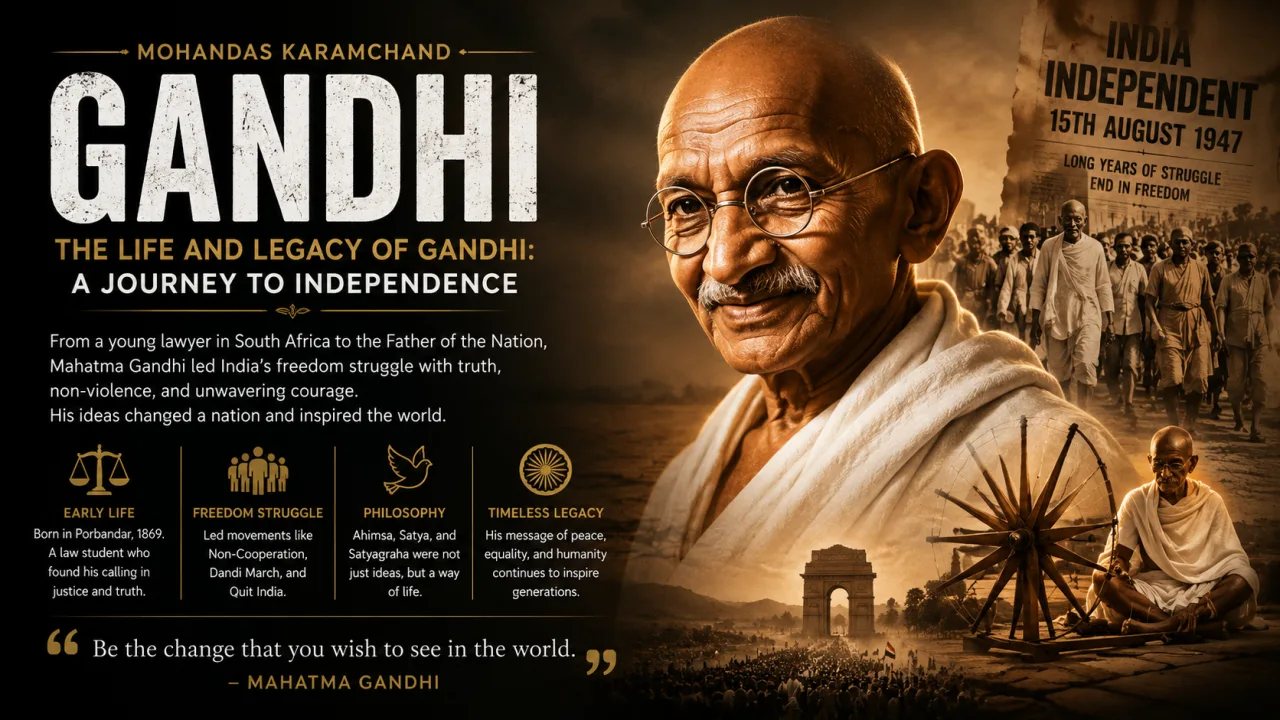
Related: The Life and Legacy of Mahatma Gandhi: A Journey to India Independence
He also championed the creation of the Indian Administrative Service and the Indian Police Service, describing the all-India services as the country's "steel frame".[1] On 21 April 1947 he told the first probationers that civil servants must stay out of politics and communal disputes. For this he is often called the father, or patron saint, of India's civil services, and 21 April is now observed in India as Civil Services Day.[10]
Patel's influence also reached rural Gujarat. He encouraged Kheda dairy farmers to organise their own milk processing and sale, which led to the Kaira District Co-operative Milk Producers' Union, the forerunner of the Amul brand.[1][9] He also pledged to rebuild the Somnath Temple; the work was completed after his death.
Relations with Gandhi and Nehru
Patel was intensely loyal to Gandhi, who served as an arbiter between him and Nehru. The two men shared a long partnership but disagreed on issues such as Kashmir policy and the handling of the princely states.[1] On 30 January 1948 Patel met Gandhi privately, and Gandhi urged him to remain in government alongside Nehru. Gandhi was assassinated minutes after Patel left.
After the assassination, Patel's Home Ministry faced criticism, and he offered to resign. Nehru wrote to reaffirm their partnership, and both leaders publicly stood together.[1] As Home Minister, Patel also banned the RSS in February 1948; the ban was lifted in July 1949 after the organisation adopted a written constitution. Within months of Gandhi's death, Patel suffered a serious heart attack.
Final Years and Death
In 1948 and 1949 Patel received honorary doctorates from several universities. In March 1949 an aircraft carrying him and his daughter made a forced landing in the Rajasthan desert, and his safe return was greeted with a long ovation in Parliament.[1]
His health declined through 1950. On 12 December he was flown to Bombay to recover, and on 15 December 1950 he died at Birla House after a second heart attack.[1] Nehru declared a week of national mourning, more than 1,500 civil and police officers gathered at his Delhi residence to pledge their loyalty to India's service, and around a million people attended his cremation at Sonapur in Bombay.
Honours and Legacy
Patel was posthumously awarded the Bharat Ratna, India's highest civilian honour, in 1991.[1][8] Since 2014 his birthday, 31 October, has been celebrated as Rashtriya Ekta Diwas, or National Unity Day.[7]
The Statue of Unity, a 182-metre figure of Patel facing the Sardar Sarovar Dam on the Narmada River in Gujarat, was inaugurated on 31 October 2018, the 143rd anniversary of his birth. It is the tallest statue in the world.[2]
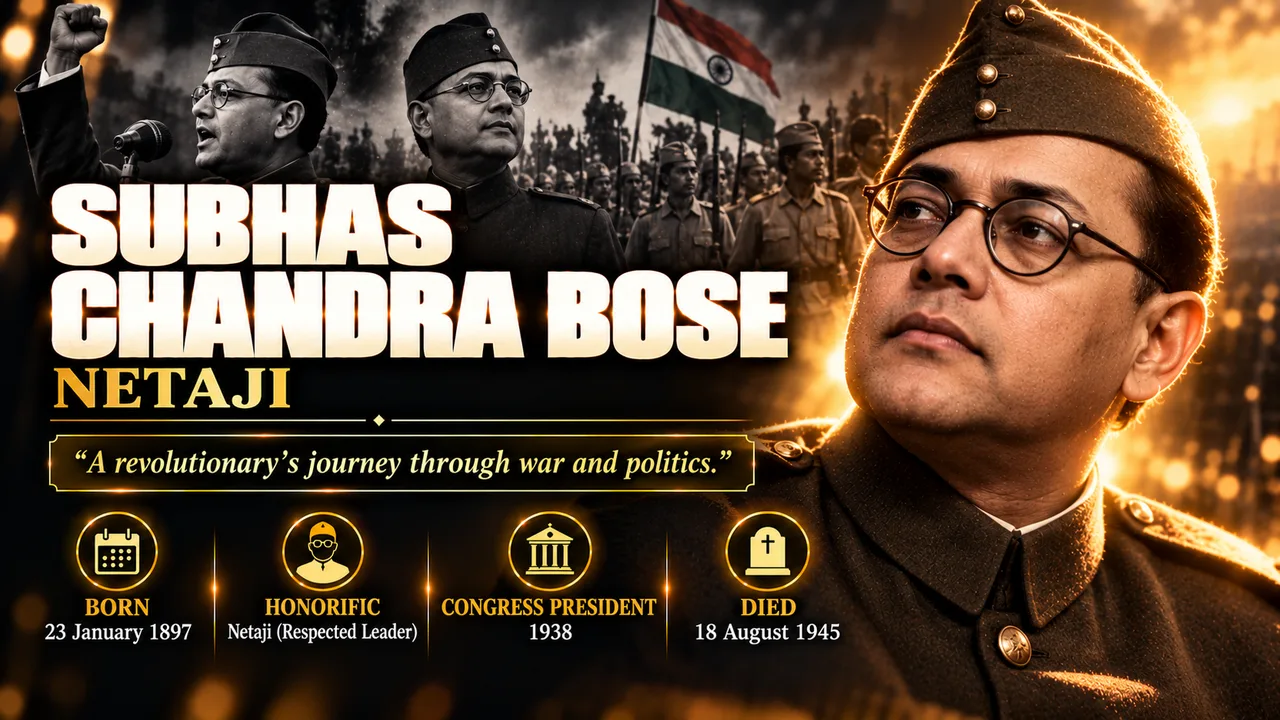
Related: Subhas Chandra Bose: A Revolutionary's Journey Through War and Politics
Many institutions bear his name, among them Ahmedabad's international airport, the Sardar Vallabhbhai National Institute of Technology in Surat, Sardar Patel University and India's national police academy in Hyderabad.[1] His life was dramatised in the 1993 film Sardar, with Paresh Rawal in the title role.[11]
Interesting Facts
The following points highlight lesser-known details about Patel.
- His recorded birthday of 31 October was the date he wrote on his own examination papers.[1]
- His elder brother Vithalbhai used Vallabhbhai's travel papers to study in England first.[1]
- He completed a 36-month law course at the Middle Temple in 30 months.[1]
- He appeared on the cover of Time magazine in January 1947.[1]
- The height of the Statue of Unity, 182 metres, matches the number of seats in the Gujarat Legislative Assembly.[1][2]
Frequently Asked Questions
Why is Vallabhbhai Patel called the Iron Man of India?
He earned the name for his firm and decisive leadership in uniting around 565 princely states with India after independence in 1947.[1][5]
Why is he called Sardar?
The women of Bardoli first called him Sardar, meaning chief, during the 1928 Bardoli Satyagraha that he led.[1][3]
When is National Unity Day?
National Unity Day, or Rashtriya Ekta Diwas, is held every year on 31 October, Patel's birthday, and has been observed since 2014.[7]
How tall is the Statue of Unity?
The Statue of Unity in Gujarat is 182 metres (597 feet) tall and was inaugurated on 31 October 2018.[2]
Conclusion
Vallabhbhai Patel rose from a small-town lawyer to one of the founders of modern India. His leadership of the Kheda and Bardoli campaigns showed his gift for organisation, and his work as Home Minister in the turbulent years after 1947 turned a patchwork of provinces and princely states into a single country.
He was also a controversial figure who clashed with colleagues and faced criticism over his handling of partition-era tensions. Yet his role in shaping the Constitution, founding the modern civil services and securing India's unity explains why his birthday is now celebrated as National Unity Day and why he remains one of the country's most admired leaders.
- ^ [1] "Vallabhbhai Patel". Wikipedia. Wikipedia
- ^ [2] "Statue of Unity". Wikipedia. Wikipedia
- ^ [3] "Bardoli Satyagraha". Wikipedia. Wikipedia
- ^ [4] "Kheda Satyagraha of 1918". Wikipedia. Wikipedia
- ^ [5] "Political integration of India". Wikipedia. Wikipedia
- ^ [6] "Annexation of Hyderabad". Wikipedia. Wikipedia
- ^ [7] "National Unity Day (India)". Wikipedia. Wikipedia
- ^ [8] "Vallabhbhai Patel". Encyclopaedia Britannica. Britannica
- ^ [9] "Amul". Wikipedia. Wikipedia
- ^ [10] "Civil Services of India". Wikipedia. Wikipedia
- ^ [11] "Sardar (1993 film)". Wikipedia. Wikipedia
Content adapted from Wikipedia (Vallabhbhai Patel: The Iron Man Who United India). Licensed under CC BY-SA.
Source
Portions of this article are adapted from the Wikipedia article 'Vallabhbhai Patel', licensed under CC BY-SA 4.0. (revision 1383005069)















Discussion
Log in with