






 By
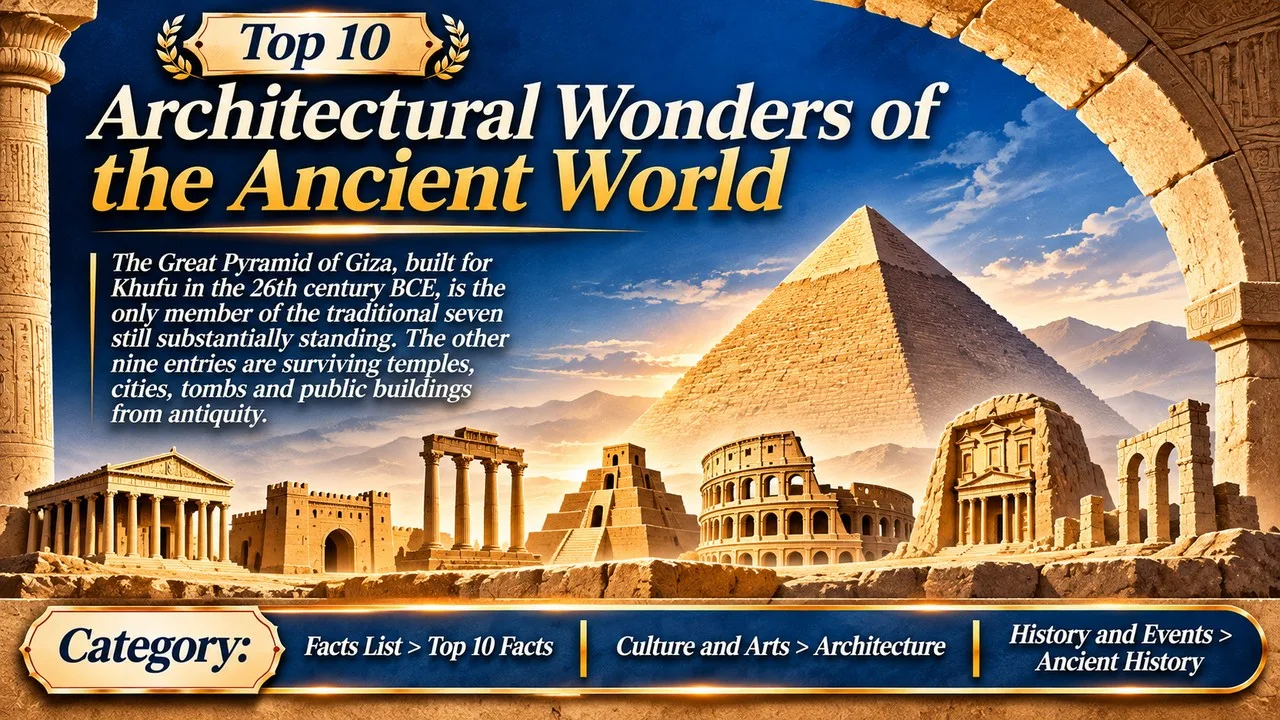
This list ranks ten documented architectural wonders of the ancient world as surviving or well-attested monuments, not as a rerun of the classical seven. The traditional seven, compiled in antiquity, mixed lost works with one monument that still stands, the Great Pyramid of Giza. Finepedia already has a separate article on pyramids, so this list gives the Great Pyramid a single place and then turns to other documented temples, cities, tombs and public buildings [1][2].
"Ancient" here means the long span from the third millennium BCE through late antiquity, roughly to the sixth century CE. Later marvels such as Angkor Wat or Machu Picchu belong to medieval or early-modern worlds and are left out on that ground. Dates follow standard archaeological and historical chronologies. Rank is editorial, based on documentary importance, survival, and influence, not on a single measurable such as height [2][3].
Key Facts
Each row gives a conventional construction or floruit date and what still exists. Rank 1 is the most complete of the traditional seven, and the starting point of this wider ancient list.
Ancient Architectural Wonders at a Glance
| Rank | Monument | Culture and place | Conventional date | What survives |
|---|---|---|---|---|
| 1 | Great Pyramid of Giza | Old Kingdom Egypt | 26th century BCE | Core masonry, almost complete |
| 2 | Karnak temple complex | Thebes, Egypt | Mainly second millennium BCE, with later work | Temples, halls, pylons, sacred lake |
| 3 | Stonehenge | Wiltshire, Britain | Main sarsen setting about 2500 BCE | Standing stones and earthwork |
| 4 | Persepolis | Achaemenid Persia | Founded about 518 BCE | Terrace, palaces, reliefs, gateways |
| 5 | Parthenon, Athens | Classical Greece | 447 to 432 BCE | Doric temple, ruined but standing |
| 6 | Petra | Nabataean Arabia, Jordan | City floruit, first centuries BCE and CE | Rock-cut tombs, facades, hydraulic works |
| 7 | Mausoleum of the First Qin Emperor | Qin China | Late third century BCE | Tomb mound and terracotta army pits |
| 8 | Colosseum | Imperial Rome | Opened in 80 CE | Amphitheatre shell |
| 9 | Pantheon, Rome | Imperial Rome | Hadrianic rebuilding, about 118 to 128 CE | Complete concrete dome in use |
| 10 | Teotihuacan | Central Mexico | Major building in the early centuries CE | Pyramids, avenue, compounds |
1. Great Pyramid of Giza
The Great Pyramid was built for the Old Kingdom king Khufu in the 26th century BCE on the Giza plateau. Its original height was about 146.6 metres; loss of casing stones has reduced the present height to about 138.5 metres. It is the only one of the traditional seven wonders of the ancient world that still stands in substance [1][2].
It is first because of that unique survival, and because its scale and precision remain the standard against which later Egyptian stone building is judged. This article does not expand into a general pyramid ranking, which Finepedia already treats separately [2].
The monument is a royal tomb, a fact sometimes lost in popular wonder lists. The surrounding Giza complex, including later pyramids and the Sphinx, is context, not a second entry [1].
2. Karnak temple complex
Karnak, at Thebes (modern Luxor), is not a single temple but a religious city of pylons, courts, hypostyle halls, obelisks and a sacred lake, built and rebuilt mainly in the Middle and New Kingdoms and later, across many centuries of the second and first millennia BCE [2][3]. The Great Hypostyle Hall of the temple of Amun is the most familiar interior.
It is second as the largest surviving religious ensemble of pharaonic Egypt, and as a reminder that ancient "wonder" can be a complex grown over time rather than a tomb finished in one reign. Unlike Giza, Karnak was a living cult centre for more than a thousand years [3].
A visitor in 2026 still walks among standing columns and inscribed walls. Restoration and tourism management are modern facts; the architecture is ancient [2].
Related: Top 10 Oldest Surviving Buildings on Earth
3. Stonehenge
Stonehenge, on Salisbury Plain, is a prehistoric earth and stone monument whose main sarsen circle and trilithons were set about 2500 BCE, with earlier banks, ditches and smaller stones going back to about 3000 BCE [4]. It is British prehistoric architecture at monumental scale, not a classical temple.
It is third as the best-known well-dated stone circle in Europe, and as a different kind of ancient building: a solar-aligned ceremonial enclosure rather than a roofed hall. The transport of sarsen and bluestone, and the lintelled joints, are the engineering facts that earn it a place among wonders [4].
The site is managed as a protected monument. The date range, not a single legendary year, is the honest construction history [4].
4. Persepolis
Persepolis was founded by Darius I about 518 BCE as a ceremonial capital of the Achaemenid Empire, on a great terrace in present-day Fars, Iran. Successors added palaces, stairways and the Gate of All Nations. Alexander's army burned the complex in 330 BCE [3][5].
It is fourth as the outstanding palatial architecture of the Persian Empire, documented in inscriptions and in a field of standing columns, carved processions and gateways. The site is a ruin, but a readable one, and it is a UNESCO World Heritage property [5].
The terrace and reliefs, not a single roofed hall, are what survive. That is enough to judge the original ambition of the court [5].
5. Parthenon, Athens
The Parthenon, on the Acropolis of Athens, was built from 447 to 432 BCE as a temple of Athena, to designs associated with Iktinos and Kallikrates, with sculptural direction by Phidias, in the aftermath of the Persian destruction of the earlier acropolis [3][6]. It is a Doric peripteral temple in Pentelic marble, later a church and a mosque, and badly damaged in a 1687 explosion.
Related: Top 10 Legendary Pyramids Around the World
It is fifth as the central building of classical Greek architecture, still standing as a ruin that can be measured, drawn and conserved. The wider Acropolis, including the Propylaea and Erechtheion, is the setting; this entry is the Parthenon itself [6].
Sculptures now divided among Athens and other museums are part of the building's history, not a substitute for the architecture that remains on the rock [6].
6. Petra
Petra, in present-day Jordan, was the Nabataean capital, flourishing in the first centuries BCE and CE, with rock-cut tombs and facades, a colonnaded street, and a sophisticated water system in a desert gorge [7]. Al-Khazneh, the so-called Treasury, is the facade most often photographed; the site is much larger than that one cut.
It is sixth as the outstanding rock-cut city of the Hellenistic and Roman Near East, a place where a trading kingdom carved architecture from sandstone cliffs rather than assembling it from imported blocks [7]. It is a UNESCO World Heritage property.
The city declined as trade routes changed, and an earthquake in 363 CE caused serious damage. What a visitor sees is a funerary and civic landscape, not a single temple isolated from its hydrology [7].
7. Mausoleum of the First Qin Emperor
The mausoleum of Qin Shi Huang, who died in 210 BCE, lies near present-day Xi'an. The tomb mound itself has not been excavated in the modern scientific era; the nearby pits of the terracotta army, discovered in 1974, are the visible architectural and sculptural fact that made the complex world-famous [8]. The whole is a planned funerary landscape, not only a collection of figures.
It is seventh as the largest and most carefully described imperial tomb complex of early imperial China, attested by Sima Qian and by archaeology. The figures are sculpture; the pits, ramps and planned precinct are architecture [8].
Related: Top 10 Things That Existed While Woolly Mammoths Were Still Alive
This list does not treat the army as a stand-alone art work torn from the tomb. The wonder is the buried precinct as a designed whole, of which only parts have been opened [8].
8. Colosseum
The Flavian Amphitheatre in Rome, known as the Colosseum, was begun under Vespasian and opened in 80 CE under Titus, with later work under Domitian [9]. It is the largest Roman amphitheatre, a stacked system of arcades, vaults and seating for tens of thousands, later damaged by earthquake and stripped of some stone.
It is eighth as the emblem of imperial Roman public building, and as a structure whose type, the amphitheatre, is distinct from the Greek theatre. Finepedia's later article on attractions in Rome will treat it as a visit; this entry treats it as ancient architecture [9].
The opening year, 80 CE, is the date to remember. The popular name "Colosseum" is later, from a colossal statue that stood nearby [9].
9. Pantheon, Rome
The Pantheon in Rome bears an inscription of Marcus Agrippa but is, in the building we have, a reconstruction under Hadrian, usually dated about 118 to 128 CE [9][10]. Its unreinforced concrete dome, with a central oculus, remains the defining interior of Roman imperial architecture, and the building has been in continuous use, including as a church since the seventh century.
It is ninth, immediately after the Colosseum, because the two are complementary Roman achievements: one a vast public entertainment shell, the other a complete roofed rotunda that still works as a building [10]. The dome's span, about 43 metres, is the technical fact usually cited.
Related: Cleopatra's Tomb: History, Theories and the Search at Taposiris Magna
A 2026 visitor can still stand under the oculus. That continuity is rare among the monuments on this list [10].
10. Teotihuacan
Teotihuacan, northeast of present-day Mexico City, was one of the largest cities in the ancient Americas. Its major monuments, including the Pyramid of the Sun, the Pyramid of the Moon, the Street of the Dead and the Temple of the Feathered Serpent, were raised in the early centuries CE, and the city was a regional power for centuries before its political collapse [11]. The builders' original name for the city is not known; "Teotihuacan" is a later Nahuatl name.
It is tenth as a planned urban and ceremonial ensemble, not as a second Egyptian-style pyramid list. The pyramids are platforms within a city grid, which is why the entry is the site as a whole [11].
The city is a UNESCO World Heritage property and a major Mexican archaeological park. Climbing rules have changed in recent years; the architecture does not depend on standing on the summit [11].
Conclusion
The ancient world's architectural wonders, on a documentary rather than a purely legendary standard, include the Great Pyramid, the long-lived temple city of Karnak, prehistoric Stonehenge, the Persian terrace of Persepolis, the Parthenon, Petra, the Qin funerary precinct, the Colosseum, the Pantheon, and the planned city of Teotihuacan [1][5][9]. Several of the classical seven are absent because they are lost, and several monuments that the seven never included are present because they survive and can be dated [2].
A wonder list is still a curatorial argument. Height alone would have favoured Giza and a few pyramids; this article favoured range of type and of culture, and it stopped before the medieval world. For that later period, see the companion lists of medieval cathedrals and of modern architectural wonders, and for Egypt's tombs as a type, the existing Finepedia pyramid article.
- ^ [1] Egyptian Ministry of Tourism and Antiquities / standard Giza documentation, Great Pyramid of Khufu, dimensions and date. Official Egypt travel and antiquities information
- ^ [2] UNESCO World Heritage description of Memphis and its Necropolis, including Giza, and of other Egyptian sites. UNESCO: Memphis and its Necropolis
- ^ [3] Standard archaeological chronologies for Karnak, Persepolis and the Parthenon in major reference works. Encyclopaedia Britannica site entries
- ^ [4] English Heritage official history of Stonehenge, sarsen setting about 2500 BCE. English Heritage: Stonehenge history
- ^ [5] UNESCO World Heritage description of Persepolis. UNESCO: Persepolis
- ^ [6] Acropolis Restoration Service and official Acropolis documentation, Parthenon 447 to 432 BCE. Acropolis of Athens
- ^ [7] UNESCO World Heritage description of Petra. UNESCO: Petra
- ^ [8] UNESCO World Heritage description of the Mausoleum of the First Qin Emperor, and the 1974 discovery of the terracotta pits. UNESCO: Mausoleum of the First Qin Emperor
- ^ [9] Parco archeologico del Colosseo and standard Roman topographic sources, opening in 80 CE. Colosseum Archaeological Park
- ^ [10] Official and scholarly accounts of the Hadrianic Pantheon, about 118 to 128 CE. Pantheon, Rome
- ^ [11] UNESCO World Heritage description of Teotihuacan, and Instituto Nacional de AntropologÃa e Historia site information. UNESCO: Teotihuacan





















Discussion
Log in with