






 By
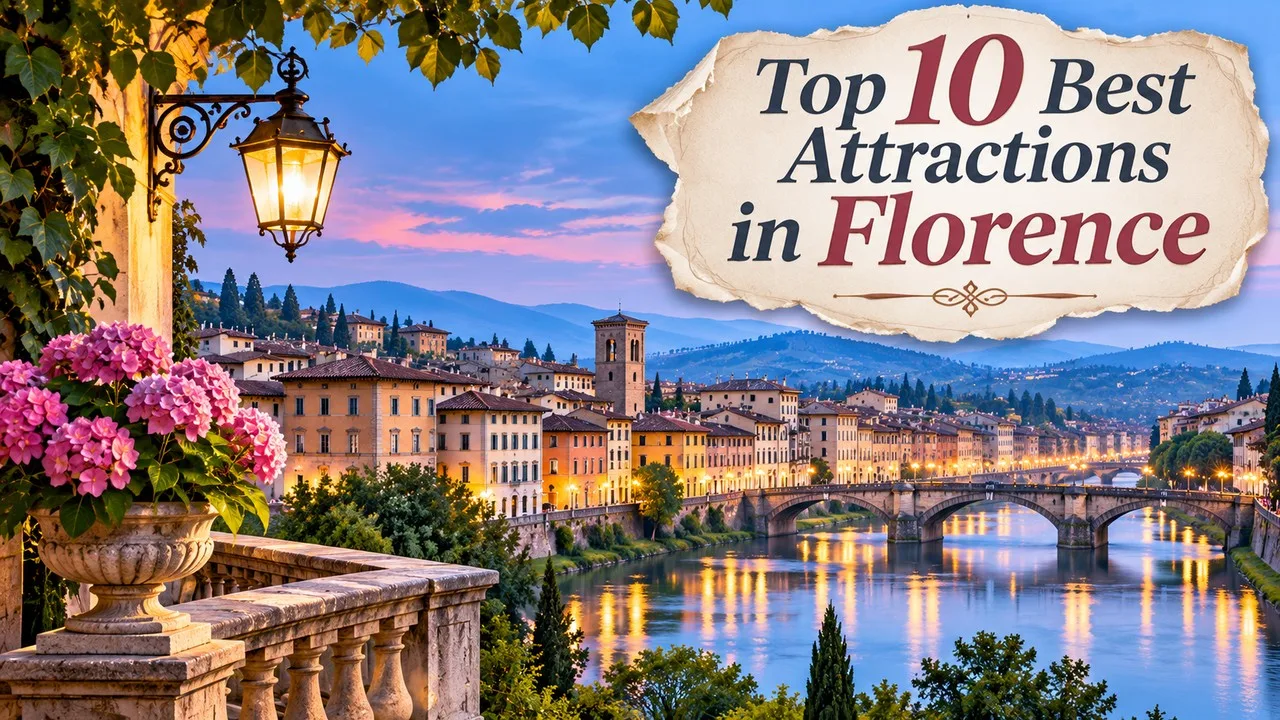
The best attractions in Florence are ranked here as official historic and cultural sites, with dated openings for the Uffizi, the Duomo, and the Bargello. The Uffizi Gallery opened to the public in 1769, the Cathedral of Santa Maria del Fiore was consecrated on 25 March 1436, and the Bargello opened as a national museum in 1865, while Michelangelo's David has been in the Galleria dell'Accademia since August 1873 [1][2][3][4]. Those dated facts are why a 2026 list cannot treat the Uffizi as a private Medici corridor or the Accademia as a piazza statue.
Rank is editorial, by documentary importance and by official access. The Uffizi, the Accademia, and the Opera del Duomo complex use official timed tickets. This article describes buildings and a river crossing and does not copy official crests, exact church facades, or sculpture, including David, in any featured image. Pisa, Siena, and Fiesole are day trips, not intramural entries, the same method used for Versailles in the Paris list.
A useful 2026 habit is to book the Uffizi, the Accademia, and the cathedral complex on official sites, and to remember that the baptistery, the campanile, the dome, and the cathedral museum are parts of one Opera del Duomo system, not four separate ranks in this ten [1][2][4]. A street seller in the piazza is not the official ticket office.
Key Facts
Consecration, public opening, and transfer dates follow official gallery, Opera del Duomo, and national-museum accounts. The Ponte Vecchio was rebuilt in 1345 after a flood, the Boboli Gardens were opened to the public in 1766, and Piazzale Michelangelo was laid out from 1869 [5][6][7]. Rank 1 is the outstanding official picture gallery, which is also the oldest public museum opening in this ten.
Those booking habits matter because the main rooms sell out in the same weeks as Easter, summer, and major temporary exhibitions. A same-day walk-up can fail at the Uffizi even when the courtyard is in view, and a dome climb is a timed official product, not a free church visit [1][2]. The table below is the official spine of the list: dates first, 2026 access second, and no out-of-town cathedral is smuggled into the intramural ten. The Arno is the documentary axis that joins the Uffizi, the Ponte Vecchio, and the Pitti palace; it is not itself a tenth attraction.
Florence Attractions at a Glance
| Rank | Attraction | Official date | 2026 note |
|---|---|---|---|
| 1 | Uffizi Gallery | Opened to the public 1769 | Official timed tickets |
| 2 | Cathedral of Santa Maria del Fiore | Consecrated 25 March 1436 | Official Opera del Duomo tickets for the complex |
| 3 | Ponte Vecchio | Rebuilt 1345 | A public historic bridge with official shops above the river |
| 4 | Palazzo Pitti and Boboli Gardens | Boboli opened to the public 1766 | Official Uffizi Galleries tickets for palace and garden |
| 5 | Galleria dell'Accademia | David transferred August 1873 | Official tickets; the sculpture is not reproduced here |
| 6 | Palazzo Vecchio | Civic palace from the late thirteenth century | Official museum tickets in the civic square |
| 7 | Basilica of Santa Croce | Historic Franciscan basilica and civic tombs | Official tickets for the complex |
| 8 | Museo Nazionale del Bargello | Opened 1865 as a national museum | Official sculpture-museum tickets |
| 9 | Piazzale Michelangelo | Laid out from 1869 | A free official viewpoint |
| 10 | Basilica of Santa Maria Novella | Historic Dominican basilica | Official tickets for the church complex |
1. Uffizi Gallery
The Uffizi Gallery, in Giorgio Vasari's offices for the Florentine magistrates, opened to the public in 1769 as an official gallery of the Medici collections and remains the principal state picture museum of the city [1]. Official timed tickets are the way in. The Vasari Corridor, when a separate itinerary is offered, follows official rules and is not automatically part of a gallery ticket.
It is first as the outstanding official museum visit, dated to a public opening older than the Bargello and the Accademia as museums, and still the documentary centre of Florentine painting as a public collection [1]. A later ticket price will not change the 1769 opening.
Temporary exhibitions follow the museum's own rules. The official Uffizi Galleries site is the only safe source for a 2026 slot [1].
2. Cathedral of Santa Maria del Fiore
The Cathedral of Santa Maria del Fiore was consecrated on 25 March 1436, with Filippo Brunelleschi's dome as its outstanding engineering fact, and it is visited today through the official Opera di Santa Maria del Fiore ticket system that also covers, according to the chosen pass, the baptistery, the campanile, the dome climb, and the cathedral museum [2]. The cathedral is a working church. This article records the consecration and the complex; it does not copy the exact facade or the dome in the featured image.
Related: Top 10 Most Bizarre Phobias: Strange Fears That Exist
It is second as the outstanding official church visit, a 1436 consecration date, and a single official ticket family rather than four rival monuments [2]. A later pass combination will not change the consecration date.
Dome slots sell out early. The Opera del Duomo official site is the legal source [2].
3. Ponte Vecchio
The Ponte Vecchio, the historic shop-lined bridge of the Arno, was rebuilt in 1345 after a flood destroyed an earlier crossing, and it remains a public roadway with official goldsmiths' premises and the corridor passing above [5]. Walking the bridge is free. The shops are private businesses, not a museum, and the corridor above is an official gallery itinerary when it is open, not a right of the roadway.
It is third as the outstanding official river monument, with a firm fourteenth-century rebuild date, and the structure that joins the Uffizi bank to the Pitti side in one documented walk [5]. A later shop front will not change the 1345 rebuild.
Crowds are ordinary from morning. Official city and gallery descriptions are the source [5].
4. Palazzo Pitti and Boboli Gardens
Palazzo Pitti, the official palace museum on the left bank, and the Boboli Gardens, opened to the public in 1766, are administered with the Uffizi Galleries as a state museum ensemble [6]. Official tickets cover the gardens and, according to the chosen product, the palace museums. The garden is a historic landscape, not a free city park, and the palace is not a second Uffizi under another name.
It is fourth as the outstanding official palace-and-garden visit, dated by the 1766 public opening of Boboli, and the counterpart on the far side of the Ponte Vecchio [6]. A later combined ticket will not change that garden date.
Related: Top 10 Oldest Buildings in the World
Summer heat and uphill paths are ordinary. The official Uffizi Galleries pages for Boboli and Pitti are the source [6].
5. Galleria dell'Accademia
The Galleria dell'Accademia is the official state gallery that has housed Michelangelo's David since the statue was transferred there in August 1873 from the Piazza della Signoria, and it remains a timed-ticket museum in 2026 [4]. Official tickets are the way in. This article records the museum and the transfer date; it does not reproduce the sculpture.
It is fifth as the outstanding official sculpture-gallery visit, dated to a precise transfer, and a necessary counterpart to the copy or later stand-in that visitors still see in the piazza [4]. A later exhibition of drawings will not change the August 1873 move.
Advance slots are the 2026 habit. The Accademia's official site is the legal source [4].
6. Palazzo Vecchio
Palazzo Vecchio, the official civic palace of the Florentine republic and later of the duchy, rose from the late thirteenth century on the Piazza della Signoria and is now a municipal museum of state rooms, including later Medici apartments [8]. Official tickets are the way in. The piazza outside, with its sculptures and the Loggia dei Lanzi, is a public square; this entry is the palace.
It is sixth as the outstanding official civic-palace visit, a counterpart to the Pitti residential palace, and the political room of the same city that built the Uffizi as offices [8]. A later tower-climb timetable will not change the palace itself.
Related: The Science Behind Auroras: How Solar Winds Create Colorful Skies
Museum routes can vary. The official Palazzo Vecchio museum site is the source [8].
7. Basilica of Santa Croce
The Basilica of Santa Croce, the official Franciscan church of the historic centre, is a documented burial church of civic figures, including Michelangelo and Galileo, and it is visited on official tickets for the basilica, cloisters, and related spaces [9]. It is a working religious complex as well as a civic pantheon. This article records the official house; it does not treat the tombs as decorative props.
It is seventh as the outstanding official funerary basilica, a counterpart to the cathedral complex, and a ticketed interior rather than a free facade view [9]. A later conservation closure of a chapel will not change the basilica itself.
Official site tickets are the legal source [9].
8. Museo Nazionale del Bargello
The Museo Nazionale del Bargello opened in 1865 as a national museum of sculpture and the applied arts in the medieval Bargello palace, and it is officially described as Italy's first national museum of that kind [3]. Official tickets are the way in. It is a sculpture museum, complementary to the Accademia, and not a second David ticket.
It is eighth as a documented national-museum founding, dated to 1865, and a palace-museum whose opening is as precise as the Uffizi's 1769 public opening [3]. A later exhibition will not change the 1865 date.
The official Bargello Museums site is the 2026 source [3].
9. Piazzale Michelangelo
Piazzale Michelangelo, the official terrace viewpoint over the river and the cathedral dome, was laid out from 1869 in Giuseppe Poggi's nineteenth-century expansion of the city, and it remains a free public square [7]. A bronze copy of David stands there as a later civic marker; the original is in the Accademia and is not reproduced in this article's image. The square is a viewpoint, not a museum.
Related: Top 10 Tallest Buildings in the World
It is ninth as the outstanding official panoramic visit, dated to 1869, and a counterpart to the closer river crossings in the centre [7]. A later kiosk or parking rule will not change the layout date.
Sunset crowds are ordinary. Official city descriptions are the source [7].
10. Basilica of Santa Maria Novella
The Basilica of Santa Maria Novella, the official Dominican church near the main station, is a historic complex of facade, interior, and cloisters, visited on official tickets [10]. It is a working religious house and a documented art church, not a station waiting room. This article records the official complex; it does not copy the exact facade.
It is tenth as the outstanding official mendicant counterpart to Santa Croce, a second great friars' basilica in the intramural city, and a ticketed interior rather than a facade glimpse from the piazza [10]. A later cloister exhibition will not change the basilica itself.
Official complex tickets are the legal source [10].
Conclusion
A 2026 Florence list has to keep the Uffizi's 1769 public opening, the cathedral's 25 March 1436 consecration, the Bargello's 1865 national-museum opening, and the Accademia's August 1873 receipt of David on the same page as the Ponte Vecchio's 1345 rebuild, the Boboli Gardens' 1766 public opening, and Piazzale Michelangelo from 1869 [1][2][3][4][5][6][7]. Around those dated facts sit Palazzo Vecchio, Santa Croce, and Santa Maria Novella, all official interiors with tickets or posted church rules [8][9][10]. The useful habit is official booking for the Uffizi, the Accademia, and the Opera del Duomo pass, and a refusal to treat a sculpture, a crest, or a facade as something a featured image should copy.
Pisa, Siena, and Fiesole remain day trips. A later ticket bundle will not change the 1769 gallery, the 1436 consecration, or the 1865 museum. Those official dates are the spine of the list, and they will still be the spine after a time-slot screen or a garden gate hour has changed in a later tourist season in the same river city.
- ^ [1] Official Uffizi Galleries information, gallery opened to the public in 1769. Uffizi Galleries: about us
- ^ [2] Official Opera di Santa Maria del Fiore information, cathedral consecrated 25 March 1436. Opera del Duomo: cathedral
- ^ [3] Official Museo Nazionale del Bargello information, opened 1865. Bargello Museums
- ^ [4] Official Galleria dell'Accademia information, David transferred August 1873. Galleria dell'Accademia
- ^ [5] Documented rebuild of the Ponte Vecchio in 1345. Visit Tuscany / city sources: Ponte Vecchio
- ^ [6] Official Uffizi Galleries information on the Boboli Gardens, opened to the public in 1766. Boboli Gardens
- ^ [7] Official and city information on Piazzale Michelangelo, laid out from 1869. Visit Tuscany: Piazzale Michelangelo
- ^ [8] Official Palazzo Vecchio museum visitor information. Palazzo Vecchio
- ^ [9] Official Opera di Santa Croce visitor information. Santa Croce
- ^ [10] Official Santa Maria Novella complex visitor information. Santa Maria Novella





















Discussion
Log in with