






 By
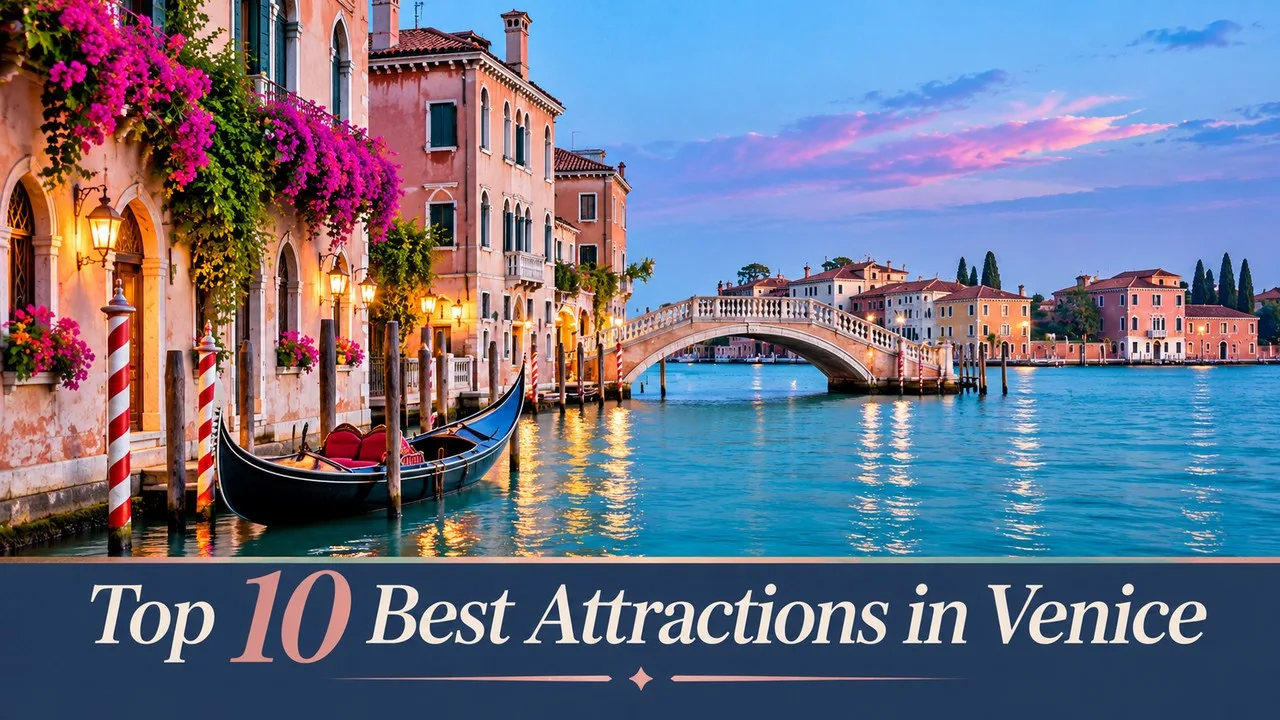
The best attractions in Venice are ranked here as official historic and cultural sites, with a 2026 note on the city's access-fee trial. The Comune's contributo di accesso trial for 2026 ended on 26 July, and from 27 July 2026 no payment or exemption registration was required; the official scheme is due to return in 2027 on listed dates, which is a fact a mid-2026 visitor notice will not yet show [1]. St Mark's Basilica was consecrated in 1094, the present Rialto Bridge was completed in 1591, and Teatro La Fenice reopened on 14 December 2003 after the 1996 fire [2][3][4]. Those dated facts belong in the same 2026 list as the access-fee calendar.
Rank is editorial, by documentary importance and by official access. Tourist entry to St Mark's and the Doge's Palace uses official tickets, which are separate from any city access fee [2][5]. This article describes buildings and a canal landscape and does not copy official crests, exact basilica mosaics, or copyrighted paintings in any featured image. Murano, Burano, and Torcello are lagoon trips, not intramural entries, the same method used for Versailles in the Paris list.
A useful 2026 habit is to check the official Contributo di Accesso site before a 2027 visit, and to book basilica and palace tickets from the official houses rather than from a tout on the piazza [1][2][5]. A private gondola is a service, not a monument, and it is not a substitute for the Grand Canal as a civic waterway.
Key Facts
Consecration, completion, reopening, and access-fee dates follow official basilica, civic-museum, theatre, and Comune accounts. The Jewish Ghetto was established in 1516, and Santa Maria della Salute stands as a seventeenth-century votive church on the Grand Canal [6][7]. Rank 1 is the outstanding official church, which is also the documentary centre of the main square.
Those booking habits matter because palace and basilica slots fill in the same weeks as regattas, holidays, and acqua alta disruptions. A same-day walk-up can fail at the Doge's Palace even when the facade is in view, and a 2027 day-tripper who ignores the official access calendar can meet a charge that did not apply in late 2026 [1][5]. The table below is the official spine of the list: dates first, 2026 and 2027 access second, and no lagoon island workshop is smuggled into the intramural ten. The water is the documentary axis of the city; it is not itself a numbered museum.
Venice Attractions at a Glance
| Rank | Attraction | Official date | 2026 note |
|---|---|---|---|
| 1 | St Mark's Basilica | Consecrated 1094 | Official tourist tickets, separate from any city access fee |
| 2 | Doge's Palace | Historic ducal palace, official civic museum | Official tickets through the civic museum system |
| 3 | Rialto Bridge and Grand Canal | Present stone bridge completed 1591 | A public crossing and a civic waterway |
| 4 | St Mark's Campanile | Reopened 25 April 1912 after the 1902 collapse | Official tower tickets on the main square |
| 5 | Gallerie dell'Accademia | Official academy gallery of Venetian painting | Official timed tickets; works are not reproduced here |
| 6 | Santa Maria della Salute | Seventeenth-century votive church | A working church at the mouth of the Grand Canal |
| 7 | Basilica di Santa Maria Gloriosa dei Frari | Historic Franciscan basilica | Official tickets for the interior |
| 8 | Scuola Grande di San Rocco | Historic scuola with a major painted cycle | Official tickets; paintings are not reproduced here |
| 9 | Teatro La Fenice | Reopened 14 December 2003 after the 1996 fire | Official performances and daytime visits |
| 10 | Jewish Ghetto | Established 1516 | Historic quarter with official museum and synagogue itineraries |
1. St Mark's Basilica
St Mark's Basilica, the official ducal chapel and later cathedral of Venice, was consecrated in 1094 and remains a working church of mosaics and treasury rooms on Piazza San Marco [2]. Official tourist tickets, with optional pala or terrace itineraries according to the basilica's own rules, are the 2026 way in for most visitors. This article records the consecration and the visit; it does not copy the mosaics or the facade in the featured image.
It is first as the outstanding official church, older as a consecrated house than any other monument in this ten, and the documentary centre of the main square [2]. A later ticket price will not change the 1094 consecration.
Liturgical times restrict tourist circulation. The basilica's official site is the legal source [2].
Related: Top 10 Famous Stone Bridges of the World
2. Doge's Palace
The Doge's Palace, the official historic seat of the Venetian government, is visited as a civic museum of state rooms, armouries, and prison routes, administered through the official Musei Civici system [5]. Official tickets are the way in. Combined products with the Correr Museum and other Piazza San Marco museums, when offered, follow official rules and are not automatically included in a basilica ticket.
It is second as the outstanding official civic-palace visit, the political counterpart to the basilica beside it, and a ticketed interior rather than a free facade on the lagoon [5]. A later secret-itinerary tour will not change the palace itself.
Advance purchase is the 2026 habit. The official civic-museum ticket pages are the source [5].
3. Rialto Bridge and Grand Canal
The present stone Rialto Bridge, designed by Antonio da Ponte, was completed in 1591 as the official crossing at the city's historic market bend, and the Grand Canal remains the principal civic waterway of Venice [3]. Walking the bridge is free. The shops on the span are private businesses, not a museum, and a vaporetto is a public-transport ticket, not a monument ticket.
It is third as the outstanding official river monument, with a firm 1591 completion date, and the structure that explains the city's water axis better than any single palace facade [3]. A later shop front will not change the 1591 bridge.
Crowds are ordinary from morning. Official city descriptions are the source [3].
4. St Mark's Campanile
St Mark's Campanile, the official bell tower of the basilica and a civic landmark of the square, collapsed on 14 July 1902 and was rebuilt as it was, reopening on 25 April 1912 [8]. Official tickets are the way in for the lift and the viewpoint. The tower is a 1912 reconstruction of an older campanile, which is the honest 2026 fact, not a claim that the present brickwork is medieval throughout.
Related: Top 10 Places to Visit Before They Disappear
It is fourth as the outstanding official viewpoint on the main square, dated to a precise reopening, and a counterpart to the basilica at its foot [8]. A later lift timetable will not change the 25 April 1912 return.
Slots fill in clear weather. Official tower information is the source [8].
5. Gallerie dell'Accademia
The Gallerie dell'Accademia are the official state gallery of Venetian painting, in the former Scuola della Carita complex, and they remain a ticketed museum of the city's own school [9]. Official tickets are the way in. This article records the official gallery; it does not reproduce the paintings.
It is fifth as the outstanding official picture-gallery visit, a counterpart to the Scuola Grande di San Rocco as a house of canvases, and a museum rather than a church [9]. A later room reopening after conservation will not change the gallery itself.
Timed entry can apply when the house is busy. The official Accademia site is the schedule [9].
6. Santa Maria della Salute
Santa Maria della Salute, the official votive church at the mouth of the Grand Canal, was built in thanksgiving after plague and stands as a seventeenth-century landmark of the entrance to the basin of San Marco [7]. It is a working church with posted visiting hours. The exterior is part of the official canal prospect; the interior is the visit.
It is sixth as the outstanding official Baroque church on the water, a counterpart to the medieval basilica in the square, and a documented votive house rather than a generic dome [7]. A later sacristy ticket, when required, will not change the church itself.
Related: Top 10 Most Bizarre Phobias: Strange Fears That Exist
Official church notices set the interior rules [7].
7. Basilica di Santa Maria Gloriosa dei Frari
The Basilica di Santa Maria Gloriosa dei Frari, the official Franciscan church of the San Polo district, is a historic brick basilica with a documented interior of tombs and altarpieces, visited on official tickets [10]. It is a working religious house as well as a civic pantheon. This article records the official basilica; it does not reproduce the paintings.
It is seventh as the outstanding official mendicant church, a counterpart to St Mark's as a different kind of Venetian interior, and a ticketed space rather than a free facade [10]. A later conservation scaffold will not change the basilica itself.
Official site tickets are the legal source [10].
8. Scuola Grande di San Rocco
The Scuola Grande di San Rocco, a historic Venetian confraternity house, is the official monument of a major painted cycle in situ and is visited on official tickets [11]. Official tickets are the way in. This article records the scuola and the visit; it does not reproduce the canvases.
It is eighth as the outstanding official scuola visit, a lay religious house rather than a parish church, and a counterpart to the Accademia as a place to see Venetian painting in its original rooms [11]. A later audio guide will not change the scuola itself.
The official Scuola Grande di San Rocco site is the source [11].
9. Teatro La Fenice
Teatro La Fenice, the official opera house of Venice, reopened on 14 December 2003 after the fire of 29 January 1996, following earlier fires and rebuilds in its longer history, and it remains a working theatre with official performances and daytime visit tickets [4]. A tour is not a performance ticket. The 2003 reopening is the date a pre-fire guidebook will miss.
It is ninth as the outstanding official theatre visit, dated to a precise return, and a civic monument of performance rather than a palace museum [4]. A later season programme will not change the 14 December 2003 reopening.
Related: Top 10 Oldest Buildings in the World
The theatre's official site is the legal source [4].
10. Jewish Ghetto
The Jewish Ghetto of Venice, a documented enclosed quarter established by the Republic in 1516, remains a historic neighbourhood with official museum and synagogue itineraries administered through the official Jewish community institutions [6]. Official tickets, when a museum or synagogue circuit is offered, are the way in. This article records the official quarter and the date; it does not treat the streets as decorative scenery.
It is tenth as the outstanding official minority-heritage visit, dated to 1516, and a necessary civic fact in a city list that would otherwise be only churches and palaces [6]. A later museum combination will not change the 1516 establishment.
Quiet and posted rules apply in religious spaces. Official museum and community pages are the source [6].
Conclusion
A 2026 Venice list has to say that the city's access-fee trial ended on 26 July 2026 and that the official charge is due to return on listed 2027 dates, and it has to keep the 1094 consecration of St Mark's, the 1591 Rialto Bridge, the 1912 campanile reopening, and La Fenice's 14 December 2003 return on the same page [1][2][3][8][4]. Around those dated facts sit the Doge's Palace, the Accademia, the Salute, the Frari, the Scuola Grande di San Rocco, and the Jewish Ghetto established in 1516 [5][9][7][10][11][6]. The useful habit is a check of the official Contributo di Accesso calendar before a 2027 visit, official tickets for the basilica and the palace, and a refusal to treat a mosaic, a painting, or a crest as something a featured image should copy.
Murano, Burano, and Torcello remain lagoon trips. A later access-fee date list will belong in a revision of the 2026 status line; it will not change the 1094 basilica, the 1591 bridge, or the 2003 theatre. Those official dates are the spine of the list, and they will still be the spine after a ticket kiosk or a vaporetto timetable has changed in a later tourist season in the same lagoon city.
- ^ [1] Official Comune di Venezia Contributo di Accesso information: 2026 trial ended 26 July; scheme due to return on listed 2027 dates. Contributo di Accesso
- ^ [2] Official Basilica di San Marco chronology and visitor information, consecrated 1094. Basilica di San Marco
- ^ [3] Documented completion of the present Rialto Bridge in 1591. City sources: Rialto Bridge
- ^ [4] Official Teatro La Fenice history, reopened 14 December 2003. Teatro La Fenice
- ^ [5] Official Musei Civici / VisitMuve tickets for the Doge's Palace. Doge's Palace
- ^ [6] Official and documented accounts of the Venetian Ghetto, established 1516. Jewish community / museum information
- ^ [7] Documented history of Santa Maria della Salute as a seventeenth-century votive church. City sources: Salute
- ^ [8] Documented collapse of St Mark's Campanile on 14 July 1902 and reopening on 25 April 1912. Basilica / campanile official accounts
- ^ [9] Official Gallerie dell'Accademia visitor information. Gallerie dell'Accademia
- ^ [10] Official Frari basilica visitor information. Basilica dei Frari
- ^ [11] Official Scuola Grande di San Rocco visitor information. Scuola Grande di San Rocco






















Discussion
Log in with