





 By
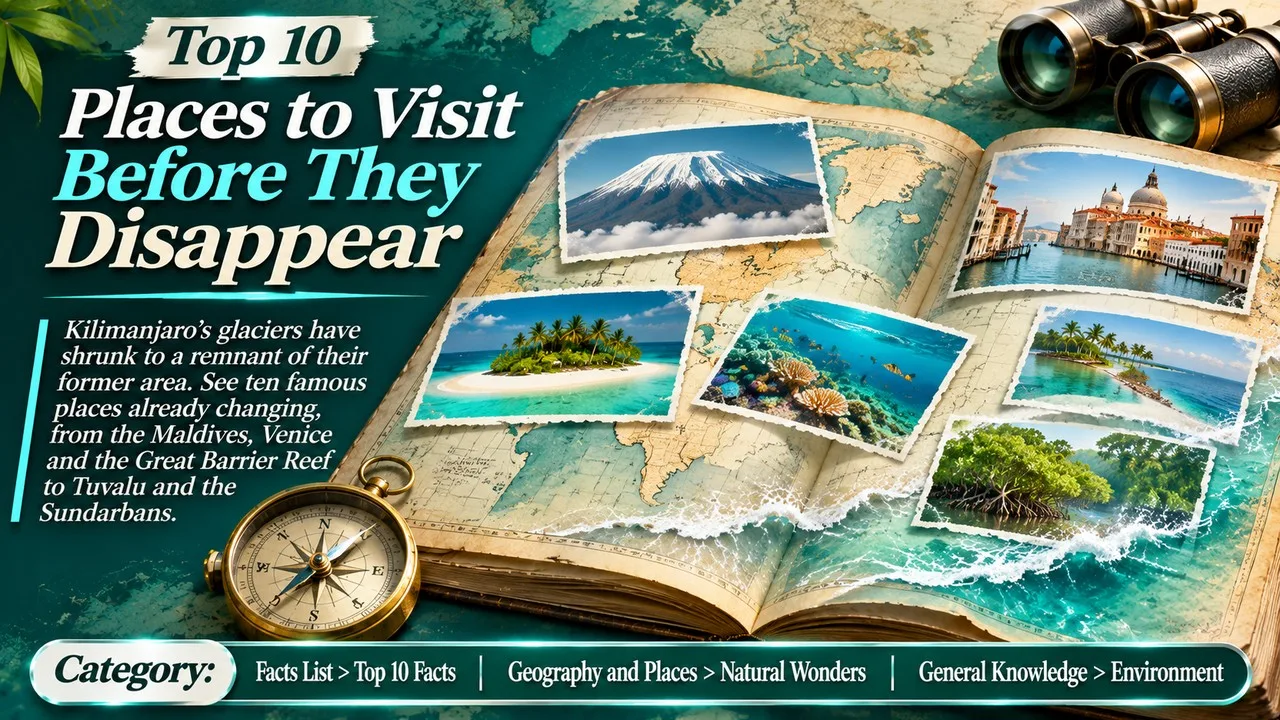
Kilimanjaro's summit glaciers have shrunk to a remnant of their early twentieth-century area, and several other famous places face a similar squeeze. "Disappear" on this list does not mean that a country or a city will vanish next year. It means that a landscape, a reef, a glacier or a low-lying homeland is already being altered by climate, erosion or subsidence in ways that will change what a visitor can see [1][2].
The ten places below are chosen for that combination of fame and documented threat: shrinking ice, rising or relatively rising seas, a damaged reef, a sinking city, or a wetland under salt and storms. A 2015-style warning that Havana might "lose its old charm" is not a physical disappearance, so it is not used here. Antarctica as a whole continent is not disappearing either, though individual ice shelves and glaciers are retreating, and the North Pole is a shifting point on sea ice rather than a fixed destination [3][4].
Some of these places have also gained new defences. Venice's MOSE barriers are now in operation, and parts of the Great Barrier Reef have seen coral cover recover between bleaching years. Those facts belong in the story; they do not remove the underlying risk [5][6]. The picture below is as of November 2026.
Key Facts
The table gives each place, the main threat, and a current status note.
Places Facing Change at a Glance
| Rank | Place | Country or region | Main threat | Status note |
|---|---|---|---|---|
| 1 | Kilimanjaro glaciers | Tanzania | Retreat of summit ice | Ice area has fallen from more than 11 square kilometres around 1900 to under 1 square kilometre |
| 2 | Maldives | Maldives | Sea-level rise | The world's lowest-lying country, with an average elevation of about 1.5 metres |
| 3 | Venice | Italy | High tides and long-term sea-level rise | MOSE barriers now operate; the lagoon city remains exposed over the longer term |
| 4 | Great Barrier Reef | Australia | Marine heatwaves and bleaching | Coral cover has fluctuated; heat, cyclones and starfish remain threats |
| 5 | Columbia Glacier | Alaska, United States | Rapid tidewater glacial retreat | One of the most dramatically receding glaciers in North America |
| 6 | Everglades | Florida, United States | Sea-level rise, altered water flow and habitat loss | A UNESCO site still dependent on restoration of freshwater flow |
| 7 | Tuvalu | Tuvalu | Sea-level rise | A low atoll nation facing an existential coastal threat |
| 8 | Glacier National Park glaciers | Montana, United States | Shrinkage of named glaciers | Ice remains, but many glaciers are much smaller than a century ago |
| 9 | Jakarta | Indonesia | Land subsidence plus sea-level rise | One of the world's fastest-sinking large cities |
| 10 | Sundarbans | India and Bangladesh | Sea-level rise, erosion and cyclones | The world's largest mangrove forest, and a tiger habitat under pressure |
1. Kilimanjaro glaciers
Mount Kilimanjaro, Africa's highest peak at 5,895 metres, still holds small glaciers near the summit, including remnants of the ice cap that once spread across the crater area [1][7]. Scientific surveys have recorded a collapse in ice cover over the past century, from more than 11 square kilometres around 1900 to well under one square kilometre in recent measurements [1]. The Furtwangler Glacier, the best-known remaining patch, has been thinning and fragmenting.
The loss is important because Kilimanjaro is a free-standing mountain whose white summit has been part of its identity in travel writing, including in Ernest Hemingway's The Snows of Kilimanjaro. Climbers who reach the crater today already see more rock than the early photographs show [7]. The ice is not the reason most people start the climb, but it is the feature that is disappearing.
Predictions of a complete loss have been made for years and should be dated carefully; the remaining ice has lasted longer than some early forecasts, but the direction of change is not in doubt [1][7].
2. Maldives
The Maldives is the world's lowest-lying country, a chain of coral atolls in the Indian Ocean whose average ground elevation is only about 1.5 metres above sea level [8]. That makes even a moderate rise in global sea level, together with coastal erosion and saltwater intrusion, a threat to housing, airports and freshwater lenses, not only to beaches [8]. The country has been a leading diplomatic voice on climate change for that reason.
It is also one of the world's best-known resort destinations, which creates a tension this list has to be honest about. Tourism is the economic lifeline, and it is also a source of pressure on reefs and waste systems. A visit still has a point: the islands, the culture and the reefs are not gone, and several inhabited islands are investing in sea walls and reclamation [8].
"Before they disappear" is, for the Maldives, a phrase about a nation's long-term habitability, not about a cancelled holiday next season. The time scale is decades, and it depends on the path of global emissions as well as on local adaptation [8].
Related: Top 10 Most Relaxing Destinations to Visit
3. Venice
Venice, built on islands in a lagoon, has been sinking and flooding for centuries. Twentieth-century groundwater extraction increased the city's subsidence, a process that slowed after pumping was restricted, but acqua alta (exceptionally high tides) still sends water over the pavements [5][9]. The MOSE system of mobile barriers at the lagoon inlets is now in operation and has already been used to keep high tides out of the historic city, a major change from the period when such a scheme was only a plan [5].
That success is not the end of the story. The barriers have costs, operational limits and a design life that will be tested by higher seas. Venice also faces the quieter pressures of overcrowding, which Finepedia discusses in a different way in its list of car-free destinations [9].
A visitor in 2026 therefore sees a city that is better protected against the classic flood event than it was a decade ago, and still exists in a lagoon that is rising around it. The honest warning is long-term, not immediate abandonment [5][9].
4. Great Barrier Reef
The Great Barrier Reef, off Queensland, is Earth's most extensive coral-reef complex and a UNESCO World Heritage site [10]. Repeated marine heatwaves have caused mass bleaching in the 2010s and 2020s, killing large amounts of coral in some regions and years, while other years have allowed partial recovery of coral cover [6][10]. The Australian Institute of Marine Science's 2025-26 monitoring summarised a mixed picture: limited bleaching in that season and recovery in some areas, with heat stress, cyclones and crown-of-thorns starfish still listed as the main threats [6].
The reef is not a single object that will be "gone" on a given date. It is a vast mosaic, some of it still spectacular, some of it badly damaged, and all of it sensitive to the next hot summer [6]. That is why it belongs on a list of places to see with a sense of urgency, and also why casual claims that it is already dead are wrong.
Snorkelling and diving remain possible and, in many sites, still excellent. The scientific message is to go, look carefully, and not to treat any one season's coral cover as the last word [6][10].
5. Columbia Glacier
The Columbia Glacier, which flows from the Chugach Mountains into Prince William Sound in Alaska, is one of the best-documented cases of rapid tidewater glacier retreat [11]. From the 1980s onwards it thinned, receded many kilometres up its fjord, and became a case study in how a glacier that has come off its moraine shoal can lose ice quickly [11].
Related: Top 10 Most Beautiful Slot Canyons
Cruise and kayak visitors who now enter the newly opened fjord are looking at a landscape that did not exist in this form a few decades ago. Icebergs, newly exposed rock and a receding terminus are the spectacle, and also the evidence. The glacier is still there; the version of it that reached far down the inlet is not [11].
Columbia is on this list as a specific, measurable disappearing ice front, rather than as a stand-in for all of Alaska. Other Alaskan glaciers are retreating too, but few have changed so visibly in a single generation of travel [11].
6. Everglades
The Everglades in southern Florida are a vast, slow-moving wetland of sawgrass, sloughs, mangroves and tree islands, protected in large part as a national park and recognised as a UNESCO World Heritage site [12]. The system has been squeezed for decades by drainage, urban growth in Miami and elsewhere, invasive species, and now by rising seas that push salt water inland and threaten freshwater habitats [12]. Restoration projects have tried to return a more natural flow of water from the north, with incomplete but real progress.
A visitor still comes for bird life, alligators, airboat or canoe trails, and the sense of a grassland of water. What is at risk is not the park's legal existence but the character of the wetland if salt, drought and development keep winning [12].
The Everglades belong here because they are a famous natural place whose boundaries on a map do not guarantee that the ecosystem inside those boundaries will stay the same [12].
7. Tuvalu
Tuvalu is a small Polynesian island country in the central Pacific, made up mainly of low atolls. Much of the habitable land is only a couple of metres above the sea, and national planning documents describe sea-level rise as an existential threat, with further relative rise expected by mid-century and late century [13][14]. Coastal erosion, king tides and saltwater contamination of soils and groundwater are already practical problems, not only future scenarios [13].
Unlike the Maldives, Tuvalu is not a mass-tourism brand, which is why it is less often included in popular "see it before it goes" lists and why it belongs on a more careful one. The people, the language and the culture are not exhibits. A responsible account has to treat the country as a living society making adaptation and diplomatic choices, including debates about mobility and legal identity if land were lost [13][14].
Related: Top 10 Mighty Waterfalls of the World
Including Tuvalu is a way of saying that the disappearing-places story is about inhabited nations, not only about glaciers and reefs [13].
8. Glacier National Park glaciers
Glacier National Park in Montana was named for the ice that helped to carve its valleys and that still sits, in reduced form, on its peaks [15]. Repeat photography has made the park one of the most famous illustrations of glacial retreat in North America: named glaciers have shrunk, split or, in some cases, lost the area needed to be counted as glaciers under scientific definitions [15]. More recent research has also cautioned against older, very early "all ice gone by 2020" slogans; some perennial ice is now expected to last longer than those first public forecasts, though still in a much reduced state [15].
Visitors come for lakes, trails and mountain scenery as well as for glaciers, and those other attractions will remain. What is disappearing is the park's original ice inventory, and with it a part of the reason for the name [15].
The park is therefore a good place to see climate change in a documented landscape, not a place that itself is about to vanish from the map [15].
9. Jakarta
Jakarta, Indonesia's capital, is often described as one of the world's fastest-sinking large cities. In some northern districts, land subsidence caused mainly by groundwater extraction has been measured at several centimetres a year, which, when added to sea-level rise, produces a relative water-level change much larger than the global average [16][17]. Large parts of the coastal city already rely on walls and pumps; studies have warned that without a change of course, substantial areas could be inundated or very hard to live in by mid-century [16][17].
Indonesia has announced a long-term plan to move some government functions to a new capital, Nusantara, on Borneo, a policy that is itself a response to Jakarta's environmental and urban strains [17]. For a visitor, the interest is not only in the old Kota and the museums, but in a living megacity negotiating water, land and growth.
Related: Top 10 Most Beautiful Sand Dunes in the World
Jakarta is included because a disappearing shoreline can run through a metropolis, not only through a remote atoll. The threat here is uneven: some districts are far more exposed than others [16][17].
10. Sundarbans
The Sundarbans, shared by India and Bangladesh, are the world's largest mangrove forest and a UNESCO-listed habitat of the Bengal tiger, at the tangled mouths of the Ganges, Brahmaputra and Meghna [18]. The same low, tidal landscape that makes the forest unique also makes it vulnerable: sea-level rise, cyclones, erosion of islands, and increasing salinity all eat at the mangrove and at the villages around it [18].
A visitor may come for a boat journey, for birds and, rarely, for a tiger sighting. The more lasting impression is of a forest that stands in salt water and of communities that have already lived through cyclone disasters. Conservation here is inseparable from coastal protection and from the lives of people who harvest fish, honey and timber under strict rules [18].
The Sundarbans close this list because they combine several of its themes: a famous ecosystem, a rising sea, and a place where disappearance would be both ecological and human [18].
Conclusion
The ten places above are not a countdown to empty maps. They are destinations whose glaciers, reefs, wetlands, atolls or urban shorelines are already changing, in some cases very quickly, in others over decades. Venice now has flood barriers; parts of the Great Barrier Reef still have coral; Glacier National Park still has ice. The argument for going is to see what is there, and to see it accurately.
A responsible trip is not a race to use up a disappearing asset. It is a visit that follows local rules, pays attention to the science, and does not confuse a marketing slogan with a forecast. For related Finepedia geography lists, see the hottest places in the world and the geographical extreme points of the world.
- ^ [1] "Extreme weather and climate events impact millions in Africa in 2025". World Meteorological Organization. WMO: Africa climate extremes, including Kilimanjaro ice
- ^ [2] "Tuvalu's Contributions to the Secretary General's Report on Sea Level Rise". United Nations. UN: Tuvalu sea-level rise contribution, 2026
- ^ [3] "Columbia Glacier (Alaska)". Wikipedia. Wikipedia: Columbia Glacier
- ^ [4] "Retreat of glaciers since 1850". Wikipedia. Wikipedia: Retreat of glaciers since 1850
- ^ [5] "MOSE (a system of mobile barriers to defend Venice from high tides)". Consorzio Venezia Nuova / official project information via Wikipedia. Wikipedia: MOSE
- ^ [6] "Annual Summary Report of Coral Reef Condition 2025/26". Australian Institute of Marine Science. AIMS: GBR condition summary 2025-26
- ^ [7] "Mount Kilimanjaro". Wikipedia. Wikipedia: Mount Kilimanjaro
- ^ [8] "Maldives". Wikipedia. Wikipedia: Maldives
- ^ [9] "Venice". Wikipedia. Wikipedia: Venice
- ^ [10] "Great Barrier Reef". UNESCO World Heritage Centre. UNESCO: Great Barrier Reef
- ^ [11] "Columbia Glacier (Alaska)". USGS / Wikipedia. Wikipedia: Columbia Glacier (Alaska)
- ^ [12] "Everglades National Park". UNESCO World Heritage Centre. UNESCO: Everglades National Park
- ^ [13] "Tuvalu National Adaptation Plan 2025". UNFCCC. UNFCCC: Tuvalu National Adaptation Plan
- ^ [14] "Tuvalu". Wikipedia. Wikipedia: Tuvalu
- ^ [15] "Glacier's glaciers expected to persist for awhile longer". Hungry Horse News. Hungry Horse News: Glacier National Park ice, December 2025
- ^ [16] "Sea levels rising dramatically in some areas due to land subsidence". Technical University of Munich. TUM: subsidence and relative sea level
- ^ [17] "Jakarta rapidly sinks as climate change and overdevelopment collide". PBS News. PBS: Jakarta subsidence
- ^ [18] "Sundarbans". UNESCO World Heritage Centre. UNESCO: The Sundarbans



















Discussion
Log in with