






 By
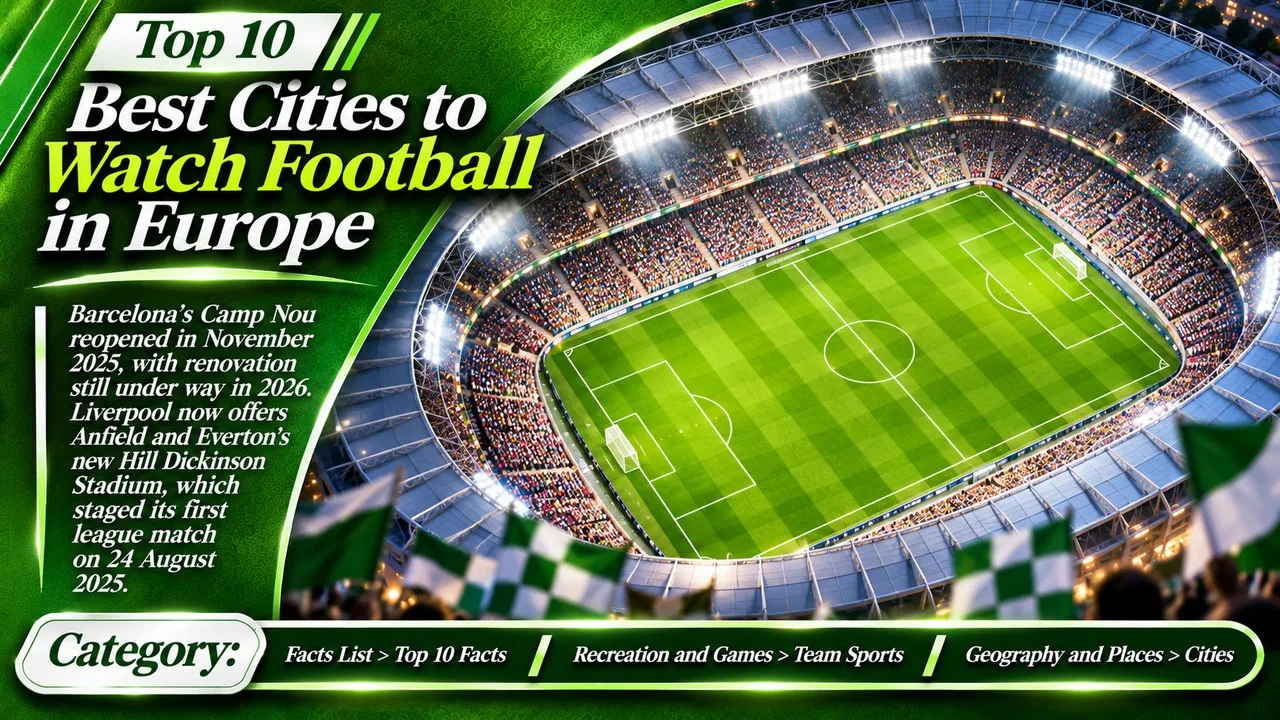
The best European cities in which to watch football are ranked here as cities and grounds, not as a rerun of the largest-stadiums list. The unit is a city: how many serious clubs it holds, how distinctive the grounds are in 2026, and how much of a football culture a visitor can actually walk into, from a national stadium to a neighbourhood derby [1][2].
Sponsor names on stadiums change. This article uses the name in common use in 2026 and, where a historic name is still the legal or local name, mentions both. Tickets, travel and safety rules are the clubs' and the cities', not a promise that a seat will be easy to buy [1]. Rank is editorial.
Key Facts
Grounds and opening or reopening dates were checked for the 2025-26 and 2026 seasons. Rank 1 is the city with the deepest concentration of major clubs and a national stadium.
Football Cities at a Glance
| Rank | City | Principal grounds in 2026 | Why the city ranks |
|---|---|---|---|
| 1 | London | Wembley Stadium; Emirates Stadium; Tottenham Hotspur Stadium; Stamford Bridge; London Stadium, and others | Most top-club density, plus the national stadium |
| 2 | Madrid | Santiago Bernabeu; Metropolitano Stadium | Two national heavyweights in one capital |
| 3 | Barcelona | Camp Nou, reopened November 2025 and still being finished in 2026; RCDE Stadium | A historic cathedral ground in mid-rebuild |
| 4 | Manchester | Old Trafford; Etihad Stadium | Two major clubs, two distinct grounds |
| 5 | Munich | Allianz Arena | A modern national-club ground and a World Cup legacy |
| 6 | Milan | San Siro (Stadio Giuseppe Meazza), still shared in 2026 | Two clubs in one historic stadium |
| 7 | Liverpool | Anfield; Hill Dickinson Stadium, first league match 24 August 2025 | Two historic clubs, one new waterfront ground |
| 8 | Istanbul | The home grounds of Galatasaray, Fenerbahce and Besiktas | Three major clubs and a famous derby culture |
| 9 | Dortmund | Signal Iduna Park, the Westfalenstadion | One club, one of Europe's great standing terraces |
| 10 | Glasgow | Celtic Park; Ibrox Stadium | The Old Firm in one city |
1. London
London has more current top-flight clubs than any other city on this list, and it also has Wembley Stadium, the national ground, rebuilt and opened in 2007 on the site of the earlier Wembley [1]. In 2026 a visitor can, in principle, move between Arsenal at the Emirates Stadium, Tottenham at the Tottenham Hotspur Stadium, opened in 2019, Chelsea at Stamford Bridge, West Ham United at London Stadium, and other Premier League and lower-tier grounds in the same urban area.
It is first for that density, and for the fact that a national final and a neighbourhood match can happen in the same week in the same city [1]. No other European city offers quite that combination of national stage and club spread.
Travel between grounds is a public-transport problem, not a romantic walk. The football fact is the number of serious houses, not the ease of a crawl [1].
2. Madrid
Madrid is the home of Real Madrid, at the rebuilt Santiago Bernabeu, and of Atletico Madrid, at the Metropolitano Stadium, with Rayo Vallecano as a third, strongly local, top-tier presence in many seasons [2]. The Bernabeu's recent reconstruction, including a new roof, has changed the look of the ground without moving the club out of the Chamartin district.
It is second as a capital in which two of Europe's most followed clubs play every other week, in grounds that are both modern and central enough to be part of a city visit [2]. That is a different offer from London's spread: fewer clubs, two very large institutions.
Ticket difficulty is part of the truth at both major grounds. The city ranking is about the clubs and the stadiums, not about a guaranteed seat [2].
Related: Top 10 Best Attractions in Barcelona
3. Barcelona
Barcelona's principal football experience in 2026 is Camp Nou, the home of FC Barcelona, which reopened in November 2025 after a period of temporary exile during the Espai Barca works, with renovation still under way. Reporting in 2026 described the return of more of the north stand and of the singing section in March, while the third tier and the roof remained unfinished [3]. Espanyol play at the RCDE Stadium in Cornellà , a second senior club in the metropolitan area.
It is third because Camp Nou, even in a building site year, is still one of the essential European grounds, and because the 2025 reopening and the incomplete 2026 works are checked facts a visitor needs [3]. A half-finished stand is not a reason to pretend the house is complete.
Match-day access, museum access, and tour routes have changed with the works. Official club notices outrank a 2025 guidebook [3].
4. Manchester
Manchester holds two Premier League clubs of European stature: Manchester United at Old Trafford, opened in 1910 and repeatedly expanded, and Manchester City at the Etihad Stadium, the former City of Manchester Stadium of the 2002 Commonwealth Games, reconfigured for football [1][4]. The two grounds are a short journey apart and feel like different football worlds.
It is fourth as a two-club city whose grounds are both major, and whose local rivalry is a documented part of English football, not a tourist invention [4]. Plans to redevelop Old Trafford have been publicly discussed; in 2026 the club still played there.
A visitor should not treat the two houses as interchangeable. The city rank is the pair, not either club alone [4].
5. Munich
Munich is the home of FC Bayern at the Allianz Arena, opened in 2005 and a venue of the 2006 World Cup, a modern bowl on the north side of the city with a distinctive inflatable facade [5]. Other clubs, including TSV 1860 Munich, keep a local football life beyond the dominant club.
Related: Top 10 Most Bizarre Phobias: Strange Fears That Exist
It is fifth as a one-club-dominant city whose main ground is nevertheless a European reference, and as a World Cup city whose stadium is still the weekly home of the national champion in many seasons [5]. The sponsor name is the official 2026 name of the stadium; older names appear in history.
A single great ground can carry a city rank when the club and the house are both at this scale. Munich is that case [5].
6. Milan
Milan is unique in this ten for a still-shared historic stadium: AC Milan and Inter continue, in 2026, to play at the Stadio Giuseppe Meazza, known as San Siro, a ground whose main stands date in origin to 1926 and later enlargements [6]. In late 2026 the two clubs presented plans for a new shared stadium, reported to target an opening around 2031, with the present house still in use until then [6].
It is sixth because watching two clubs in one vast, old stadium is a city experience that will not last forever, and because in 2026 it had not yet ended [6]. A press rendering is not a move-in date.
The neighbourhood, the ramps, and the midweek or Sunday timetable are the practical facts. The shared house is the ranking fact [6].
7. Liverpool
Liverpool in 2026 offers two distinct senior grounds: Anfield, home of Liverpool Football Club since 1892, and Everton's new Hill Dickinson Stadium at Bramley-Moore Dock, which hosted its first Premier League match on 24 August 2025 after the club left Goodison Park, its home since 1892 [7][8]. The new ground's capacity is 52,769. Anfield remains a larger and older European house.
Related: Top 10 Oldest Buildings in the World
It is seventh as a two-club port city that has just changed one of its maps. A visitor in 2026 can see a historic terrace culture at Anfield and a new waterfront bowl at Everton in the same trip [7][8]. That combination is new, and it is the reason Liverpool sits here with a dated stadium fact.
Goodison's closure as a men's first-team house is part of the same story. The new dockland stadium does not erase the city's older football geography [8].
8. Istanbul
Istanbul has three major clubs, Galatasaray, Fenerbahce and Besiktas, with large modern or rebuilt grounds on different shores of the city, and a derby culture that is among the most intense in Europe [9]. Sponsor names on the stadiums have changed repeatedly; the clubs and the districts are the stable facts.
It is eighth as a three-club metropolis whose football life is a city-wide fact, not a single stadium visit [9]. Crossing the water for a match is part of the geography.
Crowd noise, ticketing, and local advice on which fixtures are appropriate for a visitor are practical matters. The ranking is about the clubs and the city, not about treating a derby as a spectacle without caution [9].
9. Dortmund
Dortmund is, on this list, a one-club city in the best sense: Borussia Dortmund at the Westfalenstadion, sponsor-named Signal Iduna Park in 2026, whose south stand, the Sudtribune, is one of the largest standing terraces in European football [10]. The ground's midweek atmosphere is a documented reference point for visiting supporters and for other clubs studying stadium design.
Related: The Science Behind Auroras: How Solar Winds Create Colorful Skies
It is ninth because one extraordinary terrace and a consistently full large ground can define a city visit as clearly as a capital with many clubs [10]. Capacity figures and standing-room rules can change with safety law; the terrace as a type is the fact to see.
Dortmund is not a three-club capital. It does not need to be [10].
10. Glasgow
Glasgow remains the city of the Old Firm: Celtic at Celtic Park and Rangers at Ibrox Stadium, two historic grounds in one urban area, with a rivalry of unusual depth in Scottish and European football [11]. Both houses are large, old, and still central to each club's identity in 2026.
It is tenth as a two-club city whose derby is a defining civic fact, and as a reminder that a ranking of "best places to watch" should include a place where football is a weekly civic argument, not only a tourist circuit [11]. Fixtures, ticketing, and conduct rules are to be taken seriously.
The two grounds are not a combined stadium. They are two institutions a short city journey apart, which is the point of a city list [11].
Conclusion
A useful 2026 list of European football cities is a list of grounds as they actually stand: London's spread and Wembley, Madrid's two large houses, Camp Nou in mid-rebuild after its November 2025 reopening, Manchester's pair, Munich's modern bowl, San Siro still shared, Liverpool with Anfield and a new dockland stadium that staged its first league match on 24 August 2025, Istanbul's three clubs, Dortmund's terrace, and Glasgow's Old Firm [3][6][8]. Largest-stadium tables would have produced a different ten.
Sponsor names will move, and so will a few clubs, as Milan's 2031 plan already advertises. The habit is to check the week's actual current ground, not last decade's guidebook. For city visits beyond the turnstiles, see the later Finepedia attraction lists, including Barcelona.
- ^ [1] Premier League and club official stadium information for London and Manchester grounds, including the 2019 opening of Tottenham Hotspur Stadium. Premier League
- ^ [2] Official Real Madrid and Atletico Madrid stadium information, including the rebuilt Santiago Bernabeu. Real Madrid
- ^ [3] Reporting on Camp Nou's November 2025 reopening and continued 2026 works, including the north stand in March 2026. ESPN: Camp Nou works
- ^ [4] Official Manchester United and Manchester City stadium information, Old Trafford and the Etihad Stadium. Manchester United
- ^ [5] Official Allianz Arena and FC Bayern information, stadium opened 2005. Allianz Arena
- ^ [6] Club and press accounts of San Siro still in shared use in 2026, with a new Milan-Inter stadium plan aimed at about 2031. AC Milan / Inter official and 2026 reporting
- ^ [7] Premier League, "What's new for 2025/26", Everton's Hill Dickinson Stadium as a new league ground, first top-flight match 24 August 2025, capacity 52,769. Premier League
- ^ [8] Everton Football Club report of the first competitive match at the new stadium, 24 August 2025. Everton FC
- ^ [9] Official club information for Galatasaray, Fenerbahce and Besiktas and their Istanbul grounds. Turkish Football Federation
- ^ [10] Official Borussia Dortmund and Signal Iduna Park information, including the south stand. Borussia Dortmund
- ^ [11] Official Celtic and Rangers stadium information, Celtic Park and Ibrox. Celtic FC





















Discussion
Log in with