






 By
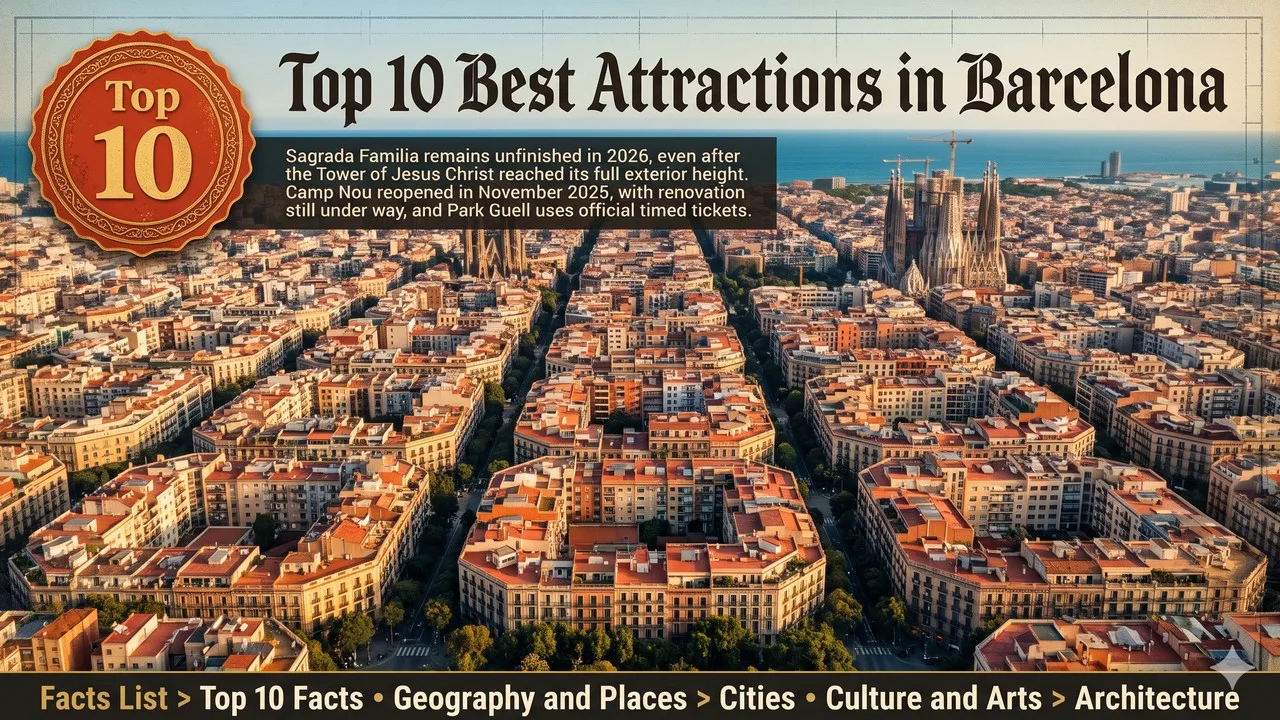
The best attractions in Barcelona are ranked here as official historic and cultural sites, with 2026 notes for Sagrada Familia and Camp Nou. Antoni Gaudi's church is still a building site in the centenary year of his death; the stadium of FC Barcelona is open again after a temporary exile, but the works are not finished [1][2]. Those two dated facts are why a 2026 list cannot simply copy a pre-pandemic or 2023 guidebook.
Rank is editorial, by documentary importance and by official access. Several of the modernista houses and Park Guell use timed official tickets. This article describes buildings and does not copy copyrighted facades in any featured image, a rule already used in the modern-architecture entry on Sagrada Familia [1][3]. The city's football geography is also treated in the European football-cities article; the stadium appears here as a visit, with the same 2026 status.
Key Facts
Construction, consecration, and reopening dates follow official institutional accounts. A useful 2026 habit is to book Sagrada Familia, Park Guell, and the Gaudi houses on official sites, and to read the club's notices before planning a Camp Nou tour, because stands and routes have been changing as the works advance. Rank 1 is the outstanding official monument, even though it is unfinished.
Barcelona Attractions at a Glance
| Rank | Attraction | Official date | 2026 note |
|---|---|---|---|
| 1 | Sagrada Familia | Begun 1882; consecrated 2010; unfinished | Tower of Jesus Christ at full exterior height; other work remains |
| 2 | Park Guell | Gaudi estate-park, early twentieth century | Official timed tickets; monument zone caps |
| 3 | Casa Batllo | Remodelled 1904 to 1906 | Official house-museum tickets |
| 4 | Casa Mila (La Pedrera) | Built 1906 to 1912 | Official tickets for the flats and roof |
| 5 | Gothic Quarter and Cathedral | Medieval city fabric and the cathedral | A district walk plus a working cathedral |
| 6 | Palau de la Musica Catalana | Opened 1908 | Official tours and concerts; a UNESCO concert hall |
| 7 | Camp Nou | Historic stadium, reopened November 2025 | Renovation still under way in 2026 |
| 8 | Museu Nacional d'Art de Catalunya, Montjuic | National art museum on the 1929 hill | Official museum tickets and a city viewpoint |
| 9 | Hospital de Sant Pau | Modernista hospital, now a visitable monument | Official tours of a UNESCO site |
| 10 | Museu Picasso | Opened 1963, in historic palaces | Official timed tickets in the old town |
1. Sagrada Familia
The BasÃlica de la Sagrada Familia was begun in 1882, taken over by Antoni Gaudi in 1883, consecrated in 2010, and remains unfinished in 2026, the centenary year of Gaudi's death [1][4]. In that year the Tower of Jesus Christ reached its full exterior height, while interior work, the Glory facade, and other elements were still going on, and a final completion date was still not a firm public contract [1][4]. Official tickets are the way in. Finepedia's modern-architecture list treats the construction history; this entry is the 2026 visit.
It is first as the city's outstanding official monument, precisely because it is still being built, which is a rare and dated fact [1]. A photograph of a completed skyline is, in 2026, still a hope rather than a document.
Towers and museum spaces can be separate ticket options. The basilica's official site is the only safe source [1].
2. Park Guell
Park Guell is a Gaudi-designed park and garden estate of the early twentieth century, later a municipal park, with a monument zone of pavilions, a hypostyle hall, and a terrace that is now visited on official timed tickets with a cap on numbers [3][5]. The park is a UNESCO World Heritage property as part of the Gaudi works. The surrounding free parkland is not a substitute for the ticketed core, and it is not automatically open in every corner.
It is second as the outstanding official Gaudi landscape visit, a park rather than a church, with a ticket system that exists because the site was being worn down [5]. Mosaic benches and pavilions are copyrighted visual designs and are not copied in this article's image brief.
Heat and queues are ordinary in high season. Official time slots are the 2026 habit [5].
Related: Top 10 Most Famous Monuments in Europe
3. Casa Batllo
Casa Batllo, on Passeig de Gracia, is a Gaudi remodelling of an existing house, carried out from 1904 to 1906, and it is now an official house-museum on a timed ticket [6]. The facade, the stair, and the roof are the usual official itinerary. This article records the dates and the visit; it does not reproduce the facade.
It is third as the outstanding official single-house Gaudi visit on the city's main modernista street [6]. A block of rival houses nearby is context, not a second entry.
Audio guides and night openings, when offered, are official extras. The house's own tickets are the legal ones [6].
4. Casa Mila (La Pedrera)
Casa Mila, popularly called La Pedrera, was built from 1906 to 1912 as a large apartment building by Gaudi, and it is visited officially for its flats, attic, and stone roof [7]. It is a UNESCO World Heritage property. The roof is the usual climax of the visit; the building is still in part a lived-in and working structure, not only a museum.
It is fourth as the official large-scale civil counterpart to Casa Batllo, with a firm construction span [7]. The two houses are a short walk apart and are not the same ticket.
Evening concerts or projections, when held, are a later official use. Day tickets remain the standard visit [7].
5. Gothic Quarter and Cathedral
The Barri Gotic is the historic civic core of Barcelona, a walkable fabric of streets, palaces, and the Cathedral of the Holy Cross and Saint Eulalia, a Gothic cathedral with a long building history and a working liturgical life [8]. The quarter is not a single ticket. The cathedral is a church with posted visiting hours and, often, a separate fee for cloister or terrace itineraries.
Related: Top 10 Architectural Wonders of the Modern World
It is fifth as the official medieval city visit, a necessary counterpart to the modernista ten [8]. Roman and medieval fragments in the neighbourhood, including later museum spaces, are part of the same civic ground.
Crowds on the cathedral square are ordinary. Official church notices, not a walking-tour script, set the interior rules [8].
6. Palau de la Musica Catalana
The Palau de la Musica Catalana, designed by Lluis Domenech i Montaner and opened in 1908, is a concert hall and a UNESCO World Heritage building, visitable on official guided tours and, better, at a concert [9]. It is not a Gaudi work, which is the point of including it: modernisme in Barcelona is a wider official story. The stained glass and the sculpted interior are copyrighted and are not reproduced here.
It is sixth as the outstanding official music-house visit, a working hall rather than a silent house-museum [9]. Restoration and later extensions have kept it in use.
Tour tickets and concert tickets are different products. The Palau's official site is the source [9].
7. Camp Nou
Camp Nou, the home of FC Barcelona, reopened in November 2025 after a period when the club played at the Estadi Olimpic during the Espai Barca works, and in 2026 renovation was still under way, with more of the north stand and the singing section reported back in use in March, while the third tier and the roof remained unfinished [2]. A stadium tour, when offered, follows official club routes that have been changing with the works.
It is seventh as the official football visit, dated to a reopening that a 2025 or earlier guidebook will miss [2]. Match-day access and museum access are not the same product.
Related: Top 10 Tallest Church Buildings in the World
The sponsor name on the stadium has changed in official usage; the historic name is the one this list uses alongside the 2026 status [2].
8. Museu Nacional d'Art de Catalunya, Montjuic
The Museu Nacional d'Art de Catalunya occupies the National Palace on Montjuic, a 1929 exhibition building that is now the official national museum of Catalan art, with Romanesque mural collections of unusual importance and a terrace view over the city [10]. Official tickets cover the collections. The hill also holds other 1929 and later venues; this entry is the national museum.
It is eighth as the outstanding official art-museum visit, and as a reminder that the city's culture is not only modernista houses [10]. The walk or the official transport up the hill is part of the visit.
Special exhibitions are ticketed separately at times. The museum's own site is the schedule [10].
9. Hospital de Sant Pau
The Hospital de la Santa Creu i Sant Pau, designed by Domenech i Montaner, is a modernista hospital complex and a UNESCO World Heritage property, no longer a general hospital in the old pavilions and now officially visitable as a monument [11]. Official tours explain a medical city of pavilions and gardens rather than a single facade. It is a different official modernista visit from the Gaudi houses on Passeig de Gracia.
It is ninth as a documented, visitable hospital-monument, often less crowded than Park Guell and just as official [11]. The later hospital buildings nearby are a working medical campus and are not the historic pavilions.
Related: Top 10 Best Cities to Watch Football in Europe
Ticketed tours are the intended path. The official Sant Pau site is the source [11].
10. Museu Picasso
The Museu Picasso, opened in 1963 in a row of medieval palaces in the old town, is the official city museum of Picasso's early and formative work, with a particular strength in the years the artist spent in and around Barcelona [12]. Official timed tickets are the 2026 method in a tight historic interior. It is a museum of a named artist's work; this article does not reproduce the paintings.
It is tenth as the outstanding official artist-museum visit in the historic centre, a counterpart to the national collections on Montjuic [12]. The palaces are part of the experience.
Street queues form when time slots fill. The museum's official tickets are the legal ones [12].
Conclusion
A 2026 Barcelona list has to say that Sagrada Familia is still unfinished, even after a tower reached its full exterior height, and that Camp Nou is open again after November 2025 with the works still visible [1][2]. Around those two dated facts sit Park Guell, the official Gaudi houses, the Gothic quarter and cathedral, the Palau de la Musica, the national art museum on Montjuic, the Hospital de Sant Pau, and the Museu Picasso, all of them official doors with tickets or posted church hours [5][9][11].
The useful habit is official booking and a refusal to treat a facade as something a featured image should copy. For the church as a modern architectural wonder, see the companion article in this batch. For the stadium as a football-city fact, see the European football list, where Barcelona ranks third. A later completion date at Sagrada Familia, if one is ever firmly announced, will belong in a revision; it is not a fact in November 2026.
- ^ [1] Official Sagrada Familia construction and ticket information, 1882 start, 2010 consecration, 2026 works. Sagrada Familia
- ^ [2] Reporting on Camp Nou's November 2025 reopening and continued 2026 renovation. ESPN: Camp Nou works
- ^ [3] UNESCO World Heritage information on Gaudi's works in Barcelona. UNESCO: works of Gaudi
- ^ [4] 2026 reporting on the Tower of Jesus Christ and remaining facades. CNN and official basilica updates
- ^ [5] Official Park Guell ticket information, City of Barcelona. Park Guell
- ^ [6] Official Casa Batllo visitor information, remodelling 1904 to 1906. Casa Batllo
- ^ [7] Official La Pedrera / Casa Mila visitor information, 1906 to 1912. La Pedrera
- ^ [8] Official Cathedral and City of Barcelona information on the Gothic Quarter. Barcelona Cathedral
- ^ [9] Official Palau de la Musica Catalana history, opened 1908. Palau de la Musica Catalana
- ^ [10] Official Museu Nacional d'Art de Catalunya visitor information. MNAC
- ^ [11] Official Hospital de Sant Pau monument visitor information. Recinte Modernista de Sant Pau
- ^ [12] Official Museu Picasso, Barcelona, opened 1963. Museu Picasso





















Discussion
Log in with