





Top 10 Best Fall Foliage States in the United States
 By Dhiraj Sharma · Published
Share Post
Loading…
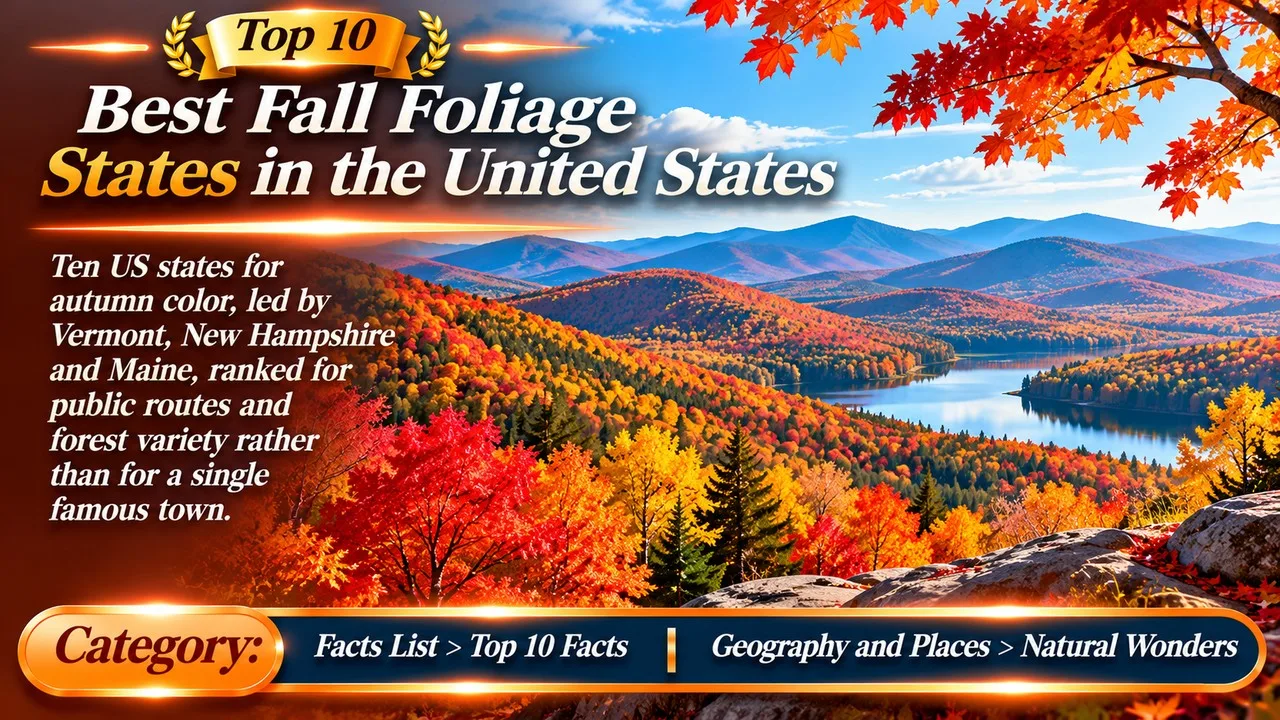
Autumn color across these American states is a seasonal event, and the best places are those with long public routes, varied forests and a reliable peak week. Peak week moves with elevation, latitude and the year's weather, so a state can be outstanding and still be green, or bare, if a visitor arrives on the wrong weekend [1][2].
This is a curated 2026 list, not a satellite ranking and not a copy of older travel lists that put a small New England state first by habit. Vermont, New Hampshire and Maine lead because they combine maple-rich hardwood forest, public roads and a foliage season that is central to travel in those states. Connecticut has fine color, especially in the northwest hills, but it is too small and too often treated as a default winner to occupy first place on a national list [1][3].
Key Facts
Timing below is a typical window, not a 2026 forecast. Higher elevations and more northerly counties usually turn first. Check a current foliage report before a long drive.
Fall Foliage States at a Glance
| Rank | State | Typical peak window | Signature public routes | Why it is here |
|---|---|---|---|---|
| 1 | Vermont | Late September to mid-October | Route 100, the Green Mountains, Lake Champlain valleys | Dense hardwood color and a road network built for looking |
| 2 | New Hampshire | Late September to mid-October | Kancamagus Highway, White Mountains, Lake Sunapee region | Mountain views and a classic foliage highway |
| 3 | Maine | Late September to mid-October | Rangeley Lakes, Acadia, the western mountains | Color plus coast and lakes, with a slightly longer north-south spread |
| 4 | New York | Late September to late October | Adirondacks, Catskills, Hudson Valley, Finger Lakes | Several distinct foliage regions in one state |
| 5 | Massachusetts | Early to mid-October | Berkshires, Mohawk Trail, central orchards | Compact, reachable, and still a genuine hardwood landscape |
| 6 | Virginia | Mid-October, later at lower elevations | Skyline Drive, Blue Ridge Parkway, Shenandoah Valley | Long ridge driving with a later southern peak |
| 7 | North Carolina | Mid to late October in the mountains | Blue Ridge Parkway, Great Smoky Mountains, high country towns | Southern Appalachian color at scale |
| 8 | Michigan | Late September to mid-October in the north | Upper Peninsula, Tunnel of Trees, Great Lakes shores | Lakes, hardwoods and a peninsula geography |
| 9 | Colorado | Mid-September to early October at altitude | Kebler Pass, Independence Pass, San Juan skyline roads | Aspen gold rather than maple red |
| 10 | Oregon | Mid-October in many west-side valleys; earlier in the high country | Columbia River Gorge, McKenzie Pass, the Wallowas | A Pacific mix of oak, maple, larch and high-country gold |
1. Vermont
Vermont is first because the state's hardwood forests, especially sugar maple, birch and beech, produce the color that most people mean by "New England fall," and because public roads such as Route 100 run through those forests for long stretches rather than only past a single overlook [1][3]. The Green Mountains, the Northeast Kingdom and the valleys around Lake Champlain offer different elevations, which spreads the peak across several weeks.
The state is also small enough that a visitor can change elevation or county in a day if the color has already dropped in one valley. That is a practical advantage over a larger state with only one famous loop [1]. Crowds around mid-October weekends are the main caveat; midweek driving and overnight stays booked early are the usual answer [3].
Vermont does not have a monopoly on maples. It does have an unusually consistent match between forest and public road [1][3].
2. New Hampshire
New Hampshire's White Mountains give foliage a vertical backdrop that Vermont's ridges only sometimes match, and the Kancamagus Highway remains one of the most famous foliage drives in the country [1][3]. Lakes, notches and higher summits create a range of peak dates in a relatively small area.
The state is second, not first, because the most famous roads can be slower and more crowded than Vermont's quieter north-south routes at the same weekend. The color itself is not inferior. Franconia Notch, the Lakes Region and the less busy western towns are useful alternatives when the Kancamagus is congested [3].
As in Vermont, late September at elevation and the first half of October in many valleys are the usual planning windows, subject to the year's weather [1].
Related: Top 10 Most Bizarre Phobias: Strange Fears That Exist
3. Maine
Maine adds coastline, large lakes and a bigger north-south spread to the same hardwood palette. The western mountains and the Rangeley Lakes region are the classic interior foliage territory; Acadia National Park and the mid-coast add color against the sea, which is a different picture from an inland maple valley [1][4].
The state is third because getting from one good region to another can take longer than in Vermont or New Hampshire, not because the color is weaker. Northern Maine can peak earlier than the coast. A 2026 trip should pick a region rather than trying to "do the state" in a weekend [4].
Acadia in particular needs a current park-traffic plan in autumn, when leaf season and ordinary coastal tourism overlap [4].
4. New York
New York State is not only New York City, and its foliage map is larger than many visitors expect: the Adirondacks, the Catskills, the Hudson Valley and the Finger Lakes are four different autumn trips [1][3]. That variety is why the state is fourth rather than lower.
The Adirondacks often peak earlier than the Hudson Valley. The Catskills are closer to the city and can be busy on peak weekends. The Finger Lakes combine vineyards, water and hardwoods in a way that is closer to a long weekend than to a wilderness loop [3].
A single "New York foliage" date does not exist. The right 2026 plan is to choose one region and watch a local report [1].
5. Massachusetts
Massachusetts, especially the Berkshires and the Mohawk Trail, remains a genuine foliage state, not only a day trip from Boston. The hardwood hills, the village greens and the orchard country of the centre and west are the main draw; the coast can be handsome too, but it is not the core maple landscape [1][3].
Related: Top 10 Oldest Buildings in the World
The state is fifth because it is compact and easy to reach, and because the color is still excellent, even if the total forest acreage is smaller than in Maine or New York. Peak weekends around popular towns are busy. Back roads and midweek travel help [3].
Connecticut, which some older lists placed first, is a short drive from the same hills and shares some of this landscape. It is not a separate national first place on this list [1][3].
6. Virginia
Virginia's Blue Ridge and Shenandoah Valley give the mid-Atlantic a long, high ridge drive, including Skyline Drive through Shenandoah National Park and the Virginia section of the Blue Ridge Parkway [2][5]. The color is often a little later than in northern New England, which makes the state useful for travellers who missed the first week in Vermont.
The ridge roads are the experience, and they can be slow when everyone arrives on the same Saturday. Lower elevations in the valley turn later than the crest. A 2026 plan should include a park entrance strategy and a fallback date a week later at a lower height [5].
It is sixth as the first southern-Appalachian state on the list, and as a public-road landscape of national quality [2][5].
7. North Carolina
North Carolina's mountains, including the Blue Ridge Parkway, the high country around Boone and Blowing Rock, and the North Carolina side of Great Smoky Mountains National Park, are the southern heart of American foliage travel [2][5]. Elevation differences are large, so the season can run for weeks as color drops from the highest ridges toward the piedmont.
The state is seventh because the best color is concentrated in the west, not because it is a minor landscape. A visitor who stays in the eastern lowlands and expects Vermont will be looking in the wrong place. Peak timing is often mid to late October in many mountain towns, later than New Hampshire's first wave [5].
Related: The Science Behind Auroras: How Solar Winds Create Colorful Skies
Parkway traffic and Smokies traffic are the practical constraints. Sunrise starts and midweek days remain the best tools [2][5].
8. Michigan
Michigan's Upper Peninsula and the northern Lower Peninsula offer hardwoods, lakeshores and roads such as the Tunnel of Trees that are built, in autumn, for slow driving [1][6]. The Great Lakes change the light and the weather, and they also create views that New England cannot copy.
The Upper Peninsula often peaks earlier than towns farther south. Distances are longer than they look on a small map. A 2026 trip should be treated as a regional tour, not as a single loop that covers both peninsulas in two days [6].
It is eighth as the Midwest's strongest foliage state of this kind, with a genuine public-road landscape rather than only a city-park autumn [1][6].
9. Colorado
Colorado's autumn is a different color system. High-elevation aspen stands turn gold, often in September, against evergreen forest and bare rock, especially on routes such as Kebler Pass and other West Slope and San Juan roads [2][7]. This is not maple red, and it should not be sold as the same event.
The season can be short, and weather, including early snow at passes, can close or complicate a route. Altitude is a planning fact for visitors arriving from sea level. The reward is a landscape that extends this list beyond the eastern hardwood forest [7].
Related: Top 10 Tallest Buildings in the World
It is ninth as the outstanding Rocky Mountain foliage state, ranked below the eastern hardwood states because the experience is narrower in time and paler in red, not because it is less beautiful [2][7].
10. Oregon
Oregon closes the list with a Pacific mix: bigleaf maple and oak in western valleys and the Columbia River Gorge, larch and high-country gold in the east and northeast, and a season that does not copy Vermont's calendar [2][7]. The Gorge, the McKenzie region and the Wallowas are different trips, and a visitor should pick one.
The state's autumn is less famous in national marketing than New England's, which is part of the reason it is tenth rather than fourth. The color is real, the public landscapes are strong, and the mix of species is a useful reminder that "fall foliage" is not a single palette [7].
Washington and parts of California also have excellent autumn color in the right weeks. Oregon is the representative here because the Gorge and the mountain passes are documented, accessible and clearly seasonal [2][7].
Conclusion
The ten states above are a map of public foliage landscapes, not a claim that a quiet county in a neighbouring state cannot be just as fine on the right afternoon [1][2]. Peak week is a moving target. The most useful 2026 habit is to watch a current report, travel midweek if possible, and match the destination to the forest: maples in the Northeast and Appalachians, aspens in Colorado, a mixed Pacific canopy in Oregon.
Connecticut, Pennsylvania, West Virginia and Washington could all have been in a longer list. They were left out here to keep the ranking tight, not because their woods are dull [3][5].
- ^ [1] US Forest Service and National Weather Service discussions of fall color timing, plus New England state foliage reports. US Forest Service
- ^ [2] National Park Service autumn pages for Shenandoah, the Blue Ridge Parkway, Great Smoky Mountains and related parks. National Park Service: Shenandoah
- ^ [3] Vermont, New Hampshire, New York and Massachusetts official foliage resources. Vermont foliage
- ^ [4] Maine official tourism foliage guidance, including Acadia and the western mountains. Maine foliage
- ^ [5] Virginia and North Carolina mountain foliage and parkway travel notes. Blue Ridge Parkway
- ^ [6] Michigan official travel foliage guidance, including the Upper Peninsula. Michigan travel
- ^ [7] Colorado and Oregon autumn-color travel guidance, including aspen reports and the Columbia River Gorge. Colorado autumn color






















Discussion
Log in with