






 By
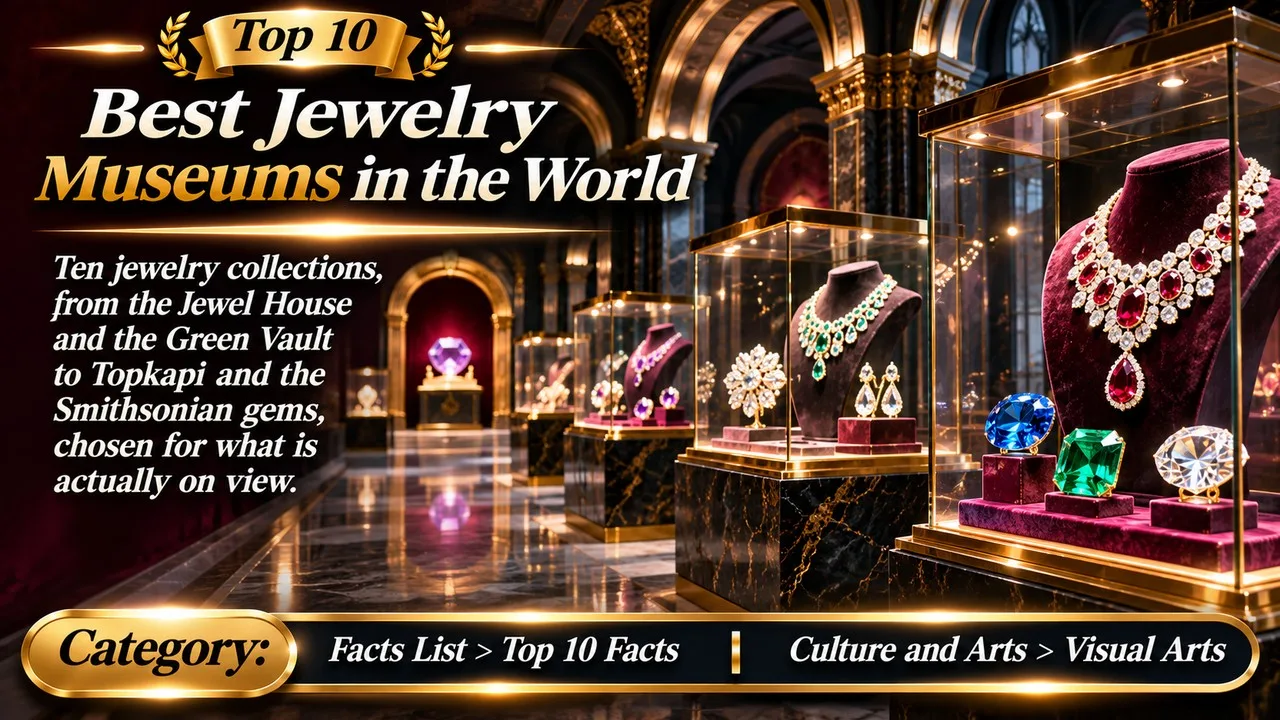
The best jewelry museums are the treasuries, galleries and gem rooms where documented jewels can still be seen under controlled conditions. Some of the most famous collections sit inside palaces or banks rather than in a building that calls itself a jewelry museum, and a useful list should include those rooms rather than pretend that only a shop-like gallery counts [1][2].
This is a curated 2026 guide, not a valuation of the most expensive stones. It favours permanent, historically documented collections that a visitor can still plan to see. Two entries, in Moscow and Tehran, have access rules that may be tighter or more changeable for many travellers; they are included because the collections are among the most important, and the access issue is stated rather than ignored [3][4].
Key Facts
"Jewelry museum" here includes palace treasuries, national jewel collections and major museum galleries devoted to gems or jewels. Status and access notes are as of November 2026.
Jewelry Museums at a Glance
| Rank | Collection | Location | What is on view | 2026 access note |
|---|---|---|---|---|
| 1 | The Jewel House | London, United Kingdom | The British Crown Jewels | Open within a Tower visit; security and queues are part of the day |
| 2 | The Green Vault | Dresden, Germany | Historic princely jewels and objets in the Residenzschloss | Open; timed tickets are wise |
| 3 | Imperial Treasury | Hofburg, Vienna, Austria | Habsburg crown jewels and imperial regalia | Open as a museum in the palace |
| 4 | Topkapi Palace Treasury | Istanbul, Turkey | Ottoman imperial jewels and objects, including famous large stones | Open within a Topkapi visit |
| 5 | Victoria and Albert Museum Jewellery Gallery | London, United Kingdom | A broad historic jewelry collection in a public museum | Open; one of the best survey galleries |
| 6 | Smithsonian National Gem Collection | Washington, D.C., United States | Gems and historic jewels, including the Hope Diamond | Open in the National Museum of Natural History |
| 7 | Galerie d'Apollon | Louvre, Paris, France | Remaining French crown jewels and hardstone vessels | Open within a Louvre visit |
| 8 | The Kremlin Armoury | Moscow, Russia | Imperial Russian regalia and jewels | A first-rank collection; travel access may be limited |
| 9 | Treasury of National Jewels | Tehran, Iran | The Iranian national jewel collection | Displayed in a bank museum; visiting rules can be strict |
| 10 | Museo del Oro | Bogota, Colombia | Pre-Hispanic goldwork, including ornaments worn as jewelry | Open; a collection of made ornaments, not European crown jewels |
1. The Jewel House at the Tower
The Jewel House, inside the Tower in London, holds the British Crown Jewels, including the coronation regalia and famous stones set in crowns, sceptres and other objects that are still used in state ceremony. The display is a secure, high-volume museum route rather than a quiet gallery, and it remains one of the world's most visited jewel collections [1][5].
The historical case is unusually strong: these are not only beautiful objects, they are working regalia with a documented ceremonial life. A 2026 visit is part of a Tower ticket, with the usual queues and security. Photography rules are tight, and the objects are seen in motion past cases, not in a private viewing [1].
It is first because of that combination of historic importance, continuity of use, and reliable public access [1][5].
2. The Green Vault
The Green Vault, in the Residenzschloss in Dresden, is the historic treasure chamber of the Saxon electors and kings, rebuilt as a museum after the Second World War and after later restoration. It is one of the richest princely jewel and objet collections in Europe, displayed in rooms that are themselves part of the story [2][6].
A 2019 jewellery theft from the historic Green Vault, in which important pieces were stolen, is part of the recent history of the collection. Some objects were later recovered; the episode is a reminder that even well-known treasuries are not abstract. A 2026 visit should be understood as a look at a great historic collection that has also had to deal with loss and conservation [6].
It is second as a purpose-built treasury of extraordinary quality, in a palace that is open as a museum [2][6].
Related: Top 10 Most Visited Museums in the World
3. Imperial Treasury
The Imperial Treasury in the Hofburg in Vienna holds the Habsburg crown jewels and other imperial and religious treasures, including the Austrian imperial crown and objects associated with the Holy Roman Empire. It is a compact, dense museum in the palace rather than a wing of a general art museum [2][5].
The collection is first-rank because it preserves the regalia of a European empire in the building complex where that court actually sat. Timed entry in peak season is a practical idea, but the museum is a standard, visitable Vienna stop in 2026 [5].
It is third as a clear palace treasury, similar in kind to the Jewel House, with a different political and artistic history [2][5].
4. Topkapi Palace Treasury
The treasury rooms of Topkapi Palace in Istanbul display Ottoman imperial jewels and precious objects, including large stones that have become famous in their own right, in the palace that was the centre of Ottoman court life for centuries [2][7]. The visit is part of a Topkapi ticket, and the treasury is one of several palace collections rather than a stand-alone jewelry museum.
That setting is a strength. The objects were assembled by a court, and they are still seen in the courtyards and rooms of that court, even though the palace is now a museum [7]. Crowds can be heavy; an early arrival helps.
It is fourth as the major Islamic-court treasury on this list that is regularly open to visitors [2][7].
5. Victoria and Albert Museum Jewellery Gallery
The jewellery gallery at the V&A in South Kensington is one of the best survey collections of jewelry as a decorative art, from historic European jewels to later design, rather than a single set of state regalia [2][5]. For a visitor who wants to understand jewelry as a craft and a history, it can be more instructive than a crown-jewel queue.
Related: Top 10 Largest Temples in the World
The V&A is a free national museum, with some special exhibitions ticketed separately. The jewellery gallery is part of the permanent collection. A 2026 visit can be combined with the museum's other design holdings in a way that a palace treasury cannot match [5].
It is fifth as the outstanding public-museum jewelry gallery, sitting beside, not below, the state treasuries [2][5].
6. Smithsonian National Gem Collection
The National Gem Collection, in the Smithsonian's National Museum of Natural History in Washington, D.C., is a gem and historic-jewel display in a science museum, anchored for many visitors by the Hope Diamond and by other named stones [2][8]. It is not a palace treasury. It is a public collection assembled to show minerals, gems and some jewels with a documented provenance.
That difference is useful. A visitor can look at a famous diamond as a mineral and as a cultural object, in a museum that also explains geology. Entry to the natural history museum is the usual way in, with the usual peak-hour crowds [8].
It is sixth as the most prominent North American public gem room, and as a collection that is about stones as well as about royal ownership [2][8].
7. Galerie d'Apollon
The Galerie d'Apollon in the Louvre displays the remaining French crown jewels, along with hardstone vessels and related objects, in a restored ceremonial gallery. Much of the French crown-jewel collection was sold or dispersed in the nineteenth century, so this is a remnant, but it is a remnant of high quality in one of the world's major museums [2][5].
A Louvre ticket is required, and the gallery is one stop in a very large palace-museum. People who are in Paris only for jewels may spend less time here than at a dedicated treasury, but the objects and the room justify the detour [5].
Related: Top 10 Magnificent Libraries of the World
It is seventh as the public face of the French royal jewels that survive in France, honestly described as a remaining collection rather than as a complete crown set [2].
8. The Kremlin Armoury
The Kremlin Armoury in Moscow is one of the oldest and most important museums of Russian imperial regalia, including crowns, jeweled objects and the treasury of the tsars. The collection would rank higher on historical weight alone [3][5].
It is eighth because, as of 2026, travel to Moscow is difficult or closed for many foreign visitors, and a list that ignored that fact would be less useful than a list that states it. The collection still exists, and the museum has a long public history; the ranking is about a traveller's ability to see it as well as about the objects [3].
Anyone who can visit should treat the Armoury as a first-rank treasury and should follow the museum's own ticket and photography rules [3][5].
9. Treasury of National Jewels
The Treasury of National Jewels in Tehran, often associated with the Central Bank, holds the Iranian national jewel collection, including objects from the Safavid and later royal treasuries. It is one of the world's great jewel assemblages, displayed as a bank museum rather than as a palace gallery [4][5].
Access has long been controlled, with specific opening days, identification rules and security procedures. Those rules can change, and a 2026 visit should be planned only from current official information. The collection is ninth, like the Armoury, because access is part of a useful ranking, not because the jewels are a lesser group [4].
Related: Top 25 Interesting Facts About the Solar System
It belongs on any serious world list. A travel article that omitted it to keep the map inside Western Europe would be incomplete [4][5].
10. Museo del Oro
The Museo del Oro in Bogota holds a vast collection of pre-Hispanic goldwork, including ornaments that were worn as jewelry, ritual objects, and other worked metal from cultures across what is now Colombia. It is not a European treasury of crowns. It is one of the world's great museums of gold as personal and ceremonial ornament [5][9].
That widening of the category is deliberate. A list of jewelry museums that only covers royal crowns implies that jewelry history begins in European courts. The Bogota collection is a necessary counterexample, and it is a well-run public museum that remains open to visitors [9].
It is tenth as a different kind of first-rank collection, not as an afterthought. People who want a branded crystal theme park should look elsewhere; this is a museum of made ornaments with an archaeological and historical frame [5][9].
Conclusion
The ten collections above are treasuries, museum galleries and a gold museum, not a circuit of jewelry shops [1][2]. Some of the most important rooms are inside palaces and banks. Two of them may be hard to reach in 2026, and that limit is part of the record rather than a reason to pretend the collections do not exist.
A visitor should check current tickets, photography rules and identification requirements before travel, especially for the bank and palace treasuries. Branded visitor attractions can be entertaining, but they are not the same as a documented historic collection [5][6].
- ^ [1] Historic Royal Palaces, Jewel House, Tower of London. The Crown Jewels
- ^ [2] Overviews of the Green Vault, the Vienna Imperial Treasury, Topkapi, the V&A jewellery gallery and the Louvre's Galerie d'Apollon. Official museum pages and Wikipedia. Green Vault
- ^ [3] Moscow Kremlin Museums, Armoury Chamber. Kremlin Armoury
- ^ [4] Treasury of National Jewels, Central Bank of Iran visitor information. Treasury of National Jewels
- ^ [5] "Crown jewels" and museum collection overviews. Wikipedia. Wikipedia: Crown jewels
- ^ [6] "Green Vault" and reports on the 2019 theft and later recoveries. Wikipedia. Wikipedia: Green Vault
- ^ [7] Topkapi Palace Museum. Topkapi Palace
- ^ [8] Smithsonian National Museum of Natural History, National Gem Collection. Hope Diamond and National Gem Collection
- ^ [9] Museo del Oro, Banco de la Republica, Bogota. Museo del Oro






















Discussion
Log in with