






 By
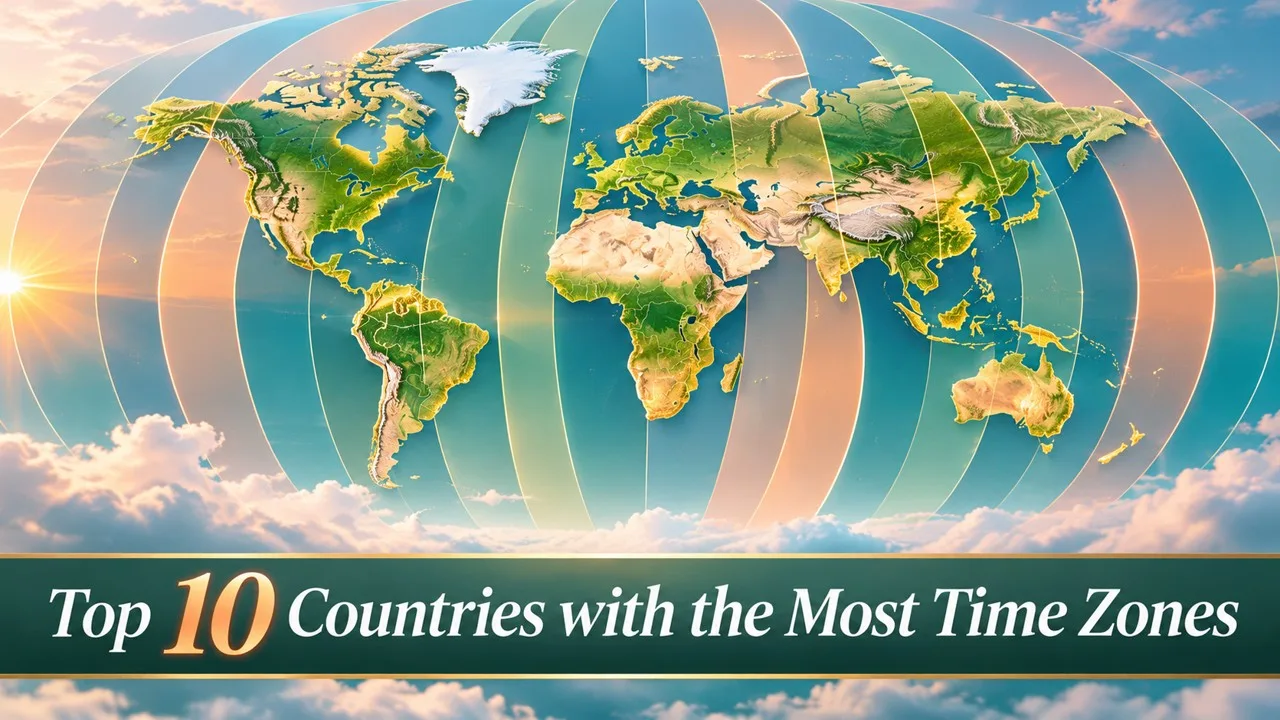
The countries ranked here use official standard civil time zones, and overseas territories are included, with any exclusion labelled rather than mixed in. Rank is by official standard civil time zones, and overseas territories are included, with any exclusion labelled rather than mixed into a different official product [1][2]. France is first, with 12 official standard civil time zones once overseas territories are counted, from UTC-10 in parts of French Polynesia to UTC+12 in Wallis and Futuna; metropolitan France itself uses only one standard zone [1][2]. An Antarctic claim, or a thirteenth local time when Saint Pierre and Miquelon is on daylight saving time, is a different official or seasonal product and is not used here as a silent 13-zone first place [1][2]. Russia is second, with 11 official standard zones from Kaliningrad (UTC+2) to Kamchatka and Chukotka (UTC+12), almost all of them on a contiguous landmass [1][2]. The United States is third, also with 11 official standard zones when territories and uninhabited outlying islands are included, from Baker and Howland Islands (UTC-12) to Wake Island (UTC+12); the 50 states use six standard zones, and that narrower count is labelled rather than used as a silent replacement [1][2].
Later names remain in the same official standard-zone class, with territories included. The United Kingdom has nine official standard zones once overseas territories are counted; the main territory itself uses one standard zone, Greenwich Mean Time, in winter [1]. Australia also has nine official standard zones once external territories and the small Central Western offset around Eucla are counted; a list confined to the three mainland standard zones, or a list that drops uninhabited Heard Island and the Eucla offset, is a narrower official product and is labelled rather than used as a silent replacement [1]. Canada has six official standard zones when the Newfoundland half-hour zone is included, the usual civil count; some compilations that omit that half-hour zone give five, and that alternative is labelled [1][2]. New Zealand has five official standard zones when the Cook Islands, Niue, Tokelau, and the Chatham Islands are included; the Cook Islands and Niue are self-governing in free association, a status that is labelled rather than used to drop the zones in silence [1]. Brazil has four official standard zones [1]. Mexico has four official standard zones [1]. Denmark has four official standard zones once Greenland and the Faroe Islands are included, after Greenland's recent official time reform [1]. Chile, Indonesia, and Kiribati, each with three official standard zones, sit just outside. This article does not copy official crests, flags, or exact clock-face trademarks as decorative art.
Key Facts
The ten below are the labelled official standard-zone leaders, with overseas territories included: France, 12; Russia, 11; the United States, 11 including territories and uninhabited outlying islands, or six in the 50 states; the United Kingdom, 9; Australia, 9 including external territories and the Eucla offset; Canada, 6 including Newfoundland; New Zealand, 5 including free-association states and Tokelau; Brazil, 4; Mexico, 4; and Denmark, 4, after the official Greenland reform [1][2]. Rank 1 is the outstanding official count, which is also the only country in the ten that reaches 12 standard civil zones.
Daylight saving time is not counted as an extra zone. China, despite its width, uses one official standard zone and does not belong in this ten. The table is the official spine: standard civil zones first, territory inclusion labelled, and no daylight-saving or Antarctic-claim substitution smuggled in as an official cell.
Most Time Zones at a Glance
| Rank | Country | Official standard civil zones | 2026 note |
|---|---|---|---|
| 1 | France | 12, including overseas territories | Metropolitan France uses one zone; an Antarctic claim or a daylight-saving thirteenth local time is labelled and not used to reorder |
| 2 | Russia | 11 | Almost all on a contiguous landmass, from Kaliningrad to Kamchatka |
| 3 | United States | 11 including territories and uninhabited outlying islands | The 50 states use six standard zones, a labelled narrower count |
| 4 | United Kingdom | 9, including overseas territories | The main territory uses one standard zone in winter |
| 5 | Australia | 9, including external territories and the Eucla offset | A three-zone mainland-only count is a narrower official product |
| 6 | Canada | 6, including Newfoundland | Some compilations that omit the half-hour Newfoundland zone give five, labelled |
| 7 | New Zealand | 5, including the Cook Islands, Niue, Tokelau, and the Chatham Islands | The Cook Islands and Niue are self-governing in free association, labelled |
| 8 | Brazil | 4 | Official standard civil zones, including offshore islands |
| 9 | Mexico | 4 | Official standard civil zones; a labelled tie with Brazil and Denmark |
| 10 | Denmark | 4, including Greenland and the Faroe Islands | After Greenland's official time reform; Chile, Indonesia, and Kiribati, each with three, sit just outside |
1. France
France is first, with 12 official standard civil time zones once overseas territories are counted [1][2]. Metropolitan France uses only Central European Time as its standard zone. The remaining official zones are overseas, from UTC-10 in the Society Islands, Tuamotus, and Austral Islands, through the Marquesas (UTC-9:30), the Gambier Islands (UTC-9), Clipperton, the Caribbean departments and collectivities, French Guiana, Saint Pierre and Miquelon, Mayotte, Réunion, the French Southern and Antarctic lands in the Indian Ocean, New Caledonia, and Wallis and Futuna at UTC+12 [1]. An Antarctic claim, or a thirteenth local time when Saint Pierre and Miquelon is on daylight saving time, is labelled and is not used as a silent 13-zone first place [2]. This article records the official 12-zone standard count.
It is first as the outstanding official standard-zone count, a labelled overseas-territory fact, and the documentary centre of this ten [1][2]. A later official legal-time decree will belong in a revision of the cell.
Official French legal-time decrees and standard civil-zone compilations are the sources [1][2].
2. Russia
Russia is second, with 11 official standard civil time zones, from Kaliningrad Time (UTC+2) to Kamchatka Time (UTC+12) [1][2]. Ten of those 11 zones cover a contiguous landmass; only Kaliningrad is an exclave. The figure is an official standard count after the post-2010 reforms that first reduced and then restored the number of Russian zones, not a daylight-saving count, and not a silent combination with occupied or disputed territories used as extra zones. This article records the official 11-zone standard count.
It is second as the outstanding official 11-zone contiguous-landmass count, a labelled fact, and a necessary counterpart to the United States [1][2]. A later official revision will belong in a revision of the cell.
Related: Top 10 Most Bizarre Phobias: Strange Fears That Exist
Official and standard civil-zone accounts of time in Russia are the sources [1][2].
3. United States
The United States is third, with 11 official standard civil time zones when territories and uninhabited outlying islands are included, from Baker and Howland Islands at UTC-12 to Wake Island at UTC+12 [1][2]. The 50 states use six standard zones: Eastern, Central, Mountain, Pacific, Alaska, and Hawaii-Aleutian. That narrower six-zone count is a different official product, and it is labelled rather than used as a silent replacement that would drop the country down the ten [1]. Several of the 11-zone offsets, including Baker, Howland, and Wake, are uninhabited or sparsely used outlying islands, and that status is labelled. This article records the official 11-zone count with territories included and the six-zone state count in the open.
It is third as the outstanding official 11-zone count with territories included, a labelled fact, and a necessary counterpart to the United Kingdom [1][2]. A later official revision will belong in a revision of the cell.
Official and standard civil-zone accounts of time in the United States are the sources [1][2].
4. United Kingdom
The United Kingdom has nine official standard civil time zones once overseas territories are counted [1]. The main territory, together with the Crown dependencies and Saint Helena, Ascension and Tristan da Cunha, uses Greenwich Mean Time as its standard winter zone. The remaining official offsets include Pitcairn, the Cayman Islands and the Turks and Caicos Islands, the Caribbean territories and Bermuda, the Falkland Islands, South Georgia, Gibraltar, Akrotiri and Dhekelia, and the British Indian Ocean Territory [1]. Daylight saving time in the main territory is not counted as an extra zone. This article records the official nine-zone count with territories included.
It is fourth as the outstanding official nine-zone count among the European states with overseas territories, a labelled fact, and a necessary counterpart to Australia [1]. A later official revision will belong in a revision of the cell.
Official and standard civil-zone accounts of time in the United Kingdom are the source [1].
Related: Top 10 Oldest Buildings in the World
5. Australia
Australia has nine official standard civil time zones once external territories and the small Central Western offset around Eucla are counted [1]. The three familiar mainland standard zones are Australian Western, Australian Central, and Australian Eastern Standard Time. Lord Howe Island, Norfolk Island, Christmas Island, the Cocos Islands, uninhabited Heard and McDonald Islands, and the UTC+8:45 offset around Eucla complete the nine-zone count [1]. A list confined to the three mainland standard zones, or a list that drops Heard Island and the Eucla offset, is a narrower official or semi-official product and is labelled rather than used as a silent replacement. This article records the official nine-zone count with those inclusions labelled.
It is fifth as the outstanding official nine-zone count in the southern hemisphere, a labelled fact, and a necessary counterpart to Canada [1]. A later official revision will belong in a revision of the cell.
Official and standard civil-zone accounts of time in Australia are the source [1].
6. Canada
Canada has six official standard civil time zones when the Newfoundland half-hour zone is included: Pacific, Mountain, Central, Eastern, Atlantic, and Newfoundland [1][2]. Newfoundland Standard Time, at UTC-3:30, is a distinct official civil zone, not a daylight-saving variant of Atlantic Time. Some compilations that omit that half-hour zone give Canada five standard zones; that alternative count is labelled rather than used as a silent replacement [1]. Yukon's year-round UTC-7 offset is part of the Mountain standard group in current civil practice and is not counted as an extra zone. This article records the official six-zone count including Newfoundland.
It is sixth as the outstanding official six-zone count, a labelled half-hour-zone fact, and a necessary counterpart to New Zealand [1][2]. A later official revision will belong in a revision of the cell.
Official and standard civil-zone accounts of time in Canada are the sources [1][2].
Related: The Science Behind Auroras: How Solar Winds Create Colorful Skies
7. New Zealand
New Zealand has five official standard civil time zones when the Cook Islands, Niue, Tokelau, and the Chatham Islands are included [1]. The main territory uses New Zealand Standard Time (UTC+12). The Chatham Islands use a distinct UTC+12:45 offset. Tokelau uses UTC+13. The Cook Islands and Niue, self-governing in free association with New Zealand, use UTC-10 and UTC-11; that free-association status is labelled rather than used to drop the zones in silence, the same honesty used elsewhere for those states [1]. This article records the official five-zone count with those inclusions labelled.
It is seventh as the outstanding official five-zone count, a labelled free-association fact, and a necessary counterpart to Brazil [1]. A later official revision will belong in a revision of the cell.
Official and standard civil-zone accounts of time in New Zealand are the source [1].
8. Brazil
Brazil has four official standard civil time zones, from UTC-5 in Acre and southwestern Amazonas to UTC-2 on the offshore islands including Fernando de Noronha [1]. The official BrasÃlia time, UTC-3, covers most of the population. The figure is an official standard count after earlier reductions in the number of Brazilian zones, not a daylight-saving count. This article records the official four-zone count. It stands in a labelled official tie with Mexico and Denmark.
It is eighth as one outstanding official four-zone count, a labelled fact, and a necessary counterpart to Mexico [1]. A later official revision will belong in a revision of the cell.
Official and standard civil-zone accounts of time in Brazil are the source [1].
9. Mexico
Mexico has four official standard civil time zones, from the Northwest Zone in Baja California (UTC-8) to the Southeast Zone in Quintana Roo (UTC-5), with most of the country in the Central Zone (UTC-6) [1]. The figure is an official standard count after recent official changes on the northern border and in the southeast, not a daylight-saving count. This article records the official four-zone count. It stands in a labelled official tie with Brazil and Denmark, and is listed ninth only as a named order, not because Mexico has fewer official zones than Brazil.
Related: Top 10 Tallest Buildings in the World
It is ninth as one outstanding official four-zone count, a labelled tie, and a necessary counterpart to Denmark [1]. A later official revision will belong in a revision of the cell.
Official and standard civil-zone accounts of time in Mexico are the source [1].
10. Denmark
Denmark has four official standard civil time zones once Greenland and the Faroe Islands are included, after Greenland's official time reform: Pituffik at UTC-4, most of inhabited Greenland at UTC-2, the Faroe Islands and a Greenland east-coast offset at UTC+0, and metropolitan Denmark at UTC+1 [1]. Some older compilations gave Denmark five zones before that reform; the later official four-zone count is used here, and the earlier five is labelled rather than kept as a silent replacement [1][2]. Chile, Indonesia, and Kiribati, each with three official standard zones, sit just outside this ten [1]. This article records the official four-zone count as the last named country in the ranking.
It is tenth as one outstanding official four-zone count, a labelled post-reform fact, and a necessary counterpart to Mexico [1]. A later official revision, or a later official count that belongs above four, will belong in a revision of the ten.
Official and standard civil-zone accounts of time in Denmark, including Greenland, are the sources [1][2].
Conclusion
A 2026 most-time-zones list has to keep France at 12 official standard civil zones with overseas territories included, keep Russia and the United States at 11, and refuse to treat daylight saving time, an Antarctic claim, or a 50-state-only United States count as a silent official cell [1][2]. The United Kingdom, Australia, Canada including Newfoundland, New Zealand including free-association states, Brazil, Mexico, and Denmark complete a named ten in which territory inclusion and official reforms are stated in the open [1]. The useful habit is an official standard-zone count, a labelled territorial scope, and a refusal to mix a seasonal offset into a standard-zone cell.
A later official legal-time decree will belong in a revision of a cell; it will not change the method. Those labelled official counts are the spine of the list, and they will still be the spine after a later government has restated a standard-zone map in a later year.
- ^ [1] Standard compiled official counts of standard civil time zones, with overseas territories included and daylight saving time not counted as an extra zone: France, 12; Russia, 11; the United States, 11 including territories and uninhabited outlying islands, or six in the 50 states; the United Kingdom, 9; Australia, 9 including external territories and the Eucla offset; Canada, 6 including Newfoundland; New Zealand, 5 including the Cook Islands, Niue, Tokelau, and the Chatham Islands; Brazil, 4; Mexico, 4; Denmark, 4 including Greenland and the Faroe Islands after the official Greenland reform; Chile, Indonesia, and Kiribati, 3 each, just outside the ten. List of time zones by country
- ^ [2] Standard civil-time accounts of France as the country with the most time zones (12 in standard time, with a thirteenth local time only when Saint Pierre and Miquelon is on daylight saving time), and of Russia and the United States at 11. timeanddate





















Discussion
Log in with