






 By
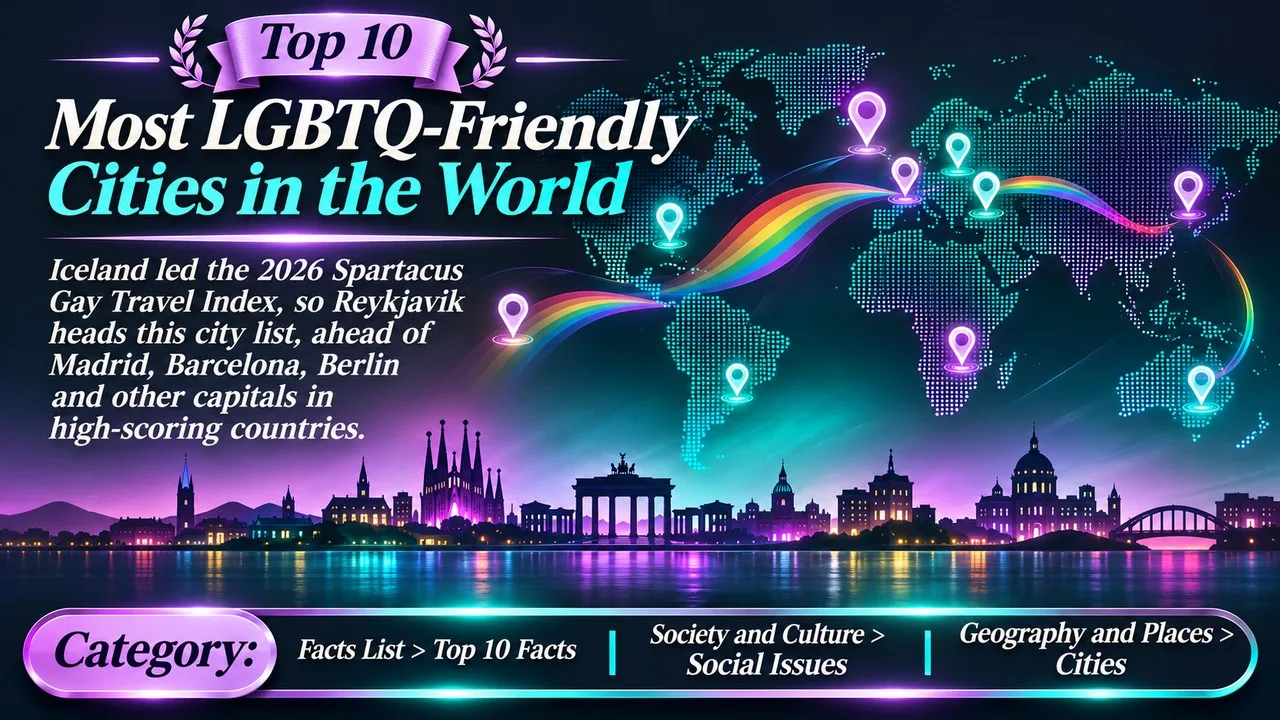
Spartacus ranks countries, not cities: Iceland led its Gay Travel Index for 2026, which is why Reykjavik heads this editorial list of LGBTQ-friendly cities. The index, presented with Booking.com's Travel Proud programme and evaluated on 26 February 2026, scored 217 countries and territories on law, safety and social climate. Malta and Spain tied for second; Belgium, Canada, Germany and Portugal tied for fourth [1][2].
There is no official global table of cities. Older 2014 travel lists often led with New York, San Francisco, Amsterdam and Tel Aviv on the strength of historic neighbourhoods and Pride events. Those cities remain important, but a 2026 list that ignored the country scores would be out of date, especially where national law or public hostility has shifted. The United States, in particular, is described in the 2026 index commentary as deeply divided, so no American city is ranked here as if the national context were settled [1].
The ten cities below are editorial choices. Each is in a high-scoring 2026 country (or, in one case, a historically central European city discussed with that caveat) and has a documented Pride culture, queer infrastructure or legal environment that travellers can actually check. This is not a safety guarantee for every person in every neighbourhood [1][3].
Key Facts
Country ranks are from the Spartacus Gay Travel Index 2026. City placement on this list is editorial.
LGBTQ-Friendly Cities at a Glance
| Rank | City | Country (2026 index) | Why it is here |
|---|---|---|---|
| 1 | Reykjavik | Iceland (1st) | Capital of the highest-scoring country in 2026 |
| 2 | Madrid | Spain (tied 2nd) | Large Pride, strong legal baseline, major urban scene |
| 3 | Barcelona | Spain (tied 2nd) | Long-established neighbourhoods and events in the same legal setting |
| 4 | Berlin | Germany (tied 4th) | Historic and still central European queer city |
| 5 | Toronto | Canada (tied 4th) | Large Pride and a high-scoring national legal framework |
| 6 | Lisbon | Portugal (tied 4th) | Capital of a top-four country with growing visitor infrastructure |
| 7 | Brussels | Belgium (tied 4th) | EU capital in a top-four legal environment |
| 8 | Oslo | Norway (tied 8th) | High-scoring Nordic capital with an established Pride |
| 9 | Zurich | Switzerland (tied 8th) | High country score and strong city-level acceptance in one European survey |
| 10 | Montevideo | Uruguay (tied 11th) | Latin American capital in a high-scoring legal environment |
1. Reykjavik
Iceland is first on the 2026 Spartacus index, the only country alone at the top, with a perfect or near-perfect set of legal marks and no score for hostile local conditions in that table [1][2]. Reykjavik is the only large city in the country, so the national rank and the visitor experience are unusually closely aligned.
The city's Pride events are civic rather than niche, and the legal package, including marriage and anti-discrimination rules, is settled at national level. That does not make every street identical, but it does make Reykjavik the clearest capital to place first when the only systematic 2026 ranking is a country index [1].
A 2025 European survey of LGBTIQ people, reported in 2025-2026 travel coverage, also placed Reykjavik first among cities for friendliness, ahead of Zurich, Copenhagen, Oslo and Hamburg [3]. The two sources are different, but they point in the same direction.
2. Madrid
Spain tied for second in 2026, with Malta [1][2]. Madrid is the country's capital and hosts a Pride gathering that is among the largest in Europe, with a long-standing scene in and around Chueca. The national legal baseline, including marriage and broader LGBTIQ protections, is the foundation; the city's scale is what makes it a destination rather than only a legal example.
Madrid also scores well in lifestyle surveys that mix nightlife, visitor numbers and perceived friendliness, though those surveys are not the same thing as a human-rights index [3]. The reason it is second here is the combination of a top-tier 2026 country score and a large, documented urban culture.
Related: Top 10 Most Bizarre Phobias: Strange Fears That Exist
Travellers should still use current local advice, as they would in any capital. The 2026 index is a legal and climate snapshot, not a street-by-street guide [1].
3. Barcelona
Barcelona sits in the same Spanish legal framework as Madrid and has its own long-established neighbourhoods, beaches and Pride calendar [1]. It is listed separately because visitor patterns, language mix and the city's tourist pressures are different from the capital's, not because the national law differs.
The 2026 country tie with Malta and Spain's second place is the ranking signal; the city's own history is the travel reason [1][2]. Barcelona has been a southern European reference point for queer visitors for decades, and that reputation is still used in European city comparisons [3].
As in other heavily visited cities, crowding and short-term rental pressure are practical issues. They do not cancel the legal baseline, but they shape the experience [3].
4. Berlin
Germany tied for fourth on the 2026 index [1][2]. Berlin's place on any such list is historical as well as legal: Schoneberg, Kreuzberg and later neighbourhoods have been central to European queer history since the early twentieth century, with interruptions and recoveries that are themselves part of the story.
The 2026 score puts Germany in the leading group, with a deduction in at least one social or religious-influence category in the published table, which is why Berlin is not automatically first [1][2]. The city still has one of the densest infrastructures of bars, cultural institutions and Pride events on the continent.
Berlin is a better example than a smaller German city of how a high national score appears on the ground, because so much of the country's visible queer culture is concentrated there [1].
5. Toronto
Canada tied for fourth in 2026, though the index commentary noted pressure on social-acceptance scores even in some liberal countries, including Canada [1]. Toronto's Pride is one of the largest in the world, and the legal framework, including marriage, is national.
Related: Top 10 Oldest Buildings in the World
The city is here as Canada's most internationally visible queer destination, not as a claim that every Canadian city is interchangeable, or that the 2026 commentary's warning about hostility can be ignored [1]. Neighbourhoods such as Church and Wellesley have a documented history that predates the index.
A visitor using this list should read the country caveats as well as the city name. A fourth-place national rank is still a leading rank, but it is not the same as Iceland's first place [1][2].
6. Lisbon
Portugal also tied for fourth in 2026 [1][2]. Lisbon has, over the 2010s and 2020s, become a much more visible destination for queer travellers, with Pride events and a growing infrastructure that now matches the country's legal position more closely than it did a generation ago.
The 2026 score, including strong marks for marriage and anti-discrimination, is the reason Portugal belongs in the top group [2]. Lisbon is the capital and the usual entry point, which is why it is the city named here rather than a smaller Portuguese town with a good local record.
European lifestyle surveys have also listed Lisbon among cities that score well for friendliness, which is supporting context, not the primary source [3].
7. Brussels
Belgium tied for fourth in 2026 [1][2]. Brussels is both the national capital and a seat of European Union institutions, and it has an established Pride and a legal environment that has been among Western Europe's more advanced for years.
Related: The Science Behind Auroras: How Solar Winds Create Colorful Skies
It is less famous as a leisure destination than Amsterdam or Barcelona, which is precisely why a 2026 list should not be only a reprint of 2014 nightlife reputations. The index is about law and climate; Brussels sits in a top-four country and has the urban scale to make that fact usable for a visitor [1].
The city's bilingual character and international workforce also shape its queer infrastructure, which is more dispersed than a single village-style neighbourhood [1].
8. Oslo
Norway tied for eighth in 2026, with New Zealand and Switzerland [1][2]. Oslo has a long-running Pride and a national legal framework that remains among the world's more protective, even if the 2026 table no longer places Norway at the exact summit.
The same European survey that put Reykjavik first also placed Oslo in the leading group of cities for perceived friendliness [3]. That is a useful cross-check, because it is a city-level question, whereas Spartacus is a country-level one.
Oslo stands here for the Nordic capitals as a group, several of which (including Copenhagen) remain widely visited, even where a country's 2026 score moved a little on social-acceptance lines [1][3].
9. Zurich
Switzerland tied for eighth in 2026 [1][2]. Zurich is the country's largest city and, in the European survey reported alongside recent index coverage, ranked second only to Reykjavik for LGBTIQ friendliness among the cities compared [3].
Switzerland's national path on marriage and related rights has been more gradual than Iceland's or Spain's, which is why the country sits behind the top four in 2026 even though some of its cities poll very well [1][3]. A city list should notice that gap, not hide it.
Related: Top 10 Tallest Buildings in the World
Zurich is therefore an example of a place where city-level acceptance and country-level scores are both high, but not identical [3].
10. Montevideo
Uruguay tied for 11th in 2026, with Australia, Chile and France [1][2]. Montevideo is included to avoid a purely European list. Uruguay has been a legal pioneer in Latin America on marriage and related rights, and the capital is where that national fact is most visible to visitors.
Eleventh in a 217-entry index is still a leading group. The city's scene is smaller than Madrid's or Berlin's, which should be said plainly, but the legal environment is the point of this particular ranking method [1][2].
Santiago and Sydney could have been used from the same country band. Montevideo is the choice here because it is less often copied from older North Atlantic lists and because Uruguay's legal record is central to the regional story [1].
Conclusion
As of the February 2026 Spartacus index, the safest systematic evidence is still national: Iceland first, then a tight group of European and other states [1][2]. Cities inside those states are where travellers actually go, which is why this article names ten of them and is honest about the step from country scores to an editorial city list.
Historic centres such as New York, San Francisco, Amsterdam and Tel Aviv are not "removed" from LGBTQ history by being left out of this numbered ten. They are omitted from the ranking because the 2026 country evidence, especially for the United States, no longer supports a simple global city league table copied from a 2014 magazine list [1]. Anyone planning a trip should also check current local guidance, because an index score is not a substitute for on-the-ground advice about neighbourhoods, events and the law as they stand in the week of travel. National laws and street-level conditions can both change still change faster than any annual published index.
- ^ [1] "SPARTACUS Gay Travel Index 2026 - Between Progress and Backlash". Spartacus Gay Travel Blog. Spartacus: Gay Travel Index 2026
- ^ [2] "Gay Travel Index 2026" (PDF). Spartacus, evaluation date 26 February 2026. Spartacus Gay Travel Index 2026 PDF
- ^ [3] European city comparison reporting on LGBTIQ friendliness, including Reykjavik, Zurich, Copenhagen, Oslo and Hamburg. Maenner.media. Reporting on a European LGBTIQ city survey






















Discussion
Log in with