






 By
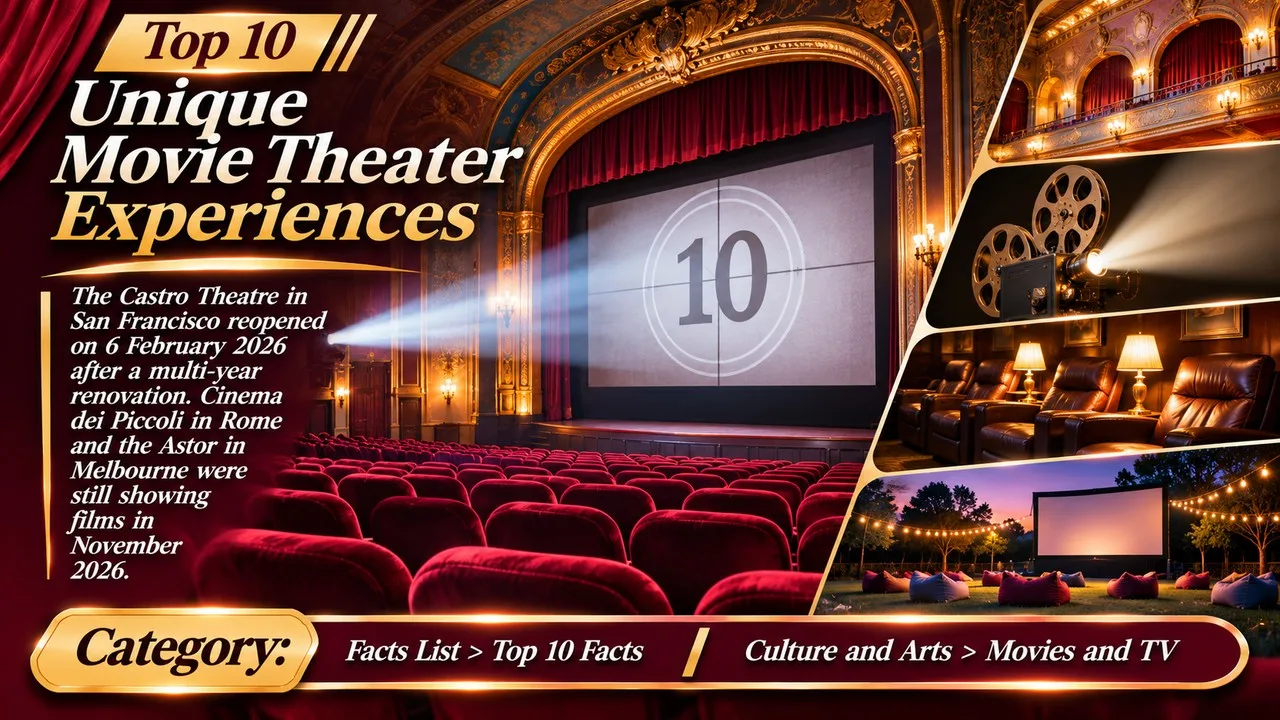
The unique movie theaters in this list were checked as operating cinemas in 2026, and each is a distinctive house rather than a standard multiplex hall. A unique experience here means a building, a programme, or a viewing setup that is documented and still in use: a historic auditorium, a tiny licensed house, a repertory screen that still shows film prints, or a public cinema inside a national film archive [1][2]. Seasonal pop-ups and brand-owned theme-park auditoriums are left out.
Status was checked where a 2026 calendar or official notice could be found. Houses can close for repairs or change operators, so a reader should confirm the week's programme before travelling [1][3]. Rank is editorial, by how distinctive the working experience is, not by seat count or ticket price.
Key Facts
All ten were operating, or had a published 2026 programme, at the time of writing. Rank 1 is the outstanding surviving atmospheric picture palace in Europe that is still a first-choice cinema.
Unique Movie Theaters at a Glance
| Rank | Theater | Place | Opened | 2026 status |
|---|---|---|---|---|
| 1 | Le Grand Rex | Paris, France | 1932 | Working cinema and tour |
| 2 | Pathe Tuschinski | Amsterdam, Netherlands | 1921 | Working cinema in a historic house |
| 3 | Castro Theatre | San Francisco, United States | 1922 | Reopened 6 February 2026 after renovation |
| 4 | Grauman's Chinese Theatre | Los Angeles, United States | 1927 | Working Hollywood house and courtyard |
| 5 | Cinema dei Piccoli | Rome, Italy | 1934 | Screening in November 2026; a very small licensed house |
| 6 | Electric Cinema, Notting Hill | London, United Kingdom | 1910 | Working historic cinema |
| 7 | The Astor Theatre | Melbourne, Australia | 1936 | November 2026 repertory calendar, including film prints |
| 8 | Music Box Theatre | Chicago, United States | 1929 | Working atmospheric repertory house |
| 9 | Cine Dore | Madrid, Spain | 1912 | Public cinema of the national film archive |
| 10 | Institut Lumiere | Lyon, France | Historic factory site, later museum cinema | Working cinema on the Lumiere site |
1. Le Grand Rex
Le Grand Rex, on the Boulevard Poissonniere in Paris, opened in 1932 as a large atmospheric cinema, with a starred ceiling, a tower facade, and a main auditorium that remains one of the largest in Europe [1]. It is still a working film house, and it also offers a backstage tour of the building, a combination that is unusual among surviving picture palaces.
It is first as a complete, still-used 1930s cinema machine in a capital city: a place to see a film, and a place to walk the wings of an auditorium designed as spectacle [1]. The building has been renovated over the years, but the type, an atmospheric palace, is intact.
A large modern multiplex can out-seat a historic hall. It cannot copy this interior, which is the point of the ranking [1].
2. Pathe Tuschinski
The Tuschinski theater in Amsterdam opened in 1921, built for Abraham Tuschinski as a richly decorated cinema and variety house in a mix of Amsterdam School, Art Deco and earlier ornamental styles [2]. It remains a working cinema, operated in the present day as a Pathé house, which means a 2026 visitor can still buy a ticket and sit in the historic main auditorium.
It is second as one of the most intact early-twentieth-century cinema interiors still in daily film use in Europe [2]. The name on the operator can change; the house and the auditorium are the experience.
The building is a protected monument. Protection is not the same as a museum: films still start on a working screen [2].
Related: Top 10 Most Bizarre Phobias: Strange Fears That Exist
3. Castro Theatre
The Castro Theatre in San Francisco opened in 1922 as a neighborhood picture palace with a single large auditorium and an organ tradition, and it has long been a landmark of the Castro district and of the city's film culture [3]. It closed for a major renovation and reopened on 6 February 2026, after a project widely reported at about 40 to 41 million dollars, with a mixed programme of films and live events under a new operator [3].
It is third because the 2026 reopening is a checked fact, and because the house is again a public auditorium rather than a closed shell [3]. A mixed film-and-live calendar is part of how large historic cinemas now survive; the Castro is honest about that mix.
The organ, the auditorium, and the street facade are the historic facts. A residency or a concert date does not cancel the cinema identity, but a visitor should read the week's bill [3].
4. Grauman's Chinese Theatre
The Chinese Theatre on Hollywood Boulevard opened on 18 May 1927, built for Sid Grauman, and it has remained a working first-run and event cinema with a forecourt of footprints and signatures that is as famous as the auditorium [4]. The house has had later official names under later sponsors; this article uses the historic Grauman name in the heading and treats the present commercial name as an operator fact, not as a required logo.
It is fourth as the outstanding still-working Hollywood premiere house, a place where a film and a public courtyard ritual have been documented for nearly a century [4]. The courtyard is a street-side experience; the unique cinema fact is that the auditorium behind it still shows films.
Premieres, tourists, and ordinary showtimes now share the same building. That overlap is the modern condition of the house, not a reason to drop it [4].
5. Cinema dei Piccoli
Cinema dei Piccoli, in the Villa Borghese in Rome, opened in 1934 as a cinema for children and has long claimed a Guinness record as the smallest building used as a cinema [5]. In November 2026 it was still publishing a daily programme of afternoon family films and evening original-language and repertory titles, which is the check this list requires [5].
Related: The Evolution of Stranger Things: Seasons, Themes, and Characters
It is fifth as a working tiny house, the opposite of the Grand Rex, and as a reminder that uniqueness can be scale and continuity rather than palatial decoration [5]. The park setting is part of the visit: the cinema sits inside a public garden, not on a mall corridor.
A small room can close for a summer break, as this house sometimes does. The 2026 autumn calendar shows that the closure, when it happens, has not been a permanent end [5].
6. Electric Cinema, Notting Hill
The Electric Cinema on Portobello Road in London opened in 1910 and is one of the oldest cinemas in the United Kingdom still used as a cinema [6]. Its present character is a historic auditorium fitted with comfortable individual seating, a working bar, and a first-run and repertory mix, a formula that has been widely copied and that this house helped to make fashionable in Britain.
It is sixth as a documented early cinema that is still a ticketed film house in 2026, not a converted shop or a plaque on a vanished auditorium [6]. Many older British cinemas have become bingo halls or churches; this one did not.
The 1910 date is the historic fact. The seating style is a later comfort, and both belong in a description of the experience [6].
7. The Astor Theatre
The Astor Theatre in St Kilda, Melbourne, opened in 1936 and remains a single-screen repertory cinema with stalls and a dress circle, still showing a rotating programme of classics, cult films, and selected new work, including 35mm and 70mm prints as well as digital projection [7]. Palace Cinemas has operated the house since a 2014 lease crisis that almost closed it. A November 2026 calendar was online, with named titles on the bill, which is the operating check used here [7].
It is seventh as a surviving single-screen repertory palace that still treats film prints as a normal part of the week, a rarer fact than a handsome facade [7]. Heritage listing has helped keep the interior; public support and a later operator kept the door open.
Related: Chernobyl Miniseries: Stories of Tragedy of a Nuclear Catastrophe, Heroism and Sacrifice
A calendar can change week to week. The type of programme, repertory in a 1936 auditorium, is the stable fact [7].
8. Music Box Theatre
The Music Box Theatre in Chicago opened in 1929 as an atmospheric neighborhood cinema, with a starred ceiling and a pipe organ, and it remains an independent repertory and first-run house [8]. Organ preludes and a two-auditorium complex, the original hall plus a later small screen, are part of the present experience.
It is eighth as a working American atmospheric theater that is still programmed as a cinema, not only hired out for private events [8]. The 1929 interior is the unique fact; the second screen is a practical addition.
Independent repertory houses depend on a city's film audience. The Music Box's continued life is a Chicago fact as well as a building fact [8].
9. Cine Dore
Cine Doré, on Calle de Santa Isabel in Madrid, opened in 1912 and is now the public cinema of the Filmoteca Española, the Spanish national film archive [9]. The building includes a restored historic auditorium and a later hall, and the programme is archive, repertory and special seasons rather than a standard commercial week.
It is ninth as a national-archive cinema in a historic house, a different unique experience from a picture palace that still runs blockbusters [9]. A visitor is watching films in the care of an archive, in a building that was a cinema before it was an institution.
Related: The Family Man: A Spy Thriller of Modern India Balancing Family Life and National Security
Prices and membership rules follow the filmoteca, not a commercial chain. That is part of the experience and should be checked before a visit [9].
10. Institut Lumiere
The Institut Lumière in Lyon occupies the site associated with the Lumière family factory and the early public projection of films, and it includes a museum and a working cinema, notably in and around the Hangar du Premier-Film [10]. Seeing a film there is less about luxury seating than about sitting on a historic site that still takes its job as a cinema seriously.
It is tenth as a unique origin-site experience: a place where film history is the building, and where a ticket is still a ticket to a screening [10]. Lyon is not a substitute for Paris on this list; it is the right city for this particular house.
The museum and the cinema are related but not identical. This entry is the screening, on the site, in 2026 [10].
Conclusion
A unique movie-theater experience, in 2026, is still a ticket in a distinctive room: a 1932 atmospheric palace in Paris, a 1921 Amsterdam interior, a San Francisco house that reopened on 6 February 2026, a Hollywood premiere courtyard and auditorium, a tiny licensed cinema in the Villa Borghese that was still showing films in November 2026, an early London house from 1910, a Melbourne single-screen repertory calendar that still includes film prints, a Chicago atmospheric theater, a Madrid archive cinema, and a Lyon screening on the Lumière site [3][5][7].
Multiplex comfort is a different, valid pleasure. It is not what this list is for. A later repair or a later operator can change a bill, so the habit is to read the week's programme. For city visits that may include one of these houses, see the later Finepedia lists of attractions in Paris, Rome, London, and New York.
- ^ [1] Official history and visitor information for Le Grand Rex, Paris, opened 1932. Le Grand Rex
- ^ [2] Official and municipal information on the Tuschinski theater, Amsterdam, opened 1921. Pathé Tuschinski
- ^ [3] Reporting and venue information on the Castro Theatre reopening, 6 February 2026. CBS News: Castro Theatre reopening
- ^ [4] Official history of the Chinese Theatre, Hollywood Boulevard, opened 18 May 1927. Chinese Theatre
- ^ [5] Official Cinema dei Piccoli programme, Rome, including November 2026 listings, and the house's 1934 history. Cinema dei Piccoli
- ^ [6] Official Electric Cinema, Notting Hill, history, opened 1910. Electric Cinema
- ^ [7] The Astor Theatre, St Kilda, official calendar and Palace Cinemas house description, November 2026. The Astor Theatre
- ^ [8] Official Music Box Theatre, Chicago, history, opened 1929. Music Box Theatre
- ^ [9] Filmoteca Española information on Cine Doré, Madrid. Filmoteca Española
- ^ [10] Institut Lumière, Lyon, museum and cinema on the historic Lumière site. Institut Lumière






















Discussion
Log in with