





 By
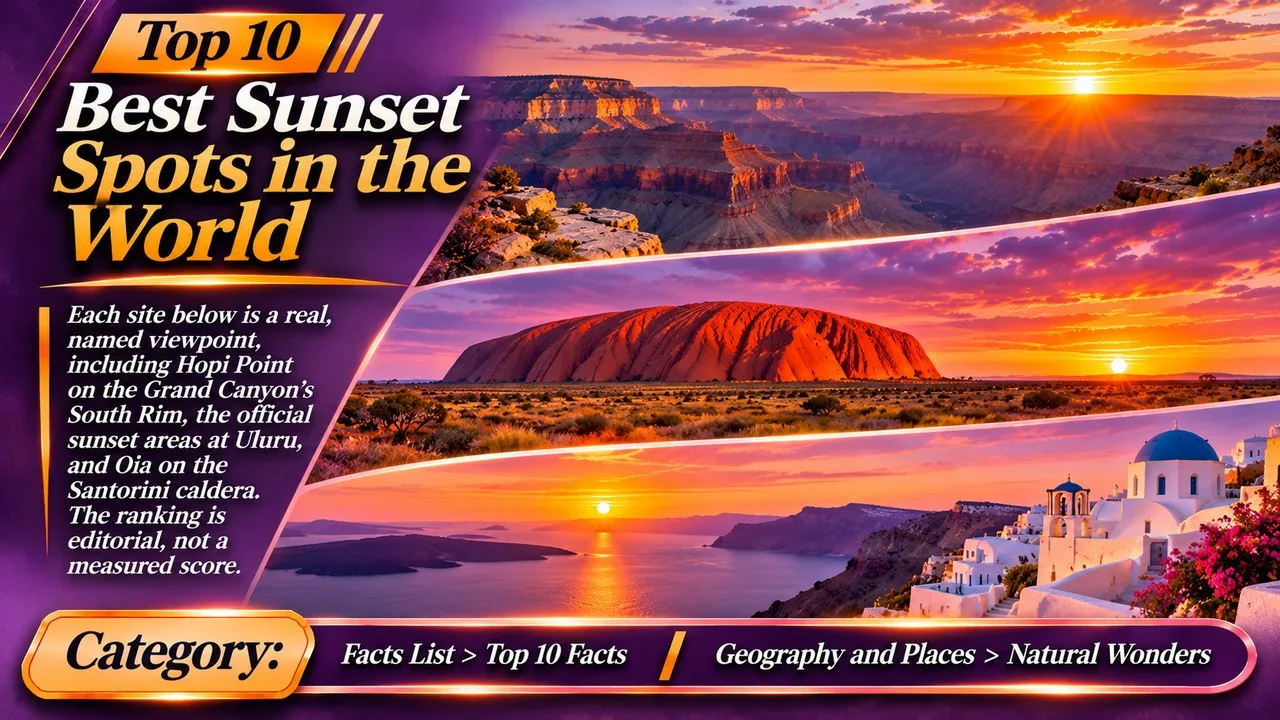
The sunset spots in this list are real, named viewpoints, chosen as documented places to watch the sun go down rather than as a scored contest. "Best" here is a curatorial word. There is no official worldwide ranking of sunsets, and a clear evening at an ordinary coast can outshine a famous name in cloud. What the ten places below share is a documented, named vantage, a reason the light is worth planning for, and a public or official way to stand there [1][2].
Crowds, tickets, weather and cultural rules matter as much as the sky. Several of these viewpoints limit numbers or close for wind, ceremony, or park hours. A 2026 visitor should treat this list as a map of real places, not as a promise of a clear horizon [1][3].
Key Facts
Each entry is a named viewpoint or a tightly defined official viewing area. Rank is editorial, by documentary fame of the specific point and the distinctness of the setting.
Sunset Viewpoints at a Glance
| Rank | Viewpoint | Place | Why the light is distinctive | Practical note |
|---|---|---|---|---|
| 1 | Oia, Santorini | Greece | West-facing caldera village and island silhouettes | Extremely crowded in high season |
| 2 | Hopi Point | Grand Canyon, United States | Official west-facing South Rim point | Park hours and rim safety apply |
| 3 | Uluru sunset viewing areas | Northern Territory, Australia | Official desert-arena views of a single monolith | Use the designated areas; the climb is closed |
| 4 | Signal Hill | Cape Town, South Africa | Atlantic horizon and a view back to Table Mountain | Wind and traffic are routine |
| 5 | Mallory Square | Key West, United States | Open harbour sunset and a long-running public gathering | Nightly, weather allowing |
| 6 | Phnom Bakheng | Angkor, Cambodia | Hilltop temple looking over the forest and, in season, the distant lake | Limited sunset tickets |
| 7 | Tanah Lot | Bali, Indonesia | Sea temple on a rock in the surf | Temple etiquette and a ticketed precinct |
| 8 | Cape Reinga / Te Rerenga Wairua | New Zealand | Headland at the meeting of two seas | A sacred site; stay on the paths |
| 9 | Gornergrat | Zermatt, Switzerland | High rail terrace toward the Matterhorn and glaciers | Last trains and weather close the view |
| 10 | Jokulsarlon | Iceland | Glacier lagoon and ice on a black shore in low light | Winter days are short; midsummer nights are long |
1. Oia, Santorini
Oia, at the northern lip of Santorini's caldera, is a west-facing village of terraces and a ruined Venetian castle, looking down to the flooded volcanic crater and to silhouettes of neighbouring islands [1]. It is one of the most photographed sunset towns in the Mediterranean, and in high season the lanes and the castle rock fill early.
It is first as the most widely documented village-scale sunset in this ten, a place where the viewpoint is the settlement itself, not a single ticketed platform [1]. The fame is also a warning: the light is real, and so are the crowds and the narrow paths.
A cloudy Aegean evening can cancel the postcard. The location remains a named, visitable vantage [1].
2. Hopi Point
Hopi Point, west of Grand Canyon Village on the South Rim, is a National Park Service viewpoint that faces down-canyon and west, and it is one of the rim points most often recommended for sunset because the sun drops over a long stretch of inner-canyon form [2]. It is a short walk from a Hermit Road stop, with seasonal bus access.
It is second as an official named park viewpoint whose purpose, at the end of the day, is documented in park materials rather than only in travel blogs [2]. Rim rock is unfenced in places; the unusual fact is the canyon, not a dare.
The South Rim has other sunset points, including Yavapai and Pima, and weather or fire can change road access. Hopi Point is the representative official name used here [2].
Related: Top 10 Most Relaxing Destinations to Visit
3. Uluru sunset viewing areas
Uluru, in Uluru-Kata Tjuta National Park, has designated sunset viewing areas from which the monolith's colour can be watched as the sun leaves the desert, a practice Parks Australia documents and manages [3]. The climb has been closed since 26 October 2019, and it stays closed. The lawful view is from the official areas, with cultural respect for what is a living sacred place as well as a landform.
It is third as a named, official desert sunset, not as a climb and not as a casual pull-off wherever a driver likes [3]. Kata Tjuta has its own viewing areas and can be as striking; this entry is the Uluru sunset sites.
Colour on the sandstone changes with dust and cloud. The designated car parks are the 2026 way to watch it [3].
4. Signal Hill
Signal Hill, above Cape Town's Atlantic seaboard, is a drive-up and walk-up ridge with a wide western horizon and a view back toward Table Mountain and the city [4]. It is one of the city's standard sunset terraces, along with the more weather-dependent Table Mountain cableway.
It is fourth as a named urban-nature viewpoint where the sun often goes down into the Atlantic in a way that is easy to plan for, subject to wind and parking [4]. The noon gun is a different Signal Hill tradition and is not the sunset.
Table Mountain, Lion's Head and the coastal road offer related views. Signal Hill is the accessible official name used here [4].
5. Mallory Square
Mallory Square, at the western harbour end of Key West, Florida, is the site of a long-running public sunset gathering, with street performers and a clear look over the water toward the horizon [5]. The habit is civic and nightly, weather allowing, rather than a remote trek.
Related: Top 10 Most Popular Beaches in the World
It is fifth as a documented named square whose purpose at dusk is the sunset itself, in a town that has made that hour a public event [5]. It is not wilderness, and it does not pretend to be.
Cruise-ship days and weather change the feel of the crowd. The square and the western exposure remain the facts [5].
6. Phnom Bakheng
Phnom Bakheng is a late-ninth- and early-tenth-century hill temple at Angkor, used in modern times as a ticketed sunset viewpoint over the forest canopy, with some evenings offering a distant sense of the water in the countryside beyond [6]. The Apsara Authority limits the number of sunset visitors, a rule that exists because the hill and the temple were being worn by uncontrolled crowds.
It is sixth as a named archaeological sunset with an official cap, not as a free-for-all on the stones [6]. Angkor Wat itself is more often a sunrise monument in visitor practice; Bakheng is the sunset hill.
Temple rules, footwear, and the day's ticket quota are part of a lawful visit. The light is not a reason to climb on fragile masonry [6].
7. Tanah Lot
Pura Tanah Lot, on a rocky islet off the Tabanan coast of Bali, is a sea temple whose profile against the evening Indian Ocean has made it one of Indonesia's most visited sunset precincts [7]. The temple is an active Hindu site; the tourist terraces and ticketed approaches around it are the usual lawful viewing stands.
It is seventh as a named coastal temple sunset, documented in Bali's official tourism and temple practice, with etiquette that outranks a photograph [7]. Tide, spray and ceremony can change how close a visitor may go.
Related: Top 10 Most Unusual Roads in the World
A west-facing island shrine in surf is the geographic reason the light is famous. The precinct, not the inner shrine, is the public viewpoint [7].
8. Cape Reinga / Te Rerenga Wairua
Cape Reinga, or Te Rerenga Wairua, at the northwestern tip of New Zealand's North Island, is a headland where the Tasman Sea and the Pacific are seen to meet, and where the sun can set over the western water. It is a sacred Maori place, the departure point of spirits in tradition, and it is managed with paths, a lighthouse, and clear requests to stay off restricted ground [8].
It is eighth as a named national headland whose sunset is part of a larger cultural landscape, not only a compass viewpoint [8]. The drive is long; weather can be severe.
The meeting of seas is visible in many conditions. The sunset is a bonus of a western exposure, and the site remains sacred whether the sky is clear or not [8].
9. Gornergrat
Gornergrat, reached by cog railway from Zermatt, is a high terrace at about 3,000 metres with a documented view of the Matterhorn, the Gorner glacier and a ring of four-thousand-metre peaks, a view that in clear late light is one of the standard alpine sunsets of the Swiss Valais [9]. The last descending train is a hard limit.
It is ninth as a named rail-served mountain viewpoint, more specific than a general "Matterhorn sunset," and subject to wind, cloud and winter timetables [9]. Lakes such as Riffelsee, lower on the same ridge, are related reflection points at other hours.
Related: Top 10 Most Visited Countries in the World
An alpine sunset is often a brief clearing, not a guaranteed show. The terrace and the timetable are the practical facts [9].
10. Jokulsarlon
Jokulsarlon, the glacier lagoon at the foot of Vatnajokull in southeast Iceland, is a named body of ice-filled water beside a black sand shore, where low northern light, especially in late autumn and winter, can colour the ice for a long dusk, and where midsummer barely gets dark at all [10]. The site is part of the Vatnajokull National Park system and has official parking and paths.
It is tenth as a high-latitude sunset, or a long twilight, whose unusual fact is ice in low sun rather than a cliff-top village [10]. Weather closes the colour as often as it opens it.
Icebergs move, the lagoon changes with the glacier, and a winter afternoon is short. The named lagoon remains the viewpoint [10].
Conclusion
A useful list of sunset spots is a list of real places: Oia on the Santorini caldera, Hopi Point on the Grand Canyon's South Rim, the official Uluru viewing areas, Signal Hill, Mallory Square, Phnom Bakheng, Tanah Lot, Cape Reinga, Gornergrat, and Jokulsarlon [2][3][8]. None of them owns the sun, and all of them can fail on a cloudy day.
The practical rule is the same as for lava or for sacred lakes: stand where the park, the temple, or the community asks you to stand, and treat a famous name as a plan, not as a guarantee. A later clear evening in an unnamed place can be just as fine, which is why this article dates its claims to documented viewpoints rather than to a permanent league table of the sky. For unusual colour in water rather than in the sky, see the list of unusual lakes. For city visits that may include an evening walk, see the later city-attraction articles in this batch.
- ^ [1] Official Santorini and Greek National Tourism documentation of Oia as a caldera viewpoint. Visit Greece
- ^ [2] National Park Service, Grand Canyon, South Rim viewpoints including Hopi Point. Grand Canyon National Park
- ^ [3] Parks Australia, Uluru-Kata Tjuta National Park, designated sunset viewing areas and the closed climb. Uluru-Kata Tjuta National Park
- ^ [4] Official Cape Town visitor information for Signal Hill and related viewpoints. Cape Town tourism
- ^ [5] City of Key West and local public information on the Mallory Square sunset gathering. City of Key West
- ^ [6] APSARA Authority guidance on Phnom Bakheng sunset visits and ticket limits. Angkor Enterprise / APSARA
- ^ [7] Official Bali tourism and temple-precinct information for Tanah Lot. Indonesia Travel / Tanah Lot
- ^ [8] Department of Conservation, New Zealand, Cape Reinga / Te Rerenga Wairua site information. Department of Conservation
- ^ [9] Gornergrat Bahn and Zermatt official viewpoint information. Gornergrat Railway
- ^ [10] Vatnajokull National Park information on Jokulsarlon. Vatnajokull National Park























Discussion
Log in with