






 By
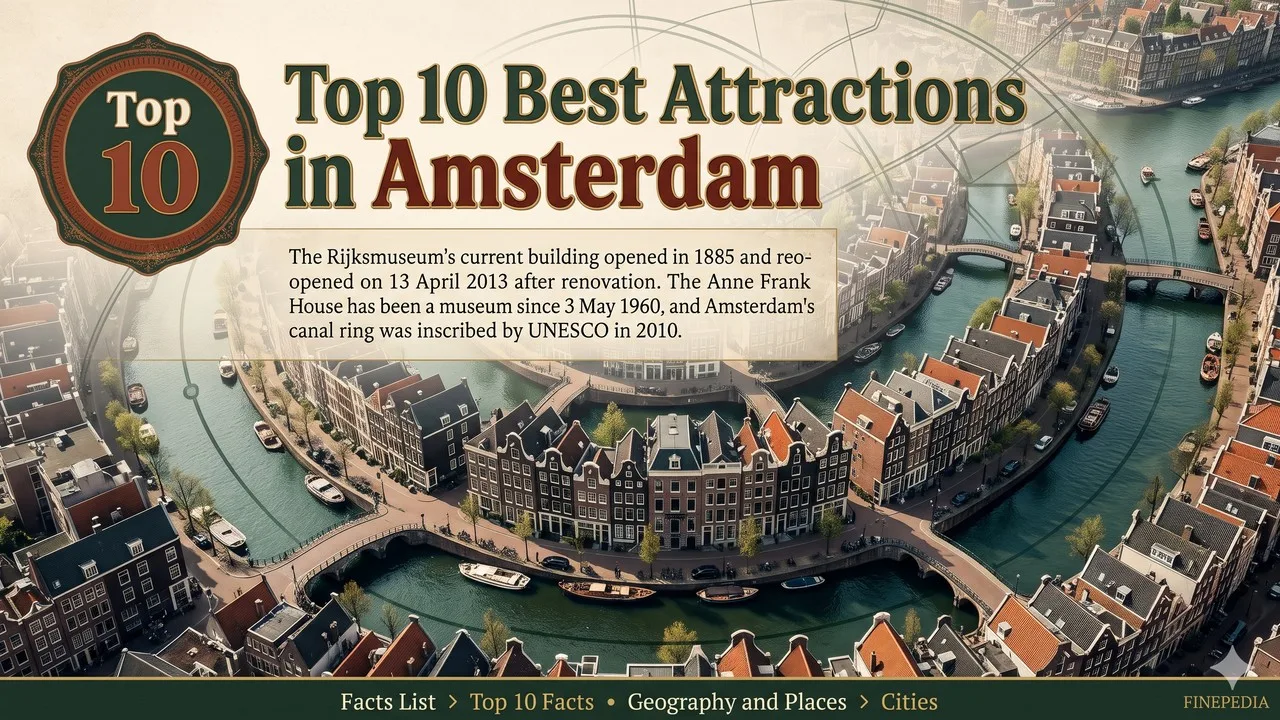
The best attractions in Amsterdam are ranked here as official historic and cultural sites, with dated museum openings and the 2010 canal-ring inscription. The Rijksmuseum's present building opened in 1885 and reopened on 13 April 2013 after a long renovation, the Anne Frank House has been a public museum since 3 May 1960, and the seventeenth-century canal ring is a UNESCO World Heritage property rather than a single ticket [1][2][3]. Those dated facts are why a 2026 list cannot simply copy a pre-2013 guidebook, when the national museum was still a building site.
Rank is editorial, by documentary importance and by official access. Timed tickets are obligatory at the Anne Frank House and ordinary at the Rijksmuseum and the Van Gogh Museum. This article describes buildings and a landscape and does not use likenesses, diary pages, or copyrighted paintings in any featured image, a rule already used for artist museums in the Madrid and Barcelona lists. Day trips to Zaanse Schans, Haarlem, or Keukenhof are outside the municipal ten, the same method used for Versailles in the Paris article and El Escorial in the Madrid article.
A useful 2026 habit is to treat the official Anne Frank House ticket shop as the only legal source, because unofficial resellers are a known problem at this museum, and to book the Museumplein houses early in high season [2][1]. The canal ring itself does not require a ticket, but a canal cruise is a private service, not the heritage inscription.
Key Facts
Opening, reopening, and inscription dates follow official institutional and UNESCO accounts. The Van Gogh Museum opened on 2 June 1973, the Stedelijk Museum reopened to the public on 23 September 2012, and the National Maritime Museum reopened on 1 October 2011 [4][5][6]. Rank 1 is the outstanding official national collection, which is also the building most clearly dated by a twenty-first-century reopening.
Those booking habits matter because Amsterdam's main rooms sell out in the same weeks as school holidays and major temporary exhibitions. A same-day walk-up can fail at the Anne Frank House even when the canal house is open, and a palace itinerary on Dam Square can close for a royal or state event [2][7]. The 2010 UNESCO inscription is a landscape designation, not a cruise ticket, and it does not replace museum admission [3]. The table below is the official spine of the list: dates first, 2026 access second, and no day-trip village outside the city is smuggled into the intramural ten.
Amsterdam Attractions at a Glance
| Rank | Attraction | Official date | 2026 note |
|---|---|---|---|
| 1 | Rijksmuseum | Current building opened 1885; reopened 13 April 2013 | Official timed tickets |
| 2 | Anne Frank House | Museum opened 3 May 1960 | Official timed tickets only; often sold well ahead |
| 3 | Van Gogh Museum | Opened 2 June 1973 | Official timed tickets; works are not reproduced here |
| 4 | Seventeenth-century canal ring | UNESCO inscription 2010 | A heritage landscape, not a single ticket |
| 5 | Royal Palace Amsterdam | Built as city hall, opened 1655 | Official visitor days; can close for royal use |
| 6 | Stedelijk Museum | Municipal museum; reopened 23 September 2012 | Official tickets for modern and contemporary art |
| 7 | Vondelpark | First section opened 1865 | A free municipal park |
| 8 | Het Scheepvaartmuseum | Reopened 1 October 2011 | Official national maritime museum |
| 9 | Westerkerk | Completed 1631 | A working church beside the Anne Frank House |
| 10 | NEMO Science Museum | Opened 3 June 1997 as NewMetropolis | Official science museum in the harbour |
1. Rijksmuseum
The Rijksmuseum's current Cuypers building opened in 1885 as the national museum of the Netherlands, and it reopened on 13 April 2013 after a renovation that had closed the main building for years [1]. Official tickets are sold for a chosen start time. The 2013 reopening is the date a pre-renovation guidebook will miss, and it does not change the 1885 architectural fact [1].
It is first as the outstanding official museum visit in the capital, older as a national house than the Van Gogh and Stedelijk museums on the same square, and still the documentary centre of the Dutch Golden Age collections as a public museum [1]. A later ticket price will not change the 1885 opening or the 2013 return.
Temporary exhibitions follow the museum's own ticket rules. The Rijksmuseum's official site is the only safe source for a 2026 slot [1].
2. Anne Frank House
The Anne Frank House, the canal-side building where Anne Frank, her family, and four others hid from 1942 until their arrest in 1944, has been a museum since 3 May 1960 [2]. Official tickets are sold online for a specific time slot, and the museum itself warns visitors against unofficial sellers [2]. This article records the official house and the date; it does not use a likeness or reproduce diary pages.
Related: Top 10 Most Bizarre Phobias: Strange Fears That Exist
It is second as the outstanding official memorial museum in the city, a documented historic interior rather than a generic wartime exhibit, and a ticket system that exists because the rooms are small and the demand is global [2]. A later price or a later audio-guide language will not change the 1960 opening.
Advance booking, often weeks ahead, is the 2026 habit. The museum's official ticket shop is the legal source [2].
3. Van Gogh Museum
The Van Gogh Museum opened on 2 June 1973 on Museumplein, as the official museum of Vincent van Gogh's work and of related collections, and it remains a timed-ticket house in 2026 [4]. Official tickets are the way in. This article records the museum and the date; it does not reproduce the paintings.
It is third as the outstanding official artist-museum visit, a counterpart to the national collections in the Rijksmuseum and to the modern holdings in the Stedelijk, all three of them on or beside the same square [4]. The later exhibition wing is an extension of the same official house, not a second museum.
Queues form when time slots fill. The museum's official site is the schedule [4].
4. Seventeenth-century canal ring
The seventeenth-century canal ring area of Amsterdam, a planned extension of the city's grachten, was inscribed on the UNESCO World Heritage List in 2010 [3]. It is a civic landscape of water, bridges, and houses, not a single ticketed monument. A private canal cruise can be a way of seeing it; the cruise is not the inscription, and the inscription is not a substitute for museum admission.
It is fourth as the outstanding official urban landscape, the setting for the palace, the Westerkerk, and the Anne Frank House, and a 2010 date that older lists will miss [3]. House museums and hidden churches inside the ring are separate official visits, not automatic entitlements of a cruise ticket.
Walking the ring is free. Official UNESCO and city descriptions are the documentary source [3].
Related: Top 10 Oldest Buildings in the World
5. Royal Palace Amsterdam
The Royal Palace on Dam Square was built as Amsterdam's city hall and opened in 1655, later becoming a royal palace, and it is still used by the monarchy for official events while also opening to visitors on officially posted days [7]. Paleis Amsterdam sells or posts the visitor information. Itineraries can change when the palace is needed for a royal or state occasion [7].
It is fifth as the outstanding official palace visit, a seventeenth-century civic hall that became a royal house, with a firm 1655 opening date [7]. Dam Square itself is a public space in front of the palace, not a second monument in this ten.
Audio guides, when offered, are official extras. The palace's own site is the legal calendar [7].
6. Stedelijk Museum
The Stedelijk Museum, Amsterdam's official municipal museum of modern and contemporary art, reopened to the public on 23 September 2012 after a long renovation that added the conspicuous new entrance wing [5]. Official tickets are the way in. It stands on Museumplein with the Rijksmuseum and the Van Gogh Museum, and it is not a private gallery.
It is sixth as the official modern counterpart to the two older Museumplein houses, dated by a 2012 reopening that a pre-renovation guidebook will not describe correctly [5]. A later special exhibition will not change that reopening date.
Advance slots are wise when a major show is on. The Stedelijk's official site is the source [5].
Related: The Science Behind Auroras: How Solar Winds Create Colorful Skies
7. Vondelpark
The Vondelpark, the city's principal historic public park, had its first section opened in 1865 and was later enlarged into the municipal park used today [8]. It is a free civic landscape, with a pavilion and other buildings that follow their own opening rules. It is not a ticketed monument and not a substitute for the canal-ring inscription.
It is seventh as the outstanding official park visit, a nineteenth-century public ground rather than a royal garden behind a wall [8]. Open-air events, when permitted, are municipal uses, not a separate attraction in this ten.
Seasonal crowds are ordinary. The Gemeente Amsterdam pages are the official description [8].
8. Het Scheepvaartmuseum
Het Scheepvaartmuseum, the official national maritime museum, occupies the seventeenth-century naval storehouse on the eastern docks and reopened on 1 October 2011 after a major renovation [6]. Official tickets cover the museum. The historic building and the later visitor fittings are one official house, not two museums.
It is eighth as the outstanding official harbour visit, dated to a 2011 reopening, and a counterpart to the canal-ring landscape on the other side of the old town [6]. A replica ship or a temporary show, when offered, follows the museum's own rules.
The museum's official site is the 2026 schedule [6].
9. Westerkerk
The Westerkerk, a Protestant church designed in the Dutch Renaissance tradition, was completed in 1631 and remains a working church on the Prinsengracht, beside the Anne Frank House [9]. Tower climbs, when offered, are a separate official or posted itinerary. The church is not a museum of the neighbouring house, and the house is not an annex of the church.
It is ninth as the outstanding official church visit in the western canal ring, with a firm seventeenth-century completion date, and as the tower that appears in the same documentary landscape as the 1960 museum next door [9]. Concerts, when held, are a later official use.
Related: Top 10 Tallest Buildings in the World
Liturgical times restrict tourist circulation. Official church notices set the interior rules [9].
10. NEMO Science Museum
NEMO Science Museum, in Renzo Piano's green harbour building, opened on 3 June 1997 as NewMetropolis and later continued under the NEMO name as the official science museum of the city [10]. Official tickets are the way in. The roof terrace, when open, is part of the building's public offer and follows posted hours. This article describes the official museum; it does not copy the architect's exact facade in the featured image.
It is tenth as the outstanding official modern museum visit on the water, a 1997 date that belongs in a contemporary capital list alongside the older canal and church fabric [10]. It is a science museum, not a second maritime museum.
Family peak times fill slots. The museum's official site is the legal source [10].
Conclusion
A 2026 Amsterdam list has to keep the Rijksmuseum's 1885 building and 13 April 2013 reopening, the Anne Frank House's 3 May 1960 opening, and the 2010 canal-ring inscription on the same page as later official dates: the Van Gogh Museum in 1973, the Stedelijk's 23 September 2012 return, the maritime museum's 1 October 2011 reopening, and NEMO's 3 June 1997 opening [1][2][3][4][5][6][10]. Around those dated facts sit the Royal Palace, opened as a city hall in 1655, the Vondelpark from 1865, and the Westerkerk completed in 1631 [7][8][9]. The useful habit is official booking, especially at the Anne Frank House, and a refusal to treat a likeness, a painting, or a diary page as something a featured image should copy.
Day trips beyond the municipal core remain day trips. A later ticket policy at the Rijksmuseum will not change the 2013 reopening, and a later cruise-boat brand will not change the 2010 inscription. Those official dates are the spine of the list, and they will still be the spine after a time-slot screen or a palace calendar has changed in a later tourist season in the same canal city.
- ^ [1] Official Rijksmuseum visitor and building information, current building 1885, reopened 13 April 2013. Rijksmuseum: visit
- ^ [2] Official Anne Frank House history and tickets, museum opened 3 May 1960. Anne Frank House
- ^ [3] UNESCO World Heritage inscription, Seventeenth-Century Canal Ring Area of Amsterdam, 2010. UNESCO: Amsterdam canal ring
- ^ [4] Official and municipal accounts of the Van Gogh Museum, opened 2 June 1973. Van Gogh Museum
- ^ [5] Official Stedelijk Museum announcement of the 23 September 2012 public reopening. Stedelijk Museum
- ^ [6] Official royal and museum accounts of the 1 October 2011 reopening of Het Scheepvaartmuseum. Het Scheepvaartmuseum
- ^ [7] Official Paleis Amsterdam visitor information, city hall opened 1655. Royal Palace Amsterdam
- ^ [8] Official Gemeente Amsterdam information on the Vondelpark, first section opened 1865. Vondelpark
- ^ [9] Documented history of the Westerkerk, completed 1631. Westerkerk
- ^ [10] Historical account of the 3 June 1997 opening of NewMetropolis, now NEMO Science Museum. NEMO Science Museum























Discussion
Log in with