





 By
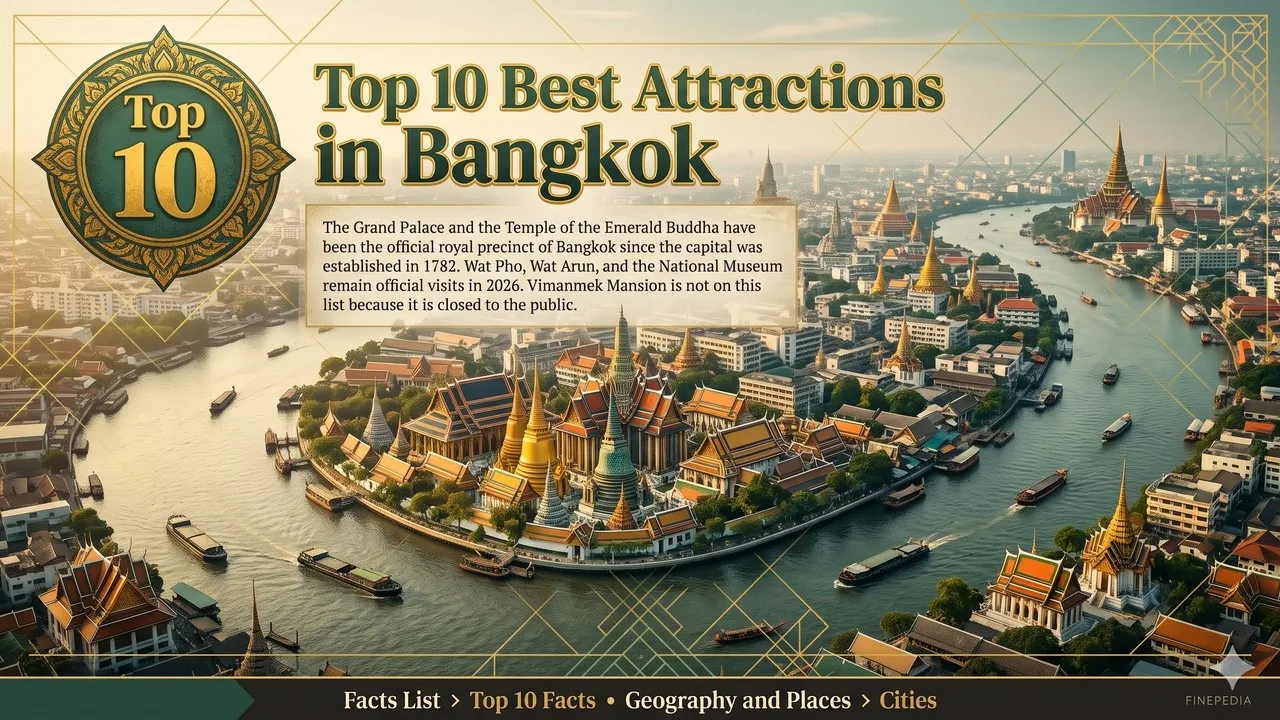
The best attractions in Bangkok are ranked here as official historic and cultural sites, including the Grand Palace and the principal royal temples. The Grand Palace and the Temple of the Emerald Buddha have been the official royal precinct of the city since the capital was established in 1782, and in 2026 they remain a ticketed official visit with a published dress code [1]. Wat Pho, Wat Arun, and the Bangkok National Museum are likewise official, open houses, which is why this list does not revive Vimanmek Mansion, a former visitor palace that has been closed to the public and is not a 2026 attraction [1][2][3]. Ayutthaya, floating markets outside the city, and other sites beyond the municipal core are day trips, not intramural entries, the same method used for Versailles in the Paris list.
Rank is editorial, by documentary importance and by official access. Temple and palace tickets are official products, and a street tout is not the ticket office. This article describes precincts and a river crossing and does not copy exact temple facades or sacred images as decorative art in any featured image. A useful 2026 habit is to buy palace and temple tickets at the official doors or official sites, to carry clothing that meets the palace dress code, and to treat the Chao Phraya as a public river, not a numbered museum [1].
Key Facts
Foundation and opening dates follow official palace, temple, and museum accounts. The National Museum occupies the former Front Palace and is a state museum with posted closed days, typically Monday and Tuesday [3]. Jim Thompson House is an official private-house museum still open to guided visits [4]. Rank 1 is the outstanding official royal precinct, which is also the documentary beginning of Bangkok as the capital.
Those booking and dress habits matter because the palace fills from the first morning slots, and a visitor who arrives without covered shoulders and legs can be turned away even when the ticket window is open [1]. The table below is the official spine of the list: dates first, 2026 access second, and no closed mansion or out-of-town former capital is smuggled into the intramural ten. The river is the documentary axis that joins the Grand Palace to Wat Arun; it is not itself a tenth temple.
Bangkok Attractions at a Glance
| Rank | Attraction | Official date | 2026 note |
|---|---|---|---|
| 1 | Grand Palace and Wat Phra Kaew | Royal precinct from 1782 | Official tickets and a published dress code |
| 2 | Wat Pho | Historic royal temple, official reclining-Buddha hall | Official temple tickets |
| 3 | Wat Arun | Historic riverside temple, Thonburi bank | Official temple tickets |
| 4 | Bangkok National Museum | Official national museum in the former Front Palace | Official tickets; typically closed Monday and Tuesday |
| 5 | Wat Traimit | Official temple of the Golden Buddha | Official temple tickets |
| 6 | Wat Saket and the Golden Mount | Historic temple and hilltop chedi | Official temple visit and a city viewpoint |
| 7 | Wat Benchamabophit | Marble Temple, completed in the early twentieth century | Official temple tickets |
| 8 | Jim Thompson House | House-museum, still open for official guided visits | Official house tickets; interiors are not copied here |
| 9 | Chatuchak Weekend Market | Official weekend market on its present site from 1982 | A public market on Saturday and Sunday |
| 10 | Lumphini Park | Official public park, opened 1925 | A free civic landscape |
1. Grand Palace and Wat Phra Kaew
The Grand Palace and the Temple of the Emerald Buddha (Wat Phra Kaew) form the official royal precinct founded when King Rama I established Bangkok as the capital in 1782, and they remain the outstanding official visit of the city, sold as a ticketed itinerary with a published dress code [1]. Official tickets are the way in. Some halls have photography rules that the palace itself posts. This article records the precinct and the date; it does not copy facades or sacred images.
It is first as the documentary centre of the capital, older as an official royal seat than the later museums and markets in this ten, and still a working ceremonial precinct rather than a ruined palace [1]. A later ticket price will not change the 1782 founding.
Morning arrival and official clothing rules are the 2026 habit. The official Grand Palace site is the legal source [1].
2. Wat Pho
Wat Pho, the official Temple of the Reclining Buddha and a historic royal monastery beside the Grand Palace, is a ticketed temple complex of halls, chedis, and later a traditional medical school that is a related official activity, not a second monument in this ten [2]. Official temple tickets are the way in. The reclining figure is a sacred image and is not reproduced in the featured image.
Related: Top 10 Most Famous Street Markets in the World
It is second as the outstanding official monastery visit beside the palace, a counterpart to Wat Arun across the river, and a temple rather than a palace hall [2]. A later massage-school timetable will not change the temple itself.
Official temple notices set hours and conduct. The temple's official information is the source [2].
3. Wat Arun
Wat Arun, the official Temple of Dawn on the Thonburi bank of the Chao Phraya, is a historic riverside monastery whose central prang is a documented early-nineteenth-century royal work, and it remains a ticketed official temple in 2026 [2]. Official tickets are the way in. Climbing rules and terrace closures, when posted, follow the temple's own notices. This article records the temple; it does not copy the exact prang in the featured image.
It is third as the outstanding official river-temple visit, the Thonburi counterpart to the Grand Palace and Wat Pho, and a ticketed climb rather than only a boat photograph [2]. A later conservation scaffold will not change the temple itself.
A public river crossing is part of the approach, not a monument ticket. Official temple information is the source [2].
4. Bangkok National Museum
The Bangkok National Museum, the official national museum of Thailand, occupies the former Front Palace and remains a state museum of historic objects, with posted hours that typically close the house on Monday and Tuesday [3]. Official tickets are the way in. It is a museum, not a second Grand Palace circuit, even though the buildings are palatial.
Related: Top 10 Most Bizarre Phobias: Strange Fears That Exist
It is fourth as the outstanding official museum visit, a counterpart to the living royal precinct nearby, and a weekday-sensitive house that a visitor who arrives on Monday will find shut [3]. A later exhibition will not change the museum itself.
The official museum pages are the 2026 schedule [3].
5. Wat Traimit
Wat Traimit, the official Temple of the Golden Buddha in the Yaowarat area, houses a documented solid-gold Buddha image and is a ticketed temple visit [5]. Official tickets are the way in. The later official museum rooms attached to the temple, when offered, follow posted rules. This article records the official temple; it does not reproduce the image.
It is fifth as the outstanding official Chinatown-side temple, a counterpart to the riverside royal monasteries, and a documented object in an official religious house [5]. A later display case will not change the temple itself.
Official temple information is the source [5].
6. Wat Saket and the Golden Mount
Wat Saket, with the Golden Mount, is the official historic temple and hilltop chedi that serves as a city viewpoint as well as a working monastery, and it remains a public official visit in 2026 [6]. Posted tickets or donations follow the temple's own rules. The climb is part of the official site, not a separate tower attraction.
It is sixth as the outstanding official hill-temple visit inside the old town, a counterpart to Wat Arun's river prang, and a viewpoint that is also a religious precinct [6]. A later lighting scheme will not change the temple itself.
Official temple notices set hours. City and temple descriptions are the source [6].
Related: Top 10 Oldest Buildings in the World
7. Wat Benchamabophit
Wat Benchamabophit, the official Marble Temple, was completed in the early twentieth century under King Rama V as a royal monastery of white marble, and it remains a ticketed official temple [7]. Official tickets are the way in. This article records the temple and the period; it does not copy the exact facade.
It is seventh as the outstanding official later royal monastery, dated to the early twentieth century, and a counterpart to the eighteenth-century palace precinct rather than a copy of it [7]. A later conservation project will not change the temple itself.
Official temple information is the source [7].
8. Jim Thompson House
The Jim Thompson House is the official house-museum of the American silk entrepreneur's Bangkok home and collection, and in 2026 it remains open for official guided visits on the house's own tickets [4]. Official tickets are the way in. This article records the house as a documented museum; it does not copy interiors, textiles, or brand marks in the featured image.
It is eighth as the outstanding official house-museum visit, a modern counterpart to the palaces and temples, and a guided interior rather than a street facade [4]. A later tour language will not change the house itself.
The official house-museum site is the legal source [4].
9. Chatuchak Weekend Market
Chatuchak Weekend Market, the official large weekend market on its present site from 1982, is a public commercial landscape of stalls that operates principally on Saturday and Sunday [8]. Entry to the market grounds is not a temple ticket. It is a market, not a museum, and weekday closures of the main stall field are part of the official rhythm.
Related: The Science Behind Auroras: How Solar Winds Create Colorful Skies
It is ninth as the outstanding official market visit, a civic counterpart to the royal precinct, and a weekend fact that a midweek visitor will miss [8]. A later stall map will not change the 1982 site.
Official city market information is the source [8].
10. Lumphini Park
Lumphini Park, the official central public park of Bangkok, was opened in 1925 and remains a free civic landscape of paths, water, and later recreational uses [9]. It is not a ticketed monument. Surrounding office towers are context, not part of the park, and events inside the park follow municipal rules.
It is tenth as the outstanding official park visit, dated to 1925, and a necessary outdoor counterpart to the palaces and temples [9]. A later event permit will not change the park itself.
Official municipal park information is the source [9].
Conclusion
A 2026 Bangkok list has to keep the Grand Palace and Wat Phra Kaew as the official 1782 royal precinct, with Wat Pho and Wat Arun as the principal official river temples, and it has to leave Vimanmek Mansion off the ten because that former visitor palace is not open to the public [1][2]. Around those dated facts sit the National Museum, Wat Traimit, Wat Saket and the Golden Mount, Wat Benchamabophit, the still-open Jim Thompson House, Chatuchak Weekend Market from 1982, and Lumphini Park from 1925 [3][4][5][6][7][8][9]. The useful habit is official tickets, a published dress code at the palace, and a refusal to treat a sacred image or a temple facade as something a featured image should copy.
Ayutthaya and out-of-town floating markets remain day trips. A later reopening claim at a closed mansion will belong in a revision only if official public access actually returns; it will not change the 1782 precinct or the official temples already on this list. Those official dates are the spine of the list, and they will still be the spine after a ticket window or a river-boat timetable has changed in a later tourist season in the same river city.
- ^ [1] Official Grand Palace visitor information, royal precinct from 1782, tickets and dress code. Grand Palace
- ^ [2] Official and city information on visiting Wat Pho and Wat Arun as ticketed temples. Tourism Thailand
- ^ [3] Official Bangkok National Museum visitor information, including closed days. Fine Arts Department / National Museum
- ^ [4] Official Jim Thompson House visitor information, house-museum still open for guided visits. Jim Thompson House
- ^ [5] Official and documented information on Wat Traimit, the Temple of the Golden Buddha. Tourism Thailand: Wat Traimit
- ^ [6] Official and city information on Wat Saket and the Golden Mount. Tourism Thailand: Wat Saket
- ^ [7] Official and documented information on Wat Benchamabophit, the Marble Temple. Tourism Thailand: Wat Benchamabophit
- ^ [8] Official city information on Chatuchak Weekend Market, present site from 1982. Tourism Thailand: Chatuchak
- ^ [9] Official and documented opening of Lumphini Park in 1925. Bangkok Metropolitan Administration





















Discussion
Log in with