






 By
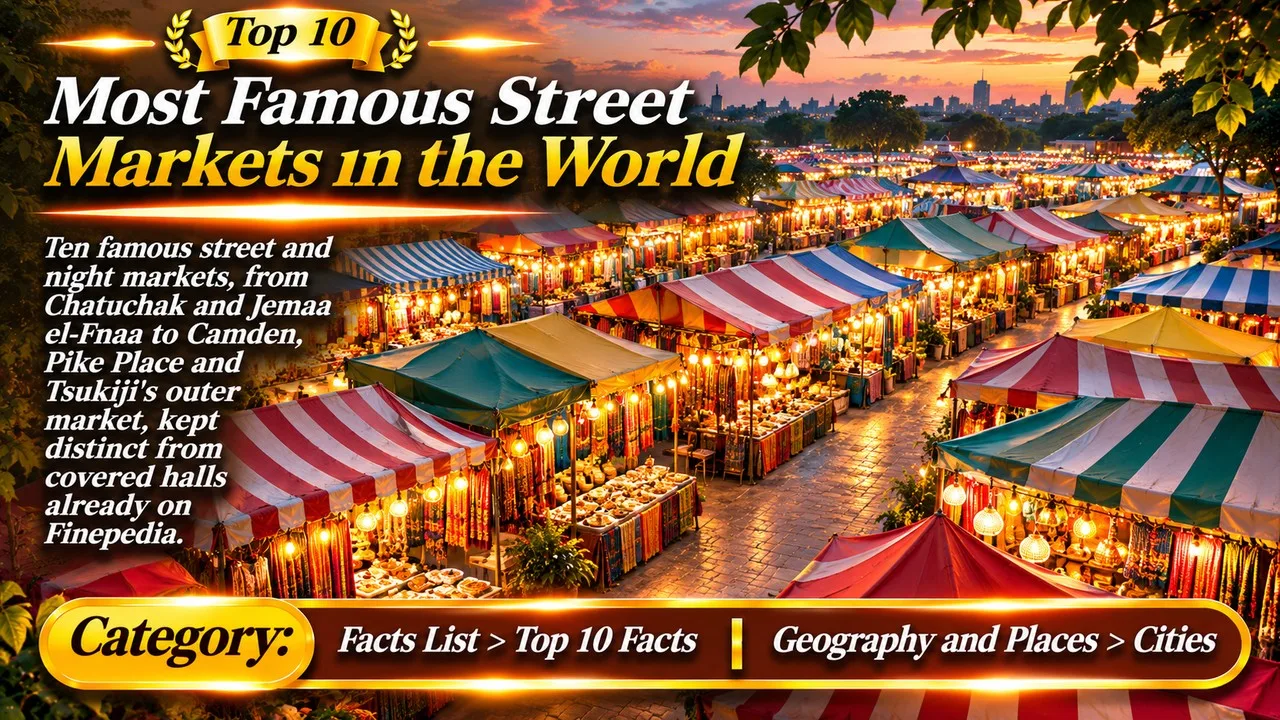
The most famous street markets are the ones that still take over streets, squares or night alleys, as public markets rather than as a single indoor food hall. Finepedia already has a list of famous covered markets, including the Grand Bazaar in Istanbul, so those halls are left off this page on purpose [1][2].
This is a curated 2026 guide, not a shopping-quality score. It favours markets that are still held in streets, open squares, night alleys or historic open-air complexes, and that a visitor can plan around by day of the week. Several famous wholesale markets have moved or split, notably Tokyo's former inner fish market, and the current address is the one that matters [3][4].
Key Facts
"Street market" here means a market whose main life is in streets, squares, piers or open-air aisles, even if some stalls have roofs. Covered bazaars and food halls on the companion list are omitted.
Street Markets at a Glance
| Rank | Market | City | When it is at its best | 2026 note |
|---|---|---|---|---|
| 1 | Chatuchak Weekend Market | the Thai capital | Saturday and Sunday | A vast outdoor-stall city, still the standard weekend market |
| 2 | Jemaa el-Fnaa | Marrakech, Morocco | Late afternoon into night | A public square that becomes a market, kitchen and theatre |
| 3 | Camden Market | London, United Kingdom | Weekend days, and busy most afternoons | A canal-side street-and-yard market, not the same as Borough Market |
| 4 | Chandni Chowk | Delhi, India | Morning for wholesale energy; most days | A dense historic street-market district, not a single row of stalls |
| 5 | Temple Street Night Market | Kowloon | Evening | A classic night-market street in Kowloon |
| 6 | Shilin Night Market | Taipei, Taiwan | Evening | One of the best-known night food markets in East Asia |
| 7 | Pike Place Market | Seattle, United States | Morning into afternoon | A historic public market on the street above the waterfront |
| 8 | Tsukiji Outer Market | Tokyo, Japan | Early morning into the day | The inner wholesale market moved to Toyosu in 2018; the outer streets remain |
| 9 | Portobello Road Market | London, United Kingdom | Saturday for antiques; other days for street stalls | A long street market in Notting Hill |
| 10 | Feria de San Telmo | Buenos Aires, Argentina | Sunday | An antiques and street fair around a historic plaza |
1. Chatuchak Weekend Market
Chatuchak Weekend Market, in Bangkok, is a city of stalls: thousands of pitches selling clothes, plants, food, crafts and almost anything else, in a dense outdoor grid that operates on Saturday and Sunday [1][5]. It is first because scale, fame and a still-running weekend ritual coincide, and because it is a street-stall landscape rather than a single hall.
A 2026 visit is easier with a plan: go early, pick a section, and treat the market as a half-day, not as a short photo stop. Heat, crowds and lost bearings are the normal conditions, not a surprise [5].
It has been the standard "largest weekend market" example for years, and it remains that example because the stall city is still there [1][5].
2. Jemaa el-Fnaa
Jemaa el-Fnaa, the main square of Marrakech's medina, is not a row of fixed shops. It is a public space that fills, especially from late afternoon, with food stalls, juice carts, performers and the life of a square that UNESCO has recognised as a place of cultural performance [1][6]. The surrounding alleys of the souks are a related, denser market world.
It is second because the market is the square itself, and because that form is still alive in 2026. Visitors should be businesslike about food hygiene, photos and official guides, and should not treat the square as a theme-park set [6].
Related: Top 10 Best Attractions in Bangkok
The medina around it includes covered passages. This entry is for the open square, which is the street-market heart of the city [1][6].
3. Camden Market
Camden Market, along the Regent's Canal in north London, is a cluster of yards, stables, streets and indoor-outdoor aisles that grew from a weekend antiques and crafts market into one of the city's most visited market districts [1][7]. It is not Borough Market, the food hall and covered market in Southwark, and it is not on Finepedia's covered-market list for that reason.
It is third as a famous street-and-yard market that is still running, even after fires, redevelopment and a more commercial tone than in its early years. A 2026 visit is busy most days, especially at weekends, and the canal path is part of the route [7].
Camden is useful as a reminder that a market can be famous and still be a mixture of stalls, shops and food courts. The street life is the reason it is here [7].
4. Chandni Chowk
Chandni Chowk, in Old Delhi, is a historic commercial spine and a district of specialised markets, from spices and textiles to jewellery and wedding goods, rather than a single weekend fair [1][5]. The streets, lanes and crossings are the market. A visitor is in a working wholesale and retail neighbourhood that happens to be a tourist destination as well.
It is fourth because of that depth and because the district is still a daily market, not a Saturday-only event. Crowds, traffic and a need for a local sense of direction are part of the visit. Early morning is often the most revealing time [5].
It is a market area, not a fenced attraction. That is the point [1][5].
5. Temple Street Night Market
Temple Street Night Market, in Kowloon, Hong Kong, is one of the city's classic evening market streets: stall canopies, street food, fortune-tellers and goods laid out after dark [1][8]. It is smaller than Chatuchak and more linear, and the experience is the street at night rather than a weekend warehouse grid.
Related: Top 10 Most Bizarre Phobias: Strange Fears That Exist
It is fifth as a still-running night market of long fame, in a city whose street-commerce rules and neighbourhoods have changed. A 2026 visitor should check current hours and any temporary street arrangements, then go in the evening, which is when the market exists [8].
Other Hong Kong night markets have faded or moved. Temple Street remains the name most people still use [8].
6. Shilin Night Market
Shilin Night Market, in Taipei, is among the best-known night food markets in East Asia, a dense evening grid of snacks, stalls and surrounding shops that fills after dusk [1][8]. Food is the main reason to go; the market is also a social street, not only a restaurant list.
It is sixth as the Taiwanese night-market representative, still operating and still famous. Queues, heat from the stalls, and a need to come hungry are the practical facts. Official and local guidance on hours should be checked, because night markets can shift or rebuild stalls [8].
Together with Temple Street, it shows that "street market" after dark is a distinct form, not a lesser version of a weekend bazaar [1][8].
7. Pike Place Market
Pike Place Market, on the hillside above the Seattle waterfront, is a historic public market of stall-holders, fishmongers, produce sellers and small shops, opened in 1907 and still working as a market rather than only as a viewing platform [4][9]. Some of it is under roofs and in arcades, but its life is the street-level aisle, the crowd, and the working stalls, which is why it is on this list and not on the covered-halls list.
Related: Top 10 Oldest Buildings in the World
It is seventh as the most famous North American public market of this kind. A 2026 visit is easier earlier in the day, before the centre aisle is only a photo queue. The market is also a residential and social institution, and a visitor who stays in the main tourist rake will miss the produce tables that still justify the word "market" [9].
The fish throw, when it happens, is a sideshow. The stalls are the point [9].
8. Tsukiji Outer Market
Tsukiji, in Tokyo, is the name many travellers still use for a fish market that has split. The inner wholesale market moved to Toyosu in 2018. The outer market, a grid of shops and stalls around the old site, remains a public food-and-kitchen-goods market, especially in the morning [3][10]. A 2026 visitor who wants the wholesale auction goes to Toyosu, under the rules that apply there; a visitor who wants the street-stall Tsukiji of earlier guidebooks is looking for the outer market.
It is eighth because the honest current geography matters more than a famous name used loosely. Both places can be worth a trip; they are not the same address [10].
Early is better, and some shops close once the morning trade is done [3][10].
9. Portobello Road Market
Portobello Road Market, in Notting Hill, London, is a long street market whose Saturday antiques stretch is the most famous version, with other stalls on other days [1][7]. It is a street in the ordinary sense: a road that becomes a market, then a road again.
It is ninth as a second London entry with a different form from Camden, and as a market that is still scheduled, even if some of the antiques trade has thinned or moved compared with decades ago. A 2026 Saturday is crowded; people who want to look at objects rather than at each other often come earlier [7].
It is not a covered food hall, and it is not Portobello as a brand of shop elsewhere. The street is the site [7].
Related: The Science Behind Auroras: How Solar Winds Create Colorful Skies
10. Feria de San Telmo
The Sunday fair in San Telmo, Buenos Aires, fills the streets around Plaza Dorrego with antiques, crafts, food and tango displays, a neighbourhood market-and-fair that has become one of the city's best-known visitor rituals [4][11]. It is a weekly street event, not a permanent warehouse.
It is tenth as a South American street fair of real fame, still held on Sundays, and as a reminder that this list should not end at Europe and East Asia. Crowds are heavy by late morning. The surrounding streets have antique shops on other days, but the feria is the Sunday transformation [11].
A visitor who goes on a Wednesday will see a handsome neighbourhood and will miss the market [4][11].
Conclusion
The ten markets above are weekend stall cities, night streets, historic public markets and a square that becomes a theatre at dusk [1][5]. They were chosen as street-level places, and they leave covered bazaars and food halls to the companion Finepedia list.
Days of the week and opening hours are the whole method. Chatuchak is a weekend, Shilin is an evening, San Telmo is a Sunday, and Tsukiji is not the address it was before 2018. A 2026 plan should start with that calendar, then with the official or local hours for the week of the trip [3][8]. It also helps to go with a short list of what you actually want to see, because a famous market can absorb a whole day in its first aisles, and because the working stalls, not the souvenir edge, are the reason these ten places still earn a journey.
- ^ [1] "Market (place)" and market-district overviews for Chatuchak, Jemaa el-Fnaa, Camden, Chandni Chowk and Portobello. Wikipedia. Wikipedia: Chatuchak Weekend Market
- ^ [2] Finepedia, "Top 10 Most Famous Covered Markets in the World." Covered markets
- ^ [3] Relocation of Tokyo's inner wholesale fish market from Tsukiji to Toyosu, 2018. Official and Wikipedia summaries. Wikipedia: Toyosu Market
- ^ [4] Public-market histories for Pike Place and related open-air markets. Wikipedia. Wikipedia: Pike Place Market
- ^ [5] Chatuchak and Chandni Chowk visitor and market-district notes. Official tourism pages. Tourism Thailand
- ^ [6] Jemaa el-Fnaa, including its status as a cultural space. UNESCO and Wikipedia. Jemaa el-Fnaa
- ^ [7] Camden Market and Portobello Road Market. Official and local London pages. Camden Market
- ^ [8] Temple Street Night Market and Shilin Night Market. Hong Kong and Taipei tourism pages. Discover Hong Kong
- ^ [9] Pike Place Market official site. Pike Place Market
- ^ [10] Tsukiji Outer Market and Toyosu visiting guidance. Tsukiji
- ^ [11] San Telmo Sunday fair, Buenos Aires tourism information. Buenos Aires tourism




















Discussion
Log in with