



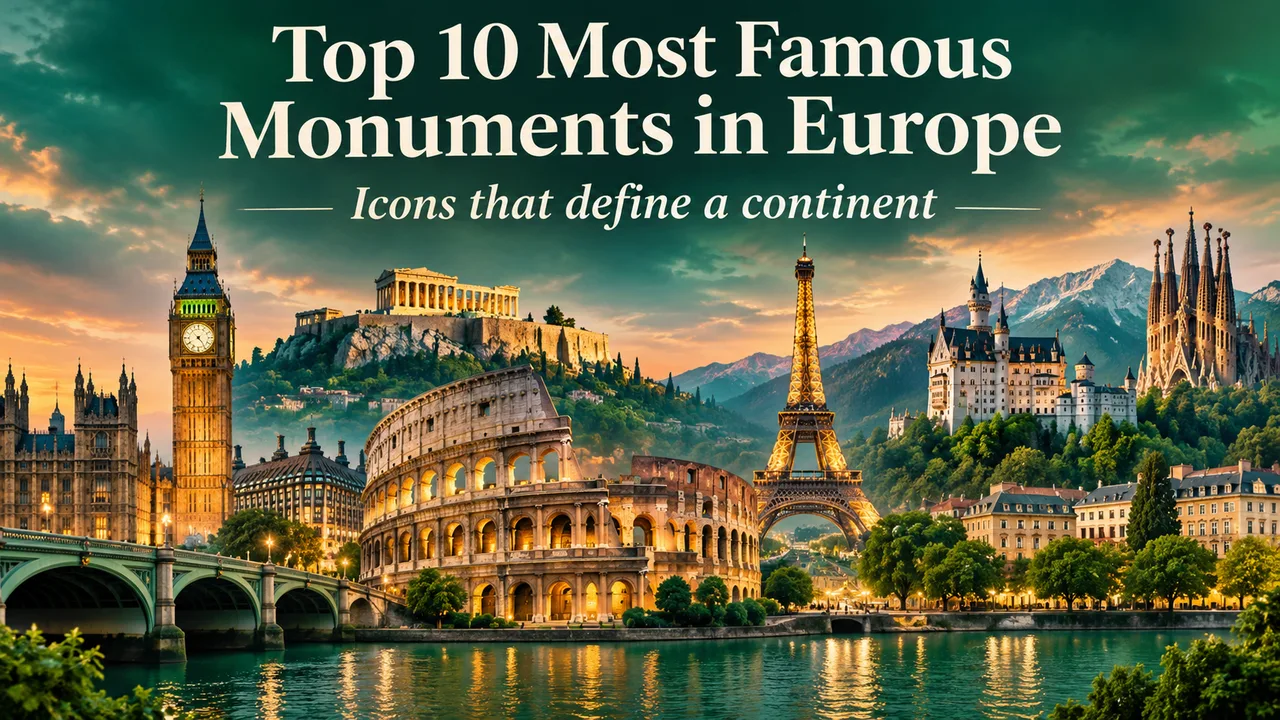
The most famous monuments in Europe span almost five thousand years, from prehistoric stone circles to iron towers and unfinished basilicas. Together they trace the story of a continent shaped by empires, faiths, revolutions and engineering breakthroughs [1].
Many of these monuments were built to impress, whether to honour gods, celebrate victories or show off new technology. Others gained their fame later, as symbols of cities and nations. Several are now UNESCO World Heritage Sites and receive millions of visitors every year [1].
This Finepedia list selects ten monuments that are instantly recognised around the world. The ranking weighs global fame, historical importance and architectural achievement, and it aims to cover a wide range of eras and countries.
Key Facts
The table below sums up the ten monuments in this list, with their city, date and a key fact for each.
Famous Monuments in Europe at a Glance
| Rank | Name | Location/Country | Key figure | Notable fact |
|---|---|---|---|---|
| 1 | Eiffel Tower | Paris, France | 330 m tall, opened 1889 | Most visited paid monument in the world |
| 2 | Colosseum | Rome, Italy | Completed AD 80 | Held an estimated 50,000 spectators |
| 3 | Acropolis of Athens | Athens, Greece | Parthenon built 447-432 BC | Symbol of classical Greece |
| 4 | Sagrada Familia | Barcelona, Spain | Begun 1882 | Antoni Gaudi's unfinished basilica |
| 5 | Stonehenge | Wiltshire, England | About 3000-2000 BC | Aligned with solstice sunrise and sunset |
| 6 | Leaning Tower of Pisa | Pisa, Italy | Built 1173-1372 | Tilts about 4 degrees |
| 7 | Big Ben (Elizabeth Tower) | London, UK | Completed 1859 | Great Bell weighs about 13.7 tonnes |
| 8 | Brandenburg Gate | Berlin, Germany | Completed 1791 | Symbol of German reunification |
| 9 | Saint Basil's Cathedral | Moscow, Russia | Built 1555-1561 | Colourful onion domes on Red Square |
| 10 | Atomium | Brussels, Belgium | 102 m tall, built 1958 | Models an iron crystal enlarged billions of times |
1. Eiffel Tower
The Eiffel Tower was built for the 1889 Exposition Universelle in Paris, marking the centenary of the French Revolution. Designed by Gustave Eiffel's engineering company, it stands about 330 metres tall including antennas [2].
At first many artists criticised the iron tower as ugly, and it was meant to stand for only 20 years. Its value as a radio transmission mast saved it, and it gradually became the defining symbol of Paris.
The tower is made of around 18,000 iron parts held by about 2.5 million rivets. It welcomes roughly six to seven million visitors a year, making it one of the most visited paid monuments in the world [2].
Visitors can climb stairs to the second level or take lifts to the summit, where views stretch for many kilometres on clear days. At night the tower sparkles with thousands of lights for a few minutes each hour, a tradition that began in 2000. It is repainted roughly every seven years to protect the iron from rust.
2. Colosseum
The Colosseum, or Flavian Amphitheatre, was begun under Emperor Vespasian and completed under Titus in AD 80. It is the largest amphitheatre ever built in the Roman world [3].
It could hold an estimated 50,000 to 80,000 spectators, who watched gladiator fights, animal hunts and public spectacles. A system of underground passages, the hypogeum, allowed animals and scenery to appear suddenly in the arena.
Earthquakes and stone robbing damaged the building over the centuries, yet it remains an icon of Rome. It is one of the New Seven Wonders of the World and part of a UNESCO site [3].
Related: Top 10 Most Bizarre Phobias: Strange Fears That Exist
The Colosseum sat at the heart of imperial Rome near the Roman Forum and Palatine Hill, which visitors can explore on the same ticket. Restoration projects have cleaned the outer walls and reopened underground areas. Each Good Friday, the Pope leads a Way of the Cross procession near the monument.
3. Acropolis of Athens
The Acropolis is a rocky hill above Athens crowned by ancient temples. Its most famous building, the Parthenon, was built between 447 and 432 BC to honour the goddess Athena [4].
The Acropolis was rebuilt under the statesman Pericles after the Persian Wars, with sculptor Phidias overseeing the artwork. Other buildings include the Erechtheion, with its porch of maiden statues, and the Propylaea gateway.
The site became a UNESCO World Heritage Site in 1987. It is seen as a symbol of democracy and of the classical ideals that shaped Western art and thought [4].
Many sculptures from the Parthenon are now in the Acropolis Museum, opened in 2009, while others are in the British Museum, which has made them the subject of a long debate about their return. Visitors climb through the Propylaea and walk among the temples, enjoying views across the city to the sea.
4. Sagrada Familia
The Basilica de la Sagrada Familia in Barcelona has been under construction since 1882. Architect Antoni Gaudi took over the project in 1883 and devoted the rest of his life to it [5].
Gaudi designed the church with tree-like columns, flowing facades and 18 planned towers. When he died in 1926 less than a quarter was complete. Work has continued using his models and modern computer design.
The basilica was consecrated by Pope Benedict XVI in 2010. Its central Tower of Jesus Christ, planned at 172.5 metres, is set to make it the tallest church in the world [5].
Each facade tells part of the Christian story. The Nativity facade, the one completed during Gaudi's lifetime, is full of carved detail, while the Passion facade is stark and angular. Inside, coloured stained glass floods the nave with shifting light that changes through the day, creating one of the most striking church interiors in the world.
5. Stonehenge
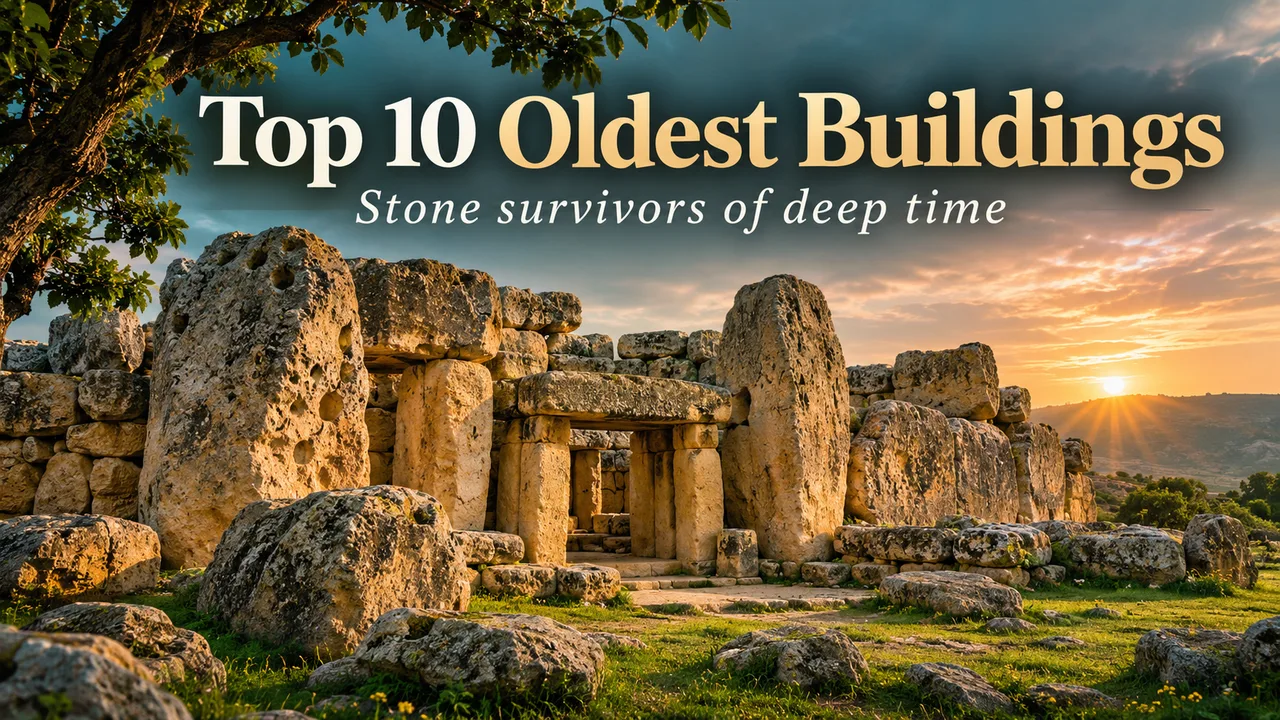
Stonehenge is a prehistoric monument on Salisbury Plain in Wiltshire, England. It was built in several stages between roughly 3000 and 2000 BC [6].
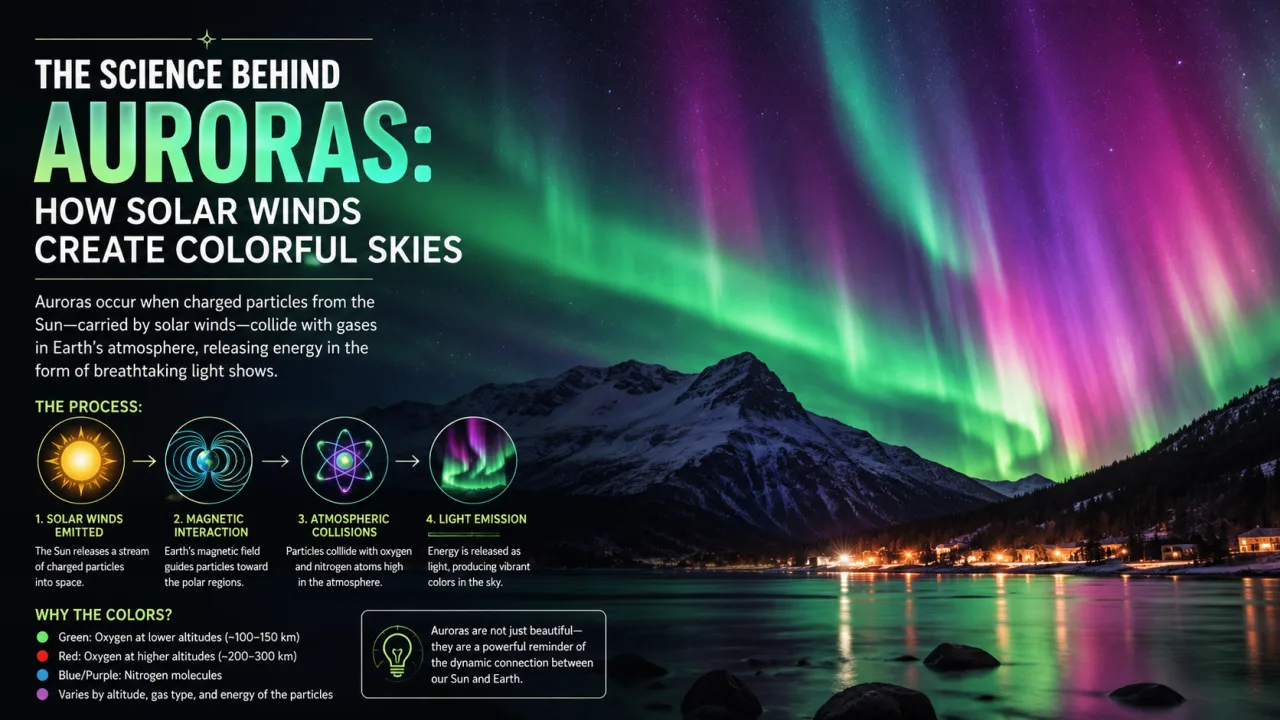
Related: The Science Behind Auroras: How Solar Winds Create Colorful Skies
The monument consists of huge sarsen stones, some weighing about 25 tonnes, and smaller bluestones brought from the Preseli Hills in Wales, more than 200 kilometres away. How Neolithic people moved them is still debated.
The stones align with the sunrise at the summer solstice and the sunset at the winter solstice. Stonehenge is part of a UNESCO World Heritage Site with nearby Avebury [6].
The purpose of Stonehenge has been debated for centuries, with theories ranging from a temple to a burial ground to a calendar. Excavations have found human remains and evidence of large gatherings nearby. A visitor centre opened in 2013, and crowds still gather at the stones to watch the solstice sunrise each June.
6. Leaning Tower of Pisa
The Leaning Tower of Pisa is the bell tower of Pisa Cathedral. Construction began in 1173 and took almost two centuries because of wars and pauses [7].
The tower began to lean during construction due to soft ground on one side. Builders tried to correct the tilt by making upper floors slightly curved. By 1990 the lean had reached about 5.5 degrees.
Engineers stabilised the tower between 1993 and 2001 by removing soil from under the high side, reducing the tilt to about 4 degrees. It is part of the Piazza del Duomo UNESCO site [7].
The tower is 56 metres tall on its lower side and has 294 steps, which visitors can climb in small groups. The tilt has made it a world-famous photo spot, where tourists pose as if pushing the tower upright. Legend says Galileo dropped balls from it to test gravity, though the story is unconfirmed.
7. Big Ben (Elizabeth Tower)
Big Ben is the nickname of the Great Bell inside the clock tower of the Palace of Westminster in London. The tower, renamed Elizabeth Tower in 2012, was completed in 1859 [8].
Related: Top 10 Facts About Dogs
The tower was designed by Augustus Pugin in the Gothic Revival style and stands about 96 metres tall. The Great Bell weighs about 13.7 tonnes and its chimes are broadcast regularly by the BBC.
A major restoration from 2017 to 2022 repaired the clock and restored the original Prussian blue colour of the dials' surrounds [8].
The clock was famed for its accuracy, kept in balance by old pennies placed on its pendulum to adjust its timing. The tower's chimes have rung in the New Year for generations of Britons. Overseas visitors cannot climb the tower, but UK residents can arrange tours through their Members of Parliament.
8. Brandenburg Gate
The Brandenburg Gate in Berlin was completed in 1791 under King Frederick William II of Prussia. Architect Carl Gotthard Langhans modelled it on the Propylaea of the Athens Acropolis [9].
The gate is topped by the Quadriga, a chariot driven by the goddess of victory. Napoleon took the sculpture to Paris in 1806, and it was returned in 1814.
During the Cold War the gate stood beside the Berlin Wall. After the wall fell in 1989 it became a symbol of German reunification and peace [9].
The gate was badly damaged during the Second World War and restored afterwards. Presidents and leaders have given famous speeches nearby, including Ronald Reagan's call in 1987 to tear down the Berlin Wall. Today it is the stage for New Year's Eve celebrations and major public events in the German capital.
9. Saint Basil's Cathedral
Saint Basil's Cathedral stands on Red Square in Moscow. It was built between 1555 and 1561 on the orders of Ivan the Terrible to celebrate the capture of Kazan [10].
The cathedral is made of nine chapels around a central tower, with colourful onion domes. Its design is unique in Russian architecture and has been compared to a flame rising into the sky.
Related: Top 10 Tallest Buildings in the World
It became a museum in the twentieth century and is part of the UNESCO-listed Kremlin and Red Square site [10].
Legend claims that Ivan had the architect blinded so he could never build anything as beautiful again, but historians consider this a myth. The interior is a maze of narrow galleries and small chapels decorated with painted flowers and icons, very different from the vast exteriors of many cathedrals.
10. Atomium
The Atomium in Brussels was built for the 1958 World's Fair, Expo 58. It represents a unit cell of an iron crystal magnified about 165 billion times [11].
The structure stands 102 metres tall and has nine stainless steel spheres connected by tubes with escalators and lifts. The top sphere offers panoramic views over Brussels.
It was renovated between 2004 and 2006 and now hosts exhibitions. It is one of Belgium's most visited landmarks [11].
Originally the Atomium was meant to stand for only six months, but its popularity saved it. It has become a symbol of Brussels and of the optimism of the atomic age, and it appears on coins, posters and souvenirs. The nearby Mini-Europe park adds to the attraction of the area.
Conclusion
Europe's most famous monuments reflect the ambitions of many eras, from Neolithic builders to modern engineers. Each tells a different chapter of the continent's history.
Visiting them is a way to see how art, faith, politics and technology have shaped Europe. Together these ten landmarks show why the continent remains one of the world's great destinations for culture and history.
- ^ [1] "List of World Heritage Sites in Europe". Wikipedia. Wikipedia: World Heritage Sites in Europe
- ^ [2] "Eiffel Tower". Wikipedia. Wikipedia: Eiffel Tower
- ^ [3] "Colosseum". Wikipedia. Wikipedia: Colosseum
- ^ [4] "Acropolis, Athens". UNESCO World Heritage Centre. UNESCO: Acropolis
- ^ [5] "Sagrada Familia". Wikipedia. Wikipedia: Sagrada Familia
- ^ [6] "Stonehenge". English Heritage. English Heritage: Stonehenge
- ^ [7] "Leaning Tower of Pisa". Wikipedia. Wikipedia: Leaning Tower of Pisa
- ^ [8] "Big Ben". Wikipedia. Wikipedia: Big Ben
- ^ [9] "Brandenburg Gate". Wikipedia. Wikipedia: Brandenburg Gate
- ^ [10] "Saint Basil's Cathedral". Wikipedia. Wikipedia: Saint Basil's Cathedral
- ^ [11] "Atomium". Wikipedia. Wikipedia: Atomium


















Discussion
Log in with