






 By
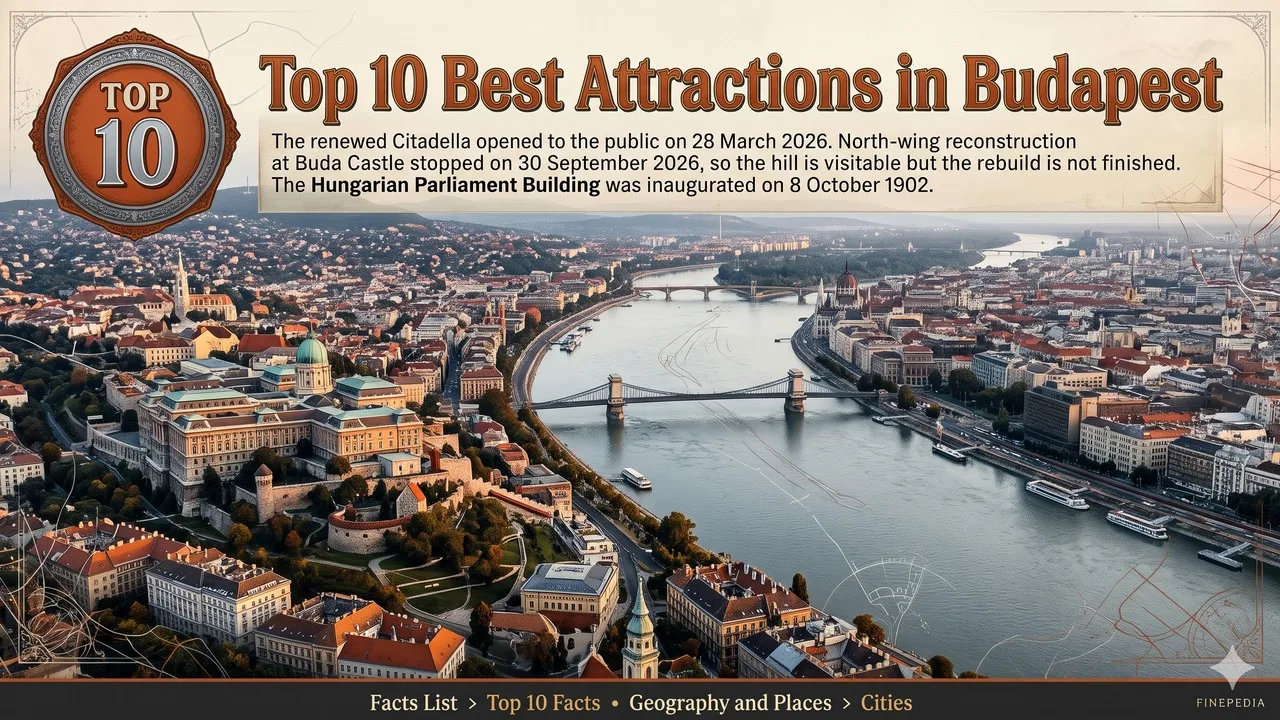
The best attractions in Budapest are ranked here as official historic and cultural sites, with 2026 notes for the Citadella and Buda Castle works. The renewed Citadella on Gellert Hill opened to the public on 28 March 2026 after a long reconstruction, with free park access and an official exhibition [1]. On the opposite ridge, Buda Castle remains a visitable historic precinct, but north-wing reconstruction under the Hauszmann programme stopped on 30 September 2026 and the wider rebuild is not finished, which is why a 2026 list cannot describe the palace as a completed restoration [2]. The Hungarian Parliament Building was inaugurated on 8 October 1902, and the Szechenyi Chain Bridge, first opened in 1849, has been open again since its renovation was completed in 2023 [3][4].
Rank is editorial, by documentary importance and by official access. Parliament tours use official tickets, and the basilica, the synagogue, and the baths have their own official calendars. This article describes buildings, a river crossing, and two hills and does not copy official crests or exact facades, including the Parliament, in any featured image. Szentendre, the Danube Bend, and other sites outside the municipal core are day trips, not intramural entries, the same method used for Versailles in the Paris list.
A useful 2026 habit is to book the Parliament on the official house site, to treat Castle Hill as a visitable precinct rather than a finished palace, and to include the Citadella as a reopened 2026 landscape rather than a closed building site [1][2][3]. A later restart of the north-wing works will belong in a revision; it is not a completion date.
Key Facts
Inauguration, consecration, and reopening dates follow official parliamentary, municipal, and monument accounts. St Stephen's Basilica was consecrated in 1905, the Dohany Street Synagogue was completed in 1859, and the Szechenyi Thermal Bath opened on 16 June 1913 [5][6][7]. Rank 1 is the outstanding official civic building, which is also a working legislature.
Those booking habits matter because Parliament slots and popular bath tickets fill in the same weeks as holidays and river festivals. A same-day walk-up can fail at the Parliament even when the facade is in view across the Danube [3]. The table below is the official spine of the list: dates first, 2026 access second, and no Bend village is smuggled into the intramural ten. The river is the documentary axis that joins Pest's civic axis to the Buda hills; it is not itself a numbered museum.
Budapest Attractions at a Glance
| Rank | Attraction | Official date | 2026 note |
|---|---|---|---|
| 1 | Hungarian Parliament Building | Inaugurated 8 October 1902 | Official tour tickets for a working legislature |
| 2 | Buda Castle | Historic royal precinct on Castle Hill | Visitable; north-wing reconstruction stopped 30 September 2026 |
| 3 | Matthias Church and Fisherman's Bastion | Historic church and late historicist terrace | Official church tickets; the bastion terraces are a posted civic viewpoint |
| 4 | Szechenyi Chain Bridge | Opened 1849; renovation completed 2023 | A public crossing, open after the 2023 works |
| 5 | St Stephen's Basilica | Consecrated 1905 | Official visiting hours and dome tickets |
| 6 | Szechenyi Thermal Bath | Opened 16 June 1913 | Official bath tickets in City Park |
| 7 | Heroes' Square and City Park | Millennium monument and historic park | A public civic landscape; museums in the park are separate tickets |
| 8 | Dohany Street Synagogue | Completed 1859 | Official tickets for the synagogue and related museum spaces |
| 9 | Citadella | Reopened 28 March 2026 | Official renewed fortress park and exhibition |
| 10 | Hungarian National Museum | National museum, historic nineteenth-century house | Official museum tickets |
1. Hungarian Parliament Building
The Hungarian Parliament Building, the official seat of the National Assembly on the Pest bank of the Danube, was inaugurated on 8 October 1902 and remains a working legislature with official guided visitor itineraries [3]. Official tickets are the way in. Security rules and session days can change the route. This article records the inauguration and the visit; it does not copy the exact facade or an official coat of arms in the featured image.
It is first as the outstanding official civic monument, a dated 1902 house still in parliamentary use, and the documentary centre of the river front [3]. A later ticket price will not change the 8 October 1902 inauguration.
Advance booking is the 2026 habit. The official Parliament visitor site is the only safe source [3].
Related: Top 10 Best Attractions in Jerusalem
2. Buda Castle
Buda Castle, the historic royal precinct on Castle Hill, is a visitable official landscape of palaces, courtyards, and museums, including national collections in parts of the former royal palace [2]. Official museum tickets cover the interiors that are open. In 2026 the hill is not a finished reconstruction: north-wing works under the Hauszmann programme stopped on 30 September 2026, and other castle-quarter projects remain incomplete [2]. A list that treats the palace as fully restored is, in late 2026, out of date.
It is second as the outstanding official castle visit, and as a case where the honest 2026 description is a historic precinct still in a interrupted rebuild [2]. A later tender or a later completion claim will belong in a revision.
Official palace-museum and castle-quarter notices are the source [2].
3. Matthias Church and Fisherman's Bastion
Matthias Church, the official historic church of the Castle Hill, and the neighbouring Fisherman's Bastion, a late historicist terrace and viewpoint, form the outstanding official upper-town church and belvedere visit [8]. Official church tickets cover the interior and, according to posted rules, related museum spaces. The bastion terraces are a civic viewpoint with posted access rules. The two are one hilltop ensemble in this ten, not two rival ranks.
It is third as the outstanding official church-and-terrace visit on the castle ridge, a counterpart to the palace precinct, and a ticketed interior rather than only a postcard parapet [8]. A later scaffolding period will not change the ensemble itself.
Official church pages are the legal source [8].
4. Szechenyi Chain Bridge
The Szechenyi Chain Bridge, the official first permanent crossing between Buda and Pest, opened in 1849 and, after a later wartime destruction and rebuild, was closed again for a major renovation that was completed in 2023, and it is a public bridge in 2026 [4]. Walking the roadway and pavements follows ordinary traffic and pedestrian rules. The lions and the chains are part of the official monument, not a separate museum.
Related: Top 10 Best Attractions in Los Angeles
It is fourth as the outstanding official river monument, dated to 1849 and to a 2023 return after works, and the structure that joins the Parliament bank to Castle Hill in one documented walk [4]. A later lighting scheme will not change those dates.
Official city and engineering accounts of the renovation are the source [4].
5. St Stephen's Basilica
St Stephen's Basilica, the official Roman Catholic basilica of Pest, was consecrated in 1905 and remains a working church with posted visiting hours and a ticketed dome lookout [5]. Official tickets, when required for the panorama or treasury, follow the basilica's own rules. The building is a civic landmark of the Pest side, not a second Parliament.
It is fifth as the outstanding official church visit in Pest, dated to a 1905 consecration, and a counterpart to Matthias Church on the Buda ridge [5]. A later dome timetable will not change the consecration year.
Official basilica notices set the interior rules [5].
6. Szechenyi Thermal Bath
The Szechenyi Thermal Bath, the official large historicist thermal complex in City Park, opened on 16 June 1913 and remains a ticketed public bath fed by the city's thermal wells [7]. Official tickets are the way in. It is a working bath, not a museum of plumbing, and it is not a substitute for the park outside. Dress and conduct rules are official, not optional.
It is sixth as the outstanding official thermal visit, dated to a precise 1913 opening, and a necessary Budapest fact that a palace-and-church list would otherwise miss [7]. A later ticket band will not change the 16 June 1913 opening.
The official bath site is the legal source [7].
7. Heroes' Square and City Park
Heroes' Square, with the official Millennium Monument, and the adjoining City Park form a civic landscape of the 1896 millennial commemorations and later park uses, including the bath, museums, and seasonal events [9]. The square and much of the park are public. Museum of Fine Arts, the Kunsthalle, and other houses on or beside the square are separate official tickets and are not second ranks in this ten.
Related: Top 10 Best Attractions in Porto
It is seventh as the outstanding official Pest park-and-square visit, a counterpart to Castle Hill, and a free landscape rather than a single ticketed hall [9]. A later museum exhibition will not change the square itself.
Official city descriptions are the source [9].
8. Dohany Street Synagogue
The Dohany Street Synagogue, the official Great Synagogue of Budapest, was completed in 1859 and remains a working synagogue with a ticketed visitor itinerary that typically includes related memorial and museum spaces [6]. Official tickets are the way in. This article records the synagogue and the date; it does not treat the memorial courtyard as decorative scenery.
It is eighth as the outstanding official Jewish-heritage visit, dated to 1859, and a necessary civic fact in a city list that would otherwise be only parliament, church, and bath [6]. A later museum combination will not change the 1859 completion.
Quiet and dress rules apply. Official synagogue and museum pages are the source [6].
9. Citadella
The Citadella, the official fortress on Gellert Hill, reopened to the public on 28 March 2026 after reconstruction, as a renewed park of terraces, amenities, and an official exhibition, with free access to the outdoor grounds according to the opening notices [1]. It is a 2026 reopening, not a closed building site and not a vague viewpoint behind hoardings. The hillside below remains a public park in the ordinary sense.
Related: Top 10 Best Attractions in Buenos Aires
It is ninth as the outstanding official 2026 landscape return, a dated reopening that a pre-works guidebook will miss, and the second Buda hill beside Castle Hill [1]. A later exhibition change will not change the 28 March 2026 opening.
Official government and city notices of the reopening are the source [1].
10. Hungarian National Museum
The Hungarian National Museum, the official national historical museum of the country, occupies its historic nineteenth-century building and remains a ticketed public collection of the national story [10]. Official tickets are the way in. It is a museum, not a second parliament, and it sits in Pest rather than on Castle Hill, where other national collections also have official rooms.
It is tenth as the outstanding official national-museum visit, a counterpart to the Castle Hill galleries, and a documented house rather than an open-air square [10]. A later exhibition will not change the museum itself.
The museum's official site is the 2026 schedule [10].
Conclusion
A 2026 Budapest list has to say that the Citadella reopened on 28 March 2026 and that Buda Castle is visitable but not a finished rebuild, after north-wing reconstruction stopped on 30 September 2026 [1][2]. Around those dated facts sit the Parliament of 8 October 1902, the Chain Bridge of 1849, open again after 2023 works, St Stephen's Basilica consecrated in 1905, the Szechenyi Bath of 16 June 1913, Heroes' Square and City Park, the Dohany Street Synagogue of 1859, and the Hungarian National Museum, with Matthias Church and the Fisherman's Bastion on the castle ridge [3][4][5][6][7][8][9][10]. The useful habit is official Parliament booking, an honest reading of Castle Hill as a works-interrupted precinct, and a refusal to treat a crest or a facade as something a featured image should copy.
The Danube Bend remains a day trip. A later restart of the palace works will belong in a revision of the 2026 status line; it will not change the 1902 Parliament, the 1859 synagogue, or the 28 March 2026 Citadella. Those official dates are the spine of the list, and they will still be the spine after a ticket kiosk or a bath timetable has changed in a later tourist season in the same river city.
- ^ [1] Official and contemporary accounts of the Citadella's public reopening on 28 March 2026. Hungarian Government: Citadella
- ^ [2] Reporting on the halt of north-wing reconstruction at Buda Castle on 30 September 2026. Budapest Times: Buda Castle works
- ^ [3] Official and documented inauguration of the Hungarian Parliament Building on 8 October 1902, and official visitor tickets. Hungarian National Assembly
- ^ [4] Documented opening of the Szechenyi Chain Bridge in 1849 and completion of the later renovation in 2023. Chain Bridge renovation
- ^ [5] Official and documented consecration of St Stephen's Basilica in 1905. St Stephen's Basilica
- ^ [6] Official and documented completion of the Dohany Street Synagogue in 1859. Dohany Street Synagogue
- ^ [7] Documented opening of the Szechenyi Thermal Bath on 16 June 1913. Szechenyi Thermal Bath
- ^ [8] Official Matthias Church visitor information, with the neighbouring Fisherman's Bastion. Matthias Church
- ^ [9] Official city information on Heroes' Square and City Park. BudapestInfo
- ^ [10] Official Hungarian National Museum visitor information. Hungarian National Museum






















Discussion
Log in with