






 By
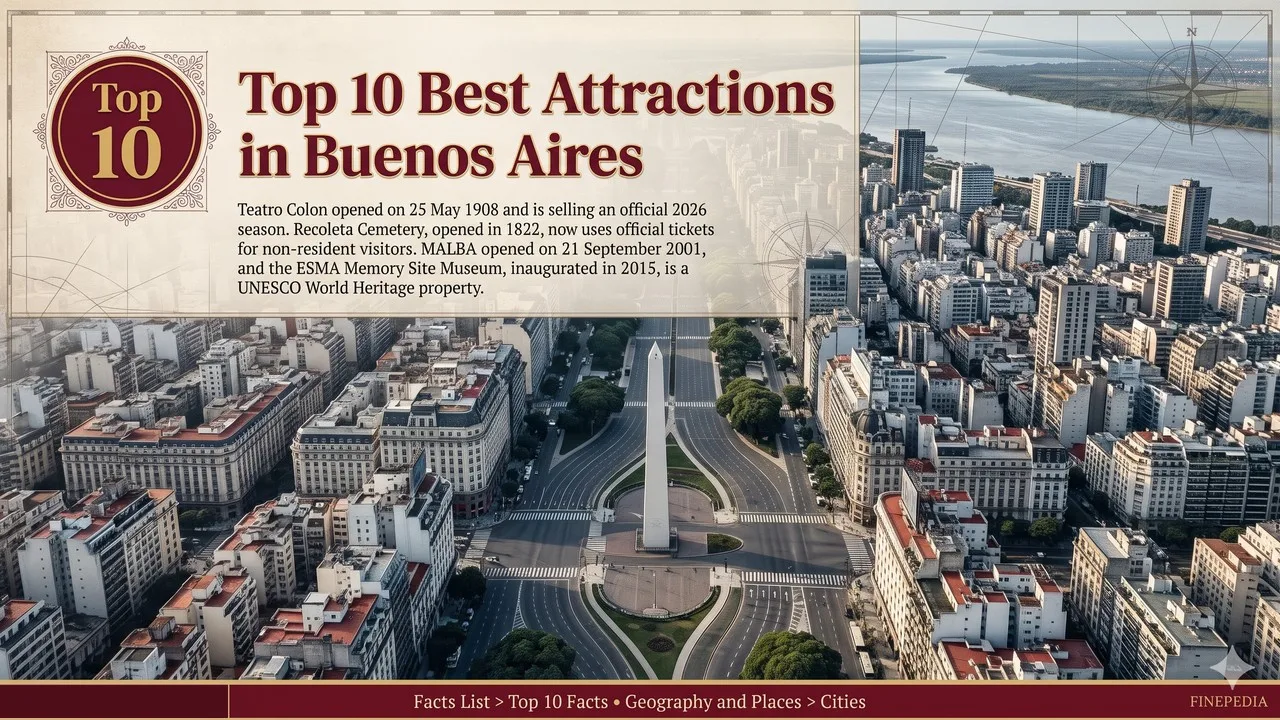
The best attractions in Buenos Aires are ranked here as official historic and cultural sites, including the 1908 Teatro Colon and the Recoleta Cemetery. Teatro Colon opened on 25 May 1908 with a performance of Verdi's Aida and remains a working official opera house, with guided visits and an official 2026 season sold on the theatre's own site [1][2]. Recoleta Cemetery opened in 1822 as the city's first public cemetery; non-resident visitors now buy official city tickets, while Argentine residents enter free with identity documents, a rule introduced in 2022 to fund conservation [3]. MALBA opened to the public on 21 September 2001, and the Museo Sitio de Memoria ESMA, inaugurated in 2015 in the former officers' casino of the Navy Mechanics School, was inscribed as UNESCO World Heritage in 2023 [4][5]. Those dated facts are why a 2026 list cannot still call the cemetery a free walk-in for every visitor or treat the Coliseum as only a postcard foyer.
Rank is editorial, by documentary importance and by official access. Theatre, museum, and cemetery tickets follow official channels. This article describes buildings, a plaza, a cemetery, and a street museum and does not copy official crests, exact facades, or Caminito murals in any featured image. Tigre and other sites outside the autonomous city are day trips, not intramural entries, the same method used for Versailles in the Paris list. MALBA Puertos, a later official venue in Escobar, is likewise outside the city ten.
A useful 2026 habit is to buy Colon tickets and cemetery entry from official sites, and to read the ESMA museum's official age and opening rules before a visit: the house is free, generally Tuesday to Sunday, and is not recommended for visitors under fifteen [1][3][5]. A later peso price at the cemetery will not change the 1822 founding; official city pages, not a screenshot, show the current tariff.
Key Facts
Opening, conversion, and inscription dates follow official theatre, city, museum, and UNESCO accounts. El Ateneo Grand Splendid opened as a theatre in 1919 and was converted into a bookstore in 2000; Caminito was established as an official open-air street museum in 1959 [6][7]. Rank 1 is the outstanding official lyric theatre, which is also the most precisely dated civic house in this ten.
Those booking habits matter because Colon performances and popular tour hours fill in the same weeks as holidays and the official season. A same-day walk-up can fail at the box office even when the facade is in view [1][2]. The table below is the official spine of the list: dates first, 2026 access second, and no delta town is smuggled into the intramural ten. The Rio de la Plata and the grid of avenidas are the documentary axes of the city; they are not themselves a numbered museum.
Buenos Aires Attractions at a Glance
| Rank | Attraction | Official date | 2026 note |
|---|---|---|---|
| 1 | Teatro Colon | Opened 25 May 1908 | Official tours and 2026 season tickets |
| 2 | Plaza de Mayo and Casa Rosada | Official civic plaza and presidential palace | A public square; palace tours and the museum follow official posted rules |
| 3 | Recoleta Cemetery | Opened 1822 | Official tickets for non-resident visitors; residents enter free with identity documents |
| 4 | Caminito, La Boca | Official open-air street museum, 1959 | A public street museum; painted facades are not copied here |
| 5 | Museo Nacional de Bellas Artes | Official national fine-arts museum | Official museum admission |
| 6 | MALBA | Opened 21 September 2001 | Official tickets; works are not reproduced here |
| 7 | El Ateneo Grand Splendid | Theatre opened 1919; bookstore from 2000 | A public bookstore in a historic theatre |
| 8 | Parque Tres de Febrero | Official Palermo park landscape | A free civic park; some interiors are separately ticketed |
| 9 | Metropolitan Cathedral | Official metropolitan cathedral on Plaza de Mayo | A working cathedral with posted visiting hours |
| 10 | Museo Sitio de Memoria ESMA | Inaugurated 2015; UNESCO inscription 2023 | Official free memory museum; not recommended for visitors under fifteen |
1. Teatro Colon
Teatro Colon, the official opera house of Buenos Aires, opened on 25 May 1908 with Verdi's Aida, after an earlier Coliseum had stood beside Plaza de Mayo, and it remains a working house of opera, ballet, and concerts, with official guided visits through historic rooms [1][2]. Official performance tickets and tour tickets are different products, both sold by the theatre. The 2026 season is posted on the official site. This article records the house and the date; it does not copy the exact auditorium in the featured image.
It is first as the outstanding official civic theatre, dated to a precise opening, and the documentary centre of the city's performance culture [1]. A later seat map will not change the 25 May 1908 inauguration.
The official Teatro Colon site is the only safe source [1][2].
2. Plaza de Mayo and Casa Rosada
Plaza de Mayo is the official civic square of the republic, and the Casa Rosada is the official presidential palace on its eastern side, with later official museum rooms and guided visits on posted days [8]. The square itself is public. Palace tours, when offered, follow official advance rules and can change with state business. The cathedral, listed separately in this ten, stands on the same square and is not a second palace ticket.
Related: Top 10 Best Attractions in Los Angeles
It is second as the outstanding official civic-plaza visit, the political room of the same city that built the Colon, and a public square rather than a ticketed hall [8]. A later balcony schedule will not change the plaza itself.
Official city and Casa Rosada visitor pages are the source [8].
3. Recoleta Cemetery
Recoleta Cemetery opened in 1822 as the city's first public cemetery and is now an official historic necropolis of vaults and later national monuments, including the Duarte family vault [3]. Official city tickets, sold through the city's official platform, apply to non-resident visitors; Argentine residents enter free with identity documents. The peso tariff changes and should be read on the official page, not from an old guidebook that still calls the cemetery free for everyone. Guided city tours, when offered, follow posted languages and hours.
It is third as the outstanding official cemetery visit, dated to 1822 and to a later ticket rule, and a conservation landscape rather than a private fright attraction [3]. A later tariff will not change the 1822 founding.
Official Entradas BA and city cemetery pages are the legal source [3].
4. Caminito, La Boca
Caminito, in La Boca, is the official open-air street museum established in 1959, on a former stream and later rail alignment, with painted conventillo facades and later public sculpture, after a neighbourhood and Benito Quinquela Martin campaign that the city recognised by ordinance [7]. Walking the street is public. Restaurants and private galleries are businesses, not the museum itself. This article records the official street; it does not copy the painted facades or murals in the featured image.
It is fourth as the outstanding official port-neighbourhood visit, dated to 1959 as a street museum, and a public lane rather than a gated theme street [7]. A later sculpture addition will not change the 1959 designation.
Related: Top 10 Best Attractions in Dublin
Official city tourism pages are the source [7].
5. Museo Nacional de Bellas Artes
The Museo Nacional de Bellas Artes is the official national fine-arts museum of Argentina, a state collection of Argentine and European art in its historic Recoleta building, and it remains a public museum with official admission rules [9]. Official tickets or posted free days follow the museum's own site. This article records the national museum; it does not reproduce the paintings. It is the encyclopedic counterpart to MALBA, not a second private collection under another name.
It is fifth as the outstanding official national-gallery visit, a civic collection rather than a street museum, and the Recoleta counterpart to the cemetery nearby [9]. A later exhibition will not change the museum itself.
The official museum site is the 2026 schedule [9].
6. MALBA
MALBA, the Museo de Arte Latinoamericano de Buenos Aires, opened to the public on 21 September 2001 as an official museum of modern and contemporary Latin American art, founded with Eduardo Costantini's gift, in a purpose-built Palermo house [4]. Official tickets are the way in. A later venue at Malba Puertos in Escobar is a related official house outside the city and is not a second rank in this ten. This article records the 2001 opening; it does not reproduce the works or copy the exact facade.
It is sixth as the outstanding official Latin American modern-art visit, dated to a precise opening, and a counterpart to the national fine-arts museum [4]. A later temporary show will not change the 21 September 2001 opening.
The official MALBA site is the legal source [4].
7. El Ateneo Grand Splendid
El Ateneo Grand Splendid, on Avenida Santa Fe, opened as the Grand Splendid theatre in 1919 and was converted into a bookstore in 2000, preserving the official historic auditorium as a public bookshop with a later cafe on the former stage [6]. Entering the shop during posted hours is the usual visit. It is a working bookstore, not a silent theatre museum, and it is not a second Colon.
Related: Top 10 Best Attractions in Porto
It is seventh as the outstanding official reused-theatre visit, dated to 1919 and to the 2000 conversion, and a Recoleta-side civic interior rather than a ticketed opera house [6]. A later shelf layout will not change those dates.
Official city tourism pages are the source [6].
8. Parque Tres de Febrero
Parque Tres de Febrero, the official park landscape of Palermo often called the Bosques de Palermo, is a documented civic park of lakes, later rose gardens, and tree-lined avenues, and much of it remains free to walk [10]. Some pavilions, planetarium hours, or garden corners follow official posted tickets. It is a park, not a second cemetery, and it is the city's outstanding official green landscape.
It is eighth as the outstanding official park visit, a counterpart to Plaza de Mayo as civic ground, and a free landscape rather than a ticketed hall [10]. A later boat hire will not change the park itself.
Official city park information is the source [10].
9. Metropolitan Cathedral
The Metropolitan Cathedral of Buenos Aires, the official cathedral of the archdiocese, stands on Plaza de Mayo as a working church with posted visiting hours and later museum or mausoleum rooms according to official notices [11]. It is a religious house on the civic square, not a palace annex. Dress and liturgical times restrict tourist circulation. This article records the official cathedral; it does not copy the exact facade.
It is ninth as the outstanding official cathedral visit, a necessary religious counterpart to the Casa Rosada on the same square, and a ticketed or posted interior rather than only a portico view [11]. A later treasury display will not change the cathedral itself.
Related: Top 10 Best Attractions in Jerusalem
Official cathedral notices set the interior rules [11].
10. Museo Sitio de Memoria ESMA
The Museo Sitio de Memoria ESMA is the official memory museum in the former officers' casino of the Navy Mechanics School, a building used as a clandestine detention centre during the last civic-military dictatorship, and it was inaugurated as a museum in 2015 and inscribed by UNESCO as World Heritage in 2023 [5]. Official admission is free. The house is generally open Tuesday to Sunday, with a last entry before closing, and official notices say the content is not suitable for visitors under fifteen [5]. This article records the official site and the dates; it treats the history as documented fact, not as advocacy, and it does not treat the building as decorative scenery.
It is tenth as the outstanding official memory-site visit, dated to 2015 and to the 2023 inscription, and a necessary civic fact in a capital list that would otherwise be only theatres, parks, and cemeteries [5]. A later audio-guide language will not change those dates.
Official government and museum pages are the source [5].
Conclusion
A 2026 Buenos Aires list has to keep Teatro Colon's 25 May 1908 opening, Recoleta Cemetery's 1822 founding and later official non-resident ticket rule, MALBA's 21 September 2001 opening, and the ESMA memory museum's 2015 inauguration and 2023 UNESCO inscription on the same page [1][3][4][5]. Around those dated facts sit Plaza de Mayo and the Casa Rosada, Caminito as a 1959 street museum, the national fine-arts museum, El Ateneo Grand Splendid from 1919 and 2000, Parque Tres de Febrero, and the Metropolitan Cathedral [6][7][8][9][10][11]. The useful habit is official booking at the Colon and the cemetery, a careful reading of the ESMA house rules, and a refusal to treat a crest, a mural, or a facade as something a featured image should copy.
Tigre remains a day trip. A later cemetery tariff or a later opera calendar will not change the 1908 theatre, the 1822 cemetery, or the 2001 museum. Those official dates are the spine of the list, and they will still be the spine after a ticket kiosk or a plaza schedule has changed in a later tourist season in the same river city.
- ^ [1] Official City of Buenos Aires and Teatro Colon information, theatre opened 25 May 1908. Teatro Colon
- ^ [2] Official Teatro Colon 2026 season and ticket information. Teatro Colon: 2026 tickets
- ^ [3] Official city information on Recoleta Cemetery, opened 1822, with official tickets for non-resident visitors. City of Buenos Aires: Recoleta Cemetery
- ^ [4] Official MALBA history, opened to the public 21 September 2001. MALBA
- ^ [5] Official Argentine government information on the Museo Sitio de Memoria ESMA, inaugurated 2015, UNESCO 2023. Museo Sitio de Memoria ESMA
- ^ [6] Official City of Buenos Aires information on El Ateneo Grand Splendid, theatre 1919, bookstore from 2000. El Ateneo Grand Splendid
- ^ [7] Official City of Buenos Aires information on Caminito as an open-air street museum, 1959. Caminito
- ^ [8] Official information on Plaza de Mayo and Casa Rosada visitor arrangements. City of Buenos Aires: Plaza de Mayo
- ^ [9] Official Museo Nacional de Bellas Artes visitor information. Museo Nacional de Bellas Artes
- ^ [10] Official city information on Parque Tres de Febrero, the Palermo park landscape. City of Buenos Aires: Parque Tres de Febrero
- ^ [11] Official Metropolitan Cathedral visitor information. Metropolitan CathedralTeatro Colon opened on 25 May 1908 and is selling an official 2026 season. Recoleta Cemetery, opened in 1822, now uses official tickets for non-resident visitors. MALBA opened on 21 September 2001, and the ESMA Memory Site Museum, inaugurated in 2015, is a UNESCO World Heritage property.






















Discussion
Log in with