






 By
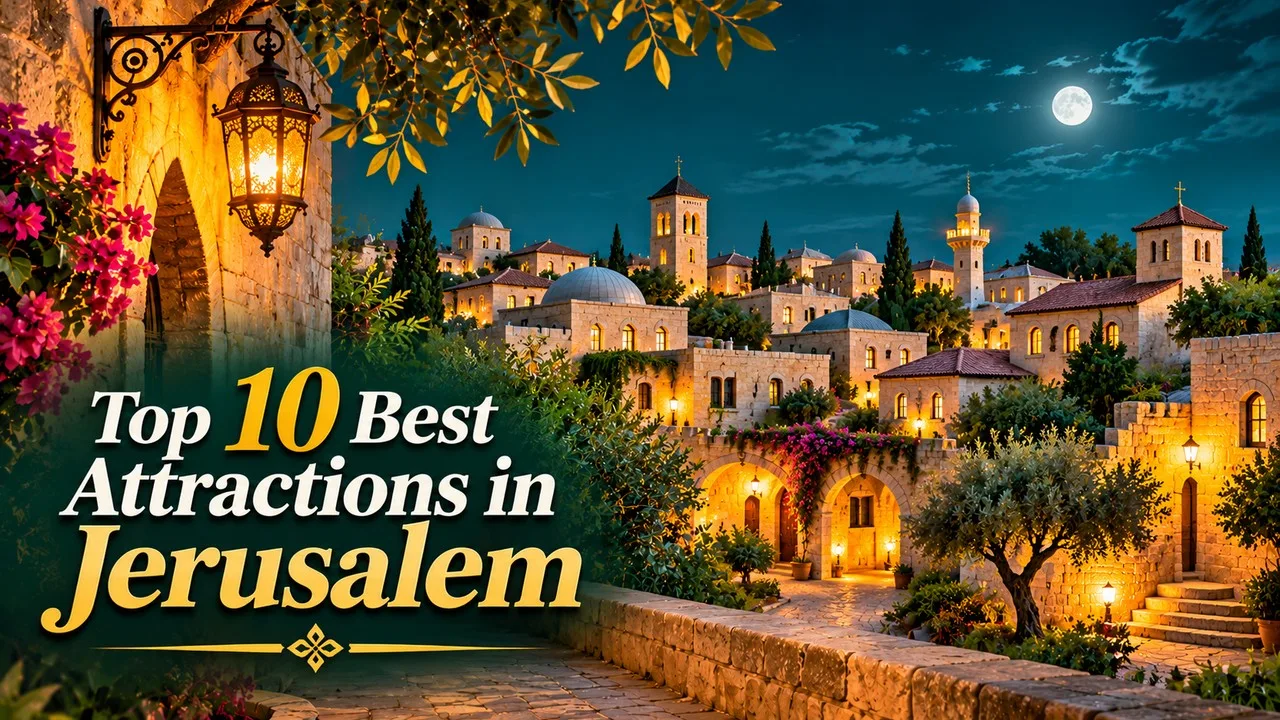
The best attractions in Jerusalem are ranked here as official historic and religious sites of more than one faith, with dated notes on access and opening rules. The Western Wall plaza is a public prayer and visitor space with official conduct and dress rules [1]. The Haram al-Sharif, also called the Temple Mount, is a living Muslim sanctuary of Al-Aqsa Mosque and the Dome of the Rock; non-Muslim visiting hours, when offered, are limited, seasonal, and can be cancelled, usually through the Mugrabi Gate, and the mosques themselves are generally not open to non-Muslim visitors [2]. The Church of the Holy Sepulchre is a working Christian church whose hours change by season [3]. Yad Vashem, the official World Holocaust Remembrance Center, is free to enter and requires advance reservation; it is closed on Saturdays and Jewish holidays, and the Holocaust History Museum is intended for visitors aged ten and older [4]. This article records official sites and posted rules. It does not take a political position, and it does not copy flags, crests, or sacred interiors in any featured image.
Rank is editorial, by documentary importance and by official access. Hours and security rules change, and a 2026 visitor should read official notices on the day of a visit rather than a printed timetable. Bethlehem and the Church of the Nativity stand in another city and are treated as a day trip, the same method used for Versailles in the Paris list.
A useful 2026 habit is to dress for religious sites, to reserve Yad Vashem in advance, to check Israel Museum hours (which vary by day), and to treat Haram al-Sharif / Temple Mount access as official and changeable, not as a guaranteed interior tour [2][4][5]. Unofficial guides cannot open a closed gate.
Key Facts
Opening, reservation, and access rules follow official memorial, museum, church, and visitor-service accounts. The Israel Museum opened in 1965, and the Shrine of the Book on its campus houses the official display of the Dead Sea Scrolls [5]. The Tower of David Museum occupies the historic citadel at Jaffa Gate [6]. Rank 1 is the outstanding official Jewish prayer and visitor plaza, which is also the documentary centre of the western wall of the Temple Mount retaining walls.
Those reservation habits matter because Yad Vashem slots and museum days fill around holidays, and a Friday schedule at several houses is shorter than a midweek one [4][5]. The table below is the official spine of the list: access first, dates second, and no site in Bethlehem is smuggled into the intramural ten. The Old City quarters are a historic urban fabric, not a tenth ticket.
Jerusalem Attractions at a Glance
| Rank | Attraction | Official date or character | 2026 note |
|---|---|---|---|
| 1 | Western Wall | Official prayer plaza at the retaining wall | Public plaza with official conduct and dress rules |
| 2 | Church of the Holy Sepulchre | Working Christian church on the traditional site of crucifixion and burial | Posted seasonal hours; a church, not a museum ticket |
| 3 | Haram al-Sharif / Temple Mount | Official Muslim sanctuary, including Al-Aqsa Mosque and the Dome of the Rock | Limited, changeable non-Muslim visiting hours; mosque interiors generally not open to non-Muslim visitors |
| 4 | Yad Vashem | Official World Holocaust Remembrance Center | Free; advance reservation required; closed Saturdays and Jewish holidays |
| 5 | Israel Museum and Shrine of the Book | Museum opened 1965 | Official tickets; hours vary by day |
| 6 | Tower of David Museum | Official citadel museum at Jaffa Gate | Official museum tickets |
| 7 | Mount of Olives and Garden of Gethsemane | Official hillside of churches, gardens, and viewpoints | Public paths and posted church hours |
| 8 | Via Dolorosa | Historic processional streets and station churches | A public walking route; interiors follow church hours |
| 9 | Mahane Yehuda Market | Official historic market | A public market; stall hours vary, especially around the Sabbath |
| 10 | Mount Zion | Historic hill of churches and related sites | Posted hours for official religious houses |
1. Western Wall
The Western Wall, the official prayer plaza at the exposed retaining wall of the Temple Mount, is a documented Jewish holy site and a public visitor space with official conduct, dress, and gender-section rules posted by the site administration [1]. The plaza is generally open to visitors. Writing a note, praying, or standing as a quiet visitor follows official notices. The wall is not a museum ticket, and it is not a substitute for the Haram al-Sharif / Temple Mount platform above, which is a separate official sanctuary with different rules.
It is first as the outstanding official Jewish holy site in the Old City, a public plaza rather than a closed shrine, and the documentary centre of the western approach to the sanctuary platform [1]. A later security arrangement will not change the site itself.
Official visitor information is the source [1].
2. Church of the Holy Sepulchre
The Church of the Holy Sepulchre is the official working church on the traditional Christian site of the crucifixion, burial, and resurrection, shared by several historic Christian communities, and it remains open on posted seasonal hours [3]. There is no single museum ticket for the church. Liturgical times, restoration work, and feast days can change circulation. This article records the church as an official religious house; it does not copy the interior in the featured image.
Related: Top 10 Best Attractions in Budapest
It is second as the outstanding official Christian church visit, a counterpart to the Western Wall and to the Haram al-Sharif, and a living sanctuary rather than a ruined monument [3]. A later hour board will not change the church itself.
Official church and Christian Information Center notices set the hours [3].
3. Haram al-Sharif / Temple Mount
The Haram al-Sharif, also called the Temple Mount, is the official elevated sanctuary in the Old City, the site of Al-Aqsa Mosque and the Dome of the Rock, and a place of outstanding importance in Islam, Judaism, and Christianity [2]. Non-Muslim visiting hours, when they are offered, are limited, usually on weekdays, change with the season, and can be cancelled without a long warning; entry for that visitor category is generally by the Mugrabi Gate ramp from the Western Wall plaza [2]. Al-Aqsa Mosque and the Dome of the Rock are generally not open to non-Muslim visitors. Dress and conduct rules are official. This article uses both historic names, records the access facts, and does not argue a political claim.
It is third as the outstanding official sanctuary platform, and as a 2026 case where honesty means a changeable official timetable, not a promise of an interior visit [2]. A later official hour or a later closure will belong in a revision.
Official posted notices on the day of a visit are the source [2].
4. Yad Vashem
Yad Vashem, the official World Holocaust Remembrance Center on the Mount of Remembrance, is a documented campus of museums, archives, and memorials, including the Holocaust History Museum, and it is free to visit with mandatory advance reservation [4]. Official opening hours are shorter on Fridays and holiday eves, and the campus is closed on Saturdays and Jewish holidays. Official notices state that entrance to the Holocaust History Museum is from age ten. This article records the official memorial; it does not treat the site as decorative architecture.
It is fourth as the outstanding official Holocaust memorial visit, a necessary civic counterpart to the Old City sanctuaries, and a reserved free campus rather than a walk-up museum [4]. A later reservation system will not change the institution itself.
Related: Top 10 Best Attractions in Buenos Aires
The official Yad Vashem reservation pages are the legal source [4].
5. Israel Museum and Shrine of the Book
The Israel Museum, the official national museum of art, archaeology, and Jewish culture, opened in 1965, and the Shrine of the Book on its campus is the official display building for the Dead Sea Scrolls [5]. Official tickets are the way in. Hours vary by day and should be read on the museum's own site. The Shrine is part of this official campus, not a second museum in this ten. This article records the museum and the date; it does not reproduce manuscripts or artworks.
It is fifth as the outstanding official encyclopedic-museum visit, dated to 1965, and a counterpart to Yad Vashem as a documentary house [5]. A later weekday closure will not change the 1965 opening.
The official Israel Museum site is the 2026 schedule [5].
6. Tower of David Museum
The Tower of David Museum, the official museum in the historic citadel beside Jaffa Gate, presents the documented history of the city in a fortress of several periods, and it remains a ticketed museum with posted hours that vary by day [6]. Official tickets are the way in. Night programmes, when offered, are a separate official product. The citadel is a museum, not a substitute for the religious sites inside the walls.
It is sixth as the outstanding official citadel visit, the civic museum at the Old City entrance, and a ticketed house rather than a free gate [6]. A later exhibition will not change the museum itself.
The official Tower of David site is the legal source [6].
7. Mount of Olives and Garden of Gethsemane
The Mount of Olives, with the Garden of Gethsemane and associated official churches, is a documented hillside of Christian sanctuaries, historic cemeteries, and viewpoints over the Old City [7]. Paths and viewpoints are largely public. Church interiors, including the Church of All Nations, follow posted hours. The hill is a landscape of more than one community, not a single ticketed park.
Related: Top 10 Best Attractions in Porto
It is seventh as the outstanding official hillside visit, a counterpart to the sanctuaries inside the walls, and a place of churches and views rather than a museum campus [7]. A later church hour will not change the hill itself.
Official church and visitor notices are the source [7].
8. Via Dolorosa
The Via Dolorosa is the official historic processional route in the Old City, a sequence of streets and station churches used in Christian devotion, and it remains a public walking itinerary rather than a single ticketed monument [8]. Some station interiors are chapels with posted hours; others are simply points on the street. Friday processions, when held, follow church and municipal arrangements. This entry is the route, not a second Holy Sepulchre, though the walk traditionally ends there.
It is eighth as the outstanding official processional visit, a street-and-church itinerary, and a documented Christian route through a living city [8]. A later station chapel hour will not change the route itself.
Official church and city descriptions are the source [8].
9. Mahane Yehuda Market
Mahane Yehuda Market is the official historic market of west-central Jerusalem, a public commercial landscape of stalls and later restaurants, and it remains freely walkable during ordinary market hours, which typically shorten toward the Sabbath [9]. It is a market, not a sanctuary, and it is the outstanding official civic-market visit outside the Old City walls. Shop interiors are private businesses.
It is ninth as the outstanding official market visit, a counterpart to the religious houses, and a public street market rather than a ticketed bazaar [9]. A later stall map will not change the market itself.
Related: Top 10 Best Attractions in Los Angeles
Official city information is the source [9].
10. Mount Zion
Mount Zion, immediately south of the Old City, is a historic hill of official religious houses and commemorative sites, including churches and related rooms with posted visiting hours [10]. Access follows each house's official rules. The hill is a compact official precinct of more than one tradition, not a single museum, and it is inside the municipal city rather than a day trip.
It is tenth as the outstanding official hill just outside the walls, a counterpart to the Mount of Olives, and a cluster of posted religious interiors rather than a free viewpoint only [10]. A later chapel hour will not change the hill itself.
Official site notices are the source [10].
Conclusion
A 2026 Jerusalem list has to hold, on the same page and without advocacy, the Western Wall plaza, the Church of the Holy Sepulchre, and the Haram al-Sharif / Temple Mount, whose non-Muslim visiting hours are limited and changeable and whose mosque interiors are generally not open to non-Muslim visitors [1][2][3]. Around those official sanctuaries sit Yad Vashem, which is free and must be reserved, the Israel Museum and Shrine of the Book from 1965, the Tower of David Museum, the Mount of Olives and Gethsemane, the Via Dolorosa, Mahane Yehuda Market, and Mount Zion [4][5][6][7][8][9][10]. The useful habit is official notices on the day of a visit, modest dress, a Yad Vashem reservation, and a refusal to treat a flag, a crest, or a sacred interior as something a featured image should copy.
Bethlehem remains a day trip in another city. A later change in sanctuary hours will belong in a revision of the 2026 access lines; it will not change the character of the houses themselves. Those official sites and rules are the spine of the list, and they will still be the spine after a reservation screen or a gate timetable has changed in a later season in the same historic city.
- ^ [1] Official Western Wall visitor information and conduct rules. Western Wall
- ^ [2] Documented visitor-access practice for the Haram al-Sharif / Temple Mount, including limited non-Muslim hours and generally closed mosque interiors. Official notices on the day of a visit take priority. Christian Information Center / official notices
- ^ [3] Official and church information on the Church of the Holy Sepulchre, including seasonal hours. Christian Information Center
- ^ [4] Official Yad Vashem visiting information: free entry, advance reservation required, closed Saturdays and Jewish holidays. Yad Vashem
- ^ [5] Official Israel Museum visitor information, museum opened 1965, including the Shrine of the Book. Israel Museum
- ^ [6] Official Tower of David Jerusalem Museum visitor information, Jaffa Gate. Tower of David Museum
- ^ [7] Official and church information on the Mount of Olives, Gethsemane, and associated churches. Christian Information Center
- ^ [8] Official and church descriptions of the Via Dolorosa as a processional route. Christian Information Center
- ^ [9] Official city information on Mahane Yehuda Market. City of Jerusalem
- ^ [10] Official information on Mount Zion religious houses and posted visiting hours. Christian Information Center






















Discussion
Log in with