






 By
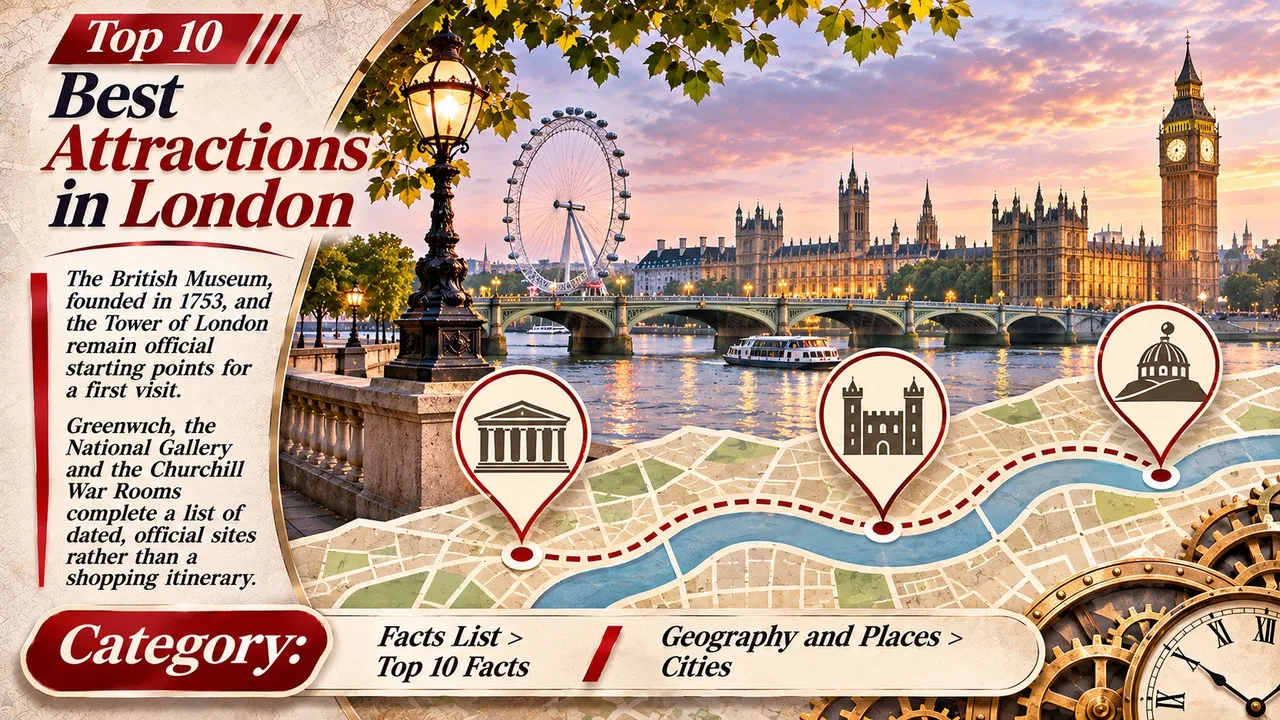
The best attractions in London are ranked here as official historic and cultural sites, with visiting notes checked for 2026. The list favours museums, royal and parliamentary buildings, and a maritime World Heritage landscape at Greenwich, not a shopping street or a purely commercial viewpoint, though some of those have their own honest pleasures [1][2]. Security, timed tickets, and ceremony days can close or slow a door; official institutional sites are the last word [1][3].
Rank is editorial, by documentary importance and by whether a 2026 visitor can actually enter or stand there under official rules. Several major museums remain free to enter, with charges for special exhibitions, a civic fact that still shapes a London day [2][4]. Finepedia's architecture articles already treat some of these buildings as fabric; this list treats them as visits. A purely commercial observation wheel or a shopping arcade can be a pleasant hour, and this article does not deny that; it simply ranks official historic and cultural sites, so that a first-time plan has a dated, checkable core rather than a list of paid viewpoints with changing brand names.
Key Facts
Founding and opening years follow official institutional histories. A useful 2026 habit is to book the Tower, the Abbey, the War Rooms, and the Greenwich observatory in advance, and to leave un-ticketed time for the free national galleries. Rank 1 is the outstanding official encyclopaedic museum.
London Attractions at a Glance
| Rank | Attraction | Official date | 2026 visiting note |
|---|---|---|---|
| 1 | British Museum | Founded 1753, public from 1759 | Free general entry; some exhibitions ticketed |
| 2 | Tower of London | White Tower from the 1070s | Historic Royal Palaces tickets; Crown Jewels |
| 3 | National Gallery | Founded 1824 | Free general entry in Trafalgar Square |
| 4 | Westminster Abbey | Gothic coronation church, long medieval and later fabric | Ticketed; a working church and a royal peculiar |
| 5 | Palace of Westminster | Medieval palace rebuilt after 1834; Elizabeth Tower later | Tours when the house timetable allows |
| 6 | Tate Modern | Opened 2000, in the former Bankside power station | National modern-art museum, generally free |
| 7 | St Paul's Cathedral | Rebuilt after 1666; Wren's church | Ticketed cathedral and dome |
| 8 | Buckingham Palace | Official royal residence | Changing the Guard; State Rooms in a seasonal opening |
| 9 | Maritime Greenwich | Official observatory, meridian, and maritime museums | A UNESCO landscape; observatory tickets |
| 10 | Churchill War Rooms | Cabinet rooms of the Second World War | Imperial War Museums, timed tickets |
1. British Museum
The British Museum was founded in 1753 and opened to the public in 1759, and it remains the country's principal encyclopaedic museum, free at the main entrance, in a later nineteenth-century building around the later Great Court [2][5]. Its collections, including Egyptian sculpture and the Parthenon sculptures from the Acropolis, are the subject of continuing public and diplomatic debate about where they should be; that debate is part of the institution's 2026 life and is recorded here as a fact, not as a verdict [5].
It is first as the outstanding official museum visit, with a founding date that can be checked and a free general door that still exists [2][5]. Special exhibitions are ticketed and should be booked.
Security screening is routine. The official site lists room closures [5].
2. Tower of London
The Tower of London, a Historic Royal Palaces site, is a fortress-palace whose White Tower dates from the 1070s, begun under William I, and which later served as a prison, a mint, and the setting for the Crown Jewels [3]. Official tickets include the jewels exhibition and the medieval walls. Yeoman Warder tours are a documented official offering, not a private add-on invented at the gate.
It is second as the outstanding official medieval fortress visit in the city, with a documented origin in the decade after the Norman conquest [3]. The river and Tower Bridge, opened in 1894, are the approach, not a substitute for the fortress.
Peak queues are long. Official advance tickets are the 2026 habit [3].
3. National Gallery
The National Gallery, founded in 1824, stands on Trafalgar Square as the national collection of Western painting, with free general entry and ticketed temporary shows [4]. The building has grown in stages around the original Wilkins facade. The square, with Nelson's Column, is a civic space rather than part of the ticket.
Related: Top 10 Most Bizarre Phobias: Strange Fears That Exist
It is third as the outstanding official painting gallery, a short walk from the official ceremonial spine of Whitehall [4]. It is not the same institution as Tate Britain or Tate Modern, which hold other official collections.
Room closures for hanging are normal. The official site is the room list [4].
4. Westminster Abbey
Westminster Abbey is the coronation church of the English and later British monarchy, a great Gothic church that is a royal peculiar rather than a cathedral, with a long medieval fabric and later additions, including the Henry VII chapel [6]. It is ticketed for visitor hours and remains a working church, with services that can close or pause tourist routes. Many statesmen and writers are buried or memorialised here; that is a documented commemorative function, not a theme.
It is fourth as the official coronation church, a visit with a different legal status from a parish or a cathedral [6]. Photography rules and shrine areas are posted.
Sunday and service times change the access. The Abbey's own site is the timetable [6].
5. Palace of Westminster
The Palace of Westminster, the meeting place of the House of Commons and the House of Lords, is a largely nineteenth-century Gothic Revival complex built after the fire of 1834, incorporating Westminster Hall, which is medieval [7]. Elizabeth Tower, popularly associated with the great bell, is part of the same official ensemble. Tours and the visitor galleries depend on the parliamentary timetable, security, and, in some years, ongoing conservation.
It is fifth as the official parliamentary palace, a working legislature first and a visitor attraction second [7]. A ceremony day or a sitting can change a tour slot overnight.
Related: Top 10 Oldest Buildings in the World
Official parliament tickets, not third-party resellers, are the path [7].
6. Tate Modern
Tate Modern opened on 12 May 2000 in the former Bankside Power Station, a mid-twentieth-century industrial building converted as the national museum of international modern and contemporary art, with a later extension [8]. General entry is free; special exhibitions are ticketed. The turbine hall is part of the official visit, a civic room as well as a gallery.
It is sixth as the outstanding official modern-art visit, with a firm opening year, and as a counterpart to the National Gallery's older collection [8]. The river walk and the Millennium Bridge are the usual approach.
Late hours on some evenings are published by the museum. The official site is the check [8].
7. St Paul's Cathedral
St Paul's Cathedral is the Anglican cathedral of the Diocese of London, rebuilt to a design by Christopher Wren after the Great Fire of 1666, with the present church rising in the late seventeenth and early eighteenth centuries [9]. It is ticketed for visitor hours, with a dome climb as a major official itinerary. The cathedral remains a working church and a national ceremonial site.
It is seventh as the official Wren cathedral visit, a documented post-fire rebuilding rather than a medieval survival [9]. Whispering-gallery and dome stages can close in bad weather or for works.
Service times affect tourist entry. The cathedral's own tickets are the official ones [9].
Related: The Science Behind Auroras: How Solar Winds Create Colorful Skies
8. Buckingham Palace
Buckingham Palace is the official London residence of the monarch, with a seasonal official opening of the State Rooms in the summer, and with the Changing the Guard on the forecourt as a free public ceremony on published days [10]. The palace is a working official building, not a year-round indoor museum. Flag and ceremony notices tell you when the household is in residence.
It is eighth as the official royal-residence visit, a combination of a free outdoor ceremony and a ticketed seasonal interior [10]. The ceremony can be cancelled or moved; the Household Division's notices are the source.
Crowds on the Mall are ordinary on ceremony days. The railings are not a seating plan [10].
9. Maritime Greenwich
Maritime Greenwich is a UNESCO World Heritage landscape on the south bank of the Thames, including the Royal Observatory and the Prime Meridian, the National Maritime Museum, the Queen's House, and the Cutty Sark [11]. The observatory and some ships are ticketed; the park and some museum areas have their own official rules. The meridian line is a scientific and tourist fact at once.
It is ninth as the official scientific and maritime visit, a short train or boat ride from central London and still part of the city's documented attraction set [11]. It is not a second-rank add-on; it is a World Heritage site.
The hill to the observatory is steep. Official combined tickets are often the efficient path [11].
Related: Top 10 Tallest Buildings in the World
10. Churchill War Rooms
The Churchill War Rooms, part of Imperial War Museums, preserve the underground Cabinet War Rooms used by the British government in the Second World War, with a later museum dedicated to Winston Churchill [12]. Timed official tickets are the 2026 visiting method in a confined historic space. The rooms are a documented wartime workplace, not a stage set.
It is tenth as the outstanding official twentieth-century history visit in this ten, a necessary modern counterpart to the medieval tower and the Wren cathedral [12]. Capacity is limited, which is why the time slot exists.
The basement is close and can be crowded. The official IWM site is the booking office [12].
Conclusion
A 2026 London list of official attractions can reasonably run from the British Museum, founded in 1753, and the Tower, through the National Gallery, Westminster Abbey, the Palace of Westminster, Tate Modern in 2000, St Paul's, Buckingham Palace, Maritime Greenwich, and the Churchill War Rooms [2][3][8][12]. Free national galleries and ticketed royal and war sites will sit in the same day, which is a civic fact, not a contradiction.
The useful habit is to book the paying houses on their own sites and to keep un-ticketed hours for the free museums. Ceremony days, sittings of Parliament, and conservation closures will move a plan faster than a ranked table will, which is why the official timetable is part of the attraction. For a historic cinema in the same city, see the Electric Cinema in this batch's movie-theater list. For football grounds, see the European football-cities article, where London ranks first for club density and Wembley. A later year may alter a palace opening season; it will not alter the 1753 founding of the British Museum or the 12 May 2000 opening of Tate Modern at Bankside, which remain the dated anchors of this official ten for any serious first visit to the city in the present year of 2026 after the official status checks listed above here.
- ^ [1] Official Visit London / Mayor of London visitor information. Visit London
- ^ [2] Official British Museum history, founded 1753, public from 1759. British Museum
- ^ [3] Historic Royal Palaces, Tower of London, White Tower from the 1070s. Tower of London
- ^ [4] Official National Gallery history, founded 1824. National Gallery
- ^ [5] British Museum collection and visiting notices, including room and exhibition information. British Museum visits
- ^ [6] Official Westminster Abbey visitor information. Westminster Abbey
- ^ [7] Official UK Parliament visitor information, Palace of Westminster. UK Parliament
- ^ [8] Official Tate Modern history, opened 12 May 2000. Tate Modern
- ^ [9] Official St Paul's Cathedral history and tickets. St Paul's Cathedral
- ^ [10] Official Royal Household information on Buckingham Palace and Changing the Guard. The Royal Family
- ^ [11] Royal Museums Greenwich and UNESCO information on Maritime Greenwich. Royal Museums Greenwich
- ^ [12] Imperial War Museums, Churchill War Rooms, official tickets. Churchill War Rooms






















Discussion
Log in with