






 By
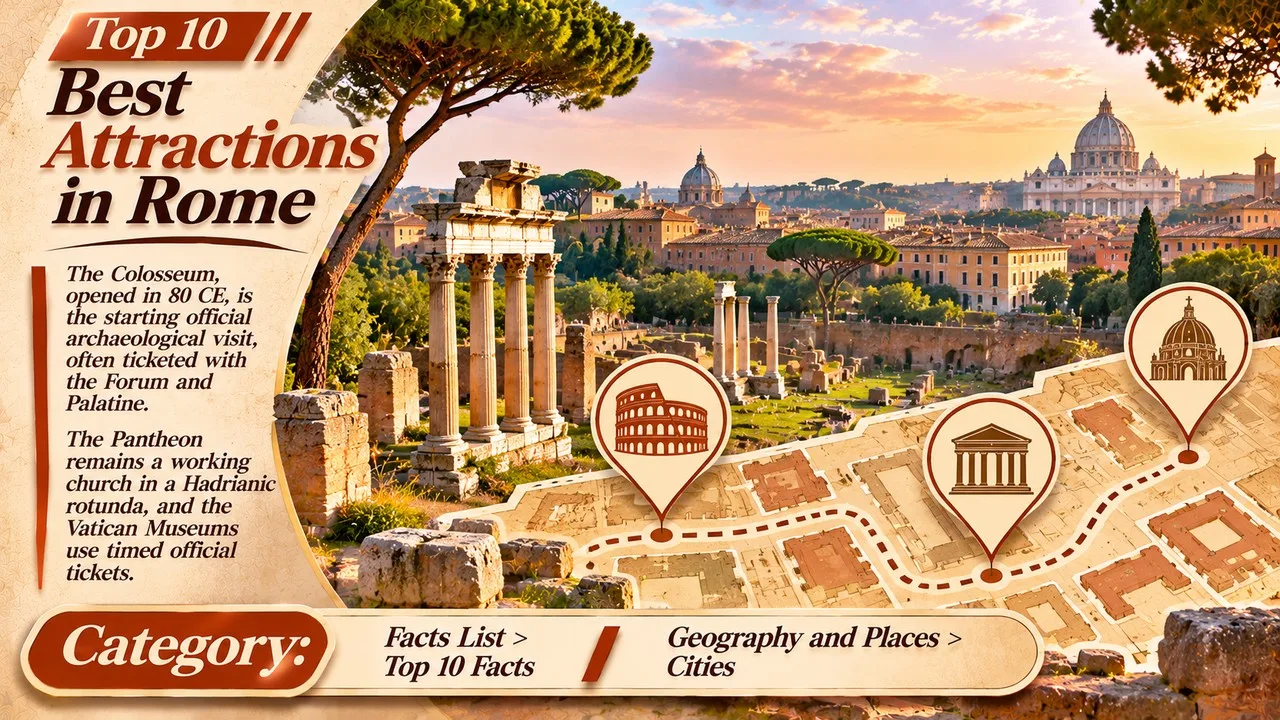
The best attractions in Rome are ranked here as official historic sites, with ticketing and access described as they stood in 2026. The city's official archaeological park, the Vatican's ticketed museums, and a handful of still-working churches and piazzas are the core of a serious first visit. Street sellers of "skip the line" paper are not official box offices, a point the park and the Vatican both have to keep repeating [1][2].
Rank is editorial, by documentary importance and by whether a 2026 visitor can actually enter under official rules. Combined tickets, time slots, dress codes, and restoration closures move during the year; the official sites are the last word [1][3]. Finepedia's ancient-architecture article already treats the Colosseum and the Pantheon as buildings; this list treats them as Rome visits.
Key Facts
Dates follow official or standard archaeological and church histories. Rank 1 is the outstanding official amphitheatre visit.
Rome Attractions at a Glance
| Rank | Attraction | Official date or type | 2026 visiting note |
|---|---|---|---|
| 1 | Colosseum | Opened 80 CE | Official park tickets; often bundled with the Forum |
| 2 | Roman Forum and Palatine Hill | Republican and imperial civic centre | Usually part of the same official archaeological ticket path |
| 3 | Pantheon | Hadrianic rebuilding, about 118 to 128 CE | Still a church; entry rules can include queues or tickets |
| 4 | Vatican Museums and Sistine Chapel | Museum complex; chapel frescoes 1508 to 1541 | Timed official tickets and a dress code |
| 5 | St Peter's Basilica | Present church consecrated 1626 | Security checks; the dome is a separate climb |
| 6 | Trevi Fountain | Completed 1762 | A public fountain; no wading |
| 7 | Galleria Borghese | Villa collection, timed tickets | Official reservations are effectively required |
| 8 | Castel Sant'Angelo | Hadrian's mausoleum, later a papal fortress | Official museum and terrace |
| 9 | Piazza Navona | Public piazza on the Stadium of Domitian | Open civic space with historic fountains |
| 10 | Capitoline Museums | Public collections on the Capitoline Hill | Official civic museums above the Forum |
1. Colosseum
The Flavian Amphitheatre, known as the Colosseum, was begun under Vespasian and opened in 80 CE under Titus, with later work under Domitian [1][4]. It is the largest Roman amphitheatre and the centre of the Parco archeologico del Colosseo. Official tickets, including those that also cover the Forum and Palatine, are the legal way in. Underground and upper-tier itineraries, when offered, are extras on that official menu.
It is first as the city's essential official ruin visit, with a completion date that can be checked and a ticket system that a 2026 visitor has to use [1][4]. The popular name comes from a later colossal statue nearby, not from the opening day.
Restoration, shade, and summer heat are practical facts. Unofficial tour touts at the exits are not the park [1].
2. Roman Forum and Palatine Hill
The Roman Forum is the civic valley of ancient Rome, a layered field of temples, basilicas, and paving, and the Palatine Hill above it is the imperial residential ridge, now one official archaeological landscape with the Colosseum park [1][4]. A first visit is easier if the visitor treats the two as one walk, because that is how the ticketing and the paths are designed.
It is second because the Forum is the documentary centre of the Roman city, even when it is less photogenic than the amphitheatre [4]. Stones here are often foundations and fragments; the importance is historical, not smoothness.
Shade is scarce at midday. Official maps and the park app, not a random path over a barrier, are the route [1].
Related: Top 10 Most Spiritual Sites in the World
3. Pantheon
The Pantheon, a Hadrianic rebuilding usually dated about 118 to 128 CE, remains a complete Roman rotunda with a concrete dome and oculus, and it is still used as a church, Santa Maria ad Martyres [5]. Finepedia's ancient-wonders list treats the dome as architecture. This entry is the visit: an interior you can still stand in, with entry rules that have at times included queues, capacity caps, or tickets, and that should be checked before a 2026 arrival [5].
It is third as the outstanding intact ancient interior in the city, still in liturgical use [5]. The Agrippa inscription on the porch is part of the building's long story, not a separate attraction.
Rain through the oculus is a real, ordinary event. Behaviour inside is church behaviour [5].
4. Vatican Museums and Sistine Chapel
The Vatican Museums are the official public collections of the Vatican City, ending for most visitors in the Sistine Chapel, whose ceiling Michelangelo painted from 1508 to 1512 and whose altar wall received the Last Judgment from 1536 to 1541 [2][6]. Timed official tickets, security, and a dress code are the 2026 facts. The museums are in Vatican City, a separate state, which is why the border and the rules feel different from a municipal ruin.
It is fourth as the principal official museum visit in the city, and as a chapel that is both a work of art and a working liturgical space [2][6]. Photography rules in the chapel have been strict; the posted rule is the rule.
Last-minute unofficial tickets are a common problem. The official Vatican ticket office is the source [2].
5. St Peter's Basilica
The present St Peter's Basilica, the great church of the Vatican, was consecrated in 1626 after a long sixteenth- and seventeenth-century rebuilding, with a dome associated with Michelangelo and a nave that later received Bernini's baldachin [6]. Security screening is routine. The basilica is usually entered without a museum ticket; the dome climb is a separate, ticketed ascent. It is a church first.
Related: Top 10 Colosseum Facts and Myths: What Really Happened in Rome's Arena
It is fifth as the official basilica visit, the counterpart to the ticketed museums next door [6]. A visitor can see the church without seeing the Sistine Chapel, and the reverse, by two different doors and two different rules.
Queues move with audiences, holidays, and security. Official notices of closures, including for papal events, outrank a guidebook hour [6].
6. Trevi Fountain
The Trevi Fountain, in the rione Trevi, was completed in 1762 to a design by Nicola Salvi, a monumental public fountain at the end of an ancient aqueduct line, restored in recent years and again a crowded open-air room of the city [7]. The custom of tossing a coin is a modern tourist habit with official collection arrangements; wading and eating on the stone are not part of that habit and are restricted.
It is sixth as the outstanding official Baroque fountain, a free public monument that needs no ticket and therefore needs more self-restraint [7]. It is a fountain, not a pool.
Early morning is quieter. The official city rules, including any temporary barriers during maintenance, govern the basin [7].
7. Galleria Borghese
The Galleria Borghese, in the Villa Borghese, holds the Borghese collection of sculpture and painting, including celebrated works by Bernini and Caravaggio, and it is visited on official timed tickets in strictly limited groups [8]. The villa is the container as well as the collection. Without a reservation, a 2026 visitor should not count on walking in.
It is seventh as the outstanding official small museum in the city, where the ticket system is part of the conservation of a house that cannot take Louvre-scale crowds [8]. The park around it is a separate, public pleasure.
Related: Top 10 Tallest Church Buildings in the World
Ticket name rules and short visiting slots are real. The official gallery site is the only safe booking path [8].
8. Castel Sant'Angelo
Castel Sant'Angelo began as the mausoleum of Hadrian and became a papal fortress, prison, and treasury, linked to the Vatican by a later elevated passage, and it is now an official museum with a terrace over the river [9]. The building is a short history of imperial and papal Rome in one drum. Official tickets cover the interiors and the view.
It is eighth as a monument that is not a church and not a ruin field, a fortress-museum with a clear official visiting path [9]. The adjacent bridge, with later statues, is the ceremonial approach.
The terrace is a viewpoint, not an unofficial climbing wall. Museum routes can close room by room for works [9].
9. Piazza Navona
Piazza Navona is a public piazza whose long outline follows the Stadium of Domitian, a rare case of an ancient entertainment building still readable in a living square, with later fountains including Bernini's Fountain of the Four Rivers of 1651 [10]. There is no ticket. The square is civic space, cafe space, and a historic floor plan at once.
It is ninth as the outstanding official piazza visit, a place to stand without a reservation, whose unusual fact is the stadium underneath the baroque room [10]. Street commerce is not the monument.
Related: Top 10 Most Bizarre Phobias: Strange Fears That Exist
Evening and morning feel like different squares. The fountains are official monuments, not dipping pools [10].
10. Capitoline Museums
The Capitoline Museums, on the hill above the Forum, are civic museums in palaces around a piazza associated with Michelangelo, with a public-collection history conventionally traced to a papal donation of bronzes in 1471 and to a later museum opening [11]. The collections look down on the same ancient centre that this list began with, which is why they close the ten. Official tickets are required.
It is tenth as the city's own official museum of its antiquities and civic art, as opposed to the Vatican's [11]. The bronze statue of Marcus Aurelius, in copy on the piazza and in the original inside, is one of the documented highlights, not the whole visit.
The hill is a walk from the Forum. Combined civic-museum tickets sometimes exist; the official civic site is the check [11].
Conclusion
A 2026 Rome list is a list of official doors and a few open squares: the Colosseum and the Forum-Palatine walk, the Pantheon still in use as a church, the Vatican Museums and St Peter's under two different rules, the Trevi Fountain, the tightly timed Galleria Borghese, Castel Sant'Angelo, Piazza Navona, and the Capitoline Museums [1][2][8]. Ticketing has become more timed and more official, which is a conservation fact as well as a tourist one.
The useful habit is to book the park and the Vatican on their own sites, and to treat a piazza as a place to stand rather than as a set to climb. Heat, dress codes, and a short Borghese slot will shape the day more than a ranked list will, which is why the official clock matters as much as the opening year. For the Colosseum and the Pantheon as ancient architecture, see the companion wonders article in this batch. For football as a city experience, Rome's Olympic Stadium is a different Finepedia subject, not a missing eleventh ruin. A later restoration can close a room; it will not move the 80 CE opening of the amphitheatre or the 1626 consecration of the present basilica of St Peter in the Vatican City State, a separate sovereign independent territory.
- ^ [1] Parco archeologico del Colosseo, official tickets and visiting information. Colosseum Archaeological Park
- ^ [2] Official Vatican Museums ticket office and visitor rules. Vatican Museums
- ^ [3] Official Roma Turismo visiting guidance. Turismo Roma
- ^ [4] Standard official chronologies, Colosseum opened 80 CE, Forum and Palatine as one park. Colosseum park history
- ^ [5] Official and church information on the Pantheon, Hadrianic rebuilding, about 118 to 128 CE. Pantheon
- ^ [6] Official Basilica of St Peter and Vatican information, present church consecrated 1626, Sistine Chapel dates. Vatican
- ^ [7] Official City of Rome information on the Trevi Fountain, completed 1762. City of Rome
- ^ [8] Official Galleria Borghese timed-ticket information. Galleria Borghese
- ^ [9] Official Castel Sant'Angelo museum information. Castel Sant'Angelo
- ^ [10] Official information on Piazza Navona and the Stadium of Domitian. Turismo Roma: Piazza Navona
- ^ [11] Official Capitoline Museums information. Capitoline Museums





















Discussion
Log in with