






 By
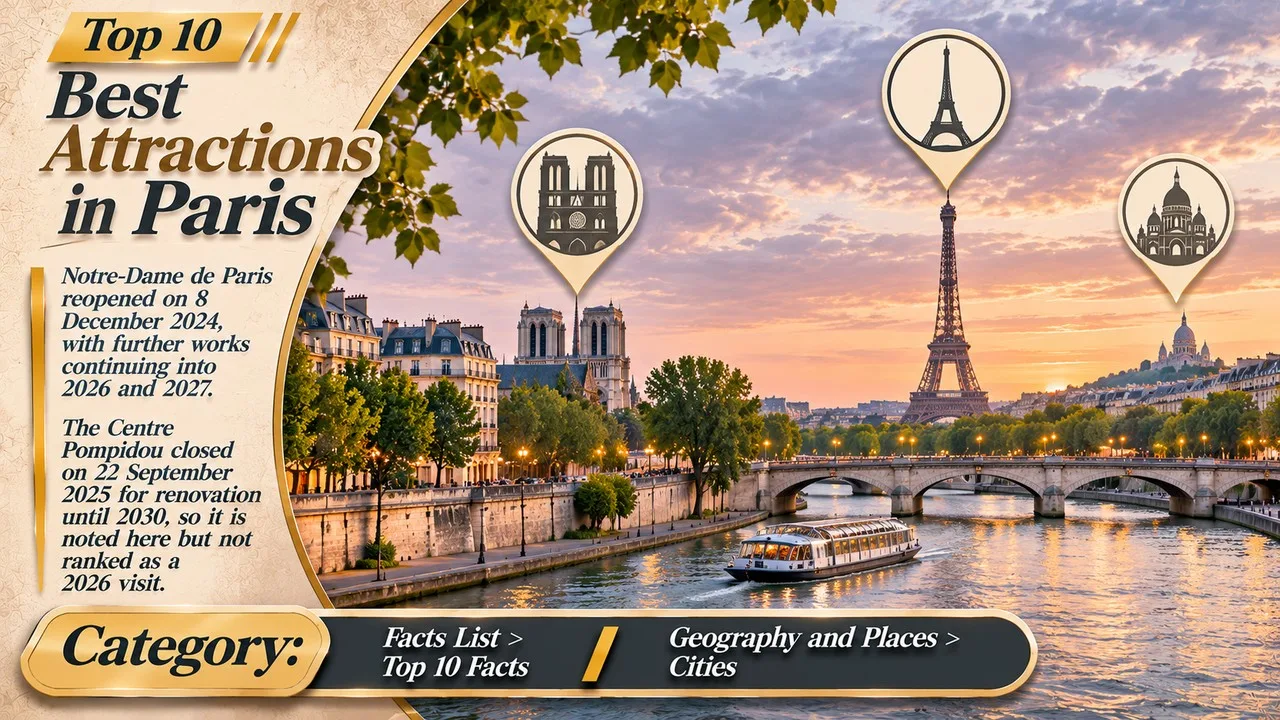
The best attractions in Paris are ranked here as official historic and cultural sites, with 2026 status notes for Notre-Dame and the closed Centre Pompidou. The Centre Pompidou, a landmark of 1977, closed to the public on 22 September 2025 for a renovation due to last until 2030; a small project space, the Maison Pompidou, opened on the piazza on 13 February 2026 [1][2]. It is therefore discussed in this introduction and not ranked as a visitable museum in 2026. The Palace of Versailles, the principal official day trip beyond the city, is likewise noted rather than forced into an intramural ten [3].
Rank is editorial, by documentary importance and by whether a visitor in 2026 can actually enter or stand in the place. Official tickets and security rules change; museum sites are the last word [3][4]. A closed masterpiece is still a masterpiece, which is why the Pompidou is explained here rather than quietly dropped, and why a day at Versailles remains a reasonable official outing even though it sits outside the municipal ten. The list would be less honest if it ranked a museum you cannot enter, or if it pretended the city ended at the Peripherique and had no official palace in the ÃŽle-de-France.
Key Facts
Dates below are opening, completion, or consecration years from official histories. Rank 1 is the city's most widely recognised official monument.
Paris Attractions at a Glance
| Rank | Attraction | Official date | 2026 note |
|---|---|---|---|
| 1 | Eiffel Tower | Opened 31 March 1889 | Ticketed monument and viewpoint |
| 2 | Louvre Museum | Palace of long royal history; public museum from 1793 | Timed official tickets |
| 3 | Notre-Dame de Paris | Begun 1163 | Reopened 8 December 2024; further works into 2026-2027 |
| 4 | Musee d'Orsay | Museum opened 9 December 1986, in the 1900 station | Official tickets for the painting collections |
| 5 | Arc de Triomphe | Inaugurated 1836 | Tomb of the Unknown Soldier; rooftop tickets |
| 6 | Sainte-Chapelle | Consecrated 1248 | Ticketed, often paired with the Conciergerie |
| 7 | Sacre-Coeur, Montmartre | Built 1875 to 1914, consecrated 1919 | Basilica and hill; busy public space |
| 8 | Palais Garnier | Opened 5 January 1875 | Opera house tours and performances |
| 9 | Jardin du Luxembourg | Public garden of the Senate | Free public park with official hours |
| 10 | Les Invalides | Complex founded 1670; Napoleon's tomb later | Army museum and tomb under official tickets |
1. Eiffel Tower
The Eiffel Tower opened on 31 March 1889 for the Exposition Universelle, a puddled-iron tower designed in Gustave Eiffel's office, and it remains the city's most official vertical monument [5]. Finepedia's modern-architecture list treats the 1889 design; this entry is the Paris visit: ticketed floors, security, and a view that is also a queue.
It is first as the monument a 2026 visitor can still name without a footnote, and as a site with a firm opening date [5]. Temporary lighting and later antennas are not a second opening.
Advance official tickets reduce disappointment. Unofficial sellers are a known nuisance on the approaches, and they are not a second official box office [5]. Weather, strike days, and evening-light openings all move the practical plan, which is why the tower's own site, not a third-party screenshot, should be checked on the morning of a visit.
2. Louvre Museum
The Louvre is a former royal palace opened as a public museum in 1793, now one of the world's principal collections of art and antiquities, in a complex whose later glass pyramid (1989) is an entrance, not the whole museum [4]. Official timed tickets and security screening are the 2026 visiting facts. The palace itself is the attraction as much as any single object.
It is second as the city's outstanding official museum, with a founding date as a public collection that can be checked [4]. This article does not turn the visit into a single-work pilgrimage.
Closed rooms, renovations, and ticket caps are normal. The official site is the schedule [4].
Related: Top 10 Most Visited Museums in the World
3. Notre-Dame de Paris
Notre-Dame de Paris was begun in 1163 and is the cathedral of the archdiocese, a medieval building that Finepedia also treats among European cathedrals [6][7]. After the fire of 15 April 2019 it reopened to the public on 8 December 2024. Further work, including on glass and the forecourt, has continued toward 2026 and 2027, so a 2026 visit is to a reopened but not fully finished site [7].
It is third because the cathedral is again a visitable church, and because the dated reopening is the fact a current list must carry [7]. A facade photograph from 2018 is out of date in some details, and a 2025 queue is not a 2019 closure.
Liturgies, security, and any remaining works affect access. Official cathedral notices outrank a blog [7].
4. Musee d'Orsay
The Musee d'Orsay opened on 9 December 1986 in the former Gare d'Orsay, a Beaux-Arts railway station of 1900, and holds the national collections of later nineteenth-century and early twentieth-century art, especially painting [8]. The reuse of the station is part of the visit: a clock-windowed nave of tracks turned into galleries.
It is fourth as the official counterpart to the Louvre for a later period, with a clear museum opening date [8]. It is not a private foundation; it is a national museum.
Timed tickets are the practical 2026 habit, as at the Louvre [8].
5. Arc de Triomphe
The Arc de Triomphe, at the Place de l'Etoile, was commissioned in 1806 and inaugurated in 1836 as a monumental arch to French armies, and it has held the Tomb of the Unknown Soldier since 1921, with a daily flame [9]. A rooftop lookout is ticketed. The axis from the Louvre through the Tuileries and the Champs-Elysees ends here in urban design, not only in postcards.
It is fifth as a civic and funerary monument still in official ceremonial use, not only as a traffic island [9]. The tomb is a memorial; behaviour at the flame is part of a visit.
Related: Top 10 Most Bizarre Phobias: Strange Fears That Exist
The traffic roundabout is not a pedestrian shortcut. Underground access is the intended way [9].
6. Sainte-Chapelle
Sainte-Chapelle, on the Ile de la Cite, was built for Louis IX to house relics and was consecrated in 1248, a palatine chapel whose upper-level glass is the essential medieval fact [10]. It is ticketed, often in a combined visit with the Conciergerie, and it is a different Gothic interior from Notre-Dame, smaller and more glass than stone wall.
It is sixth as a dated, visitable medieval chapel of unusual completeness in the glass [10]. A later restoration history, including nineteenth-century work, belongs in a careful account.
Capacity is small. Official time slots matter [10].
7. Sacre-Coeur, Montmartre
The Basilica of the Sacred Heart, on the butte Montmartre, was built from 1875 to 1914 and consecrated in 1919, a Romano-Byzantine white church that is also a hilltop viewpoint over the city [11]. The basilica is a living church; the steps and the dome, when open, are the public draw. Montmartre around it is a historic village fabric and a crowded visitor district.
It is seventh as the official hilltop basilica, with dates that place it in the Third Republic, not in the Middle Ages [11]. It should not be confused with a medieval parish church.
Street commerce on the hill is not the monument. Dress and photography rules inside the basilica apply [11].
Related: Top 10 Oldest Buildings in the World
8. Palais Garnier
The Palais Garnier, the historic house of the Paris Opera, opened on 5 January 1875, designed by Charles Garnier, and remains a working theatre as well as a ticketed interior to walk in the daytime [12]. The grand staircase and the auditorium are the usual tour facts; performances are the building's first job.
It is eighth as a completed nineteenth-century civic theatre that a visitor can still attend or tour [12]. The later Opera Bastille (1989) is a different house and is not this entry.
Tour and show tickets are separate products. The official opera site is the source [12].
9. Jardin du Luxembourg
The Jardin du Luxembourg is the official garden of the French Senate, a public park on the Left Bank with formal parterres, the Medicis fountain, and a long popular use by residents as well as visitors [13]. It has official opening hours that change with the season. There is no ticket, which is part of why it belongs in a list otherwise full of ticketed monuments.
It is ninth as the outstanding official central garden, a civic space rather than a palace interior [13]. The Senate palace is a working legislature and is not automatically a museum.
Chairs, weather, and hours are the practical facts. The garden is not open all night [13].
Related: The Science Behind Auroras: How Solar Winds Create Colorful Skies
10. Les Invalides
Les Invalides was founded in 1670 under Louis XIV as a hospital and retirement home for soldiers, and it remains a military complex, an army museum, and the site of Napoleon's tomb under the gilded dome, the tomb completed in the mid-nineteenth century [14]. Official tickets cover the museum and the tomb. The esplanade is a public approach.
It is tenth as a large official ensemble that is still a hospital and a museum, not a ruined court [14]. The dome is a landmark on the skyline; the tomb is the interior fact.
Security on a military site is real. The official museum is the visiting route [14].
Conclusion
A 2026 Paris list has to carry two status notes that older guidebooks will miss: Notre-Dame is open again after 8 December 2024, with work still continuing, and the Centre Pompidou is closed until 2030, with only a small piazza project space in its place [1][7]. The ten ranked sites are the Eiffel Tower, the Louvre, Notre-Dame, Orsay, the Arc de Triomphe, Sainte-Chapelle, Sacre-Coeur, the Palais Garnier, the Luxembourg garden, and Les Invalides, with Versailles left as the official day trip just beyond the city [3][5].
Official tickets, not street hawkers, are the way into the paid houses. Several of these ten also appear, under a different ranking question, in this batch's architecture articles; that is not a contradiction, because a cathedral can be medieval fabric and a 2026 visit at the same time. For medieval fabric at Notre-Dame, see also the cathedrals article in this batch. For the 1889 tower as architecture, see the modern-wonders list. A later year will bring the Pompidou back, if the 2030 plan holds, and a later list should then put it back among the visitable ten. Until then, the honest 2026 map is the one above: nine ticketed or ceremonial houses and one official garden, plus a closed Beaubourg and a palace at Versailles for anyone with a spare official day in the region. That is a complete enough map for a first serious visit, and it is dated to the present year in which this article was written for Finepedia in early November 2026, after the official status checks above.
- ^ [1] Centre Pompidou official renovation pages, closure 22 September 2025, reopening planned 2030. Centre Pompidou
- ^ [2] Centre Pompidou notice of the Maison Pompidou, opened 13 February 2026. Centre Pompidou: Voisin·e
- ^ [3] Official Paris tourism guidance, including Versailles as a day visit. Paris je t'aime
- ^ [4] Official Louvre Museum visitor information, public museum from 1793. Louvre Museum
- ^ [5] Official Eiffel Tower history, opened 31 March 1889. Eiffel Tower
- ^ [6] Official Notre-Dame de Paris history, begun 1163. Notre-Dame de Paris
- ^ [7] Public reopening on 8 December 2024 and later works into 2026 and 2027. Paris tourism / cathedral updates
- ^ [8] Official Musee d'Orsay history, museum opened 9 December 1986. Musee d'Orsay
- ^ [9] Official Centre des monuments nationaux information on the Arc de Triomphe, inaugurated 1836. Arc de Triomphe
- ^ [10] Official Sainte-Chapelle information, consecrated 1248. Sainte-Chapelle
- ^ [11] Official basilica information, Sacre-Coeur, consecrated 1919. Sacre-Coeur
- ^ [12] Official Paris Opera information on the Palais Garnier, opened 5 January 1875. Opera national de Paris
- ^ [13] French Senate official information on the Jardin du Luxembourg. Senate / Jardin du Luxembourg
- ^ [14] Official Musee de l'Armee / Les Invalides information. Musee de l'Armee






















Discussion
Log in with